
Japan Winter Hotel Rates Data Scraping Report 2026/27 for Ski and Snow-Festival Pricing Intelligence
Introduction
Japan’s winter tourism market attracts millions of domestic and international travellers through its world-famous ski resorts, snow festivals, winter illuminations, hot spring destinations, and seasonal cultural experiences. Destinations such as Niseko, Hakuba, Sapporo, Furano, and Nozawa Onsen experience substantial fluctuations in hotel prices as demand increases during snowfall periods, Christmas holidays, New Year celebrations, and major winter events. Japan Winter Hotel Rates data scraping enables travel companies, hotel operators, and market researchers to collect structured accommodation pricing information across these destinations and understand seasonal market movements.
Through Dynamic Pricing Intelligence, businesses can examine how hotels adjust room rates according to booking demand, occupancy, availability, competitor pricing, and travel dates. Monitoring Niseko ski resort accommodation rates monitoring provides valuable insights into premium accommodation pricing, international visitor demand, and ski-season booking patterns.
Winter hotel pricing requires continuous observation because accommodation costs can change considerably between weekdays, weekends, peak skiing periods, and festival dates. Collecting historical and current pricing information helps businesses understand market positioning, identify revenue opportunities, and develop competitive pricing strategies.
Understanding Japan's Winter Hotel Market
Japan's winter hospitality industry includes luxury ski resorts, business hotels, traditional ryokans, serviced apartments, capsule hotels, and budget accommodation. Each category follows different pricing patterns depending on location, facilities, customer preferences, and seasonal demand.
Hokkaido remains a major winter tourism destination because of its powder snow, ski facilities, and international appeal. Niseko and Furano attract skiing enthusiasts, while Sapporo experiences increased accommodation demand during its annual Snow Festival. In Nagano Prefecture, Hakuba and Nozawa Onsen attract domestic and overseas visitors looking for mountain experiences.
Hotel pricing is influenced by several factors:
- Seasonality: December through February generally represents the primary winter tourism period.
- Festival demand: Snow Festival dates and winter celebrations increase accommodation requirements.
- Ski conditions: Snowfall quality and ski resort operating conditions influence booking interest.
- Accommodation category: Luxury resorts and traditional ryokans generally have different pricing structures from budget hotels.
- Booking lead time: Early reservations and last-minute purchases can produce different price levels.
- Availability: Limited room inventory can contribute to higher prices during peak periods.
Collecting these indicators creates a comprehensive picture of Japan's winter accommodation market.
Destination-Wise Hotel Pricing and Demand Analysis
Destination-level monitoring helps businesses identify where accommodation prices increase most significantly and which locations experience the strongest seasonal demand.
Demand Forecasting becomes more effective when historical hotel prices are compared with current availability, booking windows, and seasonal travel patterns.
Major winter accommodation destinations
| Destination | Major Winter Attraction | Hotel Category | Illustrative Average Nightly Rate (JPY) | Peak Demand Period |
|---|---|---|---|---|
| Niseko | Skiing and powder snow | Luxury resort | 65,000 | December–February |
| Hakuba | Alpine skiing | Ski hotel | 38,000 | January–February |
| Sapporo | Snow Festival | City hotel | 24,000 | February |
| Furano | Skiing and snow activities | Resort hotel | 32,000 | December–February |
| Nozawa Onsen | Skiing and hot springs | Ryokan | 29,000 | January–February |
| Rusutsu | Ski resort activities | Resort hotel | 42,000 | December–February |
| Nagano | Winter sightseeing | Business hotel | 15,000 | January–February |
| Otaru | Snow illuminations | Boutique hotel | 22,000 | January–February |
| Zao Onsen | Snow monsters and skiing | Traditional ryokan | 35,000 | January–February |
| Myoko Kogen | Skiing and snowboarding | Mountain lodge | 27,000 | December–February |
| Tokyo | Winter shopping and tourism | Business hotel | 19,000 | December–January |
| Kyoto | Winter cultural tourism | Boutique hotel | 26,000 | December–February |
Illustrative research dataset for demonstrating market-monitoring methods, not verified live hotel quotations or official destination averages. Rates represent JPY per room per night.
Hakuba peak season hotel rates scraping helps identify pricing differences between standard mountain accommodation, ski-in/ski-out properties, and premium resorts. Businesses can compare rates across multiple booking dates to understand when accommodation becomes more expensive.
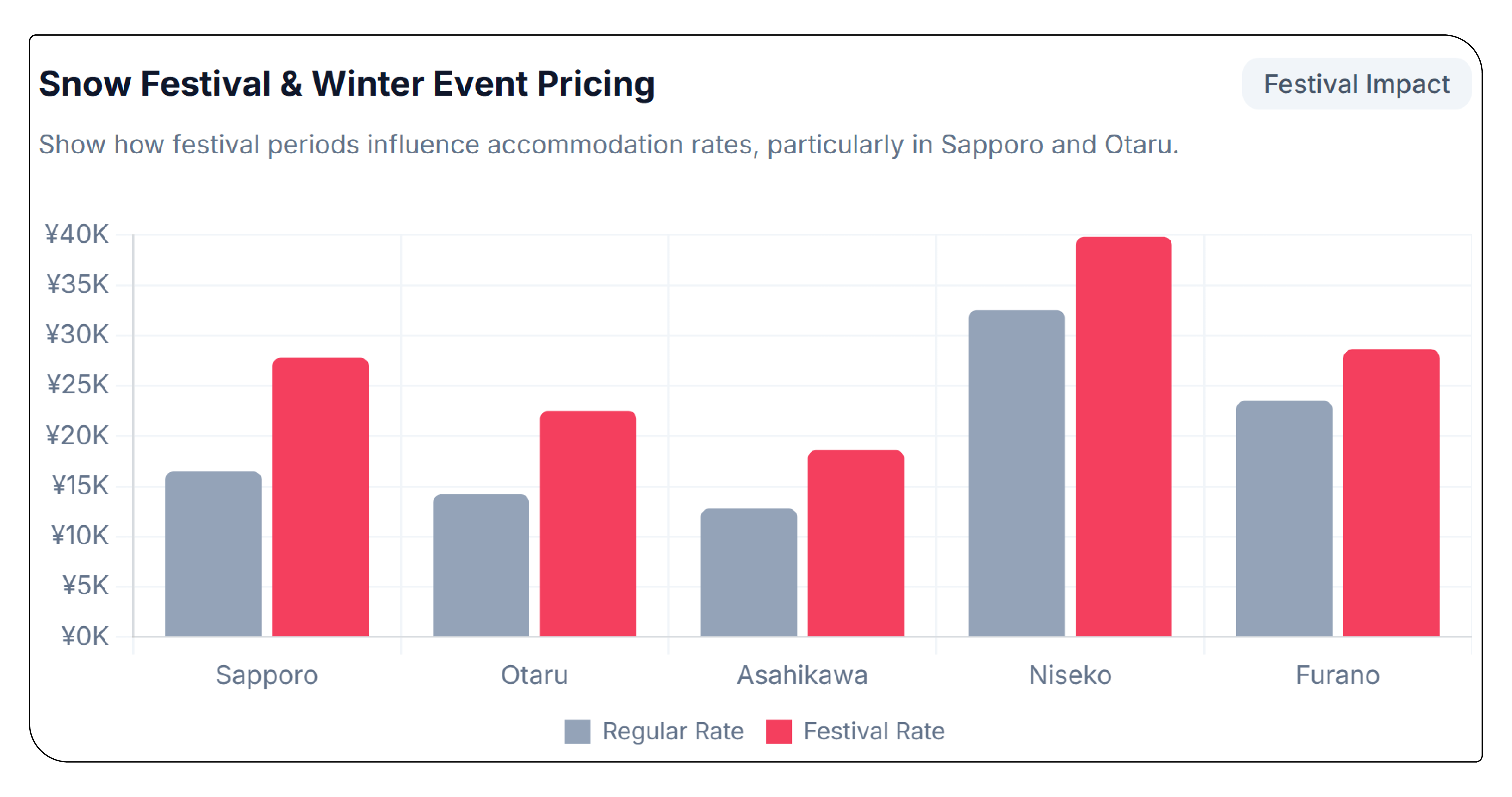
Similarly, Sapporo hotel demand forecasting during Snow Festival enables travel companies to analyse how major events influence room prices, available inventory, and reservation patterns.
Seasonal Hotel Rate Fluctuations and Competitive Benchmarking
Winter hotel prices rarely remain consistent throughout the season. Accommodation providers adjust their rates according to expected visitor arrivals, booking activity, room availability, and competitor strategies.
For example, a hotel in Niseko may offer comparatively lower rates during early December before increasing prices during Christmas and New Year. February can also experience significant demand because of favourable skiing conditions and winter events.
Scraped pricing information allows businesses to compare different booking periods and identify important pricing movements.
Illustrative monthly hotel pricing comparison
| Destination | Early December (JPY) | Christmas Week (JPY) | New Year Week (JPY) | January Mid-Season (JPY) | February Peak (JPY) | Seasonal Increase from Early December |
|---|---|---|---|---|---|---|
| Niseko | 42,000 | 68,000 | 78,000 | 58,000 | 72,000 | 71.4% |
| Hakuba | 25,000 | 39,000 | 45,000 | 33,000 | 42,000 | 68.0% |
| Sapporo | 14,000 | 21,000 | 23,000 | 18,000 | 29,000 | 107.1% |
| Furano | 22,000 | 35,000 | 39,000 | 29,000 | 37,000 | 68.2% |
| Nozawa Onsen | 19,000 | 31,000 | 35,000 | 26,000 | 33,000 | 73.7% |
| Rusutsu | 30,000 | 49,000 | 56,000 | 41,000 | 52,000 | 73.3% |
| Nagano | 11,000 | 15,000 | 17,000 | 13,000 | 18,000 | 63.6% |
| Otaru | 15,000 | 23,000 | 26,000 | 19,000 | 28,000 | 86.7% |
| Zao Onsen | 24,000 | 36,000 | 41,000 | 31,000 | 39,000 | 70.8% |
| Myoko Kogen | 18,000 | 29,000 | 34,000 | 25,000 | 32,000 | 88.9% |
Illustrative pricing scenario using hypothetical nightly room rates in JPY. Seasonal increase compares February peak pricing against early December pricing.
The comparison highlights how different destinations can experience different seasonal pricing movements. Sapporo's illustrative February increase reflects the potential impact of Snow Festival demand, while ski destinations demonstrate stronger pricing during holiday and skiing periods.
Japan peak ski season accommodation rates benchmarking allows businesses to compare competing hotels according to room categories, amenities, cancellation conditions, and location. These comparisons help identify properties that maintain premium pricing and those that compete through promotional discounts.
Hotel Data Collection Across Booking Platforms
Hotel information is distributed across multiple online travel agencies, hotel websites, metasearch engines, and accommodation marketplaces. Collecting information from these sources provides a broader understanding of market conditions.
A structured scraping system can capture:
- Hotel and property names.
- Destination and geographical location.
- Check-in and check-out dates.
- Standard room prices.
- Deluxe and premium room rates.
- Room availability.
- Occupancy and guest capacity.
- Breakfast and meal inclusions.
- Cancellation policies.
- Taxes and additional charges.
- Customer ratings and review counts.
- Promotional discounts and package offers.
Businesses can also collect room-level information to distinguish between standard double rooms, twin rooms, family suites, mountain-view rooms, and ski-in/ski-out accommodation.
Data standardisation is particularly important because booking platforms may display different currencies, room descriptions, tax treatments, and reservation conditions. Converting the collected information into consistent formats makes cross-platform comparisons more reliable.
Booking Trends and Reservation Behaviour
Understanding reservation behaviour is essential for evaluating Japan's winter hospitality market. Travellers planning ski holidays often reserve accommodation several months before arrival, particularly when selecting premium resorts with limited room inventory.
Booking Trend Insights can reveal how reservation activity changes across different destinations, accommodation categories, and travel periods.
Important indicators include:
- Average booking lead time.
- Weekend versus weekday pricing.
- Early-bird reservation discounts.
- Last-minute booking price movements.
- Room availability by destination.
- Length of stay and minimum-night requirements.
- Cancellation and refund conditions.
For example, an international traveller booking a seven-night Niseko ski holiday may have different accommodation requirements from a domestic visitor planning a two-night Sapporo festival trip.
By comparing these reservation patterns, businesses can segment customers according to travel purpose, destination preference, and booking behaviour.
Scraped information can also reveal whether premium rooms sell out earlier than standard rooms, whether weekend demand is stronger, and which accommodation categories experience the highest pricing pressure.
Real-Time Availability and Dynamic Pricing Monitoring
Hotel prices can change several times during high-demand winter periods. Monitoring only one booking date or collecting information occasionally may fail to capture these movements.
Real-Time Availability Tracking helps businesses observe changing room inventory and pricing conditions across selected properties and booking platforms.
An effective monitoring framework can record hotel prices at scheduled intervals and compare newly collected information with previous observations.
For example, if a Hakuba hotel increases its standard room price from ¥28,000 to ¥36,000 within a monitoring period, businesses can identify the 28.6% increase and investigate whether it coincides with higher demand or reduced availability.
Monitoring can also identify:
- Hotels with limited remaining inventory.
- Properties introducing peak-season surcharges.
- Competitors offering discounted packages.
- Changes in minimum-night restrictions.
- Differences between refundable and non-refundable rates.
- Hotels maintaining stable prices despite increasing demand.
However, publicly displayed availability should be treated as an observable booking signal rather than a confirmed occupancy figure. A room disappearing from a booking platform does not necessarily mean the property is fully occupied.
Data Analytics for Revenue Management
Collected hotel information becomes more valuable when transformed into analytical dashboards and reporting systems.
Travel businesses and hotel operators can use structured datasets to evaluate pricing performance, seasonal demand, and competitive positioning.
Important analytical measurements include:
| KPI | Calculation or Monitoring Method | Illustrative Value | Business Application |
|---|---|---|---|
| Average Daily Rate (ADR) | Total room revenue ÷ rooms sold | ¥32,000 | Evaluate average selling prices |
| Revenue Per Available Room (RevPAR) | Room revenue ÷ available rooms | ¥24,000 | Measure room revenue performance |
| Price Increase | (New rate − old rate) ÷ old rate × 100 | 25% | Identify pricing movements |
| Availability Change | Previous rooms available − current rooms available | 8 rooms | Monitor inventory changes |
| Booking Lead Time | Check-in date − reservation date | 45 days | Understand booking windows |
| Weekend Premium | Weekend rate − weekday rate | ¥7,000 | Compare weekend pricing |
| Discount Percentage | Discount ÷ original price × 100 | 15% | Evaluate promotional offers |
| Competitor Price Gap | Competitor rate − hotel rate | ¥5,000 | Assess market positioning |
| Seasonal Rate Index | Period rate ÷ baseline rate × 100 | 145 | Measure seasonal increases |
| Cancellation Rate | Cancelled reservations ÷ total reservations × 100 | 12% | Evaluate reservation stability |
| Average Length of Stay | Total booked nights ÷ reservations | 4.2 nights | Understand stay patterns |
| Rate Volatility | Standard deviation of observed rates | ¥4,500 | Evaluate pricing fluctuations |
All KPI values are hypothetical examples for analytical illustration, not actual hotel operating results.
These indicators help businesses identify revenue opportunities, evaluate competitor behaviour, and understand how seasonal pricing influences accommodation performance.
Business Applications of Japan Winter Hotel Rate Data
Structured hotel pricing information supports several business functions across the travel and hospitality industry.
- Travel Agencies: Agencies can compare accommodation prices across destinations and recommend competitive winter holiday packages.
- Hotel Operators: Property managers can benchmark their room prices against competing hotels and evaluate seasonal positioning.
- Online Travel Agencies: Booking platforms can analyse competitor pricing, promotional activity, and room availability to improve their market intelligence.
- Tourism Boards: Tourism organisations can study accommodation pricing movements to understand destination competitiveness and seasonal travel patterns.
- Investment and Market Research Firms: Researchers can evaluate winter hospitality demand, premium accommodation segments, and regional pricing differences.
- Revenue Management Teams: Hotels can combine historical rate observations with current booking signals to support pricing and inventory decisions.
Conclusion
Japan's winter hospitality market offers valuable opportunities for businesses seeking to understand seasonal accommodation pricing, ski resort demand, and festival-driven booking behaviour. Monitoring hotel rates across Niseko, Hakuba, Sapporo, Furano, and other winter destinations helps identify regional pricing differences, competitive movements, and changing reservation patterns.
Through Japan snow festival hotel pricing analytics, businesses can evaluate how major winter events influence accommodation prices, availability, and competitive positioning. Japan winter festival booking trends insights further support the analysis of reservation lead times, seasonal demand, and traveller preferences.
Implementing structured Hotel Data Scraping enables travel companies, hotel operators, and market researchers to transform scattered online accommodation information into organised datasets, comparative dashboards, and actionable business intelligence.
By combining historical pricing records, scheduled rate monitoring, availability observations, and destination-level benchmarking, businesses can develop stronger revenue management strategies, improve pricing decisions, and identify emerging opportunities across Japan's winter tourism industry.
Ready to elevate your travel business with cutting-edge data insights? Scrape Aggregated Flight Fares to identify competitive rates and optimize your revenue strategies efficiently. Discover emerging opportunities with tools to Extract Travel Website Data, leveraging comprehensive data to forecast market shifts and enhance your service offerings. Real-Time Travel App Data Scraping Services helps stay ahead of competitors, gaining instant insights into bookings, promotions, and customer behavior across multiple platforms. Get in touch with Travel Scrape today to explore how our end-to-end data solutions can uncover new revenue streams, enhance your offerings, and strengthen your competitive edge in the travel market.
Unlock the Full Report
Enter your details to access premium pricing intelligence insights