
Goa New Year Hotel Rates Data Scraping Report 2026/27 for India Holiday Hotel Pricing Intelligence
Introduction
Goa experiences a significant increase in tourist arrivals during the New Year period, making December one of the most commercially important months for the hospitality industry. Domestic holidaymakers, international tourists, couples, families, and group travellers create substantial demand for accommodation across North Goa and South Goa. Popular destinations such as Baga, Calangute, Candolim, Anjuna, Vagator, Colva, and Palolem witness considerable booking activity, particularly between December 25 and January 2.
Goa New Year Hotel Rates data scraping enables hospitality businesses, travel agencies, hotel operators, and market researchers to monitor accommodation prices across multiple booking platforms. By collecting hotel rates, room availability, occupancy indicators, discounts, and booking conditions, businesses can understand how festive demand influences accommodation pricing.
Hotel Data Scraping provides structured information from online travel agencies, hotel booking websites, and accommodation platforms. This information supports competitor benchmarking, promotional analysis, and seasonal pricing decisions.
India Holiday Hotel Pricing Intelligence becomes particularly valuable during peak travel periods when room prices can change frequently according to destination popularity, remaining inventory, booking lead time, and holiday demand.
This research examines how hotel pricing information from MakeMyTrip (MMT), Agoda, Booking.com, and Goibibo can be collected, compared, and transformed into actionable hospitality market intelligence. The numerical tables below present an illustrative research dataset to demonstrate the analysis methodology, rather than verified live platform quotations.
Goa's New Year Hospitality Market and Seasonal Pricing
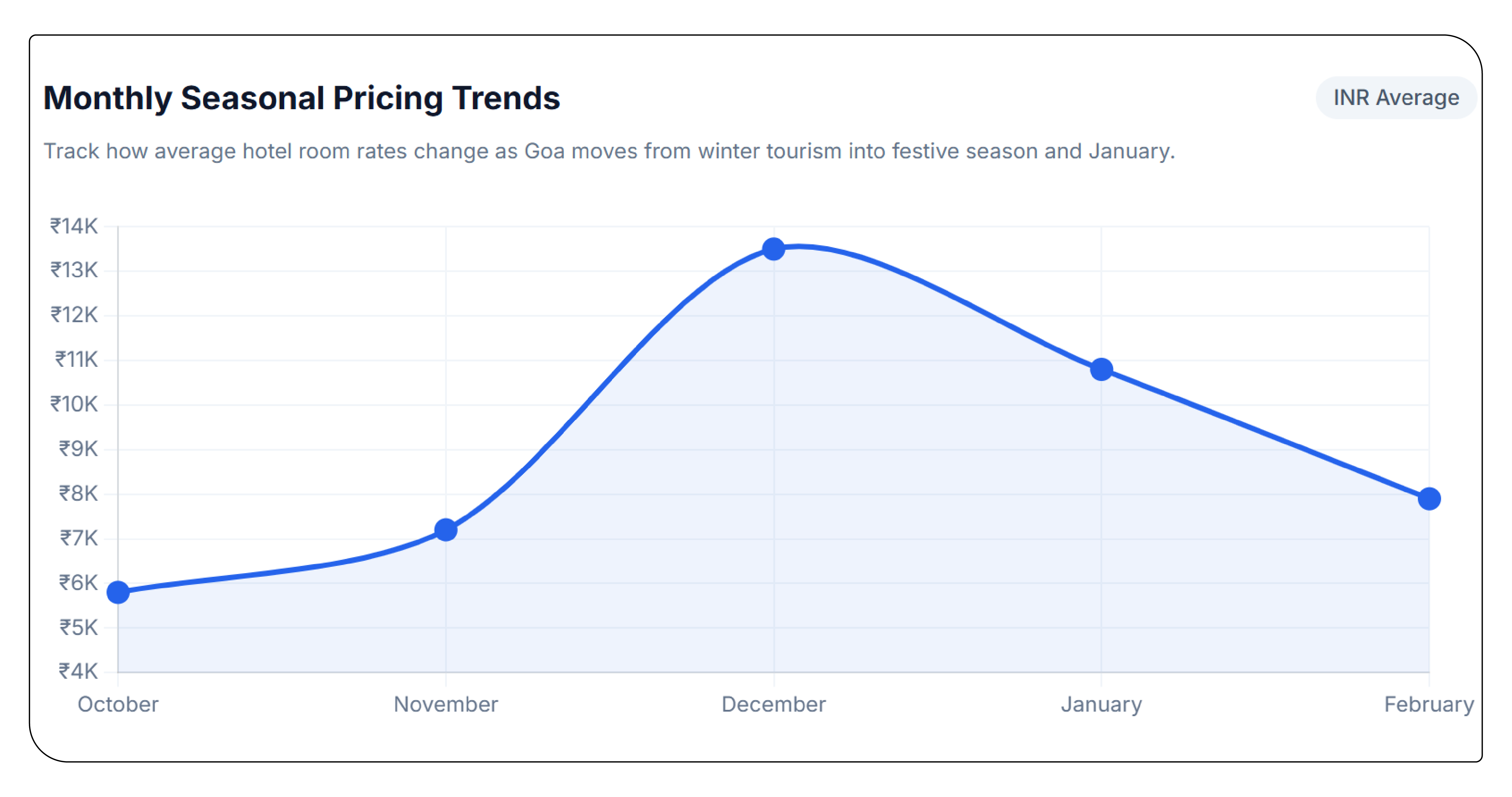
Goa's hotel market operates with a distinct seasonal pricing structure. October and November generally represent the beginning of the winter tourism season, while Christmas and New Year create concentrated demand across beach destinations. Hotels adjust their tariffs according to expected occupancy, room inventory, competitor prices, and the number of days remaining before arrival.
The Goa Tourism Department identifies December and January as peak accommodation periods and highlights the importance of advance reservations.
However, higher seasonal demand does not automatically translate into higher prices for every property. In January 2026, reporting on the Goa hotel market highlighted rate corrections, increased accommodation supply, and discounts reaching 48–50% on selected festive dates.
This makes continuous pricing analysis particularly important. Businesses need to identify which destinations are experiencing genuine demand-led increases and which hotels are reducing prices to attract bookings.
Hotel Data Intelligence helps transform scattered hotel listings into structured information that reveals these differences across accommodation categories and geographic markets.
Hotel Pricing Parameters to Monitor During New Year
A comprehensive hotel pricing dataset should capture more than the displayed room tariff. It should collect several associated attributes to understand the actual cost and commercial positioning of each property.
Important parameters include:
- Hotel name, property category, and geographical location.
- Room type, bed configuration, and occupancy capacity.
- Standard nightly price and discounted selling price.
- Original tariff and percentage discount.
- Check-in and check-out dates.
- Breakfast, dinner, and other meal inclusions.
- GST and additional mandatory charges.
- Cancellation policies and advance-payment requirements.
- Minimum-night booking restrictions.
- Room availability and remaining inventory indicators.
- Customer ratings and review counts.
- Special New Year packages and compulsory gala dinners.
Scrape Goa festive season hotel pricing to identify how these attributes change between regular December dates, Christmas week, New Year's Eve, and the first week of January.
For example, a standard double room advertised at ₹6,500 might increase to ₹11,500 during December 30–31. Another property could maintain its original tariff but introduce a compulsory New Year dinner package. Tracking only the headline room price would miss this additional expenditure.
Hotel Rate Comparison Across Goa Destinations
Geographical comparison is essential because North Goa and South Goa attract different visitor segments.
North Goa destinations such as Baga, Calangute, Candolim, Anjuna, and Vagator attract travellers interested in nightlife, beach activities, entertainment, and New Year celebrations. These locations can experience concentrated demand around December 31.
South Goa destinations such as Colva, Benaulim, Cavelossim, and Palolem attract families, couples, honeymooners, and travellers seeking quieter beach experiences. Luxury resorts and spacious properties can command different price premiums based on their facilities and location.
Panaji also provides an important comparison point for travellers interested in city accommodation, restaurants, casinos, and access to surrounding attractions.
A destination-level dataset allows businesses to evaluate:
- Average room rates by location.
- Differences between budget, mid-range, and luxury accommodation.
- Weekend versus weekday price movements.
- New Year premiums compared with ordinary December rates.
- Availability changes across different booking windows.
- Differences between beachfront and inland properties.
Illustrative Goa New Year Hotel Pricing by Destination and Category
The following table is an indicative analytical dataset for demonstrating seasonal price comparisons. Values are hypothetical averages in INR per room per night, not verified platform-wide averages.
| Goa Destination | Hotel Category | Regular Dec. Rate (₹) | Christmas Rate (₹) | New Year Rate (₹) | Increase vs Regular |
|---|---|---|---|---|---|
| Baga | Budget | 3,200 | 4,800 | 6,500 | 103.1% |
| Baga | Mid-range | 5,500 | 8,200 | 11,500 | 109.1% |
| Baga | Luxury | 12,000 | 17,500 | 24,000 | 100.0% |
| Calangute | Budget | 2,800 | 4,200 | 5,800 | 107.1% |
| Calangute | Mid-range | 5,000 | 7,500 | 10,500 | 110.0% |
| Calangute | Luxury | 11,500 | 16,000 | 22,000 | 91.3% |
| Candolim | Budget | 3,500 | 5,000 | 6,800 | 94.3% |
| Candolim | Mid-range | 6,500 | 9,500 | 13,000 | 100.0% |
| Candolim | Luxury | 15,000 | 21,000 | 28,000 | 86.7% |
| Anjuna | Budget | 3,000 | 4,500 | 6,200 | 106.7% |
| Anjuna | Mid-range | 5,800 | 8,800 | 12,000 | 106.9% |
| Vagator | Luxury | 13,500 | 19,000 | 26,000 | 92.6% |
| Panaji | Mid-range | 4,500 | 6,000 | 8,000 | 77.8% |
| Colva | Budget | 2,700 | 3,800 | 5,000 | 85.2% |
| Palolem | Mid-range | 5,000 | 7,000 | 9,500 | 90.0% |
| Cavelossim | Luxury | 16,000 | 22,000 | 30,000 | 87.5% |
This comparison demonstrates how a structured dataset can reveal pricing differences between destinations and hotel categories. In this hypothetical example, Baga mid-range hotels record a 109.1% increase over their regular December rates, while Candolim luxury properties reach ₹28,000 per night.
Such comparisons help travel businesses understand which locations have the highest festive premiums and where alternative accommodation may offer better value.
Extracting MMT, Agoda, Booking.com and Goibibo Goa Hotel Rates Data
A multi-platform monitoring approach is important because the same hotel can display different prices across online travel agencies. Differences may result from promotional campaigns, loyalty benefits, mobile-only discounts, payment offers, room availability, and cancellation conditions.
Real-Time Price Intelligence enables businesses to compare these changes through repeated data collection at consistent intervals.
Extract MMT, Agoda, Booking.com and Goibibo Goa hotel rates data to build a consolidated hotel comparison dataset covering identical properties, room configurations, and travel dates.
The four platforms offer complementary perspectives:
- MakeMyTrip (MMT): Monitor domestic travel promotions, hotel tariffs, package offers, and room availability.
- Agoda: Track accommodation pricing, promotional discounts, international traveller offers, and flexible booking conditions.
- Booking.com: Compare refundable and non-refundable tariffs, breakfast inclusions, property ratings, and room availability indicators.
- Goibibo: Examine domestic hotel offers, discounted room prices, payment promotions, and booking conditions.
The comparison process should standardise hotel names, property addresses, room categories, occupancy, and stay dates. Without standardisation, a sea-view suite on one platform might incorrectly be compared with a standard room on another.
Platform-specific taxes, discounts, and mandatory charges should also be recorded separately.
Cross-Platform Hotel Rate Comparison and Data Analysis
Cross-platform benchmarking helps identify pricing inconsistencies and promotional opportunities. A hotel may offer a room for ₹9,800 on one booking website and ₹10,600 on another, even when the room type and stay dates are identical.
The following table demonstrates how a standardised comparison dataset can be structured.
Illustrative New Year Hotel Rates Across Booking Platforms
Hypothetical sample values in INR per room per night for December 30, 2026 – January 1, 2027. These are not live platform quotations.
| Hotel / Destination | MMT (₹) | Agoda (₹) | Booking.com (₹) | Goibibo (₹) | Lowest Platform | Price Spread (₹) |
|---|---|---|---|---|---|---|
| Baga Beach Resort, Baga | 12,500 | 11,800 | 13,200 | 12,100 | Agoda | 1,400 |
| Calangute Palm Stay | 9,200 | 8,900 | 9,800 | 8,700 | Goibibo | 1,100 |
| Candolim Bay Hotel | 14,500 | 13,800 | 15,200 | 14,100 | Agoda | 1,400 |
| Anjuna Coastal Retreat | 10,800 | 10,200 | 11,500 | 10,500 | Agoda | 1,300 |
| Vagator Cliff Resort | 18,500 | 17,900 | 19,200 | 18,100 | Agoda | 1,300 |
| Panaji City Suites | 7,800 | 7,500 | 8,200 | 7,600 | Agoda | 700 |
| Colva Beach Residency | 8,500 | 8,200 | 9,000 | 8,100 | Goibibo | 900 |
| Palolem Ocean Stay | 11,200 | 10,800 | 11,900 | 10,900 | Agoda | 1,100 |
| Cavelossim Luxury Resort | 25,500 | 24,800 | 26,500 | 25,100 | Agoda | 1,700 |
| Benaulim Holiday Inn | 9,500 | 9,100 | 10,000 | 9,300 | Agoda | 900 |
| Morjim Beach Escape | 13,200 | 12,700 | 13,900 | 12,900 | Agoda | 1,200 |
| Arpora Garden Resort | 8,900 | 8,500 | 9,400 | 8,700 | Agoda | 900 |
| North Goa Boutique Stay | 15,800 | 15,200 | 16,500 | 15,500 | Agoda | 1,300 |
| South Goa Premium Suites | 21,000 | 20,200 | 22,000 | 20,700 | Agoda | 1,800 |
| Candolim Beach Villas | 28,500 | 27,800 | 29,500 | 28,100 | Agoda | 1,700 |
The illustrative comparison demonstrates three important analytical opportunities.
First, platform price differences: Cavelossim Luxury Resort shows a ₹1,700 spread between the lowest and highest listed prices. This provides an opportunity to examine promotional positioning and distribution strategies.
Second, destination benchmarking: Beachfront properties in Baga, Candolim, and Vagator demonstrate higher illustrative tariffs than several city and South Goa mid-range properties.
Third, competitive positioning: Hotels can identify whether their own selling prices are above or below comparable properties across multiple booking platforms.
For accurate comparisons, the dataset should also retain tax treatment, meal plans, cancellation conditions, and the time when each quotation was collected.
Tracking Discounts, Availability and Booking Conditions
Hotel prices are influenced by more than destination popularity. Promotional activity and inventory management can substantially change the final price displayed to travellers.
A property might initially advertise a room at ₹12,000 and subsequently offer a 15% discount, bringing the displayed tariff to ₹10,200. However, another platform could advertise the same room at ₹10,500 with complimentary breakfast.
A reliable comparison must therefore distinguish between headline discounts and actual customer value.
Important indicators include:
- Original versus discounted room prices.
- Percentage discount offered.
- Refundable and non-refundable tariffs.
- Breakfast and dinner inclusions.
- Minimum booking duration.
- Advance-payment requirements.
- Compulsory festive dining charges.
- Limited-inventory notifications.
- Changes in room availability.
Hotel Data Scraping can collect these attributes at regular intervals to create a historical record of pricing changes.
For instance, a hotel could be monitored every six hours during the final two weeks of December. Comparing the collected observations would help identify when discounts appear, when prices increase, and when specific room categories become unavailable.
Availability signals should be treated as indicators rather than confirmed occupancy figures because booking platforms do not necessarily disclose complete hotel inventory.
New Year Booking Windows and Price Movement
Booking lead time is an important variable in Goa's festive accommodation market. Travellers booking in October may encounter different prices and room options compared with those searching during the final week of December.
An analytical dataset can divide the booking journey into several monitoring periods:
| Booking Window | Monitoring Period | Primary Indicator | Analytical Purpose |
|---|---|---|---|
| Early planning | 90–60 days before arrival | Initial room tariffs | Establish baseline prices |
| Advance booking | 59–30 days | Discount movement | Identify promotional activity |
| Mid-stage booking | 29–15 days | Price changes and availability | Measure demand pressure |
| Late booking | 14–7 days | Remaining inventory signals | Identify last-minute changes |
| Final booking | 6–1 days | Tariff volatility | Track urgent booking conditions |
| Stay period | Arrival date | Final displayed rates | Compare booking-window prices |
These windows allow travel companies to examine whether early reservations offer better value and whether certain destinations experience stronger late-booking price increases.
An external 2026 accommodation analysis also identifies December as Goa's busiest month for Airbnb stays, with January following it. Its reported average booking lead time for January was approximately 32 days.
This makes lead-time monitoring a useful addition to hotel pricing research.
Data Processing and Hotel Price Intelligence Methodology
Collecting information from different booking platforms requires a consistent processing framework. Hotel names, room descriptions, currency formats, taxes, and promotional labels may differ even when listings represent the same accommodation.
A structured methodology can include the following stages:
- Source identification: Identify relevant hotels and accommodation listings across MMT, Agoda, Booking.com, and Goibibo.
- Data extraction: Collect room prices, stay dates, occupancy, discounts, meal plans, cancellation policies, and availability indicators.
- Hotel matching: Match duplicate properties using hotel names, addresses, coordinates, and room attributes.
- Data cleaning: Standardise currency, date formats, room categories, and price fields.
- Price normalisation: Calculate comparable per-night costs, including applicable taxes and mandatory charges.
- Historical storage: Maintain timestamped records to track price movements across booking windows.
- Analytical reporting: Generate destination-level comparisons, hotel rankings, promotional reports, and seasonal pricing dashboards.
The resulting dataset can be organised by destination, hotel category, platform, booking date, stay date, and room type.
This structure makes it easier to compare thousands of accommodation observations without mixing different room configurations or booking conditions.
Business Applications of Goa New Year Hotel Pricing Data
Structured hotel pricing information supports several commercial activities across the travel and hospitality ecosystem.
- Travel agencies and tour operators: Agencies can compare hotel tariffs across booking platforms and identify competitive accommodation options for New Year holiday packages.
- Hotel revenue management teams: Hotel operators can evaluate competitor prices, monitor promotional activity, and adjust their own tariffs according to market conditions.
- Online travel agencies: Booking platforms can analyse competing offers, identify pricing gaps, and improve their hotel recommendation and merchandising strategies.
- Hospitality investors: Investors can examine seasonal pricing differences across destinations and accommodation categories to understand market positioning.
- Market research companies: Researchers can develop historical datasets covering festive-season tariffs, discount movements, room availability, and destination-level price trends.
- Travel technology providers: Data-driven platforms can use historical pricing observations to develop hotel comparison tools, market intelligence products, and predictive analytics solutions.
Conclusion
Goa's New Year accommodation market provides valuable opportunities for businesses seeking to understand seasonal hotel pricing, competitive positioning, and changing traveller demand. Monitoring hotel rates across different destinations and booking platforms helps identify pricing differences that cannot be understood through individual hotel listings.
Booking Trend Insights can transform historical accommodation observations into actionable information for travel agencies, hotel chains, hospitality consultants, and online travel businesses.
Goa hotel price comparison dataset across booking platforms provides a consolidated view of room tariffs, promotional offers, availability indicators, and booking conditions across MMT, Agoda, Booking.com, and Goibibo.
Goa New Year time hotel booking trends insights help businesses understand how accommodation prices evolve as December 31 approaches, which destinations experience stronger price fluctuations, and how early reservations compare with last-minute bookings.
Demand Forecasting further strengthens these capabilities by combining historical hotel rates, booking lead times, seasonal demand indicators, destination popularity, and available inventory signals to estimate future pricing movements.
Ultimately, systematic hotel data collection creates a foundation for more informed revenue management, competitive benchmarking, and travel market research. Businesses can use these insights to understand Goa's festive hospitality landscape and develop better pricing and distribution strategies for upcoming holiday seasons.
Ready to elevate your travel business with cutting-edge data insights? Scrape Aggregated Flight Fares to identify competitive rates and optimize your revenue strategies efficiently. Discover emerging opportunities with tools to Extract Travel Website Data, leveraging comprehensive data to forecast market shifts and enhance your service offerings. Real-Time Travel App Data Scraping Services helps stay ahead of competitors, gaining instant insights into bookings, promotions, and customer behavior across multiple platforms. Get in touch with Travel Scrape today to explore how our end-to-end data solutions can uncover new revenue streams, enhance your offerings, and strengthen your competitive edge in the travel market.
Unlock the Full Report
Enter your details to access premium pricing intelligence insights