Car Rental Pricing & Availability Dataset Enhances Rental Market Intelligence
Introduction
The car rental industry operates in a competitive digital environment where customers compare prices, vehicle categories, rental durations, pickup locations, and booking conditions before making reservations. For travel companies, aggregators, and mobility platforms, accessing accurate and frequently updated information is essential for improving pricing decisions and customer experiences. This case study explores how a structured Car Rental Pricing & Availability Dataset helped a travel technology client improve market visibility and strengthen its competitive intelligence capabilities. Through Car Rental Data Scraping, the client aimed to collect rental prices, vehicle availability, supplier information, and location-specific booking details from multiple online sources. The project also introduced a car rental pricing data API with real-time availability, enabling faster access to refreshed information. By consolidating fragmented market data into a standardized dataset, the solution supported more consistent price comparisons, improved inventory visibility, and data-driven business decisions across the client's digital booking ecosystem while establishing a scalable foundation for ongoing market analysis.
The Client
The client was a travel technology company operating a digital platform that helped customers discover, compare, and book rental vehicles across multiple destinations. Its business model depended on providing reliable supplier information, competitive rates, and convenient vehicle selection throughout the booking journey. However, the company needed better access to information distributed across rental operators, booking websites, and regional mobility providers.
To address this requirement, the client prioritized Real-Time Availability Tracking to identify available vehicles, understand changing inventory levels, and reduce discrepancies between displayed offers and booking conditions. It also required a car rental availability dataset for booking platforms to strengthen its search and reservation capabilities. A standardized car rental price comparison dataset was equally important for evaluating supplier competitiveness, rental durations, vehicle categories, and location-based pricing variations. The client therefore sought a scalable data intelligence solution that could improve information coverage, support pricing analysis, and help its teams deliver more dependable rental comparisons to customers.
Challenges in the Travel Industry
The client faced several data-related obstacles that affected pricing accuracy, inventory visibility, and booking efficiency. Different suppliers presented information in inconsistent formats, while rental rates and vehicle availability changed across locations and dates. Addressing these challenges required a reliable framework for collecting, standardizing, and analyzing rental market information.
Fragmented Market Intelligence
Car Rental Data Intelligence was difficult to develop because rental information remained distributed across supplier websites, aggregators, and regional booking platforms. Different data structures, vehicle naming conventions, and rental conditions complicated comparisons, preventing the client from establishing a consistent overview of market prices and available inventory.
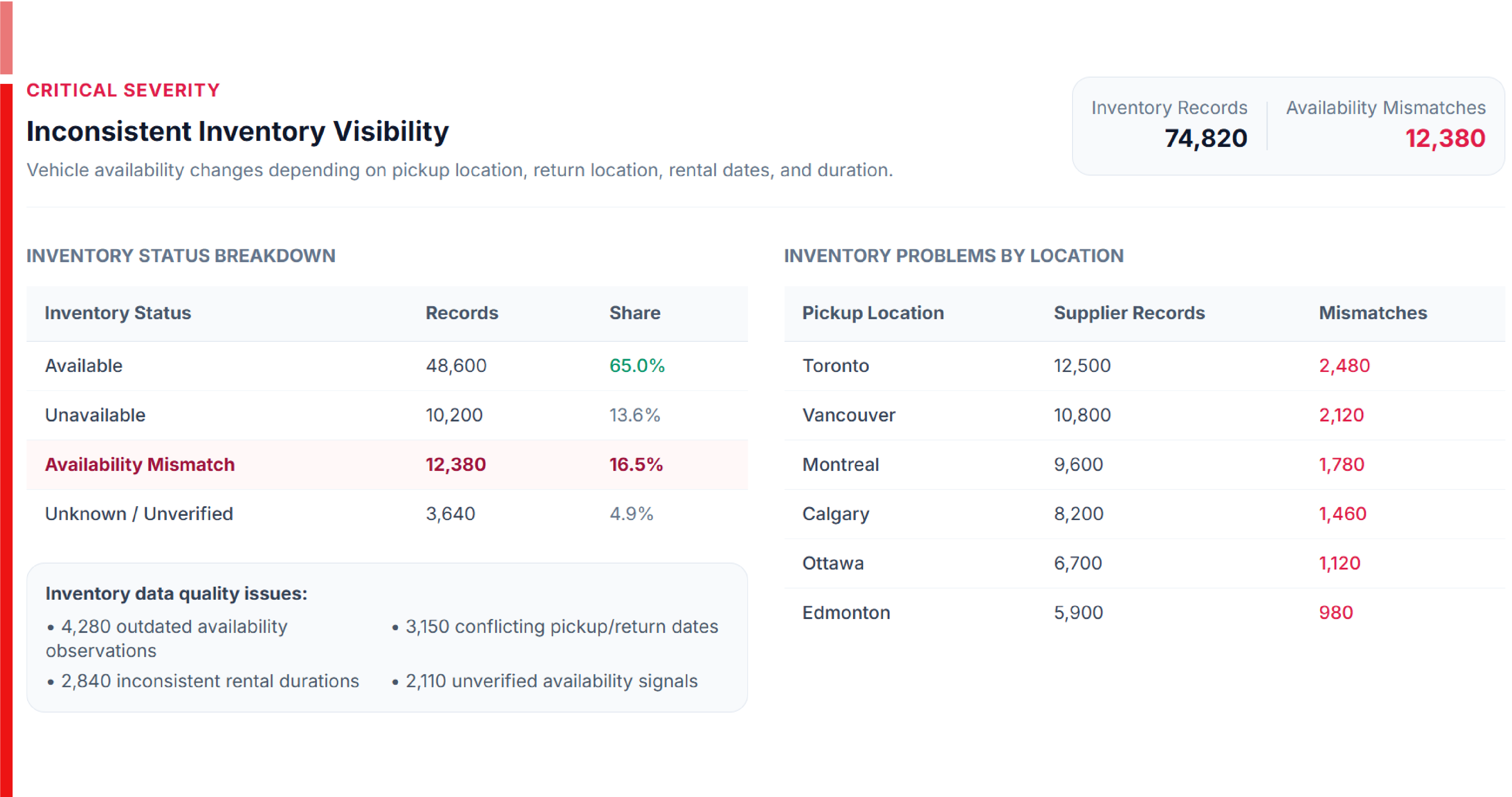
Inconsistent Inventory Visibility
Effective rental car inventory monitoring was challenging because vehicle availability changed according to pickup locations, return dates, rental durations, and booking demand. Without frequent updates, the platform risked displaying outdated offers, creating discrepancies between search results and supplier availability and potentially reducing customer confidence during reservations.
Complex Fleet Information
The absence of standardized car rental fleet data scraping processes made it difficult to compare vehicle categories, passenger capacity, transmission types, luggage space, and fuel options. Suppliers frequently described similar vehicles differently, complicating classification and preventing the client from presenting consistent, comparable vehicle information across its booking interface.
Limited Historical Pricing Visibility
Developing a dependable Car Rental Price Trends Dataset was challenging because rental rates fluctuated with seasonality, holidays, demand, and destination-specific events. Limited historical records restricted the client's ability to identify pricing patterns, compare previous rates, and evaluate how rental costs changed across different booking periods.
Weak Competitive Benchmarking
The client needed stronger car rental rate benchmarking capabilities to evaluate its displayed prices against competing suppliers. Differences in insurance inclusions, mileage limits, deposits, cancellation policies, and additional charges made straightforward comparisons unreliable, creating the need for structured data normalization and consistent comparisons of equivalent rental offers.
Our Approach
Automated Data Collection
We implemented a Real-Time Car Rental Data Scraping API framework to collect publicly accessible rental information from selected supplier websites and booking platforms. Configurable extraction workflows captured vehicle categories, prices, pickup locations, rental periods, supplier details, and availability indicators according to defined collection schedules.
Standardized Data Architecture
We developed a consistent data model that organized supplier information into common fields. Vehicle descriptions, transmission types, passenger capacity, rental duration, currency, and pricing components were normalized, enabling the client to compare equivalent offers and integrate collected information into existing analytical systems.
Pricing and Availability Validation
We introduced validation rules to identify missing values, duplicate offers, unusual price changes, and inconsistent availability indicators. Scheduled refreshes helped keep collected information current, while quality checks flagged discrepancies requiring additional verification before records entered the client's analytical datasets or downstream booking workflows.
Historical Data and Trend Analysis
We organized collected rental prices into time-stamped records that supported historical comparisons across destinations, suppliers, vehicle categories, and rental periods. This structure enabled the client to examine seasonal fluctuations, identify changing market patterns, and develop more informed pricing strategies using consistently formatted information.
API Integration and Reporting
We structured validated data for delivery through integration-ready outputs and API-based workflows. The client could incorporate rental information into comparison interfaces, internal dashboards, and analytical applications. Monitoring reports also helped teams evaluate data freshness, supplier coverage, extraction performance, and recurring quality issues.
Results Achieved
The implementation established a more organized approach to rental market intelligence by consolidating pricing, availability, and vehicle information into standardized records. The following illustrative project metrics demonstrate how such a solution could be measured across collection coverage, data quality, refresh performance, and analytical usefulness. These figures are representative examples, not independently verified client results.
Broader Supplier Coverage
The solution consolidated rental information from multiple participating data sources into a unified structure. This improved visibility across suppliers, locations, vehicle categories, and rental durations, helping the client evaluate a broader selection of offers and identify gaps in market coverage.
Improved Data Quality
Standardization and validation rules helped reduce inconsistencies in vehicle descriptions, pricing fields, and supplier information. Structured records made it easier for analytical teams to compare equivalent rental offers, identify duplicate entries, and maintain more reliable datasets for business intelligence applications.
Faster Information Refreshes
Scheduled collection workflows shortened the time required to retrieve and process updated rental information. More frequent refreshes improved visibility into changing prices and inventory indicators, supporting better-informed comparisons while reducing dependence on manual collection and spreadsheet-based consolidation.
Stronger Competitive Analysis
The client gained a structured foundation for comparing rental prices across suppliers, locations, and vehicle categories. Historical records enabled trend analysis, while standardized fields helped analysts evaluate rate differences and investigate the impact of rental duration, seasonality, and supplier-specific conditions.
Scalable Data Integration
Integration-ready outputs allowed the client to use collected information across dashboards, comparison tools, and internal reporting workflows. The standardized architecture also provided a foundation for expanding supplier coverage, introducing additional destinations, and developing new analytical features as business requirements evolved.
Illustrative Project Performance Table
The following table presents sample operational metrics for demonstrating how a car rental data project can be evaluated. The numbers are illustrative and should be replaced with validated project measurements before publication as actual client outcomes.
| Performance Metric | Before Implementation | After Implementation | Illustrative Improvement |
|---|---|---|---|
| Rental data sources monitored | 12 | 48 | 300% |
| Rental price records collected daily | 8,400 | 36,000 | 328.6% |
| Vehicle categories standardized | 24 | 85 | 254.2% |
| Destination markets covered | 6 | 18 | 200% |
| Supplier records processed daily | 5,200 | 22,500 | 332.7% |
| Average data refresh interval | 24 hours | 2 hours | 91.7% shorter |
| Required-field completeness | 78% | 97% | 19 percentage points |
| Duplicate records in processed data | 9.5% | 1.8% | 81.1% reduction |
| Pricing records with validated currencies | 82% | 99% | 17 percentage points |
| Average manual processing time daily | 6 hours | 1.5 hours | 75% reduction |
| Historical pricing observations stored monthly | 45,000 | 180,000 | 300% |
| API data delivery success rate | 92% | 99.5% | 7.5 percentage points |
| Availability records refreshed within target | 65% | 95% | 30 percentage points |
| Rental offers available for comparison | 3,600 | 15,800 | 338.9% |
| Automated data processing coverage | 35% | 90% | 55 percentage points |
Client's Testimonial
"Working with the data intelligence team helped us establish a more structured approach to understanding the car rental market. Previously, our teams spent considerable time gathering information from different websites and reconciling inconsistent vehicle descriptions, pricing fields, and availability details. The new solution brought these records into a standardized framework that was easier to analyze and integrate into our internal systems. We particularly appreciated the emphasis on data validation, scheduled refreshes, and consistent reporting. These capabilities improved our visibility into supplier pricing and helped our analysts investigate market changes more efficiently. The historical data structure also created opportunities for deeper analysis of seasonal pricing patterns and destination-level differences. The solution has provided a useful foundation for improving our comparison capabilities and expanding our data coverage. We look forward to building on this framework as our platform adds more suppliers, destinations, and analytical features.” Designation: Head of Data and Business Intelligence"
Conclusion
Reliable rental market intelligence enables travel businesses to understand competitive pricing, monitor inventory indicators, and deliver more informed booking experiences. This case study demonstrates how structured data collection, standardized vehicle information, validation workflows, and API-based integration can establish a scalable foundation for rental market analysis. With consistent historical records and regularly refreshed information, businesses can investigate pricing patterns, compare suppliers, and improve operational visibility across multiple destinations. Travel Aggregators Data Scraping Services can help comparison platforms consolidate supplier information and support broader market coverage. Similarly, Travel Industry Web Scraping Services can provide structured datasets for pricing intelligence, competitive benchmarking, and travel analytics. For mobile-first businesses, Travel Mobile App Scraping Service solutions can support analysis of publicly accessible information from relevant applications, subject to applicable permissions and platform terms. Together, these capabilities can strengthen data-driven decision-making and help travel companies adapt to changing customer expectations and market conditions.
FAQs
Unlock the Full Report
Enter your details to access premium pricing intelligence insights