Tripadvisor Italy Daily OTA Dataset for Hospitality Competitor Analysis and Performance Monitoring
Introduction
Italy’s hospitality industry operates in a highly competitive online travel marketplace where hotel prices, room availability, customer reviews, and seasonal booking patterns influence traveler decisions and revenue performance. This case study explores how a travel analytics company leveraged the Tripadvisor Italy Daily OTA Dataset to improve hotel benchmarking, competitor analysis, and pricing decisions across major Italian destinations. By implementing TripAdvisor Data Scraping, the client collected structured information from publicly accessible travel listings, enabling consistent comparisons across hotels, destinations, and booking periods. The solution also developed a comprehensive Tripadvisor Italy hotel rates and availability dataset covering essential accommodation attributes, published room prices, ratings, review volumes, and availability indicators. These insights helped the client identify pricing gaps, understand competitor positioning, and recognize demand fluctuations across Rome, Milan, Venice, Florence, and other tourism markets. Through automated collection, data validation, and historical analysis, the project transformed fragmented online travel information into actionable intelligence, supporting more informed hotel benchmarking, competitive monitoring, and strategic revenue management throughout Italy’s dynamic hospitality sector.
The Client
The client was a travel market intelligence and hospitality analytics company serving hotel operators, destination management businesses, travel consultants, and accommodation investors across Italy. Its primary objective was to create reliable market intelligence products that helped customers understand competitor pricing, room availability, guest sentiment, and destination-level performance. The organization wanted to expand its OTA Data Scraping capabilities to consolidate publicly available information from Tripadvisor and relevant online travel agency listings into a standardized analytical dataset. Through Italy hotel competitor monitoring using daily OTA data, the client aimed to identify rate differences, monitor accommodation positioning, and compare properties across cities and travel periods. Its existing research process relied heavily on manual checks, spreadsheets, and inconsistent data collection schedules, making large-scale analysis difficult. The company also needed a dependable Price Monitoring framework to support recurring reports, historical comparisons, and customer-specific dashboards. The proposed solution needed to accommodate diverse hotel categories, changing room offers, fluctuating prices, and destination-specific market conditions while maintaining data consistency, scalability, and operational efficiency.
Challenges in the Travel Industry
The client encountered several interconnected challenges while collecting, standardizing, and analyzing accommodation intelligence across Italy's fragmented online travel marketplace.
Inconsistent Hotel Rates and Offers
Hotel prices frequently changed according to travel dates, room categories, occupancy, cancellation policies, and promotional campaigns. Comparing listings without consistent collection timestamps created misleading benchmarks, making it difficult for the client to distinguish genuine competitor price movements from differences in booking conditions.
Fragmented Reviews and Reputation Signals
The client struggled to consolidate the Tripadvisor hotel reviews and ratings dataset Italy into a consistent framework. Different review volumes, rating distributions, languages, and property identifiers complicated sentiment comparisons, limiting the ability to evaluate guest satisfaction and benchmark hotel reputations across Italian destinations.
Limited Daily Monitoring Coverage
Manual research could not support daily hotel rate tracking across Italian OTAs at the required scale. Analysts spent considerable time checking individual listings, while rapidly changing room prices and availability created gaps in historical records, reducing visibility into competitor actions and short-term market movements.
Uncertain Demand Patterns and Seasonality
The client needed stronger evidence to support OTA booking demand forecasting Italy, particularly during summer holidays, festivals, business events, and regional tourism peaks. Inconsistent historical observations made it difficult to interpret seasonal patterns, distinguish temporary price changes, and anticipate shifts in accommodation competitiveness.
Insufficient Competitive Pricing Intelligence
Without structured OTA Price Intelligence, the client could not consistently identify underpriced properties, premium positioning, promotional activity, or destination-specific pricing gaps. Disconnected datasets also restricted cross-market comparisons, preventing analysts from delivering timely recommendations to hotel clients seeking stronger pricing strategies.
Our Approach
Automated Data Collection and Scheduling
We implemented an automated collection workflow to capture publicly accessible hotel listing information at scheduled intervals. The process prioritized relevant properties, published rates, availability indicators, ratings, review counts, and location attributes, creating a repeatable foundation for daily competitive analysis.
Hotel Identification and Data Standardization
We standardized hotel names, destination labels, property identifiers, and accommodation categories to reduce duplication. Records were organized using consistent field definitions and collection timestamps, helping analysts compare the same properties across observation periods without confusing similarly named hotels or different room offers.
Price and Availability Tracking
We designed a monitoring framework that recorded observed prices alongside applicable travel dates, room descriptions, and availability indicators whenever exposed. Historical snapshots enabled comparisons between observation periods, helping the client identify rate movements, promotional changes, and differences in published accommodation offers.
Review and Reputation Analytics
We integrated available ratings, review counts, and relevant review attributes into the analytical structure. This enabled property-level reputation comparisons and destination benchmarking. Data quality checks helped identify missing fields, inconsistent values, duplicate records, and unusual changes requiring further investigation before publication.
Analytics-Ready Dataset Delivery
We transformed collected information into structured, analysis-ready datasets suitable for dashboards, reports, and internal analytical workflows. Documentation, standardized schemas, validation procedures, and recurring delivery schedules helped the client integrate travel intelligence into its services and support repeatable reporting for hospitality customers.
Results Achieved
The solution established a more consistent foundation for competitor benchmarking, historical rate analysis, and hospitality market intelligence across Italian destinations.
Improved Market Coverage
The structured dataset helped the client organize accommodation intelligence across multiple Italian tourism markets. Standardized property records made it easier to compare hotel categories, destinations, and listing attributes, supporting broader competitive assessments and more systematic research coverage.
Faster Competitive Comparisons
Automated collection reduced dependence on repetitive manual listing checks. Analysts could review comparable hotel observations in structured datasets, identify relevant price differences, and prepare benchmarking reports more efficiently while spending additional time interpreting market conditions and developing customer recommendations.
Better Historical Price Visibility
Timestamped observations created a foundation for reviewing published hotel rate movements across monitoring periods. The client could investigate pricing fluctuations, promotional changes, and seasonal differences more consistently, subject to the coverage and reliability of recorded listing information.
Stronger Reputation Benchmarking
Consolidated ratings and review counts improved the client's ability to compare hotel reputation indicators across destinations. Analysts could identify properties with relatively strong or weak public feedback and incorporate these indicators into broader competitive assessments without relying exclusively on room prices.
More Scalable Intelligence Services
Reusable data structures and repeatable collection workflows supported the development of additional hospitality analytics products. The client gained a more scalable foundation for destination reports, hotel comparison dashboards, and customer-specific monitoring services, with expansion possible as source coverage and validation capabilities improved.
Numerical Dataset: Illustrative Tripadvisor Italy Daily OTA Monitoring
The following table demonstrates how the client’s structured dataset could organize hotel intelligence across major Italian destinations. These figures are illustrative sample data created to demonstrate the solution, not verified Tripadvisor measurements or actual project results.
| City | Hotels Monitored | Daily Observations | Average Listed Rate (€) | Lowest Listed Rate (€) | Highest Listed Rate (€) | Average Rating / 5 | Total Reviews | Available Listings (%) |
|---|---|---|---|---|---|---|---|---|
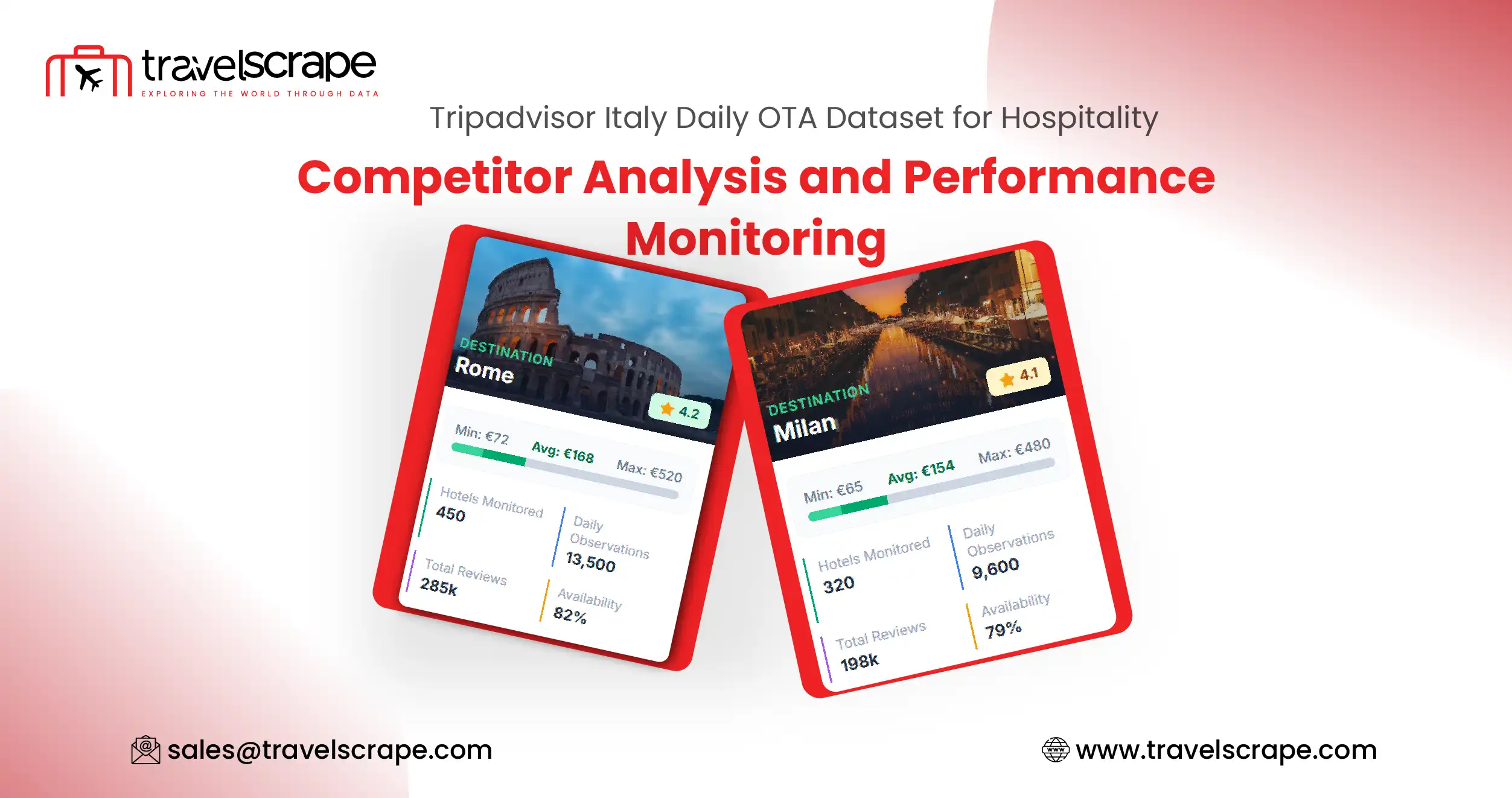
| Rome | 450 | 13,500 | 168 | 72 | 520 | 4.2 | 285,000 | 82 |
| Milan | 320 | 9,600 | 154 | 65 | 480 | 4.1 | 198,000 | 79 |
| Venice | 280 | 8,400 | 192 | 89 | 610 | 4.3 | 176,000 | 75 |
| Florence | 250 | 7,500 | 159 | 68 | 465 | 4.3 | 162,000 | 80 |
| Naples | 220 | 6,600 | 118 | 49 | 350 | 4.0 | 124,000 | 84 |
| Bologna | 160 | 4,800 | 132 | 55 | 390 | 4.1 | 83,000 | 81 |
| Turin | 140 | 4,200 | 115 | 48 | 330 | 4.0 | 71,000 | 83 |
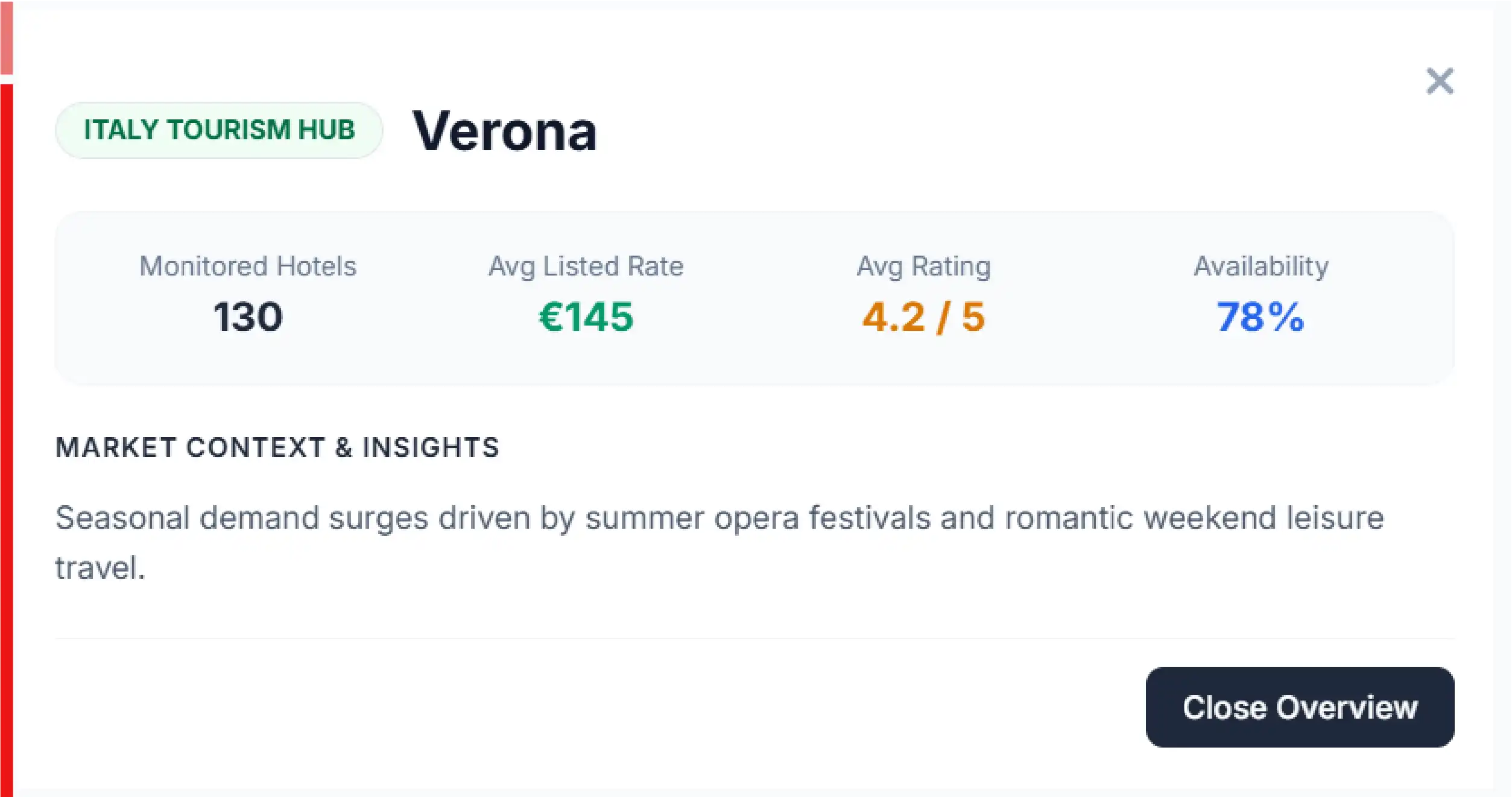
| Verona | 130 | 3,900 | 145 | 62 | 420 | 4.2 | 76,000 | 78 |
| Palermo | 120 | 3,600 | 105 | 42 | 310 | 4.0 | 68,000 | 86 |
| Pisa | 90 | 2,700 | 110 | 45 | 295 | 4.0 | 49,000 | 85 |
| Total | 2,160 | 64,800 | 146.4* | 42 | 610 | 4.13* | 1,292,000 | 80.9* |
The overall average rate and rating are illustrative, hotel-count-weighted calculations based on the sample city figures. Daily observations assume 30 records per hotel during a hypothetical monitoring month; availability percentages represent illustrative listing-level indicators, not guaranteed bookable inventory. Actual values depend on source coverage, observation timing, travel dates, and collection conditions.
Client's Testimonial
"Working with the data collection team helped us establish a more organized approach to monitoring Italy’s online accommodation market. Previously, our analysts spent considerable time reviewing individual hotel listings and manually consolidating information from different sources. The structured dataset made hotel comparisons, published rate monitoring, and reputation analysis easier to manage. We particularly appreciated the consistent property attributes, historical observation timestamps, and validation procedures, which improved our confidence when preparing destination-level reports. The solution also created opportunities to expand our hospitality intelligence offerings and provide customers with more meaningful competitor comparisons. Although market interpretation still requires context around booking dates, room conditions, and availability, the improved data foundation has made our research process more scalable and repeatable. We see significant potential to extend this framework to additional destinations and travel data categories."
Conclusion
Reliable hotel market intelligence enables hospitality businesses to understand competitive positioning, evaluate published rates, and interpret guest reputation signals more systematically. This case study demonstrates how a structured daily OTA dataset can transform fragmented travel listing information into an accessible foundation for destination analysis and hotel benchmarking. Through automated collection, property normalization, timestamped observations, and data validation, the client established a repeatable framework for monitoring Italy’s accommodation marketplace. Travel Aggregators Data Scraping Services can support similar initiatives by organizing publicly accessible travel information into consistent analytical datasets. Likewise, Travel Industry Web Scraping Services can help businesses examine competitor pricing, hotel listings, and destination-level trends across relevant sources. A Travel Mobile App Scraping Service can complement web-based intelligence where permitted access and technical conditions support mobile data collection. Ultimately, effective travel analytics combines reliable data, appropriate collection practices, transparent limitations, and contextual interpretation to support better-informed commercial decisions.
FAQs
Unlock the Full Report
Enter your details to access premium pricing intelligence insights