
Christmas Market Hotel Rates 2026 Data Scraping: European Accommodation Pricing, Seasonal Demand and Travel Market Intelligence
Introduction
Christmas markets are among Europe's most popular winter tourism attractions, bringing millions of domestic and international visitors to historic city centres between November and December. Destinations such as Vienna, Prague, Strasbourg, Berlin, Budapest, Kraków and Zurich experience significant seasonal accommodation demand as travellers plan festive holidays, weekend getaways and extended winter vacations. For hotels, travel agencies, booking platforms and tourism businesses, understanding accommodation prices during this period is essential for competitive positioning and revenue planning.
Christmas Market Hotel Rates 2026 data scraping provides a structured approach to collecting hotel room prices, availability, occupancy indicators, amenities, cancellation policies and seasonal booking information across European destinations. By gathering information from online travel agencies, hotel websites and metasearch platforms, businesses can understand how accommodation costs change before, during and after major Christmas market events.
Travel Data Intelligence enables travel companies to transform large volumes of accommodation information into meaningful market insights. It helps identify high-demand destinations, compare accommodation categories and evaluate pricing differences between central locations and surrounding neighbourhoods.
European Christmas market hotel prices monitoring also supports detailed comparisons across Austria, Germany, France, Czechia, Hungary, Poland and Switzerland. With reliable historical and current pricing observations, businesses can identify seasonal fluctuations, benchmark competitors and develop more informed pricing strategies for the 2026 winter travel season.
Understanding Europe's Christmas Market Accommodation Market in 2026
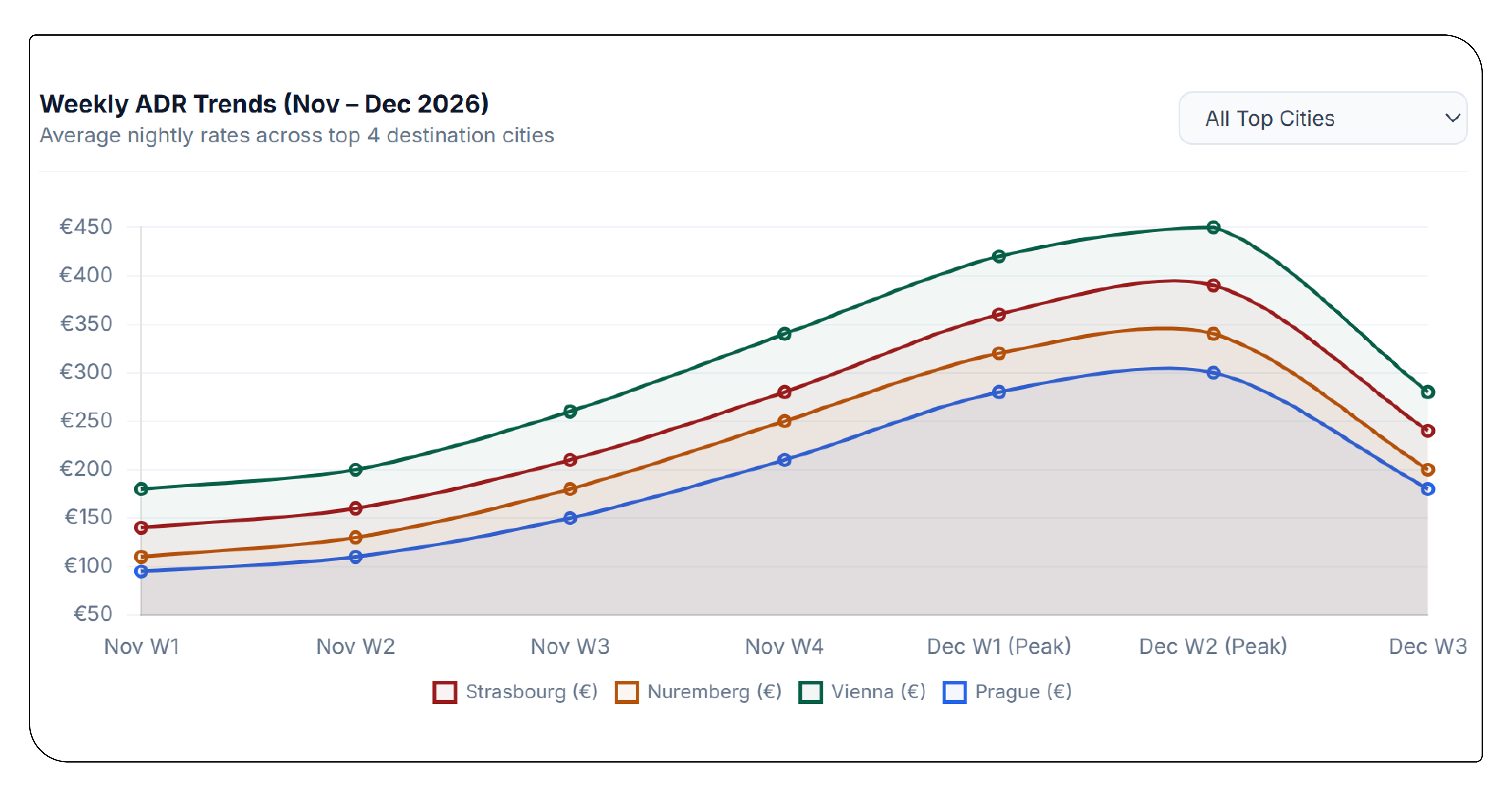
European Christmas markets create concentrated tourism demand within specific cities and travel periods. Unlike conventional holiday seasons, Christmas market tourism is influenced by individual event opening dates, weekend attractions, festive concerts, winter activities and proximity to famous market locations.
Vienna attracts visitors to Rathausplatz and Schönbrunn Palace, while Prague benefits from seasonal attractions around Old Town Square and Wenceslas Square. Strasbourg experiences considerable visitor interest around its historic Christmas markets, whereas German destinations such as Nuremberg, Dresden and Cologne attract travellers through traditional festive celebrations.
These events influence accommodation demand differently across cities. Hotels located near popular markets may introduce higher weekend rates, minimum-stay requirements or limited refundable inventory. Smaller properties and boutique hotels can also experience pricing pressure when central accommodation becomes unavailable.
Businesses therefore require destination-level hotel intelligence rather than relying on general European accommodation averages.
A comprehensive collection process should capture:
- Hotel names, addresses and geographical coordinates.
- Standard, superior, deluxe and family room prices.
- Check-in and check-out dates.
- Availability across different booking periods.
- Breakfast-inclusive and room-only rates.
- Refundable and non-refundable pricing.
- Distance from Christmas market locations.
- Guest ratings and review volumes.
- Seasonal discounts and promotional offers.
- Taxes, service charges and additional fees.
Combining these attributes creates a detailed view of the European Christmas accommodation market.
Hotel Data Scraping for Seasonal Accommodation Price Comparison
Hotel pricing changes according to demand, booking lead time, inventory availability and competitive positioning. During Christmas market periods, even properties within the same neighbourhood can display substantial differences in room rates.
Hotel Data Scraping helps businesses systematically collect accommodation information from multiple online sources and convert it into comparable datasets.
For example, a travel company monitoring Vienna can compare four-star hotels near Rathausplatz with properties around Mariahilf, Leopoldstadt and the city's outer districts. Similar comparisons can be conducted in Prague, Strasbourg and Berlin.
The following table presents an illustrative 2026 Christmas market hotel pricing dataset. These figures are hypothetical research examples, not verified live hotel quotations.
Illustrative European Christmas Market Hotel Rate Comparison 2026
| Country | Destination | Hotel Category | Average Nightly Rate (€) | Weekend Rate (€) | Weekday Rate (€) | Sample Availability (%) | Price Increase (%) |
|---|---|---|---|---|---|---|---|
| Austria | Vienna | 3-Star | 145 | 165 | 135 | 38 | 22.2 |
| Austria | Salzburg | 4-Star | 210 | 245 | 195 | 32 | 25.6 |
| Czechia | Prague | 3-Star | 125 | 148 | 115 | 35 | 20.0 |
| Czechia | Brno | 4-Star | 118 | 135 | 108 | 52 | 18.4 |
| Germany | Nuremberg | 3-Star | 138 | 162 | 125 | 34 | 22.8 |
| Germany | Berlin | 4-Star | 185 | 210 | 170 | 45 | 23.5 |
| Germany | Dresden | 3-Star | 120 | 142 | 110 | 41 | 20.0 |
| France | Strasbourg | 4-Star | 225 | 265 | 205 | 28 | 29.3 |
| France | Colmar | 3-Star | 155 | 180 | 140 | 30 | 25.0 |
| France | Paris | 4-Star | 240 | 275 | 225 | 55 | 17.0 |
| Hungary | Budapest | 3-Star | 110 | 128 | 102 | 48 | 19.6 |
| Poland | Kraków | 4-Star | 135 | 155 | 125 | 46 | 18.4 |
| Switzerland | Zurich | 4-Star | 285 | 325 | 270 | 42 | 20.4 |
| Switzerland | Basel | 3-Star | 195 | 220 | 180 | 39 | 22.2 |
Note: All prices and availability percentages in this table are illustrative. They demonstrate how a structured scraping dataset could be organised.
The comparison highlights how accommodation costs can vary between destinations and hotel categories. Strasbourg, Zurich and Salzburg represent higher-priced examples, while Budapest, Prague and Dresden demonstrate comparatively moderate sample rates.
For travel businesses, such comparisons can support destination recommendations, hotel benchmarking and seasonal pricing assessments.
Austria and Czechia Christmas Market Hotel Pricing Analysis
Austria and Czechia are important destinations for Christmas market tourism because of their traditional festive celebrations, historic architecture and established winter travel infrastructure.
Vienna offers several major Christmas market locations, including Rathausplatz, Belvedere Palace and Schönbrunn. Salzburg attracts visitors through its historic Old Town market, while Prague's Old Town Square and Wenceslas Square remain prominent seasonal attractions.
Scrape Austria and Czechia Christmas market hotel prices to understand how room rates respond to event proximity, weekend demand and seasonal booking activity.
A detailed collection strategy should compare:
- Central hotels located within walking distance of major Christmas markets.
- Properties situated between two and five kilometres from event locations.
- Budget accommodation near public transportation.
- Premium hotels offering festive dining and seasonal packages.
- Family accommodation with larger rooms and additional amenities.
For instance, a Prague hotel located near Old Town Square may have different pricing patterns from a comparable property near Prague's outer districts. Monitoring both locations helps identify the additional amount travellers pay for convenience.
In Austria, Salzburg and Vienna can be compared through weekday and weekend pricing observations. Businesses can also evaluate whether breakfast packages, cancellation flexibility and room categories influence total booking costs.
France and Germany Christmas Market Accommodation Data
France and Germany represent two major markets for European Christmas tourism. Their destinations feature established Christmas markets, historic shopping districts and extensive accommodation networks.
Strasbourg, Colmar and Mulhouse attract visitors seeking traditional Alsatian Christmas experiences. German destinations such as Nuremberg, Cologne, Dresden, Frankfurt and Munich offer different festive attractions and accommodation choices.
Extract France and Germany Christmas market accommodation data to identify pricing differences across cities, hotel categories and event periods.
A comprehensive collection should include:
- Hotel room prices around major market locations.
- Availability during opening weekends and peak December dates.
- Premium and budget accommodation comparisons.
- Booking lead times and cancellation conditions.
- Discounts for extended stays.
- Room occupancy restrictions.
- Distance from public transport and event venues.
This information helps travel companies identify destinations where accommodation becomes expensive early in the season.
For example, comparing Strasbourg with Colmar can reveal how two popular French Christmas destinations differ in accommodation positioning. Similarly, Nuremberg and Dresden can be compared to understand how market popularity and hotel inventory influence seasonal pricing.
Booking Trend Insights and Seasonal Demand Patterns
Accommodation pricing is closely connected to traveller booking behaviour. Christmas market visitors may reserve hotels several months in advance, particularly when travelling during weekends or attending popular seasonal events.
Booking Trend Insights can be developed by collecting hotel prices at consistent intervals, such as 90, 60, 30, 14 and 7 days before check-in.
This approach helps businesses understand how rates evolve as arrival dates approach.
For example, an accommodation property might initially advertise a standard room at €140. As availability decreases, its displayed price could increase to €175 or €205. Another hotel might maintain stable pricing while introducing promotional offers to attract bookings.
Businesses should distinguish between price changes and actual booking activity. Publicly displayed room availability is only an indicator and does not necessarily reveal confirmed occupancy or completed reservations.
Useful booking indicators include:
- Changes in displayed room availability.
- Price movements across booking snapshots.
- Minimum-stay restrictions.
- Newly introduced promotional offers.
- Refundable versus non-refundable rate differences.
- Differences between weekday and weekend pricing.
- Changes in the number of room categories available.
Combining these indicators provides a more meaningful understanding of seasonal accommodation demand.
Detailed Hotel Rate Collection Across European Destinations
A multi-country hotel scraping project requires a consistent data structure. Without standardised collection fields, businesses may struggle to compare accommodation prices across different currencies, room categories and booking conditions.
The second dataset below demonstrates how a destination-level collection could organise seasonal hotel observations.
Illustrative Christmas Market Hotel Pricing and Booking Trend Dataset 2026
| Destination | Observation Period | Room Type | Initial Rate (€) | Latest Rate (€) | Rate Change (€) | Rate Change (%) | Available Rooms in Sample | Stay Duration (Nights) |
|---|---|---|---|---|---|---|---|---|
| Vienna | November | Standard Double | 125 | 145 | 20 | 16.0 | 18 | 2 |
| Vienna | December | Superior Double | 165 | 205 | 40 | 24.2 | 9 | 3 |
| Salzburg | November | Standard Double | 175 | 195 | 20 | 11.4 | 15 | 2 |
| Salzburg | December | Deluxe Double | 220 | 275 | 55 | 25.0 | 6 | 3 |
| Prague | November | Standard Double | 105 | 120 | 15 | 14.3 | 24 | 2 |
| Prague | December | Superior Double | 135 | 165 | 30 | 22.2 | 11 | 3 |
| Nuremberg | November | Standard Double | 115 | 135 | 20 | 17.4 | 17 | 2 |
| Nuremberg | December | Deluxe Double | 160 | 195 | 35 | 21.9 | 7 | 3 |
| Strasbourg | November | Standard Double | 175 | 205 | 30 | 17.1 | 12 | 2 |
| Strasbourg | December | Superior Double | 220 | 280 | 60 | 27.3 | 5 | 3 |
| Colmar | November | Standard Double | 130 | 150 | 20 | 15.4 | 14 | 2 |
| Colmar | December | Deluxe Double | 180 | 225 | 45 | 25.0 | 6 | 3 |
| Budapest | November | Standard Double | 90 | 105 | 15 | 16.7 | 22 | 2 |
| Budapest | December | Superior Double | 115 | 140 | 25 | 21.7 | 13 | 3 |
| Kraków | November | Standard Double | 105 | 120 | 15 | 14.3 | 20 | 2 |
| Kraków | December | Deluxe Double | 145 | 175 | 30 | 20.7 | 10 | 3 |
| Zurich | November | Standard Double | 235 | 265 | 30 | 12.8 | 16 | 2 |
| Zurich | December | Superior Double | 285 | 340 | 55 | 19.3 | 8 | 3 |
| Basel | November | Standard Double | 165 | 185 | 20 | 12.1 | 18 | 2 |
| Basel | December | Deluxe Double | 215 | 255 | 40 | 18.6 | 9 | 3 |
Note: All observations are illustrative, not actual scraped booking records. Rate changes represent differences between hypothetical initial and latest observations.
This structure enables analysts to examine price movements across observation periods, room types and destinations.
The dataset can also be expanded with additional fields, including hotel ratings, booking platforms, tax inclusion, breakfast availability, geographical coordinates and collection timestamps.
European Winter Travel Market Intelligence for Businesses
European winter travel market intelligence provides businesses with a broader understanding of accommodation competition, destination performance and seasonal travel opportunities.
Hotel groups can use collected pricing information to evaluate their positioning against competing properties. Online travel agencies can identify destinations where accommodation costs are rising faster than expected. Tour operators can estimate hotel expenses when preparing Christmas holiday packages.
Travel analytics teams can also combine hotel information with flight prices, event calendars and transportation data to develop destination-level market reports.
Important applications include:
- Competitive Benchmarking: Compare similar hotels across destinations and booking platforms.
- Revenue Management: Identify pricing opportunities during high-demand festive periods.
- Destination Comparison: Evaluate accommodation affordability across European cities.
- Package Development: Estimate hotel expenses for Christmas travel itineraries.
- Market Forecasting: Study historical seasonal movements to support future planning.
These insights help businesses make more informed decisions while improving their understanding of European winter tourism.
Data Quality, Monitoring Frequency and Analytical Considerations
The accuracy of a hotel pricing dataset depends on consistent collection methods and proper data validation.
Accommodation listings frequently contain duplicate properties, different room descriptions and varying booking conditions. A standard double room with breakfast should not be compared directly with a non-refundable room-only offer without accounting for these differences.
A reliable monitoring framework should include:
- Standardised Hotel Identification: Match properties using names, addresses, coordinates and property identifiers.
- Room-Level Matching: Compare equivalent room categories, occupancy limits and amenities.
- Currency Normalisation: Convert prices into euros while retaining the original displayed currency and exchange-rate timestamp.
- Price Validation: Separate nightly rates from total booking costs, taxes and additional charges.
- Availability Tracking: Record displayed availability consistently without treating it as verified occupancy.
- Historical Storage: Maintain timestamped observations to identify seasonal price movements and booking-window changes.
Monitoring frequency can be adjusted according to business requirements. Weekly collection may be sufficient for broad market comparisons, while daily or more frequent monitoring can help analyse rapidly changing peak-season accommodation prices.
Responsible collection practices should also respect website terms, access restrictions, applicable privacy regulations and reasonable request limits.
Conclusion
Christmas market tourism creates valuable opportunities for European hospitality businesses, travel agencies, online booking platforms and market research companies. However, understanding accommodation competition requires more than collecting occasional hotel quotations. Businesses need structured, comparable and time-stamped information covering multiple destinations, room categories and seasonal booking periods.
By combining hotel prices, room availability, booking conditions and destination-level comparisons, businesses can identify accommodation pricing patterns and evaluate competitive opportunities throughout the festive travel season.
Seasonal Trend Analysis helps identify how hotel rates change around Christmas market opening dates, December weekends and major festive events. It also supports historical comparisons and demand-based accommodation research.
Hungary, Poland and Switzerland seasonal hotel pricing analytics provides additional opportunities to compare Budapest, Kraków, Zurich and Basel, helping businesses evaluate regional affordability, premium accommodation positioning and winter tourism demand.
A comprehensive Hotel Room Price Trends Dataset can further combine nightly rates, room categories, booking windows, hotel ratings, availability observations and seasonal price movements into a structured analytical resource.
Ultimately, Christmas market hotel pricing intelligence enables travel businesses to strengthen competitive benchmarking, improve revenue planning and understand Europe's evolving winter accommodation market in 2026.
Ready to elevate your travel business with cutting-edge data insights? Scrape Aggregated Flight Fares to identify competitive rates and optimize your revenue strategies efficiently. Discover emerging opportunities with tools to Extract Travel Website Data, leveraging comprehensive data to forecast market shifts and enhance your service offerings. Real-Time Travel App Data Scraping Services helps stay ahead of competitors, gaining instant insights into bookings, promotions, and customer behavior across multiple platforms. Get in touch with Travel Scrape today to explore how our end-to-end data solutions can uncover new revenue streams, enhance your offerings, and strengthen your competitive edge in the travel market.
Unlock the Full Report
Enter your details to access premium pricing intelligence insights