Scrape Paris Hotel Chain Location Data 2026 to Analyze Property Distribution and Brand Coverage
Scrape Paris Hotel Chain Location Data 2026 delivers valuable insights into hotel locations, brand distribution, pricing patterns, and competitive hospitality trends across Paris.
Introduction
Paris's hospitality sector is entering a transformative phase in 2026, driven by international tourism, luxury travel, corporate business activity, cultural attractions, and the continued expansion of branded hotel ecosystems across the French capital.
To understand this evolving landscape, this research explores how organizations Scrape Paris Hotel Chain Location Data 2026, enabling the monitoring of expansion strategies, district-level penetration, and competitive positioning across Paris. Advanced analytical systems powered by Hotel Chain Location Intelligence support the tracking of hotel openings, closures, room inventory, pricing signals, and geographic distribution across major hospitality groups. These capabilities strengthen hotel chains market intelligence in Paris, enabling investors, hotel operators, and hospitality analysts to make more informed, data-driven decisions.
Further refinement is achieved through hotel location data collection across Parisian districts, which improves visibility into property distribution, brand-level market density, and potential investment opportunities. Combining hotel addresses with room rates, guest ratings, amenities, and transportation accessibility provides a broader understanding of the relationship between hotel locations and visitor demand. These insights also help businesses compare premium properties with midscale and budget accommodation.
This report examines Paris hotel chain activity across the city's 20 administrative arrondissements, focusing on leading hospitality groups, property distribution, geographic concentration, operational scale, and competitive opportunities for 2026. The report uses illustrative planning estimates for its Paris-specific property counts and concentration indicators; these figures are not verified live inventories and should be validated against current property directories before commercial use.
2,400+
Hotels Tracked
100+
Hotel Brands
20
Paris Arrondissements
Covered
30+
Hotel Chain Groups
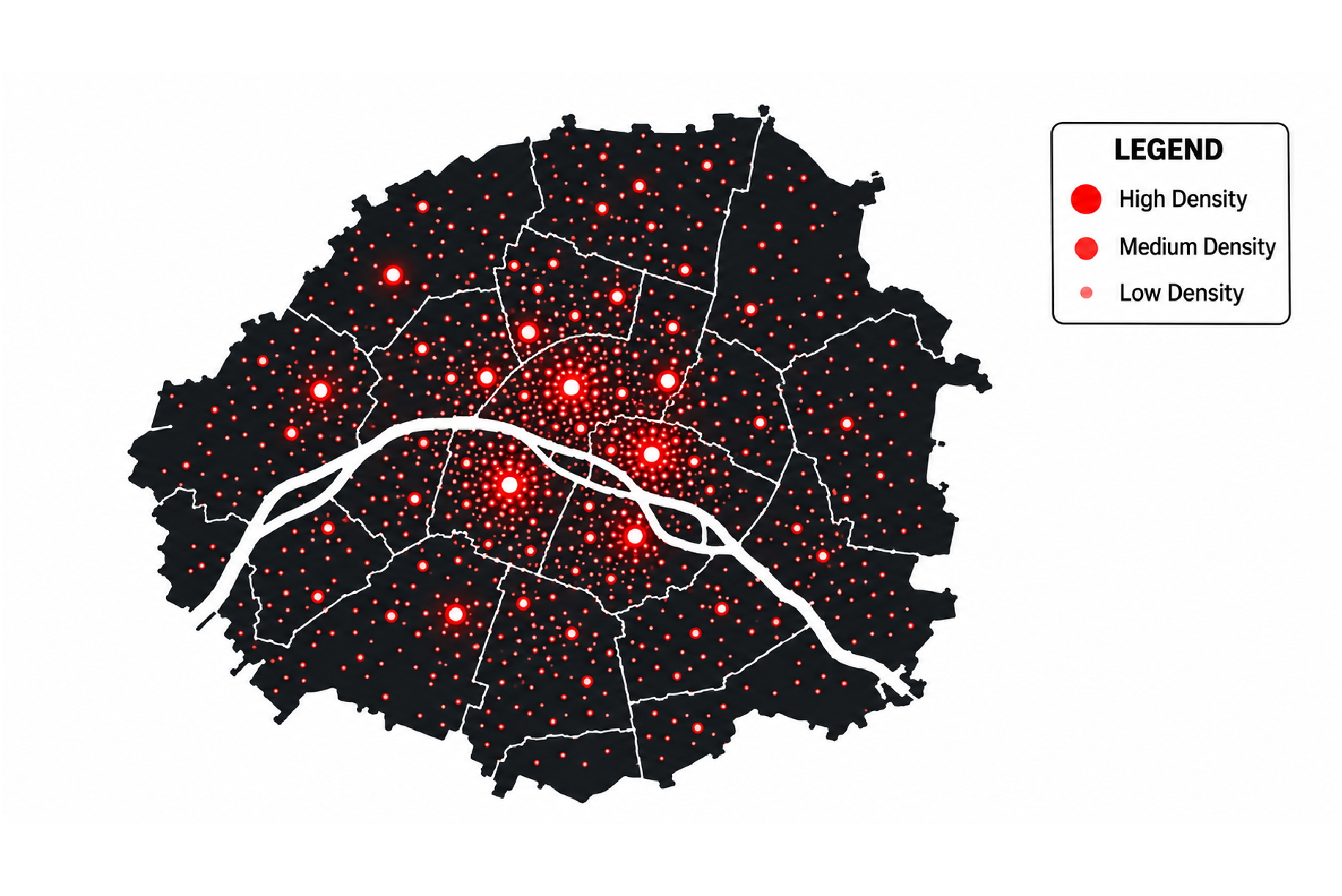
Top Areas by Number of Hotels
Areas with the Highest Concentration of Branded Hotel Chains in Paris
8TH ARRONDISSEMENT (CHAMPS-ÉLYSÉES)
210+
Driven by luxury shopping, international corporate offices, embassies, and prestigious avenues, the district attracts premium hospitality brands and affluent international travelers.
9TH ARRONDISSEMENT (OPÉRA)
190+
Major department stores, theaters, business offices, and convenient transport connections support demand for boutique, upscale, midscale, and business-oriented hotels.
1ST ARRONDISSEMENT (LOUVRE)
180+
The Louvre Museum, historic landmarks, and luxury retail destinations support high-value leisure travel and premium hotel positioning in central Paris.
15TH ARRONDISSEMENT (CONVENTION)
170+
Residential neighborhoods, exhibition-related demand, and metro connectivity support business accommodation, family travel, and value-oriented hotel chains.
17TH ARRONDISSEMENT (PORTE MAILLOT)
150+
Convention facilities, western Paris business activity, and transport connections create opportunities for corporate accommodation and internationally recognized hotel brands.
10TH ARRONDISSEMENT (GARE DU NORD AND GARE DE L'EST)
140+
International rail connections, regional transport services, and convenient access to central attractions support budget, midscale, and short-stay accommodation.
What is the largest hotel chain in Paris?
Accor is a major hotel group in Paris, with a multi-brand portfolio spanning economy, midscale, premium, and luxury accommodation. Its brands, including ibis, Mercure, Novotel, Pullman, and Sofitel, provide a useful framework for evaluating different market segments.
Accor
PROPERTIES
Segment
Economy to luxury
Coverage
Multiple districts
Extensive brand diversity supports comparisons across accommodation budgets, visitor profiles, and property categories.
Marriott International
PROPERTIES
Segment
Premium and luxury
Coverage
Central and high-value districts
A useful competitor for analyzing luxury hospitality, corporate demand, and premium room-rate positioning.
Hilton Hotels & Resorts
PROPERTIES
Segment
Upscale and luxury
Coverage
Business and visitor corridors
International brand recognition and varied property formats make Hilton relevant for corporate and leisure market comparisons.
Top 10 Hotel Chains in Paris by Property Count and Geographic Presence – 2026
The table highlights the distribution and operational scale of selected hotel groups and brands across Paris in 2026. Global operators such as Accor, Marriott, Hilton, and IHG compete across premium and business-oriented segments, while B&B Hotels, ibis, and Best Western provide important comparisons for budget and midscale accommodation. Regional operators such as Astotel also contribute to the city's diverse hospitality landscape.
Insights derived through Hotel Chains Data Scraping help businesses consolidate property locations, brand affiliations, room capacity, and geographic coverage into structured datasets. This distribution can then be refined through multi-brand location aggregation, allowing analysts to compare property density, neighborhood saturation, and competitive positioning.
| Hotel Chain | Total Properties (Paris) | Districts Covered | Estimated Locations | Download Dataset |
|---|---|---|---|---|
| Accor | 350+ | 20 | 350+ | Download |
| Marriott International | 70+ | 15+ | 70+ | Download |
| Hilton Hotels & Resorts | 45+ | 12+ | 45+ | Download |
| InterContinental Hotels Group (IHG) | 55+ | 15+ | 55+ | Download |
| Radisson Hotels | 25+ | 10+ | 25+ | Download |
| B&B Hotels | 35+ | 12+ | 35+ | Download |
| Louvre Hotels Group | 30+ | 12+ | 30+ | Download |
| Best Western | 40+ | 15+ | 40+ | Download |
| Hyatt | 15+ | 8+ | 15+ | Download |
| Meliá Hotels International | 10+ | 6+ | 10+ | Download |
What are the largest hotel chains in Paris in 2026?
Hotel chain research across Paris identifies Accor as a significant multi-brand competitor, alongside international hospitality groups such as Marriott, Hilton, and IHG. The relative ranking depends on whether comparisons measure individual properties, rooms, brands, or the broader metropolitan area. Budget and midscale operators also play an important role in serving visitors seeking affordable accommodation near transport connections and major attractions.
A deeper layer of analysis comes from geographic price parity, which compares equivalent room categories across districts and travel dates. By combining Hotel Data Scraping with property-level location records, analysts can assess advertised rate differences, promotional activity, guest ratings, and the competitive positioning of hotels operating within comparable market segments.
Top 10 Hotel Chains in Paris – 2026
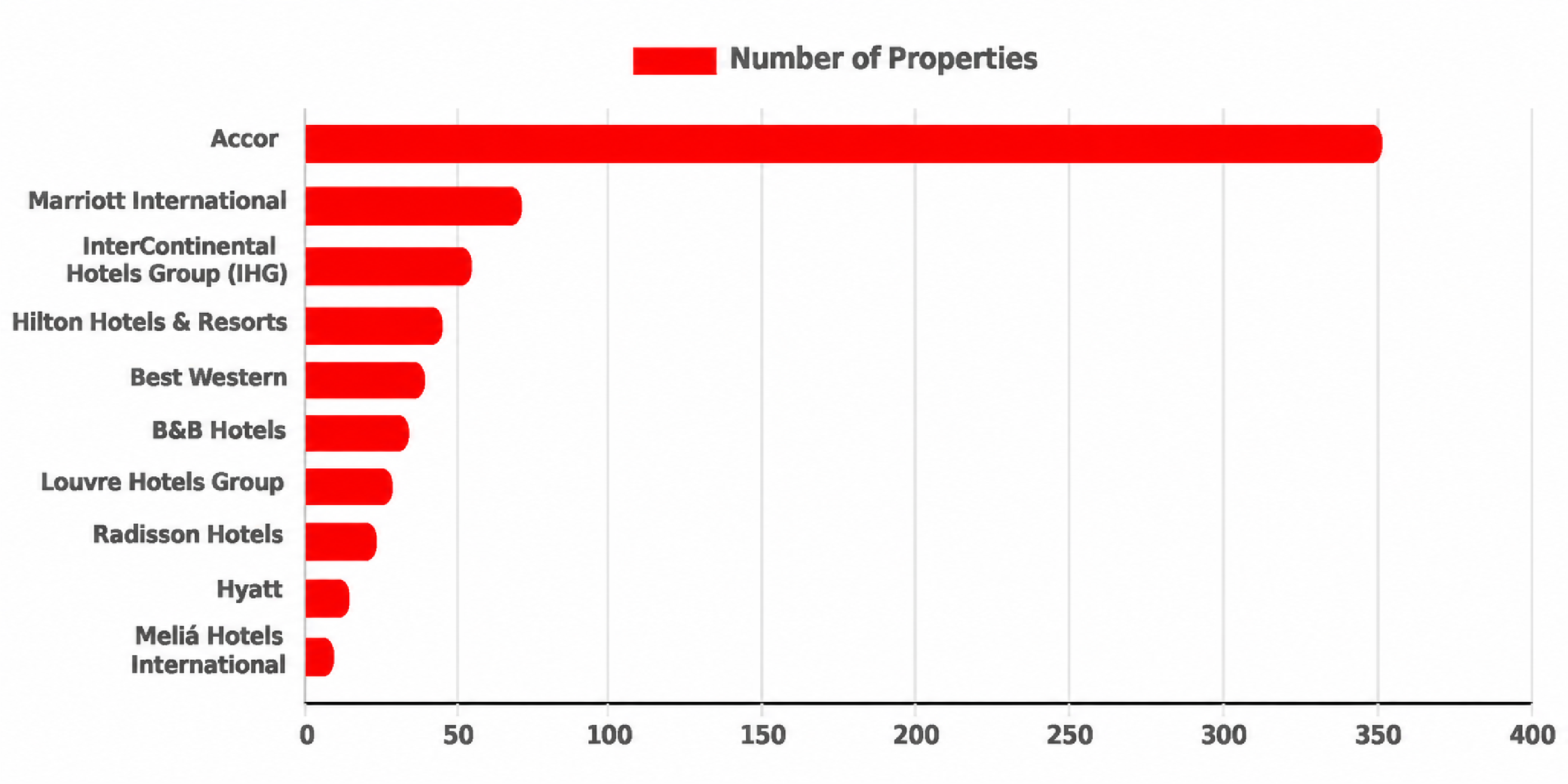
Paris's hospitality ecosystem combines international hotel groups with French and European operators serving distinct traveler segments. Accor offers broad brand coverage, Marriott and Hilton compete across premium accommodation, and IHG maintains a presence in business and leisure markets. Budget-focused operators concentrate on accessible accommodation, while luxury groups target high-value destinations and differentiated guest experiences.
A structured method to collect hotel chain location data enables property-level comparisons across geographic areas, supporting expansion planning, brand assessment, and location-based hospitality analysis. The following profiles retain the reference report's format; property figures and concentration percentages are illustrative rather than verified market shares.

Accor
Budget to Luxury Leader
Marriott International
Luxury / Premium Leader
Hilton Hotels & Resorts
Business Travel Leader
IHG Hotels & Resorts
Multi-Segment Expansion Leader
Radisson Hotel Group
Upscale Hospitality Brand
B&B Hotels
Value Budget Leader
Best Western
Midscale Urban Leader
Louvre Hotels Group
Budget to Upscale Operator
Hyatt
Luxury Hospitality Leader
Meliá Hotels International
International Leisure BrandWant insights into Paris's hotel chain ecosystem?
Connect with our experts for hotel location datasets, property-level intelligence, competitive analysis, and hospitality market research.
Advantages of Chain-Focused Hotel Location Data
District-level insights help identify underserved hospitality markets by analyzing property density, room rates, brand coverage, and available demand indicators. They improve expansion planning, support geographic price parity, strengthen Competitor Benchmarking, and help hotel operators evaluate investment opportunities while reducing exposure to oversaturated locations.
- Improving Portfolio Expansion Efficiency: Location intelligence identifies neighborhoods with limited branded accommodation and helps businesses assess potential expansion opportunities using verified property locations, transport accessibility, and tourism infrastructure.
- Strengthening Competitive Rate Alignment: Comparable room rates, amenities, and property categories help operators evaluate pricing differences between similar hotels across Paris and develop more informed rate-positioning strategies.
- Identifying High-ROI Investment Corridors: Geographic mapping reveals hotel clusters, emerging commercial corridors, and potential accommodation gaps, helping investors prioritize locations for further financial and operational assessment.
- Enhancing Demand Forecast Precision: Historical rate observations, seasonal patterns, and event-related indicators help businesses understand changes in accommodation demand and improve forward-looking market analysis.
- Improving Brand-Level Market Positioning: Detailed Paris hotel chain competitor analysis enables businesses to compare property coverage, accommodation segments, room inventory, and competitive positioning across hospitality groups.
| Field Name | Description |
|---|---|
| Property & Brand Identity | Captures hotel name, parent group, individual brand, segment, and operating status for structured benchmarking and accurate property identification. |
| Location Intelligence Data | Includes street address, arrondissement, postal code, latitude, and longitude for geographic mapping and district-level hospitality segmentation. |
| Occupancy & Demand Data | Tracks available-room observations, booking signals where accessible, and seasonal indicators for accommodation demand assessment. |
| Pricing & Revenue Metrics | Provides advertised room rates, discount fluctuations, currency, room categories, and timestamps for competitive pricing analysis. |
| Guest Experience Analytics | Aggregates publicly available ratings, review counts, amenities, and satisfaction indicators to compare property performance across locations. |
| Competitive Positioning | Competitive Positioning Combines nearby property density, brand overlap, price comparisons, and segment coverage to evaluate Paris hotel chain competitor tracking. |
Insights and Analysis
The 2026 Paris hotel ecosystem reflects a combination of international brand competition, localized demand, and differences in accommodation positioning across the city's districts. Central tourist areas and luxury shopping corridors attract premium hospitality operators, while transport-connected and residential districts support business hotels, budget accommodation, and extended-stay properties.
Continuous monitoring of hotel locations helps identify changes in geographic coverage, brand affiliations, and competitive density. However, property counts must be interpreted alongside room capacity, pricing, operating status, and market boundaries. A large number of smaller hotels does not necessarily indicate greater room supply or stronger revenue performance than a smaller number of larger properties.
The increasing use of automated location collection and structured hotel datasets supports more consistent comparisons between competing brands. By combining geographic coordinates with public pricing observations, guest ratings, and accommodation characteristics, hospitality businesses can assess potential market gaps, identify areas of competitive overlap, and prioritize locations for further research.
Reliable findings depend on removing duplicate listings, validating addresses, distinguishing individual brands from parent companies, and refreshing records regularly. These controls are essential for turning fragmented hotel listings into a useful research dataset for 2026.
Conclusion
The Paris hospitality industry in 2026 is increasingly shaped by structured data collection, geographic analysis, and competitive market intelligence. Hotel location datasets provide visibility into property distribution, brand penetration, and accommodation opportunities across Paris's administrative districts. Combining verified locations with pricing observations, room inventory, and guest experience indicators strengthens expansion planning and competitive assessment.
Ultimately, Hotel Data Intelligence helps investors, hotel operators, and hospitality analysts transform scattered property information into structured insights. With reliable property records and consistent monitoring, organizations can make more informed decisions about market positioning, portfolio development, and the evolving competitive dynamics of Paris's hotel ecosystem.