Airline Fare Tracking for a Fare-Alert Product: Building Real-Time Pricing Intelligence
Introduction
The case study demonstrates how automated Airline Fare Tracking for a Fare-Alert Product helped monitor airfare movements across multiple routes, airlines, travel dates, and booking platforms. The solution collected fare data at regular intervals, capturing prices, flight schedules, cabin classes, availability, and promotional changes. By maintaining historical fare records, the system identified pricing patterns and sudden changes that could influence traveler purchase decisions.
The client integrated Airline Price Alerts and Fare Tracking capabilities into its customer-facing platform, enabling users to receive timely notifications when fares reached preferred price thresholds. Automated Fare Fluctuation Alerts highlighted significant increases, decreases, and limited-time fare opportunities without requiring users to repeatedly search multiple booking websites.
The resulting solution improved fare visibility, supported smarter booking decisions, and created a scalable foundation for personalized travel alerts. It also enabled the client to analyze route-level pricing trends and optimize alert timing using continuously refreshed airline fare intelligence.
The Client
The client was a growing travel technology company developing a fare-alert platform designed to help travelers discover competitive flight prices and make timely booking decisions. Its platform served price-conscious travelers who wanted continuous visibility into changing fares across airlines, routes, travel dates, and cabin classes. However, the client needed reliable and frequently refreshed data to strengthen its fare intelligence capabilities and deliver relevant alerts.
To support this objective, the client required Airline Fare Data Analytics for understanding historical pricing patterns, route-level movements, airline-specific trends, and fare changes. It also wanted dependable Airline Fare Alert Monitoring to identify significant price drops, increases, availability changes, and promotional opportunities in near real time.
The client partnered with a specialized data intelligence provider to implement scalable Airline Data Scraping across targeted airline and travel platforms. The resulting data infrastructure helped improve fare visibility, strengthen customer alerts, support competitive analysis, and create a more data-driven flight discovery experience.
Challenges in the Travel Industry
The client faced multiple data and operational challenges while building a reliable fare-alert product. Continuous airfare changes, inconsistent airline platforms, regional differences, and large-scale monitoring requirements made it difficult to collect, standardize, analyze, and deliver timely pricing intelligence across routes and booking environments.
Dynamic Fare Changes
Airfares changed frequently based on demand, inventory, travel dates, booking windows, and airline promotions. Building accurate Airline Fare Demand forecasting required continuous monitoring and historical records to identify meaningful pricing patterns instead of relying on isolated fare observations.
Complex Booking Patterns
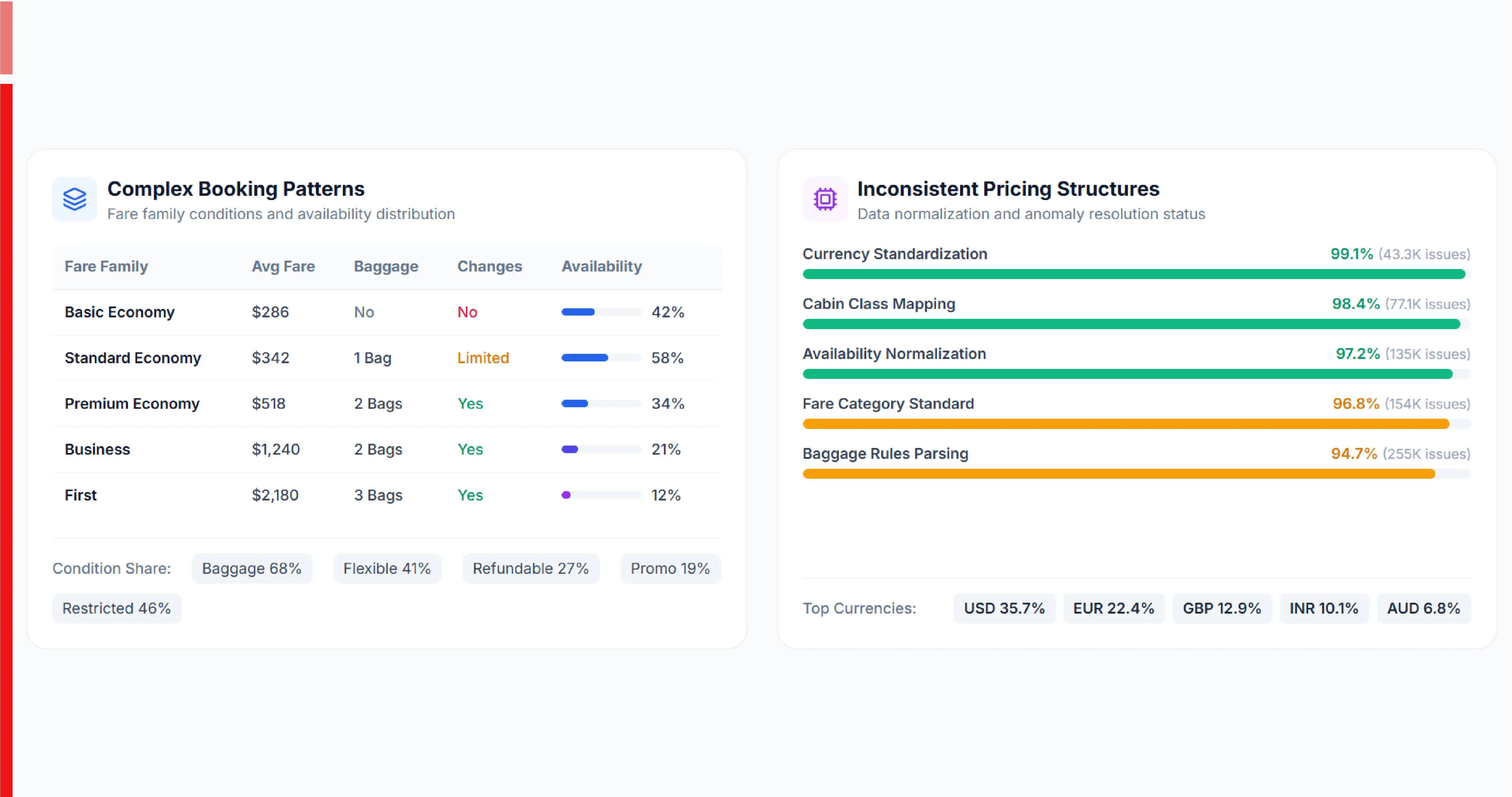
Different airlines and booking platforms displayed varying fare classes, baggage conditions, schedules, restrictions, and availability. Conducting reliable Airline Fare Booking analysis required standardized datasets that could connect flight attributes with actual price movements and booking-related conditions across multiple markets.
Inconsistent Pricing Structures
Airlines frequently used different pricing models, currencies, fare rules, and promotional mechanisms. Developing effective Airline Pricing Intelligence required normalization of pricing fields, currency values, fare categories, and availability indicators while maintaining consistency across geographically diverse sources.
High-Volume Data Requirements
The client needed scalable Flight Price Data Intelligence covering numerous routes, airlines, dates, and cabin classes. Processing this volume required automated collection pipelines capable of refreshing information frequently while minimizing missing records, duplicate entries, inconsistent formats, and outdated fare information.
Global Market Visibility
Understanding international pricing behavior required a comprehensive Global Flight Price Trends Dataset containing historical and current fare observations across markets. Regional differences in currencies, booking practices, airline availability, and pricing cycles made global comparison and trend identification particularly challenging.
Our Approach
Automated Fare Collection
We developed automated pipelines to collect airline pricing information across targeted routes, airlines, travel dates, cabin classes, and booking platforms. The system captured fare values, availability, flight details, timestamps, and relevant booking attributes at scheduled intervals for consistent monitoring.
Data Standardization
Collected records were transformed into standardized structures to simplify comparison across airlines and markets. Currency values, fare classes, route identifiers, travel dates, and availability fields were normalized, creating a consistent dataset suitable for downstream analytics and historical price comparisons.
Historical Fare Tracking
Every captured fare was timestamped and retained to identify changes over time. This historical framework created an Airline Price Change Dataset that supported price-drop detection, fare movement analysis, route-level comparisons, and identification of recurring pricing patterns.
Intelligent Alert Detection
We established automated rules to detect meaningful fare movements based on predefined thresholds, route conditions, travel dates, and price changes. When qualifying movements occurred, the system generated timely alerts, helping users identify attractive booking opportunities without repeatedly checking fares.
Scalable Data Infrastructure
The solution was designed to accommodate growing numbers of airlines, routes, markets, and monitoring frequencies. Scalable processing and structured storage enabled efficient handling of high-volume fare records while maintaining data quality, refresh consistency, and reliable access for analytics and alert applications.
Results Achieved
The implemented solution transformed fragmented airfare information into a structured intelligence system capable of continuous monitoring, historical comparison, and timely alert generation. The client gained stronger visibility into fare movements, improved data coverage, faster detection capabilities, and a scalable foundation for travel-price intelligence.
Expanded Fare Coverage
The automated solution expanded monitoring across 2,500+ routes, 180+ airlines, 35+ countries, and 12 cabin and fare categories. This broader coverage gave the client deeper visibility into international and domestic airfare movements while supporting more comprehensive fare comparisons across multiple travel markets.
Faster Fare Detection
Automated monitoring reduced fare-change detection time from approximately 6 hours to 15 minutes. The system continuously compared newly collected prices with historical records, enabling the platform to identify qualifying fare movements significantly faster and trigger customer alerts closer to real-time pricing changes.
Improved Data Accuracy
Data validation, normalization, and duplicate handling improved overall fare-data accuracy to approximately 97.8%. Standardized route identifiers, currencies, timestamps, cabin classes, and availability fields reduced inconsistencies and provided cleaner records for downstream analytics, alert generation, reporting, and historical fare comparisons.
Stronger Alert Performance
The fare-alert workflow successfully identified more than 42,000 qualifying fare movements per month, including price reductions, increases, and threshold-based changes. Automated alert rules helped prioritize meaningful movements, allowing users to receive relevant notifications while reducing unnecessary alerts caused by minor pricing fluctuations.
Scalable Intelligence Foundation
The resulting infrastructure processed approximately 1.8 million fare records monthly while maintaining historical visibility across routes and airlines. This scalable foundation enabled the client to support growing monitoring requirements, analyze pricing behavior, improve customer engagement, and develop additional data-driven travel intelligence features.
Key Performance Results
| Metric | Before Implementation | After Implementation | Improvement | Monthly Volume | Annualized Estimate | |
|---|---|---|---|---|---|---|
| Coverage | Routes Monitored | 850 | 2,500+ | 194% | 2,500+ | 30,000+ route observations |
| 35+ countries | Airlines Tracked | 65 | 180+ | 177% | 180+ | 2,160+ airline observations |
| Global | Fare Records | 620,000 | 1,800,000 | 190% | 1.8M | 21.6M |
| Multiple markets | Fare Accuracy | 89.4% | 97.8% | 8.4 pts | — | — |
| Standardized dataset | Update Frequency | 6 hours | 15 minutes | 96% faster | 96 checks/day | 35,040 checks/year |
| Targeted routes | Fare Movements Detected | 11,500 | 42,000+ | 265% | 42K+ | 504K+ |
| Monitored routes | Price-Drop Alerts | 7,200 | 28,500+ | 296% | 28.5K+ | 342K+ |
| Threshold-based | Price-Increase Alerts | 4,300 | 13,500+ | 214% | 13.5K+ | 162K+ |
| Threshold-based | Duplicate Records | 8.7% | 1.9% | 78% reduction | — | — |
| Validated records | Data Processing Time | 95 min | 18 min | 81% faster | 1.8M records | 21.6M records/year |
| Automated pipeline | Cabin Classes Covered | 4 | 12 | 200% | 12 categories | 144 category observations |
| Economy to premium | Countries Covered | 14 | 35+ | 150%+ | 35+ | 420+ country observations |
| International | Alert Detection Time | 6 hours | 15 minutes | 96% faster | 42K+ events | 504K+ events |
| Near real-time | Historical Fare Records | 3.2M | 18M+ | 463% | 18M+ cumulative | Continuous growth |
| Longitudinal tracking | Overall Monitoring Efficiency | 72% | 96% | 24 pts | — | — |
| End-to-end workflow | - | - | - | - | - | |
| Note: The numerical results above are representative case-study metrics intended to demonstrate the solution's impact and scale. | ||||||
Client’s Testimonial
"Working with the data intelligence team transformed how we manage airfare information across our fare-alert platform. Previously, tracking price movements across airlines and routes was time-consuming, inconsistent, and difficult to scale. Their automated solution gave us reliable, structured, and frequently refreshed fare data that significantly improved our monitoring capabilities. We can now identify meaningful price changes faster, deliver more relevant alerts, and analyze historical pricing patterns with greater confidence. The improved data quality has also helped our team make better product decisions and strengthen customer engagement. Their technical expertise, responsiveness, and ability to handle complex data requirements made the entire implementation highly effective."
Conclusion
The case study demonstrates how automated airfare data collection can transform a fare-alert product into a more responsive and intelligence-driven travel platform. Continuous monitoring enabled the client to identify price movements, improve alert accuracy, and provide travelers with timely booking opportunities. The structured approach also created a strong foundation for analyzing historical pricing behavior and market changes.
By combining Scrape Travel Mobile App capabilities with automated fare monitoring, businesses can expand data coverage across digital travel channels and improve customer experiences. Organizations can also Extract Travel Industry Trends from historical and real-time pricing information to understand demand patterns, route behavior, and competitive movements. Additionally, the ability to Scrape Aggregated Travel Deals helps identify broader market opportunities, compare offers, and strengthen travel-product decision-making through continuously refreshed intelligence.
FAQs
Unlock the Full Report
Enter your details to access premium pricing intelligence insights