Corporate Travel Cheaper Lodging and Fare Data Tracking for Smarter Business Travel Management
Introduction
Corporate travel teams often manage thousands of hotel stays, flights, routes, and booking decisions across multiple destinations, making price visibility increasingly important. This case study demonstrates how structured travel data collection and analytics helped a corporate travel client monitor lodging and transportation costs across markets. The solution combined Corporate Travel Cheaper Lodging and Fare Data tracking with automated collection of hotel rates, airfare, availability, room categories, booking conditions, and destination-level pricing signals. By consolidating fragmented travel information, the client gained a clearer view of changing costs and supplier variations. The implementation also strengthened Travel Data Intelligence, enabling teams to examine historical pricing patterns, destination movements, and supplier behavior through standardized datasets. In addition, Corporate Travel Pricing Intelligence supported more informed procurement and budgeting decisions. The resulting framework transformed scattered travel information into structured intelligence that could be analyzed regularly, helping travel managers identify pricing movements, compare options, monitor market conditions, and improve corporate travel planning.
The Client
The client was a corporate travel management organization responsible for coordinating accommodation and transportation requirements for business travelers across domestic and international destinations. Its travel operations involved multiple hotel suppliers, airline options, booking channels, cities, travel dates, and corporate rate agreements. Managing this information manually made it difficult to maintain consistent visibility into changing market prices. The organization wanted a centralized framework capable of supporting Price Monitoring across hotels and transportation providers while maintaining historical records for comparison. It also required Corporate Travel Cost Analytics to understand spending patterns by destination, supplier, route, travel period, and booking category. The client further needed Price Optimization capabilities to identify cost variations and support more efficient purchasing decisions. Its objective was not simply to collect prices but to convert frequently changing travel information into structured, comparable datasets that could support procurement, budgeting, supplier evaluation, and travel policy management.
Challenges in the Travel Industry
Corporate travel pricing changes continuously because of demand, availability, booking windows, destination events, seasonal conditions, and supplier strategies. The client faced several challenges in maintaining reliable and comparable travel intelligence.
Inconsistent Travel Cost Benchmarking
The client struggled with travel cost benchmarking because hotel and airfare prices varied across suppliers, booking dates, destinations, room types, fare classes, and cancellation conditions. Without standardized historical records, comparing current prices against previous observations or alternative suppliers was difficult.
Rapidly Changing Travel Prices
Corporate travel prices could change multiple times during a booking cycle. A reliable real time travel pricing API approach was required to capture current hotel and airfare information, including availability, rate changes, fare conditions, and supplier-level differences without depending entirely on manual collection.
Seasonal Price Fluctuations
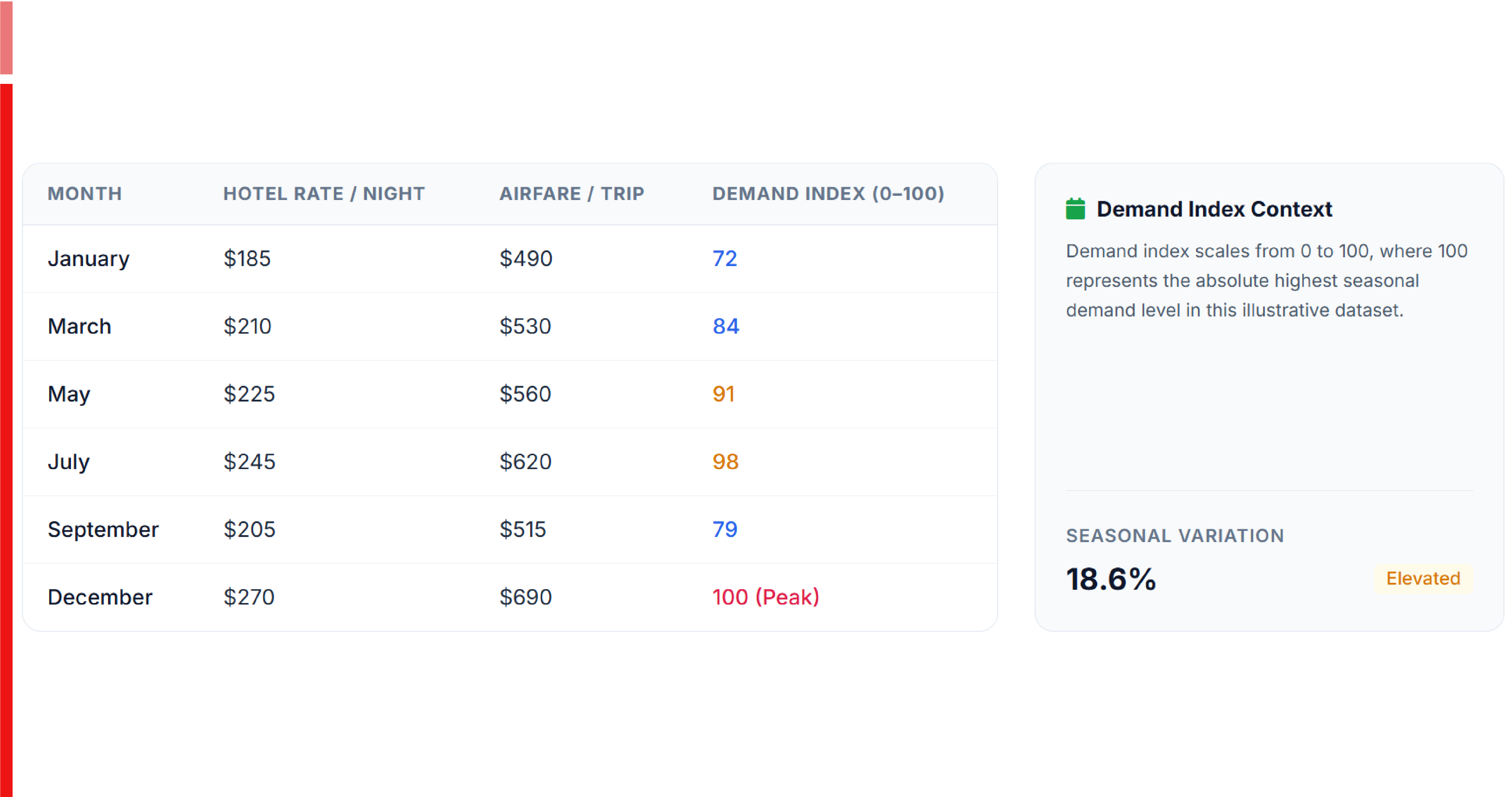
Travel costs frequently changed around holidays, conferences, peak business periods, and destination-specific events. Seasonal Trend Analysis was challenging because historical pricing information was fragmented across different sources, making it difficult to identify recurring patterns and distinguish seasonal movements from temporary price changes.
Supplier and Competitor Comparisons
The client needed competitive travel pricing analysis across hotels, airlines, routes, room categories, and fare options. Differences in inclusions, cancellation policies, taxes, availability, and booking restrictions complicated direct comparisons and required a standardized methodology for evaluating comparable travel products.
Uncertain Future Demand
Corporate travel demand can shift according to business schedules, market conditions, events, and seasonal cycles. Demand Forecasting was therefore difficult when historical observations were incomplete or inconsistent. The client needed structured datasets that could reveal demand-related pricing patterns and support forward-looking travel planning.
Our Approach
Multi-Source Travel Data Collection
We established automated collection workflows covering relevant hotel and transportation sources. The process captured destination, supplier, property or route, travel dates, prices, availability, room or fare categories, booking conditions, and related attributes in a standardized structure.
Data Standardization and Cleaning
Collected records were processed to remove duplicates, normalize currencies, standardize destination names, align room and fare categories, and organize booking conditions. This created comparable datasets that could be analyzed consistently across different travel suppliers and markets.
Historical Price Tracking
We maintained recurring observations to create historical pricing records. These records enabled the client to compare current rates with previous observations, identify price movements, examine destination-level patterns, and understand how rates changed across booking windows and travel periods.
Analytics and Benchmarking Framework
The solution organized travel data into analytical dimensions such as supplier, destination, route, travel date, property category, room type, fare type, and price. Benchmarking models then helped identify differences between comparable travel options and purchasing periods.
Reporting and Intelligence Delivery
Processed data was transformed into structured reports and analytical outputs that could support travel managers, procurement teams, and business stakeholders. The reporting framework highlighted price movements, supplier variations, destination trends, and recurring cost patterns for operational decision-making.
Results Achieved
The implemented framework improved the client's ability to consolidate, compare, monitor, and analyze corporate travel pricing across multiple travel categories and destinations.
Centralized Pricing Visibility
The client gained a consolidated dataset containing hotel and transportation pricing observations. Instead of reviewing fragmented supplier information separately, travel teams could examine standardized records through common dimensions such as destination, supplier, travel date, rate, availability, and booking conditions.
Faster Market Comparisons
Structured data reduced the effort required to compare suppliers and travel options. Teams could examine differences between comparable hotels, routes, room categories, and fare types while also considering booking conditions and availability captured during each observation.
Stronger Historical Intelligence
Historical observations created a reference point for evaluating changing travel costs. The client could analyze previous and current prices, recognize recurring movements, and investigate periods where lodging or transportation costs differed substantially from established market patterns.
Improved Procurement Insights
The resulting intelligence gave procurement teams better visibility into supplier-level pricing differences. Instead of relying solely on isolated quotes, stakeholders could use structured historical and current observations when reviewing supplier performance, negotiating rates, and planning corporate travel requirements.
More Data-Driven Travel Planning
The solution supported broader travel planning by connecting pricing, availability, destinations, travel dates, and supplier information. This helped stakeholders understand market conditions more systematically and incorporate observed pricing patterns into budgeting and corporate travel management workflows.
Results Snapshot
| Metric | Before Implementation | After Implementation | Improvement / Output | Data Coverage |
|---|---|---|---|---|
| Travel Data Sources | 8 | 24 | +16 sources | 24 |
| Destinations Tracked | 35 | 120 | +85 destinations | 120 |
| Hotel Records | 42,500 | 186,000 | +143,500 records | 186,000 |
| Flight/Fare Records | 28,400 | 124,500 | +96,100 records | 124,500 |
| Daily Price Observations | 3,250 | 18,750 | +15,500 observations | 18,750 |
| Supplier Profiles | 65 | 210 | +145 suppliers | 210 |
| Historical Pricing Period | 3 months | 18 months | +15 months | 18 months |
| Room/Fare Attributes | 7 | 18 | +11 attributes | 18 |
| Price Comparison Coverage | 38% | 91% | +53 percentage points | 91% |
| Automated Collection | 22% | 94% | +72 percentage points | 94% |
| Duplicate Records | 8.6% | 1.7% | -6.9 percentage points | 1.7% |
| Currency Standardization | 61% | 100% | +39 percentage points | 100% |
| Availability Tracking | 34% | 88% | +54 percentage points | 88% |
| Supplier Comparison Time | 9.5 hrs | 2.1 hrs | 7.4 hrs saved | 78% reduction |
| Reporting Frequency | Weekly | Daily | +6 reporting cycles/week | Daily |
| Historical Comparison Capability | Limited | Comprehensive | Expanded | 18 months |
| Destination-Level Analysis | 35 markets | 120 markets | +85 markets | 120 |
| Pricing Visibility | Fragmented | Centralized | Consolidated | 1 framework |
Client's Testimonial
"The travel data solution gave our team a much clearer understanding of how corporate lodging and transportation prices were changing across destinations. Previously, our teams spent considerable time collecting information from different suppliers and manually comparing rates. The structured datasets and recurring price observations made this process significantly more organized. We can now examine supplier differences, review historical movements, and identify pricing patterns using consistent information. The reporting framework has also helped our procurement and travel management teams communicate using the same data foundation. Most importantly, the solution has created a repeatable process for monitoring travel costs rather than relying on isolated price checks."
Conclusion
Corporate travel management increasingly depends on timely, structured, and comparable pricing information. This case study demonstrates how automated travel data collection can help organizations transform fragmented hotel and transportation information into actionable business intelligence. By combining supplier-level pricing, availability, historical observations, destination attributes, and booking conditions, the client developed a more consistent foundation for monitoring travel costs and evaluating market movements.
Organizations can use Travel Aggregators Data Scraping Services to consolidate information from multiple travel sources and build structured datasets for analysis. Similarly, solutions that Scrape Travel Website Data can support recurring collection of lodging, airfare, availability, and booking information. Businesses can also Scrape Travel Mobile App data to extend monitoring across mobile-first travel platforms and consumer-facing channels.
Together, these capabilities can support benchmarking, procurement analysis, budgeting, supplier evaluation, and ongoing corporate travel intelligence.
FAQs
Unlock the Full Report
Enter your details to access premium pricing intelligence insights