
Southern Europe Vacation Rental Data Scraping for Nightly Rates & Supply in Spain, Italy, Portugal and Greece
Introduction
Southern Europe has become an important destination for international tourism, attracting millions of travelers through its coastal resorts, historic cities, cultural attractions, and seasonal holiday experiences. Countries such as Spain, Italy, Portugal, and Greece have established strong vacation rental markets, supported by international tourism, digital booking platforms, and growing demand for flexible accommodation.
Southern Europe Vacation Rental Data Scraping enables travel businesses, property managers, investors, and hospitality companies to collect structured information from online vacation rental platforms. This information includes property prices, accommodation categories, location, guest ratings, amenities, minimum stay requirements, and booking availability.
Through Vacation Rental Data Scraping, businesses can monitor accommodation listings across multiple booking platforms and destinations, transforming scattered online information into organized market intelligence. It also supports Southern Europe vacation rental market analysis by identifying differences in rental prices, property supply, seasonal demand, and competitive positioning across major tourism destinations.
The growing importance of digital accommodation marketplaces makes structured rental data valuable for businesses looking to understand market movements. From beachfront villas in Greece to city apartments in Rome and holiday homes in Portugal, data collection helps stakeholders evaluate opportunities and develop informed pricing strategies.
Understanding the Southern European Vacation Rental Market
The Southern European vacation rental industry includes several accommodation categories, including apartments, private villas, holiday homes, serviced residences, countryside properties, and beachfront accommodations.
Spain benefits from strong leisure tourism across Barcelona, Madrid, Valencia, Malaga, Ibiza, and the Balearic Islands. Italy attracts travelers through Rome, Florence, Venice, Milan, Tuscany, and the Amalfi Coast. Portugal has established demand across Lisbon, Porto, Algarve, and Madeira, while Greece remains popular for island destinations such as Santorini, Mykonos, Crete, and Rhodes.
Each destination has different accommodation characteristics and booking patterns. Urban markets often experience demand throughout the year, whereas island destinations and coastal properties are more dependent on summer tourism.
For hospitality businesses, monitoring these differences is essential. Collecting listing-level information across destinations helps identify competitive pricing, property availability, accommodation preferences, and changes in consumer demand.
Real-Time Price Intelligence Across Vacation Rental Markets
Rental pricing is one of the most important indicators of market competitiveness. Property owners and hospitality operators need to understand how similar accommodations are priced across locations, booking periods, and property categories.
Real-Time Price Intelligence helps businesses compare advertised nightly rates, weekly accommodation costs, cleaning charges, service fees, and additional guest charges.
For example, a two-bedroom apartment in Barcelona may have a different pricing structure from a comparable property in Lisbon or Rome. However, comparing headline prices alone may produce misleading conclusions because property size, location, amenities, guest capacity, and cancellation policies can significantly influence rental costs.
Data scraping can collect these attributes alongside advertised prices, enabling more meaningful comparisons.
Businesses can also use historical pricing information to identify periods when property rates increase or decrease. This is particularly valuable for holiday rental operators managing accommodation portfolios across multiple destinations.
Major pricing intelligence opportunities
- Italy short-term rental competitor price tracking helps property managers compare accommodation rates in Rome, Venice, Florence, Milan, and coastal destinations.
- Portugal and Greece short-term rental rates tracking enables businesses to evaluate price differences between Lisbon, Porto, Algarve, Athens, Santorini, and Crete.
- Monitoring weekly and monthly rates helps identify long-stay accommodation opportunities.
- Comparing cleaning fees, additional guest charges, and booking conditions improves total-cost analysis.
- Historical price records help identify competitive pricing changes during peak and off-peak periods.
Country-Level Market Demand and Competitive Opportunities
The scale of the Southern European vacation rental industry can be understood through online booking activity. Eurostat reported approximately 951.6 million guest nights in EU short-stay accommodation booked through major online platforms in 2025, representing an 11.4% increase over 2024. Spain and Italy were among the largest markets, while Greece and Portugal also recorded substantial activity.
The following table highlights the four major Southern European markets using official 2025 platform-booked guest-night figures.
Southern Europe Vacation Rental Market – 2025 Demand Indicators
| Country | Guest Nights (Million) | Approx. Share of EU Total | Key Destinations | Market Opportunity |
|---|---|---|---|---|
| Spain | 189 | 19.8% | Barcelona, Madrid, Malaga, Valencia | Coastal and urban rentals |
| Italy | 139 | 14.6% | Rome, Florence, Venice, Milan | Cultural and luxury stays |
| Greece | 52 | 5.5% | Athens, Santorini, Crete, Rhodes | Island and beachfront villas |
| Portugal | 50 | 5.2% | Lisbon, Porto, Algarve, Madeira | Holiday apartments and villas |
| Combined | 430 | 45.2% | Four major markets | Cross-country expansion |
Source: Eurostat 2025 platform-booked guest-night statistics. Percentages are calculated against the EU total of approximately 951.6 million nights and rounded.
These figures demonstrate why businesses should not evaluate Southern Europe as a single accommodation market. Spain and Italy provide substantial booking volumes, while Greece and Portugal offer opportunities for destination-specific pricing and property segmentation.
Real-Time Availability Tracking and Booking Opportunities
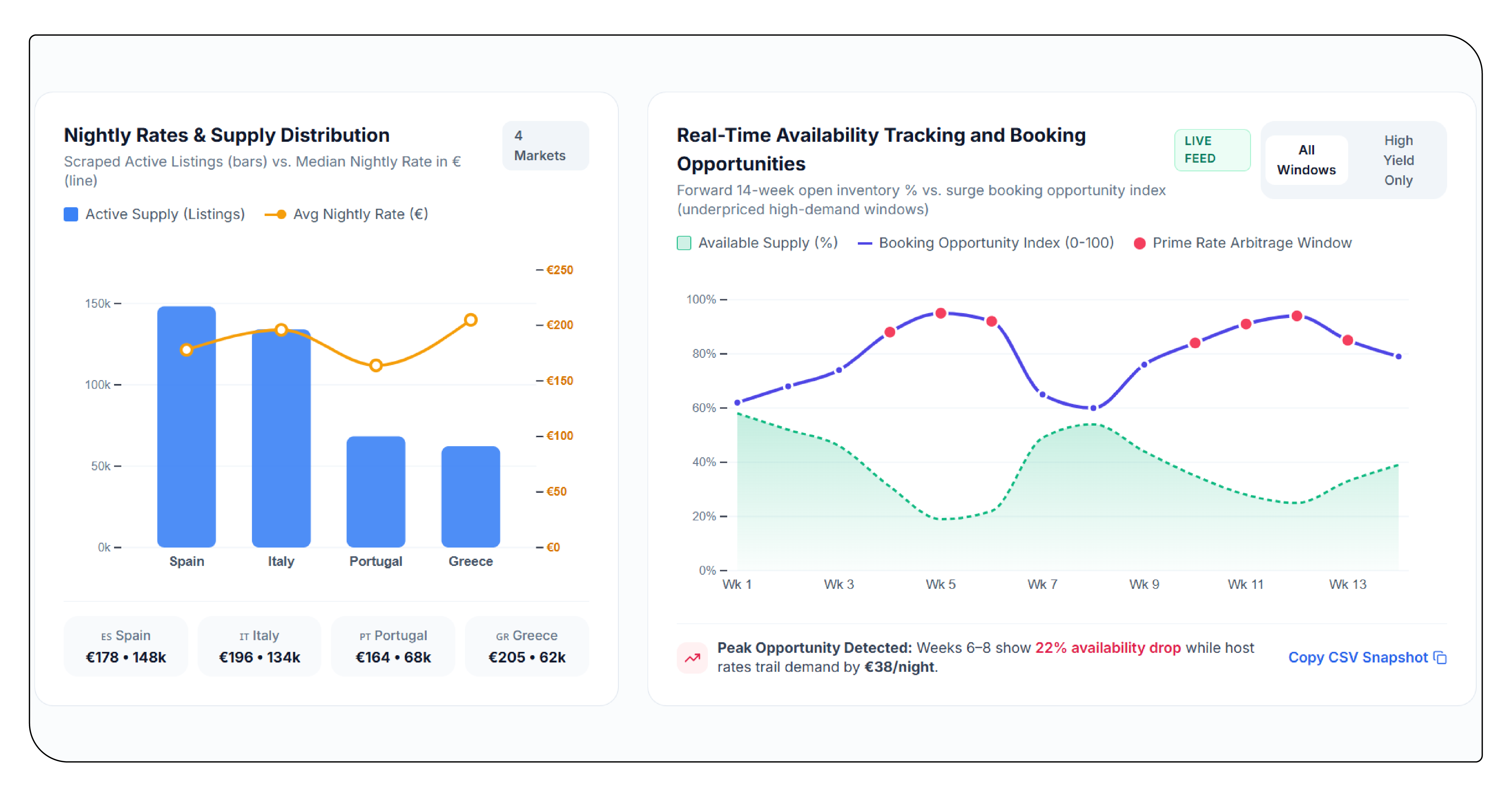
Accommodation availability is another important factor influencing vacation rental performance. Property owners need to understand whether competing properties are available for particular travel dates, while travel agencies need accurate inventory information to recommend suitable accommodation.
Real-Time Availability Tracking involves collecting listing availability across selected dates, booking windows, destinations, and property categories.
For example, a vacation rental operator monitoring Barcelona can compare the availability of competing two-bedroom apartments for a weekend in June against similar properties in Valencia or Malaga.
Important data points include:
- Available and unavailable dates.
- Minimum and maximum booking durations.
- Check-in and check-out restrictions.
- Number of available properties by accommodation category.
- Guest capacity and bedroom configuration.
- Cancellation policies and booking conditions.
- Changes in availability across repeated collection periods.
Availability data also provides useful demand signals. When a property frequently becomes unavailable for popular dates, it may indicate strong booking interest or limited inventory. However, an unavailable listing does not necessarily confirm a completed booking because owners may block dates for maintenance, personal use, or other reasons.
Combining availability records with pricing information creates a more complete picture of accommodation competition.
Country-Wise Vacation Rental Data Comparison
Comparing accommodation information across countries helps businesses understand differences in pricing, property characteristics, and booking conditions. A structured dataset can organize information according to destination, accommodation type, guest capacity, and travel period.
The following example illustrates how a comparable listing-level dataset can be structured. Prices and listing attributes are hypothetical sample values, not verified live marketplace quotations.
Sample Vacation Rental Listing and Price Comparison Dataset
| Country | Destination | Property Type | Bedrooms | Guest Capacity | Sample Nightly Rate (€) | Cleaning Fee (€) | Sample Availability (Days/30) |
|---|---|---|---|---|---|---|---|
| Spain | Barcelona | Apartment | 2 | 4 | 165 | 45 | 12 |
| Spain | Malaga | Beach Apartment | 2 | 4 | 145 | 40 | 15 |
| Spain | Valencia | Holiday Apartment | 1 | 2 | 110 | 30 | 18 |
| Italy | Rome | City Apartment | 2 | 4 | 175 | 50 | 10 |
| Italy | Florence | Heritage Apartment | 2 | 4 | 160 | 45 | 13 |
| Italy | Venice | Canal-Side Apartment | 1 | 2 | 190 | 55 | 8 |
| Portugal | Lisbon | City Apartment | 2 | 4 | 140 | 35 | 14 |
| Portugal | Porto | Holiday Apartment | 1 | 2 | 105 | 30 | 19 |
| Portugal | Algarve | Beach Villa | 3 | 6 | 225 | 65 | 11 |
| Greece | Athens | City Apartment | 2 | 4 | 125 | 35 | 17 |
| Greece | Santorini | Sea-View Villa | 2 | 4 | 260 | 70 | 7 |
| Greece | Crete | Holiday Home | 3 | 6 | 185 | 50 | 13 |
Illustrative dataset for demonstrating cross-country price and availability comparisons. Rates are in euros and do not represent scraped or verified market averages.
This structure allows businesses to compare accommodation costs while considering guest capacity, cleaning charges, and availability. For example, a six-guest villa should not be directly compared with a two-guest apartment without adjusting for accommodation capacity.
The dataset can also support calculations such as average nightly rates, total booking costs, availability ratios, and price differences between competing destinations.
Seasonal Demand and Accommodation Pricing Patterns
Seasonality plays a significant role in Southern European vacation rentals. Summer generally attracts substantial demand for coastal destinations, while major cities maintain a broader tourism calendar through cultural events, business travel, and international sightseeing.
Spain's Malaga, Alicante, Barcelona, and Balearic Islands experience strong summer tourism. Italy's Amalfi Coast, Sardinia, Tuscany, and Venice attract travelers during popular holiday periods. Portugal's Algarve and Madeira benefit from leisure travel, while Greece's island destinations experience pronounced seasonal demand.
Data scraping helps identify these movements by collecting rental prices and availability across multiple months.
Businesses can evaluate:
- Monthly changes in advertised nightly rates.
- Price differences between weekdays and weekends.
- Availability fluctuations during school holidays.
- Seasonal differences between coastal and urban destinations.
- Booking conditions for extended holiday periods.
- Changes in property listings before major festivals and events.
Historical data also helps identify whether a price increase is seasonal, destination-specific, or associated with changes in available accommodation inventory.
Key Data Points and Scraping Methodology
An effective vacation rental data collection process should capture consistent information across booking platforms and destinations.
The methodology generally includes identifying relevant accommodation sources, defining destination and date parameters, collecting listing information, standardizing currencies and property categories, and validating the resulting dataset.
Important attributes include:
| Data Category | Information Collected | Business Application |
|---|---|---|
| Property Details | Listing ID, name, property type | Competitor identification |
| Location | Country, city, neighbourhood | Geographic comparison |
| Pricing | Nightly rate, weekly rate, fees | Pricing analysis |
| Availability | Open dates, blocked dates | Inventory monitoring |
| Capacity | Bedrooms, bathrooms, guests | Property segmentation |
| Amenities | Wi-Fi, pool, parking, kitchen | Feature comparison |
| Ratings | Guest score, review count | Reputation analysis |
| Booking Rules | Minimum stay, cancellation policy | Booking evaluation |
| Historical Records | Previous prices and availability | Trend identification |
Data should be collected at consistent intervals to support reliable comparisons. Duplicate listings, currency differences, missing values, and changing property identifiers should be addressed during data cleaning.
Businesses should also account for platform terms, applicable data protection requirements, and country-specific accommodation regulations when collecting and using listing information.
Business Applications of Vacation Rental Data Intelligence
Structured vacation rental datasets can support multiple business functions across the hospitality and travel industries.
- For Property Managers: Property managers can compare competitor rates, evaluate nearby accommodation options, and adjust rental prices according to market conditions.
- For Travel Agencies: Travel companies can identify suitable accommodation options based on destination, guest capacity, amenities, and budget.
- For Real Estate Investors: Investors can examine rental supply, destination popularity, accommodation categories, and seasonal demand before evaluating potential property investments.
- For Revenue Management Teams: Historical pricing and availability records can help identify opportunities for rate optimization, promotional campaigns, and inventory planning.
- For Hospitality Consultants: Consultants can use cross-country accommodation datasets to evaluate competitive positioning and identify emerging tourism destinations.
A standardized nightly rate comparison dataset across countries can further simplify comparisons between Spain, Italy, Portugal, and Greece. Businesses can combine listing-level information with regional tourism indicators to develop more comprehensive market intelligence.
Conclusion
Southern Europe's vacation rental industry offers significant opportunities for property managers, travel companies, hospitality operators, and accommodation investors. However, understanding this competitive environment requires more than examining individual property listings. Businesses need structured information covering prices, availability, property features, guest ratings, and seasonal movements.
Data scraping makes it possible to consolidate accommodation information from multiple online platforms and organize it into actionable datasets. These datasets support competitor benchmarking, destination comparisons, pricing decisions, and inventory analysis.
Booking Trend Insights enable businesses to understand changing traveler preferences, identify popular destinations, and evaluate booking activity across different accommodation categories. Similarly, nightly rates data monitoring in Spain helps property managers compare competitive pricing across Barcelona, Madrid, Malaga, Valencia, and other major destinations.
Combining historical rental information with Seasonal Trend Analysis provides a stronger understanding of demand fluctuations, peak travel periods, and off-season pricing opportunities.
Ultimately, Southern Europe vacation rental data scraping can help businesses transform fragmented marketplace information into valuable market intelligence, strengthen competitive positioning, and make more informed decisions across the regional travel and hospitality industry.
Ready to elevate your travel business with cutting-edge data insights? Scrape Aggregated Flight Fares to identify competitive rates and optimize your revenue strategies efficiently. Discover emerging opportunities with tools to Extract Travel Website Data, leveraging comprehensive data to forecast market shifts and enhance your service offerings. Real-Time Travel App Data Scraping Services helps stay ahead of competitors, gaining instant insights into bookings, promotions, and customer behavior across multiple platforms. Get in touch with Travel Scrape today to explore how our end-to-end data solutions can uncover new revenue streams, enhance your offerings, and strengthen your competitive edge in the travel market.
Unlock the Full Report
Enter your details to access premium pricing intelligence insights