
Business Travel Fare Data Scraping for Fares on Europe's Busiest Business Routes
Introduction
Business travel is an essential component of international commerce, connecting corporate offices, clients, suppliers, investors, and business partners across major European markets. Cities such as London, Paris, Frankfurt, Amsterdam, Madrid, Zurich, Milan, and Brussels generate substantial corporate air travel demand throughout the year. With companies increasingly focusing on travel expenditure, procurement efficiency, and employee mobility, access to accurate airfare information has become an important business requirement.
Business Travel Fare Data Scraping enables organisations to collect structured airline pricing information from online booking platforms, airline websites, corporate travel portals, and other travel distribution sources. The collected information can include ticket prices, departure schedules, cabin classes, fare conditions, baggage allowances, refund policies, booking windows, and airline availability. These datasets help businesses understand how airfare changes across routes, travel dates, and booking conditions.
For organisations operating across multiple European countries, business travel pricing intelligence Europe provides a clearer understanding of regional airfare differences, airline competition, and corporate travel expenditure. Companies can evaluate routes connecting financial centres, industrial locations, technology hubs, and international airports to identify cost-effective travel opportunities.
Price Monitoring further strengthens corporate travel management by tracking airfare movements across selected airlines and routes. Instead of relying on occasional manual searches, businesses can develop structured monitoring systems that capture price changes, identify unusual increases, and compare available ticket options. This approach supports informed procurement decisions and helps organisations improve travel budget management.
Understanding the European Corporate Airfare Market
European business travel operates through a combination of short-haul regional flights, international connections, and long-haul corporate journeys. Companies frequently arrange travel between financial centres, manufacturing locations, technology clusters, and international conference destinations. Consequently, airfare demand differs considerably by route, departure time, booking period, and cabin preference.
Corporate travellers often prioritise punctuality, convenient departure schedules, flexible tickets, direct connections, and loyalty benefits. These requirements can make business-class and flexible economy tickets significantly different from the lowest advertised fares.
According to Business Travel News Europe, average airfare booked through Concur Travel across eight European markets fluctuated between $853 in June 2024 and $1,017 in December 2024. This demonstrates why historical booking data and monthly fare comparisons are valuable for corporate procurement teams.
Companies can use scraped information to understand:
- Differences between economy, premium economy, and business-class fares.
- Price variations between direct and connecting flights.
- Airline pricing differences across European business destinations.
- Advance booking discounts and last-minute fare increases.
- Refundable, flexible, and restricted ticket conditions.
- Seasonal changes in corporate travel expenditure.
Another important factor is the relationship between airline capacity and ticket pricing. When available seats decrease on high-demand routes, businesses may encounter higher fares, particularly during major conferences, exhibitions, and financial events.
How Corporate Airfare Data Collection Works
A structured airfare scraping solution gathers information from multiple digital travel sources and converts it into standardised datasets. These datasets can be organised according to airline, departure airport, arrival airport, travel date, booking date, cabin class, and fare category.
The collection process generally begins with identifying relevant European business routes and airlines. Data extraction systems then capture available fare information at predefined intervals, allowing businesses to compare prices across different booking periods.
For example, a company regularly travelling between London and Frankfurt may monitor several airlines, including British Airways, Lufthansa, and other available carriers. The system can capture ticket prices, departure schedules, baggage conditions, and cancellation policies for comparable journeys.
The next stage involves data cleaning and standardisation. Airline prices may be displayed in different currencies, formats, and fare structures. Standardisation makes it easier to compare ticket costs using consistent currencies, passenger categories, journey types, and travel conditions.
Finally, the processed information can be integrated into dashboards, analytical platforms, procurement systems, or corporate travel management applications.
Corporate Airfare Benchmarking Across European Routes
Corporate airfare benchmarking Europe allows businesses to evaluate whether their travel expenditure is competitive compared with available market fares. It helps procurement departments identify expensive routes, assess negotiated airline agreements, and understand opportunities for reducing corporate travel costs.
Benchmarking becomes particularly valuable for organisations with frequent travel between major European commercial centres.
Consider the following illustrative route-level dataset.
European Business Route Airfare Benchmarking Dataset
Illustrative analytical dataset. Prices are hypothetical sample values in EUR, not live airline quotations or verified market averages.
| Business route | Distance (km) | Economy (€) | Business (€) | Airlines monitored | Sample price gap |
|---|---|---|---|---|---|
| London–Frankfurt | 638 | 185 | 545 | 5 | 194% |
| Paris–Amsterdam | 430 | 145 | 425 | 4 | 193% |
| Frankfurt–Zurich | 306 | 160 | 465 | 4 | 191% |
| Madrid–London | 1,722 | 215 | 625 | 5 | 191% |
| Milan–Paris | 640 | 175 | 510 | 4 | 191% |
| Amsterdam–Copenhagen | 633 | 165 | 485 | 4 | 194% |
| Brussels–Berlin | 652 | 155 | 455 | 3 | 194% |
| Rome–Munich | 698 | 190 | 550 | 4 | 189% |
| Vienna–Paris | 1,036 | 205 | 595 | 4 | 190% |
| Barcelona–Frankfurt | 1,094 | 195 | 565 | 4 | 190% |
| Dublin–London | 463 | 135 | 395 | 4 | 193% |
| Stockholm–Oslo | 416 | 125 | 365 | 3 | 192% |
Sample price gap represents the percentage difference between business-class and economy fares.
This type of comparison helps corporate travel managers understand differences between routes and cabin categories. For instance, organisations can evaluate whether premium-class bookings are justified for longer journeys or whether economy-class tickets provide sufficient value for short regional trips.
Benchmarking can also reveal routes where alternative airlines offer better schedules or more competitive pricing without compromising business travel requirements.
Flight Price Data Intelligence for Real-Time Fare Monitoring
Airline fares are dynamic and can change several times depending on booking demand, available inventory, seasonality, and airline pricing strategies. Businesses that depend on outdated fare information may miss opportunities to purchase tickets at competitive prices.
Flight Price Data Intelligence transforms continuous airfare collection into actionable pricing insights. Companies can monitor ticket prices across selected routes, compare airline offers, and identify significant changes in available fares.
For example, a corporate travel department monitoring the Paris–Frankfurt route can establish a reference fare of €220 for a particular travel period. If comparable tickets increase to €290, the monitoring system can highlight a 31.8% increase and notify the procurement team.
Important monitoring indicators include:
- Current and historical ticket prices.
- Lowest available fares by airline.
- Fare differences across cabin classes.
- Departure and arrival time variations.
- Advance booking periods.
- Direct versus connecting flight costs.
- Refund and cancellation conditions.
- Baggage allowances and additional charges.
European business route fares monitoring also helps companies identify unusual price movements around public holidays, major trade fairs, international exhibitions, and seasonal corporate events.
Global Flight Price Trends Dataset for European Travel Decisions
Corporate travel programmes increasingly require historical datasets to understand how airline pricing changes over extended periods. A Global Flight Price Trends Dataset can combine European domestic, regional, and international route information to create a broader view of airfare movements.
The dataset can include historical ticket prices, airline capacity, fare categories, booking lead times, flight frequency, and seasonal demand indicators.
Industry research reinforces the importance of this approach. EUROCONTROL reported that European air ticket prices in 2025 were 1.4% lower in real terms than in 2024, while remaining 9% above their 2019 levels.
A structured Europe business flight price comparison dataset can help organisations examine these market movements at route and airline levels.
For example, travel managers can compare quarterly fare movements, identify routes with rising business-class prices, and evaluate whether negotiated corporate rates remain competitive.
Such datasets are also useful for forecasting annual travel budgets and estimating future expenditure based on historical price movements.
Airline Pricing Factors and Fare Movement Analysis
Airline pricing is influenced by multiple commercial and operational factors. Understanding these variables helps corporate travel departments interpret fare changes rather than simply identifying the cheapest available ticket.
Some of the most important pricing factors include:
- Booking Lead Time: Tickets purchased several weeks in advance may have different prices from those booked a few days before departure. Monitoring booking windows helps businesses identify suitable purchasing periods.
- Seat Availability: Limited inventory in preferred cabin classes can increase ticket prices. Tracking remaining availability indicators helps companies understand potential pricing pressure.
- Seasonal Demand: Summer holidays, Christmas, Easter, and major European business events can influence airline demand and ticket prices.
- Airline Competition: Routes served by multiple carriers may offer different pricing opportunities. Comparing competing airlines helps identify commercially attractive alternatives.
- Fare Flexibility: Refundable tickets, flexible changes, priority services, and additional baggage can affect the overall cost of corporate travel.
- Fuel and Operational Costs: Fuel prices, airport charges, aviation taxes, and operational disruptions can influence airline pricing decisions.
Corporate Airfare Monitoring and Pricing Intelligence Dataset
Illustrative sample dataset for analytical reporting. All figures are hypothetical and expressed in EUR unless otherwise specified.
| Route | Airline category | Advance booking (days) | Economy fare (€) | Business fare (€) | Fare change (%) | Sample availability |
|---|---|---|---|---|---|---|
| London–Frankfurt | Full-service | 30 | 175 | 520 | +8.5% | 18 seats |
| Paris–Amsterdam | Full-service | 21 | 140 | 410 | +6.2% | 22 seats |
| Madrid–London | Full-service | 14 | 225 | 650 | +12.5% | 12 seats |
| Frankfurt–Zurich | Full-service | 7 | 195 | 490 | +15.0% | 9 seats |
| Milan–Paris | Mixed carriers | 30 | 165 | 480 | -4.5% | 25 seats |
| Amsterdam–Copenhagen | Full-service | 14 | 180 | 510 | +9.2% | 16 seats |
| Brussels–Berlin | Mixed carriers | 21 | 155 | 440 | +3.8% | 20 seats |
| Rome–Munich | Full-service | 7 | 220 | 590 | +13.4% | 8 seats |
| Vienna–Paris | Full-service | 30 | 195 | 560 | +5.6% | 19 seats |
| Barcelona–Frankfurt | Mixed carriers | 14 | 205 | 575 | +10.8% | 14 seats |
| Dublin–London | Mixed carriers | 21 | 145 | 390 | -2.5% | 28 seats |
| Stockholm–Oslo | Regional | 7 | 135 | 350 | +7.4% | 11 seats |
| Lisbon–Madrid | Regional | 30 | 125 | 340 | -3.2% | 24 seats |
| Copenhagen–Hamburg | Regional | 14 | 150 | 395 | +4.9% | 17 seats |
| Athens–Rome | Full-service | 21 | 210 | 580 | +11.6% | 13 seats |
Fare change indicates an illustrative movement against a previous comparable observation. Availability figures are hypothetical sample indicators, not verified airline inventory.
The table demonstrates how businesses can organise airfare intelligence using multiple pricing variables. By comparing booking lead times, cabin categories, fare movements, and availability, procurement teams can identify potentially expensive booking periods and investigate alternative travel arrangements.
Benefits of Automated Business Travel Fare Data Collection
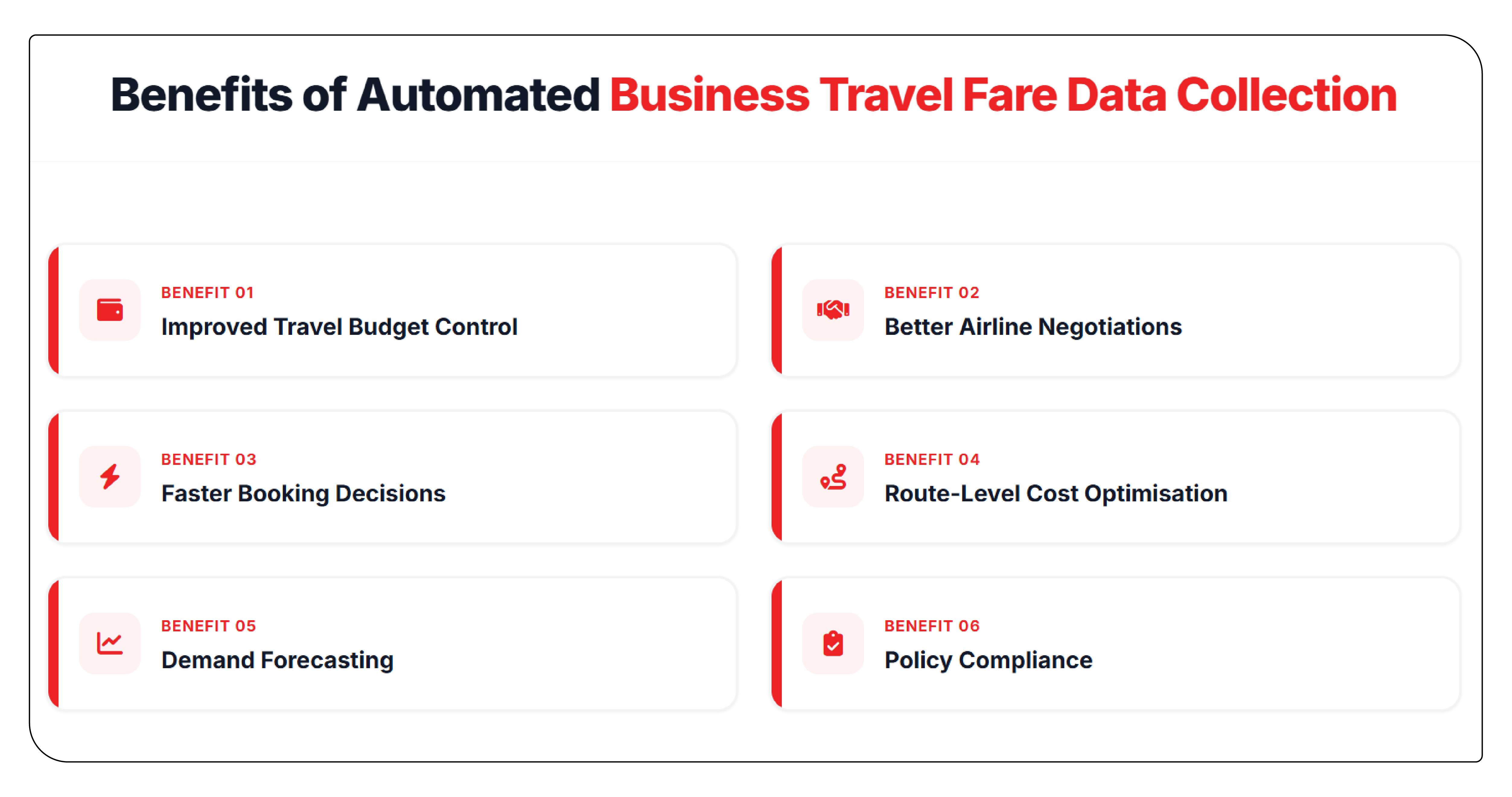
Automated airfare collection offers several advantages for businesses managing frequent employee travel across different European countries.
- Improved Travel Budget Control: Historical and current airfare information allows organisations to understand route-level expenditure and establish more realistic travel budgets.
- Better Airline Negotiations: Procurement departments can use competitor pricing and historical fare comparisons when negotiating corporate agreements with airlines.
- Faster Booking Decisions: Automated monitoring reduces dependence on repetitive manual searches and provides travel managers with organised pricing information.
- Route-Level Cost Optimisation: Businesses can compare alternative airports, airlines, departure schedules, and cabin classes to identify suitable travel options.
- Demand Forecasting: Historical fare movements and booking patterns can support estimates of future travel expenditure, especially during seasonal demand peaks.
- Policy Compliance: Corporate travel teams can compare booked fares against internal spending limits and preferred airline arrangements to identify potential policy deviations.
Data Integration, Dashboards, and Corporate Travel Applications
Collected airfare information becomes more valuable when integrated into business intelligence platforms and corporate travel applications.
Companies can develop dashboards displaying airline pricing movements, route comparisons, historical ticket costs, and booking patterns. These dashboards allow procurement managers to examine travel expenditure across departments, countries, and employee groups.
For example, a multinational organisation with offices in London, Paris, Frankfurt, and Amsterdam can consolidate airfare information into a single reporting environment. Managers can compare average ticket expenditure, identify frequently booked routes, and evaluate the performance of preferred airline agreements.
Data can be delivered through CSV, Excel, JSON, and API-ready formats depending on organisational requirements.
Automated integrations also allow companies to connect pricing information with enterprise resource planning systems, travel management platforms, financial reporting tools, and internal procurement applications.
Data quality remains essential. Duplicate records, inconsistent currencies, missing fare conditions, and differences in ticket inclusions must be addressed before analysis. Collection should also respect applicable website terms, privacy requirements, and access restrictions.
Future Opportunities in European Business Travel Pricing Intelligence
The future of corporate airfare analysis will increasingly involve artificial intelligence, predictive analytics, and automated data integration. Rather than simply comparing current ticket prices, organisations will be able to examine historical booking patterns and identify potential cost-saving opportunities.
Predictive models can use historical fares, seasonal demand, airline capacity indicators, and booking lead times to estimate future price movements. These insights can support travel planning and help businesses establish more informed purchasing strategies.
Another emerging opportunity is combining airfare intelligence with hotel rates, railway fares, airport transfers, and corporate travel expenses. This creates a more comprehensive understanding of the total cost of business trips.
For European organisations, multimodal comparisons can be particularly useful on routes where high-speed rail competes with short-haul flights. Companies can evaluate journey duration, ticket prices, flexibility, and employee convenience before selecting a travel option.
Automated data delivery will also become increasingly important as organisations require continuously updated information across multiple countries and travel platforms.
Conclusion
The growing complexity of corporate travel expenditure makes accurate airfare information essential for effective procurement, budgeting, and travel management. Automated fare collection enables organisations to compare airlines, monitor route-level pricing, analyse historical movements, and identify opportunities to optimise business travel spending.
Travel Data Intelligence helps businesses transform fragmented airline information into structured datasets and actionable market insights. With a reliable Europe business travel fare data API, organisations can integrate airline pricing information into dashboards, procurement systems, and corporate travel applications.
Furthermore, Airline Data Scraping supports continuous airfare observation, competitor benchmarking, booking analysis, and route-level pricing comparisons. By combining historical datasets, automated monitoring, and predictive analytics, businesses can build more transparent, cost-efficient, and data-driven corporate travel programmes across European markets.
Ready to elevate your travel business with cutting-edge data insights? Scrape Aggregated Flight Fares to identify competitive rates and optimize your revenue strategies efficiently. Discover emerging opportunities with tools to Extract Travel Website Data, leveraging comprehensive data to forecast market shifts and enhance your service offerings. Real-Time Travel App Data Scraping Services helps stay ahead of competitors, gaining instant insights into bookings, promotions, and customer behavior across multiple platforms. Get in touch with Travel Scrape today to explore how our end-to-end data solutions can uncover new revenue streams, enhance your offerings, and strengthen your competitive edge in the travel market.
Unlock the Full Report
Enter your details to access premium pricing intelligence insights