Cash and Miles Flight Pricing Intelligence Using Real-Time Flight Data for Travel Analytics
Introduction
Air travelers increasingly compare cash fares, award availability, mileage requirements, taxes, and redemption values before deciding how to book flights. This case study demonstrates how a travel technology client built a structured intelligence solution to monitor these changing variables across airlines, routes, dates, cabins, and loyalty programs. Using Cash and Miles Flight Pricing Intelligence, the project transformed fragmented flight information into standardized records suitable for comparison and analysis. The solution combined Airline Data Scraping with automated collection workflows to capture fare movements, award seats, mileage requirements, booking conditions, and itinerary details. A centralized Cash and Miles Flight Fare Comparison dataset enabled the client to examine cash-versus-miles value across markets and travel periods. The resulting data infrastructure supported pricing analysis, redemption research, competitive benchmarking, and route-level monitoring. By converting frequently changing flight information into structured datasets, the client gained a repeatable framework for identifying pricing movements, comparing redemption opportunities, and improving travel intelligence workflows.
The Client
The client was a travel technology and analytics company developing a data-driven platform for comparing airline fares and loyalty redemption opportunities. Its existing workflow depended on fragmented sources, manual checks, and inconsistent flight information, making large-scale comparison difficult. To strengthen its infrastructure, the company required a Real-Time Flight Data Scraping API capable of delivering structured information across multiple airline websites and booking environments. The project also required Real-Time Flight Award Availability Data extraction to identify mileage-based booking opportunities alongside conventional cash fares. The client wanted the collected information standardized by airline, route, departure date, cabin, fare type, currency, mileage requirement, taxes, and availability status. A continuously refreshed Global Flight Price Trends Dataset was introduced to support historical comparisons and market-level analysis. The resulting data framework was designed for dashboards, internal analytics, fare comparison tools, research teams, and downstream travel applications requiring timely flight intelligence.
Challenges in the Travel Industry
Changing fares, inconsistent airline interfaces, limited award transparency, and volatile travel demand created several data challenges. The client needed reliable collection, normalization, and monitoring processes capable of handling frequent changes without compromising analytical consistency.
Real-Time Fare Changes
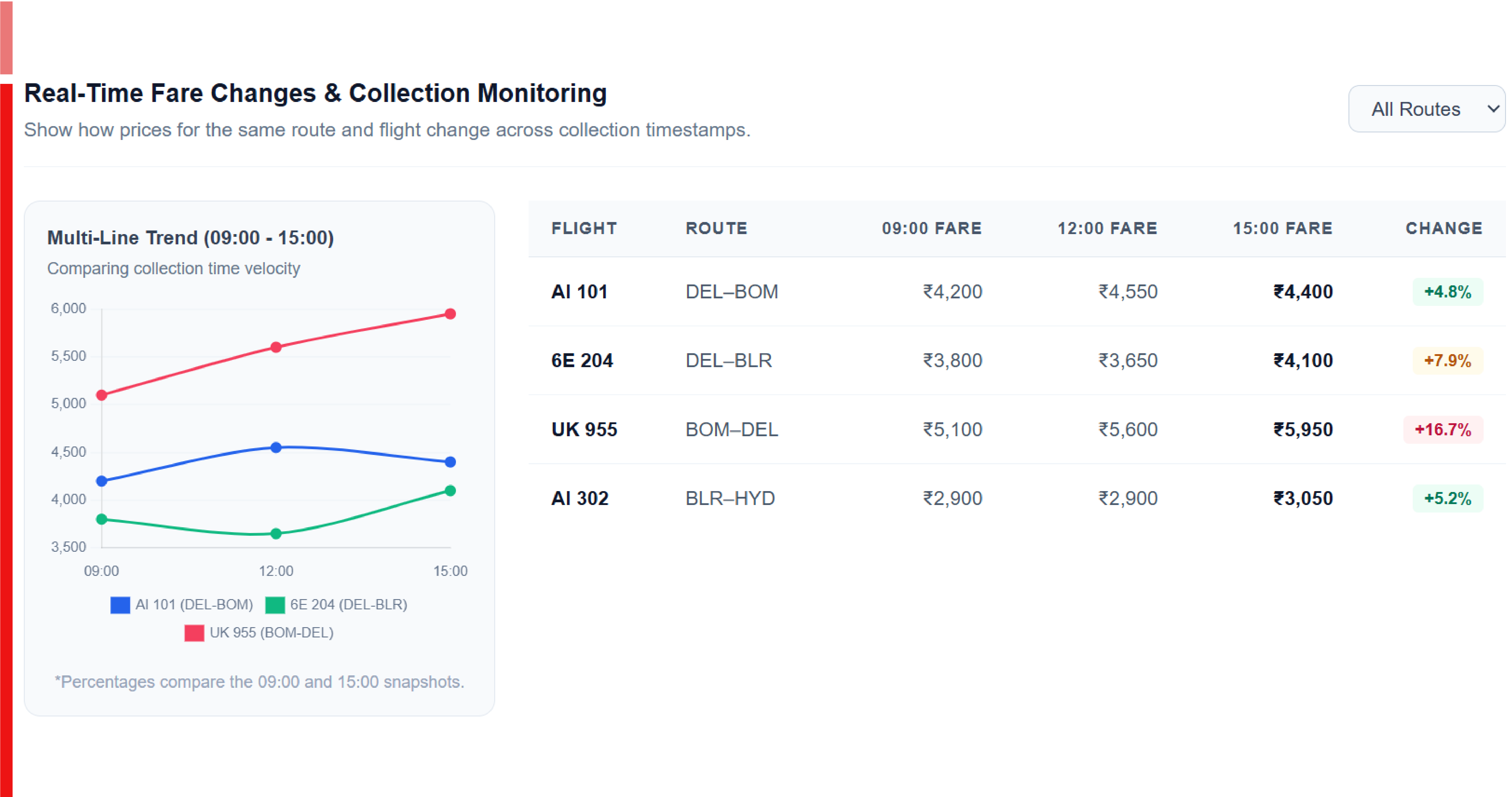
Real-Time Flight Fare Monitoring was challenging because airline prices could change repeatedly throughout the day. Different routes, departure dates, cabins, currencies, and fare classes created numerous combinations, requiring automated collection processes capable of identifying changes while maintaining consistent historical records.
Ticket Price Volatility
Real-Time Flight Ticket Price data tracking required continuous observation across multiple routes and booking windows. Fare changes could occur between collection cycles, while taxes, baggage conditions, currencies, and promotional pricing created additional variables that complicated direct comparisons between previously captured and current flight records.
Fragmented Pricing Information
Flight Price Data Intelligence was difficult to establish because relevant information appeared across airline websites, booking interfaces, fare displays, and loyalty systems. Different naming conventions and formats made normalization necessary before the client could perform reliable route, airline, cabin, currency, and pricing comparisons.
Award Redemption Complexity
Cash and Miles Flight Booking Intelligence required more than collecting mileage amounts. The client needed to connect award requirements with cash-equivalent fares, taxes, cabin classes, routes, dates, and seat availability. Missing or inconsistent award information could significantly affect comparisons and redemption-value calculations.
Demand and Seasonality
Seasonal Trend Analysis was complicated by changing travel demand around holidays, weekends, school vacations, business periods, and major events. The client needed historical observations across different booking windows to distinguish normal price movements from recurring seasonal patterns and exceptional fare changes.
Our Approach
Multi-Source Flight Collection
We developed automated collection workflows covering airline and travel booking sources relevant to the client's target markets. Flight records were captured using consistent fields, including airline, origin, destination, departure date, cabin, fare, currency, taxes, baggage conditions, mileage requirements, and availability.
Fare and Award Standardization
Collected records were normalized into common schemas so cash fares and award options could be analyzed together. Duplicate itineraries, inconsistent airline naming, varying currency formats, and differing fare descriptions were standardized, creating comparable records across routes, booking dates, cabins, and travel periods.
Continuous Data Refresh
The solution incorporated scheduled data collection to capture changing prices and availability. New observations were compared against previously collected records to identify fare movements, availability changes, and mileage fluctuations. This created a historical trail that supported monitoring and trend analysis.
Comparison-Ready Dataset Development
We structured the collected information into datasets designed for analytics and reporting. Records could be filtered by airline, route, travel date, cabin, cash fare, mileage requirement, taxes, availability, and booking window, enabling the client to conduct detailed cash-versus-award comparisons.
Quality Validation
Validation routines checked missing fields, duplicate records, invalid values, inconsistent currencies, and unexpected changes in source structures. Data quality checks helped maintain reliable outputs while supporting downstream dashboards, analytical models, pricing research, and travel intelligence applications requiring regularly refreshed flight information.
Results Achieved
The implementation converted fragmented flight information into a structured intelligence environment, improving the client's ability to monitor fares, compare redemption options, and analyze market movements.
Expanded Flight Coverage
The solution consolidated thousands of flight observations across airlines, routes, cabins, and booking periods, creating a broader analytical foundation for fare and award comparison.
Faster Pricing Monitoring
Automated refresh cycles reduced dependence on manual checks and enabled the client to identify changes in flight prices and award availability more systematically.
Improved Cash-to-Miles Comparisons
Standardized fields allowed analysts to compare cash prices, mileage requirements, taxes, cabins, and availability within a common analytical structure.
Stronger Historical Analysis
Historical records provided a foundation for evaluating fare movements across booking windows, travel periods, routes, and seasonal demand patterns.
Better Decision Support
Structured datasets supported dashboards, research workflows, route analysis, loyalty-program evaluation, and other applications requiring regularly updated airline pricing intelligence.
Results Snapshot
| Metric | Before Implementation | After Implementation | Change / Coverage |
|---|---|---|---|
| Airlines Monitored | 12 | 48 | 300% increase |
| Routes Covered | 850 | 4,200 | 394% increase |
| Daily Flight Records | 18,500 | 96,000 | 419% increase |
| Monthly Flight Records | 555,000 | 2,880,000 | 419% increase |
| Award Availability Records | 42,000 | 218,000 | 419% increase |
| Cabin Classes Tracked | 3 | 5 | 67% increase |
| Fare Attributes Captured | 8 | 17 | 113% increase |
| Historical Price Fields | 6 | 14 | 133% increase |
| Currency Coverage | 7 | 21 | 200% increase |
| Data Refresh Frequency | 24 Hours | 2 Hours | 12× more frequent |
| Duplicate Record Rate | 8.4% | 1.7% | 79.8% reduction |
| Missing Critical Fields | 6.8% | 1.9% | 72.1% reduction |
| Data Validation Accuracy | 91.6% | 98.3% | 6.7 percentage points |
| Monthly Route Comparisons | 3,200 | 18,600 | 481% increase |
| Average Processing Time | 7.5 Hours | 1.8 Hours | 76% reduction |
Client's Testimonial
"The flight intelligence solution gave our team a much more structured way to understand airline pricing and award availability. Previously, our analysts spent considerable time collecting information manually and reconciling different formats. The standardized datasets have made route-level comparisons significantly easier and have strengthened our internal reporting workflows. We can now review cash fares, mileage requirements, taxes, cabins, and availability through consistent fields and refresh cycles. The historical data has also helped our team examine price movements across different booking windows and travel periods. The solution has become an important data layer for our travel analytics platform and has reduced repetitive collection work across our research operations."
Conclusion
The case study demonstrates how structured airline data collection can support sophisticated fare, award, and travel-market analysis. By combining automated data acquisition, normalization, validation, and scheduled refreshes, the client established a scalable foundation for monitoring changing flight information. The resulting datasets connected cash fares with mileage requirements, availability, taxes, cabins, routes, and travel dates, enabling consistent comparisons across multiple market conditions. Organizations can use Travel Aggregators Data Scraping Services to consolidate information from diverse travel sources and develop structured datasets for analytics. Businesses can also Scrape Travel Website Data to support historical fare monitoring, route benchmarking, and competitive research. Similarly, the ability to Scrape Travel Mobile App information can extend coverage to mobile-first booking environments and application-based travel services. Together, these capabilities provide a practical framework for building continuously refreshed flight intelligence systems that support pricing analysis, loyalty research, market monitoring, and data-driven travel technology products.
FAQs
Unlock the Full Report
Enter your details to access premium pricing intelligence insights