
Scraping Car Rental Script Buyers Guide 2026: Content & Dataset Readiness Checklist for New Marketplace Launches
Introduction
The car-rental industry is becoming increasingly data-driven as travelers compare vehicle prices, rental conditions, availability, locations, insurance, mileage policies, and optional extras across multiple digital channels. For companies building comparison platforms, travel marketplaces, fleet intelligence products, or pricing dashboards, the quality of the underlying data can determine whether the product delivers useful intelligence or simply reproduces fragmented listings.
A Scraping Car Rental Script Buyers Guide 2026 therefore needs to evaluate much more than whether a script can collect vehicle names and prices. Buyers need to assess coverage, extraction frequency, structured fields, historical storage, scalability, anti-bot resilience, geographic coverage, API delivery, and data validation.
Car Rental Data Scraping can capture information from rental companies, aggregators, marketplaces, airport locations, local operators, and other publicly accessible digital sources. However, the most valuable systems transform raw listings into standardized records that can be compared over time.
A car rental data API can then make those structured records available to dashboards, mobile applications, pricing engines, analytics platforms, and marketplace applications. Modern rental APIs demonstrate how complex the underlying data model has become: current implementations can include pricing, availability, suppliers, depots, vehicle details, optional products, insurance, and payment information.
The buyer's challenge is consequently not simply choosing a scraper. It is choosing a complete data acquisition and intelligence architecture.
What Should a Car Rental Scraping Script Actually Collect?
A basic script might extract vehicle name, daily price, and location. That is insufficient for serious commercial intelligence.
A production-grade system should ideally capture:
- Rental company and supplier
- Vehicle make and model
- Vehicle category
- Transmission
- Fuel type
- Passenger capacity
- Baggage capacity
- Pickup and drop-off locations
- Rental dates
- Rental duration
- Base price
- Total price
- Taxes and fees
- Deposit
- Insurance
- Mileage allowance
- Cancellation policy
- One-way charges
- Additional-driver charges
- Child-seat and GPS costs
- Availability status
- Booking timestamp
- Currency
- Source URL
- Data-refresh timestamp
This distinction matters because the displayed daily rate may not represent the final amount paid. Current car-rental API documentation, for example, separates base price, total price, additional charges, optional products, payment timing, and insurance information.
Buyer Requirements for a Scraping Solution
A buyer should evaluate a scraping script across six major dimensions.
Coverage
Does it support the required countries, cities, airports, suppliers, vehicle categories, and rental locations?
Coverage should be measured quantitatively rather than described simply as "global."
Extraction Depth
Can the system collect only search-result prices, or can it retrieve detailed availability, policies, fees, optional products, and booking conditions?
Refresh Frequency
Rental pricing can change as demand, fleet availability, dates, and booking windows change. A weekly dataset may be adequate for historical research but inadequate for live pricing intelligence.
Data Quality
The system should normalize currencies, vehicle categories, supplier names, locations, dates, and price components.
Scalability
A script designed for 500 daily records may behave very differently when asked to process hundreds of thousands of offers across thousands of locations.
Delivery
Buyers should consider CSV, JSON, database storage, cloud delivery, dashboards, and APIs. The right output depends on whether the buyer needs research datasets or operational intelligence.
Illustrative Car Rental Dataset Benchmark
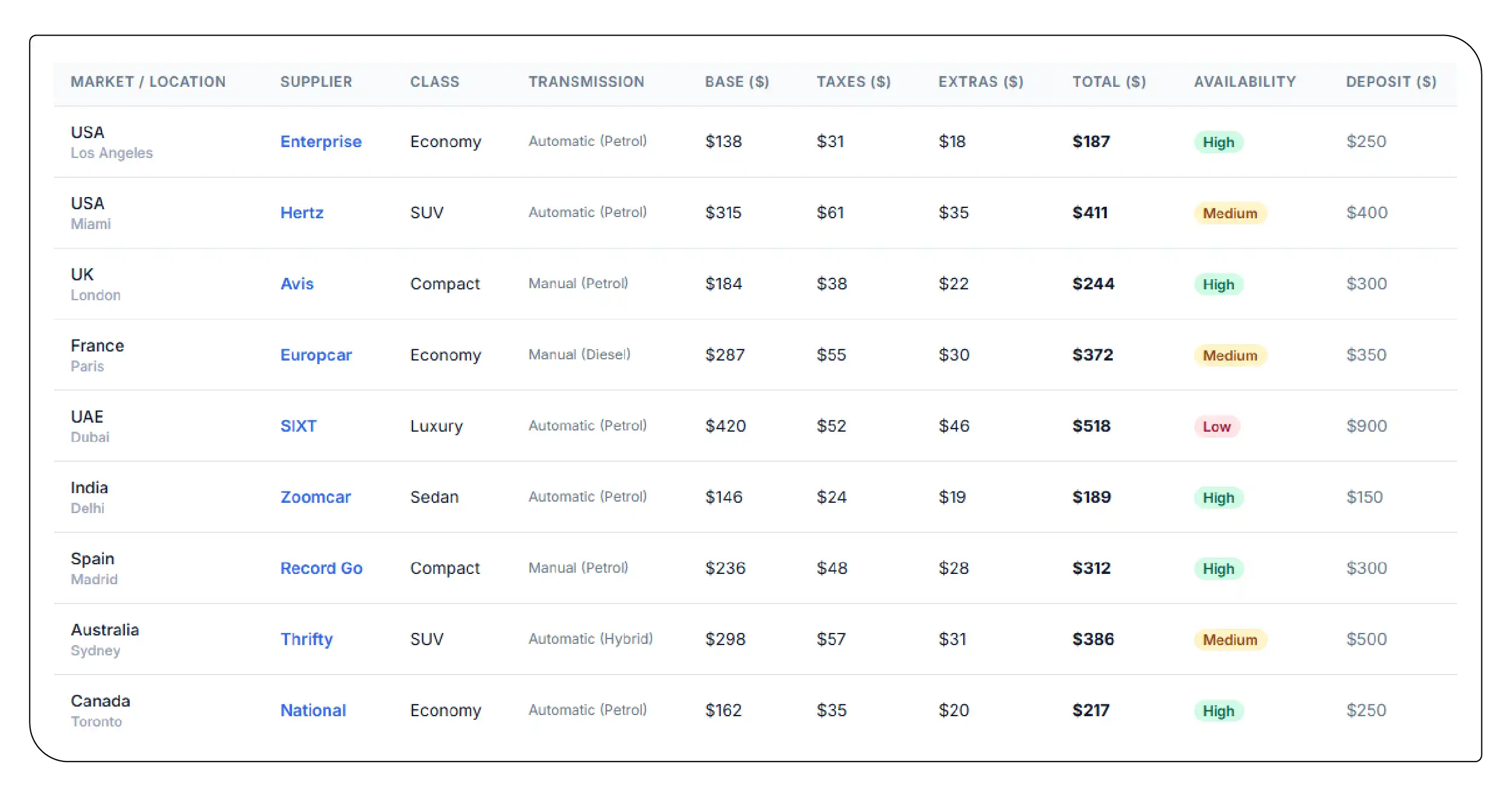
The following table represents an illustrative buyer-side benchmark dataset, not live market observations. It demonstrates the breadth of fields a commercial scraping project can capture.
| Market | Location | Supplier | Vehicle Class | Transmission | Fuel | Rental Days | Base Price ($) | Taxes ($) | Extras ($) | Total ($) | Availability | Deposit ($) | Mileage (km) | Lead Time (Days) |
|---|---|---|---|---|---|---|---|---|---|---|---|---|---|---|
| USA | Los Angeles | Enterprise | Economy | Automatic | Petrol | 3 | 138 | 31 | 18 | 187 | High | 250 | 600 | 14 |
| USA | Miami | Hertz | SUV | Automatic | Petrol | 5 | 315 | 61 | 35 | 411 | Medium | 400 | 1,000 | 21 |
| UK | London | Avis | Compact | Manual | Petrol | 4 | 184 | 38 | 22 | 244 | High | 300 | 800 | 10 |
| France | Paris | Europcar | Economy | Manual | Diesel | 7 | 287 | 55 | 30 | 372 | Medium | 350 | 1,400 | 18 |
| UAE | Dubai | SIXT | Luxury | Automatic | Petrol | 3 | 420 | 52 | 46 | 518 | Low | 900 | 600 | 12 |
| India | Delhi | Zoomcar | Sedan | Automatic | Petrol | 4 | 146 | 24 | 19 | 189 | High | 150 | 700 | 9 |
| India | Mumbai | MyChoize | SUV | Automatic | Diesel | 5 | 225 | 38 | 25 | 288 | Medium | 250 | 900 | 16 |
| Spain | Madrid | Record Go | Compact | Manual | Petrol | 6 | 236 | 48 | 28 | 312 | High | 300 | 1,200 | 25 |
| Australia | Sydney | Thrifty | SUV | Automatic | Hybrid | 4 | 298 | 57 | 31 | 386 | Medium | 500 | 800 | 20 |
| Canada | Toronto | National | Economy | Automatic | Petrol | 3 | 162 | 35 | 20 | 217 | High | 250 | 600 | 15 |
The key lesson is that price alone does not constitute useful rental intelligence. Two offers with identical daily rates can have materially different total costs because of insurance, taxes, deposits, mileage limits, one-way fees, or optional products.
Building a Car Rental Price Intelligence Layer
A sophisticated solution should preserve both raw and normalized values.
For example:
raw_price = $89
could become:
base_rate = $89
taxes = $14
insurance = $12
optional_extras = $8
total_price = $123
This structure makes historical analysis significantly more useful.
A Car Rental Price Trends Dataset should also contain timestamps. Without timestamps, a buyer cannot distinguish between a temporary promotion, seasonal demand spike, or sustained price movement.
The dataset should ideally support:
- Daily price observations
- Weekly averages
- Monthly medians
- Price volatility
- Minimum and maximum rates
- Supplier-level differences
- Vehicle-class differences
- Airport versus city-center prices
- Booking-window analysis
- Seasonal movements
What Does "Scrape Booking Data" Mean?
When buyers ask vendors to Scrape car rental booking data, they should clarify exactly what "booking data" means.
Publicly accessible search and offer information is different from private customer reservation information.
A legitimate commercial project can focus on publicly available rental offers, availability indicators, prices, vehicle specifications, policies, locations, and other permitted information. It should not assume access to private customer records.
The distinction is important because the goal of competitive intelligence is generally to understand the marketplace rather than collect personally identifiable reservation information.
Real-Time Architecture and API Requirements
A Real-Time Car Rental Data Scraping API should be evaluated according to latency, refresh frequency, source coverage, failure recovery, and delivery architecture.
A useful pipeline can follow this structure:
Source Discovery → Scraping → Validation → Normalization → Deduplication → Historical Storage → API → Dashboard
Real-time does not necessarily mean that every source is queried every second. A more practical architecture uses different refresh frequencies according to data volatility.
For example:
- Price: 5–30 minutes
- Availability: 5–15 minutes
- Vehicle specifications: daily
- Depot information: daily or weekly
- Static policies: daily or on change
- Historical analytics: continuous storage
Current industry APIs illustrate why this layered approach is useful. Skyscanner distinguishes cached indicative prices from live pricing, with indicative data designed for broader comparisons and live pricing intended when exact prices or bookable itineraries are required.
Inventory Management Should Be Part of the Dataset
A car rental inventory management dataset should go beyond "available/unavailable."
Useful fields include fleet category, units available, pickup location, return location, utilization indicator, rental period, supplier, vehicle age where available, and timestamp.
This enables businesses to identify inventory shortages before they become obvious through price changes.
For example, an analytical system could observe:
Availability ↓ → Price ↑ → Competitor spread ↑ → Booking pressure ↑
That sequence can become a useful signal for revenue-management teams.
Car Rental Marketplace Analysis
A strong car rental marketplace analysis combines pricing, supply, geography, demand signals, and vehicle categories.
Buyers should be able to answer questions such as:
- Which suppliers are consistently price competitive?
- Which vehicle categories experience the greatest price volatility?
- Which locations have recurring inventory shortages?
- How does airport pricing compare with downtown pricing?
- How far in advance do prices typically change?
- Which suppliers provide the broadest inventory?
- How often do offers disappear between searches?
- Which markets show the strongest seasonal movements?
Market research also indicates that digital booking is becoming increasingly important. Mordor Intelligence reports that online channels represented 54.12% of the global car-rental market in 2025 and forecasts online platforms to grow at a 10.42% CAGR through 2031. Its India analysis puts online channels at 66.85% of the Indian market in 2025.
Illustrative Rental Pricing Intelligence Dataset
The second benchmark table shows how a buyer can transform raw observations into analytical indicators. These figures are illustrative rather than reported market measurements.
| Month | Market | Economy Avg ($/Day) | Compact Avg ($/Day) | SUV Avg ($/Day) | Luxury Avg ($/Day) | Avg Availability % | Median Lead Time | Price Volatility % | Avg Discount % | Airport Premium % | Supplier Count |
|---|---|---|---|---|---|---|---|---|---|---|---|
| Jan | New York | 61 | 68 | 96 | 168 | 72 | 18 | 12.4 | 7.5 | 16.2 | 14 |
| Feb | New York | 58 | 65 | 92 | 161 | 76 | 21 | 10.8 | 8.1 | 15.4 | 14 |
| Mar | New York | 64 | 71 | 101 | 174 | 69 | 17 | 14.6 | 6.8 | 17.1 | 15 |
| Apr | London | 52 | 59 | 87 | 149 | 74 | 24 | 11.2 | 9.2 | 13.6 | 18 |
| May | London | 57 | 63 | 93 | 157 | 68 | 28 | 15.3 | 8.4 | 14.8 | 18 |
| Jun | London | 65 | 72 | 106 | 181 | 61 | 31 | 18.7 | 6.1 | 17.5 | 19 |
| Jul | Dubai | 55 | 62 | 91 | 165 | 79 | 19 | 9.8 | 11.4 | 8.7 | 12 |
| Aug | Dubai | 59 | 66 | 97 | 173 | 75 | 22 | 12.6 | 10.1 | 9.4 | 12 |
| Sep | Delhi | 31 | 35 | 51 | 91 | 81 | 14 | 8.9 | 12.7 | 6.3 | 16 |
| Oct | Delhi | 34 | 38 | 55 | 96 | 77 | 17 | 11.4 | 10.9 | 7.1 | 16 |
| Nov | Sydney | 48 | 55 | 79 | 139 | 70 | 26 | 16.2 | 8.7 | 12.9 | 13 |
| Dec | Sydney | 62 | 70 | 98 | 171 | 58 | 35 | 21.8 | 5.4 | 18.6 | 14 |
Car Rental Data Intelligence enables analysts to calculate pricing gaps, supplier competitiveness, seasonal volatility, inventory pressure, and booking-window behavior.
What Buyers Should Ask Before Purchasing a Scraping Script
Before selecting a vendor or technology stack, buyers should ask:
Does it support dynamic websites?
Many modern rental platforms use JavaScript-heavy interfaces and dynamically generated search results. Static HTML extraction may therefore produce incomplete datasets.
Can it handle geographic searches?
Location-based pricing requires airport codes, city coordinates, depot IDs, postal regions, and standardized geographic identifiers.
Can it detect price components?
A system that captures only headline prices can materially distort competitive analysis.
Does it maintain historical records?
Historical snapshots are essential for pricing trends and seasonal analysis.
Does it provide monitoring?
Buyers should be able to receive alerts when prices, availability, inventory, or policies change.
Can it scale?
The architecture should support additional markets, suppliers, vehicle categories, and search combinations without requiring a complete rebuild.
Does it provide structured output?
JSON, CSV, database tables, and API endpoints should be available according to the intended use case.
Evaluating a Rental Car Pricing Dataset
A rental car pricing dataset should be judged on completeness, freshness, consistency, geographic breadth, and historical depth.
A high-quality dataset should allow users to compare:
Supplier → Location → Vehicle → Dates → Price → Fees → Availability → Policy → Timestamp
rather than simply:
Supplier → Price
The difference determines whether the dataset can support serious business intelligence.
Current car-rental API architectures reinforce this principle. Booking.com's current documentation provides separate search, availability, supplier, depot, detail, and booking-related functions, while its latest pricing guidance emphasizes validating selected offers because pricing can evolve during the booking process.
Rental Car Availability Monitoring
A dedicated rental car availability monitoring system can help identify changes in fleet supply before they become visible through aggregate market statistics.
Monitoring can trigger alerts for:
- Vehicle disappearing from search
- Inventory falling below threshold
- Sudden price increase
- New supplier entering a market
- Promotional discount appearing
- Airport inventory tightening
- Weekend availability decline
- Long-weekend demand pressure
- Vehicle-class shortages
This makes scraping operational rather than merely analytical.
Cost, Scalability and ROI Considerations
The cheapest scraping script is not necessarily the lowest-cost solution.
A buyer should calculate total ownership cost across:
Infrastructure + Proxy/Access Costs + Maintenance + Data Storage + Monitoring + Engineering + API Delivery + Quality Control
A one-time scraper may be adequate for a research project. A marketplace, price-comparison platform, or revenue-management product generally needs continuous extraction and maintenance.
The best architecture is therefore determined by the required freshness and analytical use case—not simply by the initial script price.
Key Buyer Checklist
Define the exact rental fields required.
Prioritize sources according to business relevance.
Separate live pricing from indicative or cached pricing.
Capture timestamps with every observation.
Normalize currencies, suppliers, locations, and vehicle classes.
Preserve historical snapshots.
Monitor availability alongside pricing.
Build validation and deduplication into the pipeline.
Select API, database, CSV, or JSON delivery based on the use case.
Evaluate scalability and maintenance—not just initial scraping cost.
A well-designed 2026 scraping architecture should ultimately provide fresh, structured, comparable, historical, and actionable car-rental intelligence rather than a collection of disconnected prices.
Conclusion
The 2026 car-rental data environment requires buyers to think beyond simple web extraction. A commercially useful scraping solution should combine structured collection, price normalization, inventory monitoring, historical storage, geographic coverage, quality control, and API-based delivery.
The strongest buyer evaluation process begins by defining the business questions, then identifying the required fields, refresh intervals, sources, historical depth, and delivery format. Current rental-data architectures show that pricing, availability, optional products, insurance, payment timing, supplier information, and depot details can all become relevant components of a modern rental intelligence system.
For organizations building comparison engines, travel marketplaces, fleet dashboards, pricing systems, or competitive intelligence platforms, Seasonal Trend Analysis becomes particularly valuable when current observations are preserved as consistent historical snapshots. With the right architecture, car-rental scraping can evolve from a simple extraction task into a continuous intelligence layer supporting pricing decisions, inventory analysis, market research, and digital travel products.
Ready to elevate your travel business with cutting-edge data insights? Scrape Aggregated Flight Fares to identify competitive rates and optimize your revenue strategies efficiently. Discover emerging opportunities with tools to Extract Travel Website Data, leveraging comprehensive data to forecast market shifts and enhance your service offerings. Real-Time Travel App Data Scraping Services helps stay ahead of competitors, gaining instant insights into bookings, promotions, and customer behavior across multiple platforms. Get in touch with Travel Scrape today to explore how our end-to-end data solutions can uncover new revenue streams, enhance your offerings, and strengthen your competitive edge in the travel market.
Unlock the Full Report
Enter your details to access premium pricing intelligence insights