
Scrape Mauritius Hotel Rates Market Data Report 2026/27 for Indian Ocean Resort Pricing Intelligence
Introduction
Mauritius has established itself as one of the Indian Ocean's leading hospitality destinations, attracting international tourists through luxury beachfront resorts, boutique hotels, family-friendly properties, honeymoon packages, golf resorts, and premium all-inclusive experiences. Its hotel market is supported by European leisure travelers, visitors from India, regional African tourism, and growing demand for high-value international holidays. As competition increases, understanding accommodation prices, room availability, seasonal fluctuations, and competitor positioning has become essential for hotel operators, travel companies, investors, and hospitality intelligence providers.
The method to Scrape Mauritius Hotel Rates Market Data Report 2026/27 examines accommodation pricing, hotel performance, regional demand, and seasonal booking patterns to identify opportunities across the island's hospitality sector. Through structured Hotel Data Scraping, businesses can collect information from online travel agencies, hotel websites, resort booking portals, and accommodation marketplaces.
These datasets provide valuable Mauritius Hotel Pricing Trends insights, helping businesses understand how room categories, travel seasons, booking periods, and property positioning influence nightly accommodation costs.
The report combines published hotel performance statistics with observed online accommodation price benchmarks. It also evaluates how Real-Time Price Intelligence can support competitive benchmarking, revenue management, and hotel distribution strategies.
For 2026/27, the Mauritius Hotel Market Analysis 2026/27 focuses on the relationship between tourism demand, available accommodation inventory, average daily rates, and regional pricing differences. The analysis distinguishes historical market indicators from forward-looking commercial expectations.
The growing importance of a Real-Time Hotel Data Scraping API also enables hospitality businesses to automate competitor monitoring, identify pricing movements, and consolidate information across multiple booking channels.
Mauritius Hotel Market Overview 2026/27
Mauritius operates a diverse hospitality ecosystem covering luxury resorts, upscale international hotels, mid-market accommodation, boutique properties, guesthouses, and independent hotels. Its competitive positioning is supported by beachfront locations, tropical experiences, international hotel brands, and established tourism infrastructure.
According to Statistics Mauritius, at the end of June 2026, the island had 111 licensed hotels. Of these, 106 were operational, providing 13,477 rooms and 30,179 bed places. The operational hotel segment recorded 69% average room occupancy during the first half of 2026, compared with 70% during the corresponding period of 2025.
The Indian Ocean hospitality market also benefits from Mauritius's diversified tourism demand. Its hotel sector serves different customer groups, including honeymoon couples, families, luxury travelers, corporate visitors, and long-stay international tourists.
The following indicators provide a foundation for Indian Ocean Resort Pricing Intelligence and competitive market evaluation.
| Market Indicator | Reported Value | Reference Period |
|---|---|---|
| Licensed hotels | 111 | June 2026 |
| Operational hotels | 106 | June 2026 |
| Operational hotel rooms | 13,477 | June 2026 |
| Available bed places | 30,179 | June 2026 |
| Large operational hotels | 59 | June 2026 |
| Rooms in large hotels | 10,809 | June 2026 |
| Average room occupancy | 69% | H1 2026 |
| Average room occupancy | 70% | H1 2025 |
| Bed occupancy | 62% | H1 2026 |
| Bed occupancy | 63% | H1 2025 |
| Tourist nights | 7,815,264 | H1 2026 |
| Tourist nights | 7,680,872 | H1 2025 |
| Average tourist stay | 11.2 nights | H1 2026 |
| Average tourist stay | 11.3 nights | H1 2025 |
Source: Statistics Mauritius, Economic Indicators – Tourism, First Semester 2026.
The figures indicate that Mauritius maintains substantial accommodation capacity and relatively strong hotel utilization. However, slightly lower occupancy in the first half of 2026 highlights why operators need to evaluate room prices alongside booking demand rather than relying exclusively on occupancy.
Mauritius Hotel Pricing Trends and Average Daily Rates
Average Daily Rate (ADR) is one of the most important performance indicators for understanding hotel pricing. It measures the average revenue earned from occupied rooms and helps operators evaluate pricing performance across accommodation categories.
Published 2025 hotel performance figures indicate that Mauritius maintained considerable differences between three-star, four-star, and five-star accommodation.
| Hotel Category | Average Daily Rate (MUR) | Approx. INR Equivalent* | Market Position | Pricing Characteristics |
|---|---|---|---|---|
| Three-star | 7,319 | 13,174 | Mid-market | Value-oriented accommodation |
| Four-star | 8,340 | 15,012 | Upper-midscale | Premium facilities and leisure services |
| Five-star | 20,167 | 36,301 | Luxury | Premium beachfront and resort experiences |
| Five-star vs three-star | 12,848 difference | 23,127 difference | Luxury premium | Approximately 175.5% higher |
| Four-star vs three-star | 1,021 difference | 1,838 difference | Upscale premium | Approximately 14% higher |
| Five-star vs four-star | 11,827 difference | 21,289 difference | Luxury premium | Approximately 141.8% higher |
Source: Published 2025 hotel performance figures reported by BIZWEEK. INR conversions are illustrative, using an assumed exchange rate of MUR 1.80 per INR.
These are reported 2025 ADR benchmarks, not guaranteed 2026/27 booking prices.
The figures demonstrate the considerable pricing gap between luxury and mid-market accommodation. Five-star hotels command significantly higher rates because of their positioning, premium facilities, beachfront locations, personalized services, and high-value guest experiences.
For hospitality businesses, a structured Hotel Room Price Trends Dataset can reveal how these pricing differences evolve across properties, room types, and booking channels.
Another important metric is Revenue Per Available Room (RevPAR), calculated by multiplying ADR by occupancy or dividing room revenue by available rooms. It helps businesses understand whether higher prices are translating into stronger room revenue.
Mauritius's reported 2025 performance showed improvements in RevPAR across three-star, four-star, and five-star categories, with three-star properties recording particularly strong growth.
Monthly Hotel Pricing and Seasonal Demand Analysis
Seasonality plays a significant role in Mauritius's hotel pricing structure. International travel calendars, European winter holidays, school vacations, weather conditions, and honeymoon demand influence room rates throughout the year.
Online travel pricing observations published by Expedia provide an indication of monthly accommodation price differences. The following table presents observed monthly average nightly prices for two adults, excluding taxes and fees.
| Month | Average Nightly Price (INR) | Seasonal Classification | Pricing Observation |
|---|---|---|---|
| January | 26,308 | Peak | Strong holiday demand |
| February | 28,487 | Peak | Premium leisure pricing |
| March | 28,495 | Peak | High observed rates |
| April | 25,331 | Shoulder | Moderate pricing |
| May | 22,752 | Shoulder | Relatively affordable |
| June | 15,671 | Low | Lowest observed monthly price |
| July | 17,867 | Low | Competitive winter pricing |
| August | 17,270 | Low | Lower accommodation costs |
| September | 18,821 | Shoulder | Gradual demand recovery |
| October | 23,770 | Shoulder | Increasing travel demand |
| November | 27,333 | Peak | Stronger resort pricing |
| December | 24,697 | Peak | Holiday and festive demand |
| Annual monthly average | 23,400 | Mixed | Calculated average |
Source: Expedia Mauritius hotel price trends. These are observed search-based averages, not official industry ADR statistics or guaranteed future prices.
The pricing observations reveal several important market patterns:
- January to March: Higher observed prices reflect international leisure demand and holiday travel.
- April to May: Prices moderate as holiday demand changes.
- June to August: Lower accommodation prices create opportunities for value-conscious travelers.
- September to October: Prices begin strengthening as travel activity increases.
- November to December: International holidays and resort demand support higher pricing.
Interestingly, June recorded an average observed nightly price of INR 15,671, approximately 45% below March's INR 28,495 benchmark.
These differences demonstrate the commercial importance of Mauritius Seasonal Hotel Price Monitoring. Hotel operators can use historical and current pricing information to identify periods when discounts are necessary and when stronger rates can be maintained.
The monthly figures should be treated as a reference snapshot because booking platforms continuously change their displayed prices according to travel dates, room availability, guest numbers, and booking conditions.
Regional Hotel Pricing and Resort Competition
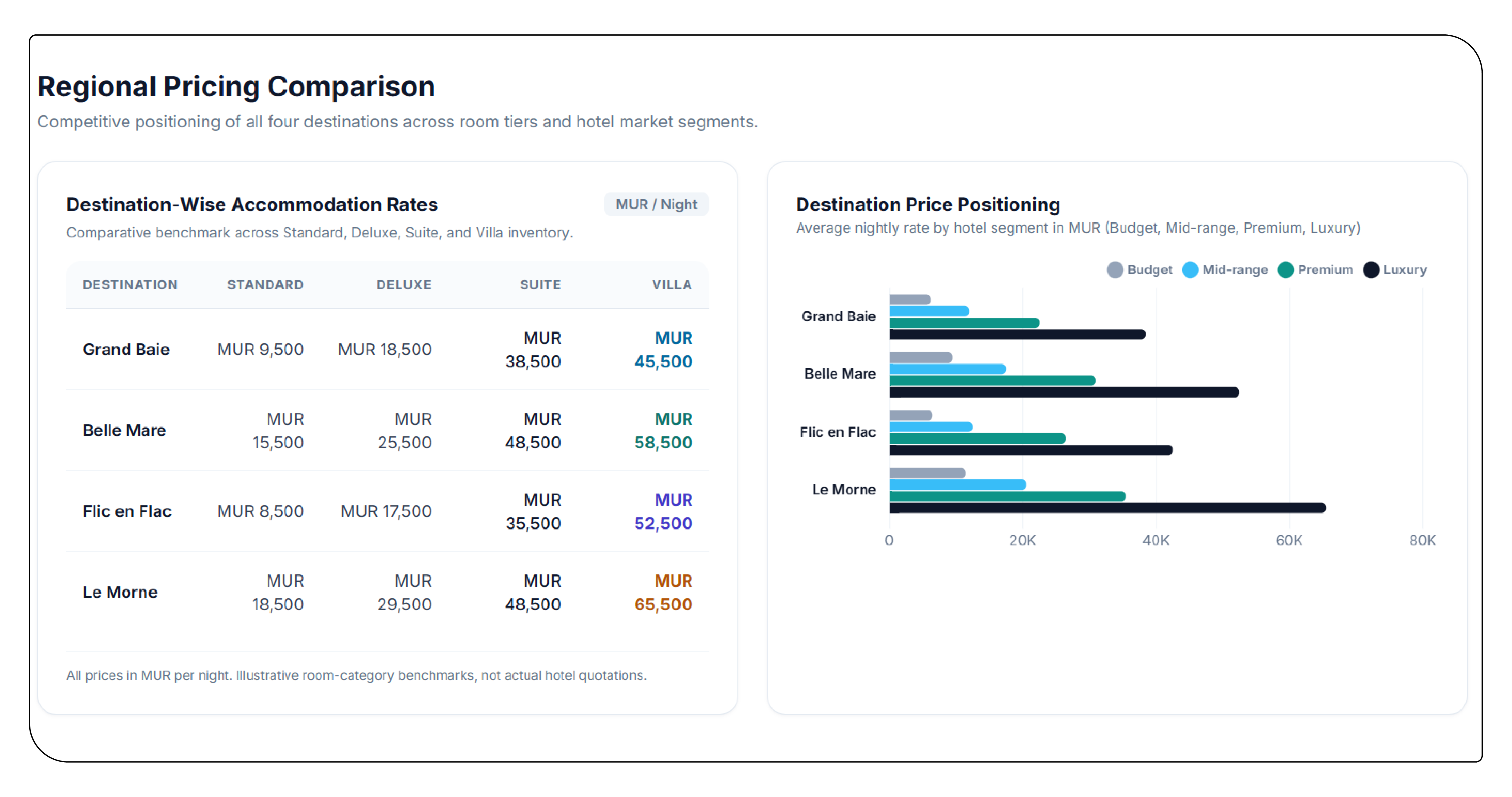
Mauritius has several established hospitality destinations, each offering different accommodation experiences and competitive pricing opportunities.
Grand Baie
Grand Baie is a prominent northern tourism destination, known for beaches, restaurants, nightlife, shopping, and boutique accommodation. Its hotel market attracts couples, families, and independent international travelers.
Pricing intelligence in this region should examine beachfront access, hotel facilities, room categories, breakfast inclusions, and proximity to entertainment areas.
Belle Mare
Belle Mare is associated with premium beachfront resorts, luxury accommodation, and upscale leisure experiences. Large resorts compete through all-inclusive packages, private beach access, spa facilities, golf, and premium dining.
Room pricing comparisons should distinguish standard rooms, suites, villas, and ocean-view accommodation.
Flic en Flac
Flic en Flac has a diverse accommodation landscape combining luxury resorts, family hotels, and mid-market properties. Its western coastal location makes it an important destination for beach tourism and sunset experiences.
Monitoring hotel rates here can help identify differences between premium resorts and comparatively affordable accommodation.
Le Morne
Le Morne is positioned around premium resort experiences, natural attractions, water sports, and luxury leisure tourism. Properties in this area can differentiate their pricing through exclusive locations, premium room categories, and personalized services.
Hotel Pricing Intelligence Requirements for 2026/27
Hospitality businesses need detailed datasets rather than isolated room-price observations. A comprehensive competitive intelligence framework should capture multiple attributes from hotel websites and online booking platforms.
| Data Category | Information Collected | Measurement | Business Application |
|---|---|---|---|
| Hotel identification | Hotel name, brand, address | Property count | Competitor mapping |
| Location | Region, city, coordinates | Geographic coverage | Regional benchmarking |
| Room categories | Standard, deluxe, suite, villa | Room types | Product comparison |
| Nightly pricing | Displayed room price | MUR, INR, USD | Rate benchmarking |
| Discount information | Original and discounted prices | Percentage | Promotional analysis |
| Occupancy signals | Availability and sold-out indicators | Available/unavailable | Demand assessment |
| Meal plans | Room-only, breakfast, half-board | Package type | Price normalization |
| Booking conditions | Refundable, non-refundable | Policy category | Offer comparison |
| Guest ratings | Review scores and counts | Rating and volume | Quality benchmarking |
| Stay duration | Check-in and check-out dates | Number of nights | Seasonal comparison |
| Taxes and fees | Service charges and applicable taxes | Currency amount | Total-cost comparison |
| Cancellation policies | Free cancellation and deadlines | Policy details | Booking flexibility |
This information enables the development of a structured Mauritius Hotel Pricing API that consolidates hotel information into standardized formats.
Businesses can compare similar properties, identify unusual price movements, measure promotional activity, and evaluate competitor positioning across different booking channels.
Opportunities for Hospitality Businesses in 2026/27
The Mauritius hospitality market offers several opportunities for companies using automated pricing intelligence.
Dynamic Revenue Management
Hotels can compare competitor prices and adjust their room rates according to seasonal demand, remaining inventory, and booking patterns. This supports more informed revenue management decisions.
International Travel Market Comparison
Travel agencies and tour operators can compare accommodation costs across different regions and hotel categories. Indian travel businesses can particularly benefit from monitoring prices in INR alongside MUR and USD.
Luxury Resort Benchmarking
Premium hotels can evaluate competing five-star properties by comparing room categories, packages, amenities, and cancellation policies.
Promotional Performance Tracking
Historical price observations help identify discount campaigns, promotional periods, and changes in advertised prices across booking platforms.
Booking Demand Forecasting
Combining historical room rates, occupancy indicators, booking lead times, and seasonal demand can support more accurate demand forecasting.
Mauritius Hotel Market Outlook for 2026/27
Mauritius enters the 2026/27 reporting period with an established hospitality infrastructure, strong international tourism recognition, and substantial premium resort capacity.
The first half of 2026 recorded 69% hotel room occupancy, while tourist nights increased by approximately 1.75% year over year. The average tourist stay remained relatively stable at 11.2 nights. These indicators suggest that the market continues to attract extended-stay leisure visitors, although accommodation utilization requires continued monitoring.
Three major developments will influence hotel pricing intelligence:
- Luxury accommodation competition: Premium resorts will continue differentiating themselves through exclusive experiences, facilities, and personalized services.
- Seasonal rate optimization: Hotels will need to balance premium holiday pricing with competitive rates during traditionally weaker travel periods.
- Digital distribution: Greater visibility across online booking platforms will increase the importance of accurate competitor comparisons and pricing information.
For 2027, businesses should prioritize tracking actual booking prices rather than relying exclusively on historical monthly averages. They should also distinguish advertised prices from final payable rates, particularly when taxes, meal plans, and cancellation conditions differ.
Conclusion
The Mauritius hotel market presents valuable opportunities for hospitality operators, travel agencies, investors, and accommodation intelligence providers. Its diverse hotel inventory, established luxury resort segment, international tourism demand, and seasonal price variations make it an important destination for competitive pricing research.
The 2026/27 market assessment highlights the importance of monitoring average daily rates, room occupancy, regional competition, booking conditions, and seasonal accommodation costs. Combining these indicators enables businesses to identify pricing opportunities and develop stronger revenue management strategies.
Implementing automated Hotel Availability Forecast Dataset solutions alongside historical pricing records can further improve demand analysis, availability tracking, and competitive benchmarking.
Ultimately, structured hotel market intelligence can help businesses understand changing accommodation prices, evaluate resort performance, and make informed commercial decisions across Mauritius and the wider Indian Ocean hospitality market.
Ready to elevate your travel business with cutting-edge data insights? Scrape Aggregated Flight Fares to identify competitive rates and optimize your revenue strategies efficiently. Discover emerging opportunities with tools to Extract Travel Website Data, leveraging comprehensive data to forecast market shifts and enhance your service offerings. Real-Time Travel App Data Scraping Services helps stay ahead of competitors, gaining instant insights into bookings, promotions, and customer behavior across multiple platforms. Get in touch with Travel Scrape today to explore how our end-to-end data solutions can uncover new revenue streams, enhance your offerings, and strengthen your competitive edge in the travel market.
Unlock the Full Report
Enter your details to access premium pricing intelligence insights