
Scrape European Event City Hotel Rates Market Data 2026/27 for European Event Travel & Hotel Inventory Intelligence
Introduction
Europe's hospitality market is experiencing significant demand fluctuations driven by international exhibitions, business conferences, sporting championships, music festivals, cultural celebrations, and seasonal tourism. Major event cities such as London, Paris, Berlin, Munich, Amsterdam, Barcelona, Milan, Rome, Frankfurt, and Madrid experience substantial changes in hotel room rates and availability during high-profile events. These demand patterns create opportunities for hotel operators, travel agencies, event organizers, investors, and hospitality intelligence companies to understand market movements and optimize accommodation strategies.
The strategy to Scrape European Event City Hotel Rates Market Data approach enables businesses to collect structured information about hotel prices, room availability, accommodation categories, booking conditions, and event-related demand.
Through Hotel Data Scraping, businesses can compare accommodation costs across booking platforms, hotel websites, and competing properties, identifying pricing differences and inventory fluctuations.
The European Event Hotel Price monitoring process further helps organizations understand how major events influence hotel rates, booking windows, room availability, and competitive positioning. For 2026/27, event-driven accommodation intelligence is particularly valuable because hotel demand can change considerably between regular weekdays, event dates, exhibition periods, and peak tourism seasons.
This report examines European event-city hotel pricing, inventory availability, market comparisons, and data-driven opportunities across important hospitality destinations.
European Hotel Market Overview for 2026/27
The European hotel industry is entering a period of measured performance growth, supported by international tourism, corporate travel, exhibitions, and large-scale entertainment events. According to CBRE's 2026 European Real Estate Market Outlook, international business travel is forecast to grow by 10% year-on-year, while European hotel RevPAR growth is expected to remain around 1%–3%.
CBRE's November 2026 hotel market update also reports that European RevPAR increased by 5.0% year-to-date through September 2026, with average daily rates increasing by 4.1%. This indicates that pricing improvements are contributing more significantly to hotel revenue growth than occupancy gains.
For 2027, event-related demand will remain an important pricing factor. STR and Tourism Economics forecast approximately 76% aggregate occupancy across 31 European hotel markets, while 2027 RevPAR growth is projected at -0.1%. Supply growth is forecast at 2.3%, highlighting the importance of destination-level and event-specific analysis rather than relying exclusively on regional averages.
Key European Hotel Market Indicators
| Market Indicator | 2026 Performance / Forecast | 2027 Forecast |
|---|---|---|
| European RevPAR growth (CBRE) | 1%–3% forecast | Moderate growth outlook |
| European RevPAR growth (STR) | +1.2% | -0.1% |
| European ADR growth (STR) | +0.8% | Rate growth varies by market |
| Aggregate occupancy (STR) | Market-dependent | 76.0% |
| Hotel supply growth (STR) | Market-dependent | 2.3% |
| International business travel growth | +10% | Continued demand opportunity |
| European hotel pipeline CAGR (2026–2031) | 0.5% | 0.5% projected |
| European hotel-night demand CAGR (2026–2031) | — | 4.0% projected |
Sources: CBRE European Real Estate Market Outlook 2026, CBRE European Hotels Figures November 2026, and STR/CoStar Q3 2026 forecast. Figures represent different reporting scopes and should not be treated as directly interchangeable.
Major European Event Cities and Hotel Pricing Patterns
European hotel prices are strongly influenced by the relationship between event attendance, available room inventory, property positioning, and booking lead times. Cities hosting international exhibitions and conferences generally experience concentrated demand around exhibition venues, business districts, and transport corridors.
London, Paris, Berlin, Amsterdam, Barcelona, Frankfurt, Munich, Milan, and Madrid represent important destinations for event-related accommodation analysis.
The following table provides an indicative planning benchmark for 2026/27. These are illustrative market-rate ranges in euros per room per night, not verified live quotations or historical event-date averages. Actual rates depend on hotel category, booking date, room type, cancellation conditions, and event calendar.
European Event City Hotel Rate Benchmark
| Event City | Regular Period Rate (€) | Major Event Rate (€) | Indicative Rate Increase | Primary Demand Segment |
|---|---|---|---|---|
| London | 150–230 | 220–380 | 25%–65% | Exhibitions, concerts, sports |
| Paris | 160–250 | 240–420 | 30%–70% | Fashion, exhibitions, sports |
| Berlin | 100–170 | 160–290 | 25%–65% | Technology, trade fairs |
| Amsterdam | 140–220 | 220–360 | 30%–70% | Conferences, festivals |
| Barcelona | 120–200 | 200–350 | 35%–75% | Technology, exhibitions |
| Frankfurt | 110–180 | 200–380 | 40%–100% | Financial and trade fairs |
| Munich | 130–210 | 210–400 | 35%–90% | Industrial exhibitions, festivals |
| Milan | 130–220 | 210–390 | 35%–85% | Fashion, design, exhibitions |
| Madrid | 110–180 | 160–290 | 25%–65% | Sports, business events |
| Rome | 120–200 | 170–310 | 20%–60% | Cultural, religious, sports |
| Vienna | 110–180 | 160–280 | 25%–60% | Conferences, cultural events |
| Prague | 90–150 | 140–250 | 25%–65% | Festivals, conferences |
Benchmark methodology: illustrative indicative ranges developed for comparative planning, not sourced transaction-level prices. Event premiums are indicative assumptions and are not guaranteed market outcomes.
The comparison demonstrates why a single European hotel pricing benchmark is insufficient. Frankfurt and Munich can experience pronounced exhibition-related pricing fluctuations, while Paris and Milan attract premium demand through fashion, cultural, and international business events. Barcelona's technology exhibitions can generate concentrated accommodation requirements, particularly near Fira de Barcelona.
Major European Events Influencing Hotel Rates in 2026/27
Event calendars provide an important foundation for forecasting accommodation demand. International visitors frequently reserve hotels months before major exhibitions, sporting competitions, and entertainment programmes. Consequently, hotel prices may increase before the event begins, particularly when centrally located properties have limited remaining inventory.
Paris offers a particularly interesting example. Paris tourist authorities report that Céline Dion's 2026 and 2027 concert residency could attract nearly 460,000 spectators across 16 performances, potentially increasing hotel occupancy by 5% and generating approximately €265 million in additional hotel revenue. These are published projections rather than confirmed final outcomes.
Important Event Dates and Hotel Inventory Opportunities
| City | Major Event | Event Period | Event Category | Hotel Demand Opportunity |
|---|---|---|---|---|
| London | Frieze London | 14–18 October 2026 | Art exhibition | Premium and business hotels |
| Amsterdam | Amsterdam Dance Event | 21–25 October 2026 | Music festival | Central and budget hotels |
| Paris | Art Basel Paris | 23–25 October 2026 | Art exhibition | Luxury and boutique hotels |
| Lisbon | Web Summit | 9–12 November 2026 | Technology conference | Business and extended-stay hotels |
| Paris | Céline Dion concerts | 12 September–17 October 2026 | Entertainment | Premium and central hotels |
| Paris | Céline Dion concerts | 8–29 May 2027 | Entertainment | Leisure and luxury hotels |
| Barcelona | ISE | 2–5 February 2027 | Technology exhibition | Business hotels |
| Paris | Salon International de l'Agriculture | 27 February–7 March 2027 | Trade exhibition | Midscale and business hotels |
| Barcelona | MWC Barcelona | 1–4 March 2027 | Technology conference | Corporate and premium hotels |
| Rome | Rome Marathon | 14 March 2027 | Sporting event | Central and budget hotels |
| Paris | Paris Marathon | 11 April 2027 | Sporting event | Leisure and central hotels |
| Paris | French Open | 17 May–6 June 2027 | Sporting event | Premium and midscale hotels |
Sources: Published event calendar and destination information from NJoy, Paris je t'aime, and Barcelona business-event listings. Event dates should be reconfirmed with organizers before commercial use.
The event calendar creates opportunities to compare hotel rates before, during, and after individual events. For example, MWC Barcelona can be assessed against regular February and March pricing, while the French Open can be evaluated through hotel availability in western Paris and surrounding districts.
Hotel Inventory Gap Analysis Across European Event Cities
Hotel inventory is not distributed evenly across event destinations. Properties near exhibition centres, stadiums, concert venues, and central business districts often experience higher demand than hotels located farther from event locations.
Inventory Gap Analysis helps identify the difference between accommodation demand and available hotel rooms during important event periods. It considers property capacity, room categories, remaining inventory, booking restrictions, and distance from event venues.
For example, Frankfurt's major exhibitions can concentrate demand around Messe Frankfurt and nearby business districts. Barcelona's Fira Gran Via attracts international exhibitors and visitors, creating accommodation requirements across L'Hospitalet, central Barcelona, and surrounding transport-connected locations.
A comprehensive inventory analysis should monitor:
- Total listed properties across booking channels.
- Available rooms by hotel category and neighbourhood.
- Remaining room availability during event dates.
- Minimum-stay restrictions and booking conditions.
- Rate differences between central and peripheral locations.
- Changes in available inventory as booking dates approach.
European Hotel Inventory Intelligence allows businesses to distinguish between genuine accommodation shortages and temporary distribution gaps. A property unavailable on one booking platform may still have rooms available through its official website or another distribution channel.
This distinction is particularly important for corporate travel managers and event organizers negotiating room blocks. It also helps travel platforms identify alternative accommodation options before prices become commercially unattractive.
Hotel Rates Analysis During Major European Events
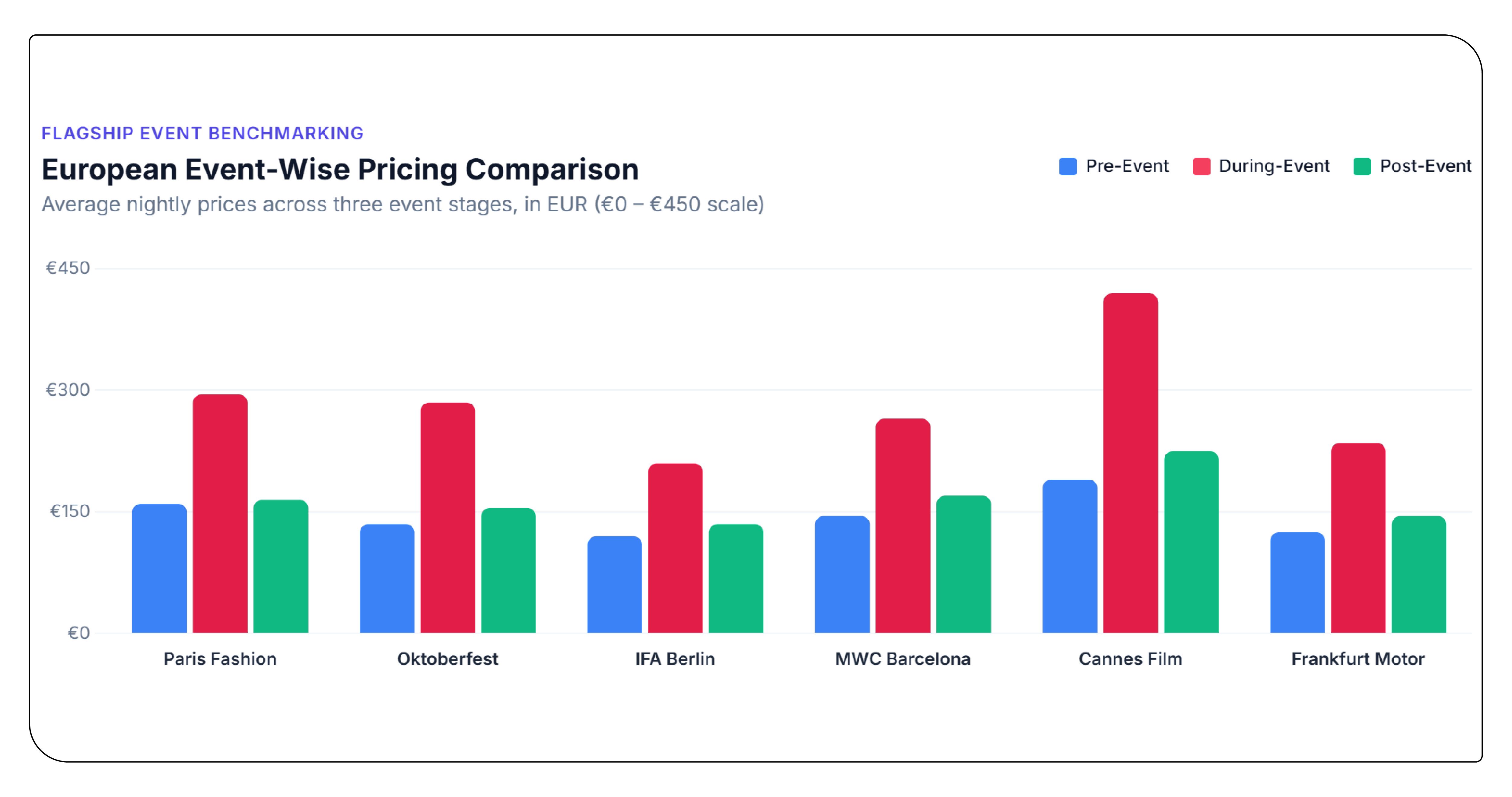
Hotel Rates analysis During Major European Events helps businesses understand how accommodation prices change across different event stages. Hotel pricing typically follows a demand cycle involving early bookings, increasing reservations, limited availability, and last-minute purchasing.
Three important pricing periods should be monitored:
- Pre-Event Period: Hotels may introduce early-booking discounts to attract corporate groups and leisure travellers. Monitoring prices 60–120 days before an event helps identify initial pricing strategies and reservation patterns.
- During-Event Period: Accommodation demand can increase significantly as visitors, exhibitors, performers, and event professionals compete for available rooms. Hotels may adjust prices according to remaining inventory and booking activity.
- Post-Event Period: Rates generally return towards normal market levels as temporary demand declines. Comparing post-event prices with regular weekday rates helps identify the duration of event-related pricing effects.
For accurate analysis, businesses should collect hotel rates at consistent intervals and compare identical room categories, occupancy conditions, stay durations, and cancellation policies.
Hotel Data Collection and Competitive Benchmarking
Hotel Data Intelligence transforms information collected from multiple accommodation sources into structured datasets that support commercial decisions. Businesses can monitor individual properties, hotel groups, booking platforms, and geographical markets through a unified data collection framework.
Important data attributes include:
| Data Category | Information Collected | Business Application |
|---|---|---|
| Hotel Information | Hotel name, brand, address | Property identification |
| Location | City, neighbourhood, coordinates | Geographical comparison |
| Room Information | Room type, bed configuration | Category benchmarking |
| Pricing | Nightly rate, total booking cost | Price comparison |
| Availability | Available rooms, sold-out status | Inventory monitoring |
| Booking Conditions | Cancellation, minimum stay | Reservation comparison |
| Guest Capacity | Adults, children, occupancy | Demand segmentation |
| Property Rating | Star category, guest rating | Quality benchmarking |
| Event Information | Event name, venue, dates | Demand attribution |
| Booking Platform | Source website, listing identifier | Distribution analysis |
| Rate Changes | Previous and current prices | Pricing movement |
| Additional Charges | Taxes, breakfast, service fees | Total-cost comparison |
| Stay Duration | Check-in and check-out dates | Length-of-stay analysis |
| Collection Timestamp | Date and time of extraction | Historical tracking |
This information can be organized into city-wise, event-wise, hotel-wise, and date-wise datasets. Businesses can subsequently use dashboards to compare pricing patterns and identify competitive opportunities.
Event City Hotel Price Benchmarking
Event City Hotel Price Benchmarking enables hospitality companies to compare accommodation prices across similar properties and competing destinations.
For example, a business organizing an international technology conference can compare business hotel rates in Barcelona, Berlin, Amsterdam, and London. The comparison can include standard room prices, premium accommodation, proximity to venues, and availability during event dates.
Benchmarking also helps identify hotels maintaining relatively stable rates despite increasing destination demand. Such properties may offer better opportunities for negotiated corporate accommodation and group reservations.
European Event Travel and Hotel Inventory Intelligence Applications
European Event Travel & Hotel Inventory Intelligence supports several business functions across the hospitality and travel ecosystem.
- Corporate Travel Management: Companies can identify cost-effective accommodation options for employees attending conferences, exhibitions, and international meetings.
- Event Accommodation Planning: Organizers can evaluate room availability around event venues and negotiate accommodation agreements with hotel groups.
- Hotel Revenue Management: Hospitality operators can understand competitor pricing, monitor market demand, and adjust room rates according to booking activity.
- Travel Platform Optimization: Online travel agencies can compare inventory across distribution channels, identify unavailable listings, and improve accommodation recommendations.
- Investment Research: Hospitality investors can examine event-driven accommodation demand, destination pricing patterns, and potential opportunities for hotel development.
Research Methodology and Data Analysis Framework
A comprehensive European event-city hotel market dataset requires consistent collection, standardization, and analysis.
The research methodology can include five major stages:
- Source Identification: Identify hotel websites, online travel agencies, accommodation marketplaces, and official event calendars across European destinations.
- Hotel Data Extraction: Collect hotel information, room categories, nightly rates, availability, taxes, cancellation conditions, and property locations.
- Data Standardization: Normalize currencies, room categories, occupancy conditions, dates, and booking policies to ensure accurate comparisons.
- Historical Price Tracking: Record hotel pricing at regular intervals before, during, and after major events to understand market movements.
- Market Intelligence Reporting: Develop dashboards and comparative datasets highlighting event premiums, inventory gaps, competitor positioning, and destination-level pricing patterns.
For reliable benchmarking, the methodology should distinguish between advertised prices, final booking costs, unavailable rooms, and genuinely sold-out properties. It should also account for different stay lengths and booking conditions.
Conclusion
The European hotel market in 2026/27 presents significant opportunities for businesses seeking better visibility into event-driven accommodation pricing, inventory availability, and competitive positioning. Major exhibitions, sporting championships, concerts, and international conferences continue to influence hotel demand across leading European destinations.
A structured hotel market dataset enables businesses to compare accommodation prices, identify inventory shortages, evaluate event-related demand, and understand destination-specific pricing movements.
Combining historical booking information, competitor monitoring, event calendars, and Dynamic Pricing Intelligence allows hospitality companies, travel agencies, and event organizers to make more informed commercial decisions. Ultimately, reliable European event-city hotel intelligence can support better accommodation planning, stronger revenue management, and more effective hospitality strategies throughout 2026/27.
Ready to elevate your travel business with cutting-edge data insights? Scrape Aggregated Flight Fares to identify competitive rates and optimize your revenue strategies efficiently. Discover emerging opportunities with tools to Extract Travel Website Data, leveraging comprehensive data to forecast market shifts and enhance your service offerings. Real-Time Travel App Data Scraping Services helps stay ahead of competitors, gaining instant insights into bookings, promotions, and customer behavior across multiple platforms. Get in touch with Travel Scrape today to explore how our end-to-end data solutions can uncover new revenue streams, enhance your offerings, and strengthen your competitive edge in the travel market.
Unlock the Full Report
Enter your details to access premium pricing intelligence insights