
Multi-Country Trivago Monitoring for a Latin American Online Travel Company
Introduction
The travel and hospitality industry across Latin America is highly competitive, with hotel prices, room availability, and customer preferences changing frequently across countries and booking platforms. A travel intelligence client wanted to strengthen its understanding of hotel pricing trends and competitive positioning across multiple Latin American markets. To achieve this, the client partnered with a data intelligence provider to implement Multi-Country Trivago Monitoring, enabling systematic tracking of hotel listings, rates, and availability across different destinations. The project focused on Hotel Data Scraping to collect structured information from Trivago, covering essential hotel attributes, geographical details, pricing variations, and booking conditions. Through multi-country Trivago hotel price data extraction, the client aimed to develop a consolidated view of accommodation pricing across selected countries. The initiative helped establish a consistent data collection framework, improve market visibility, identify competitive pricing movements, and support informed decisions for hotel benchmarking, revenue planning, and travel market analysis across Latin America.
The Client
The client was a travel intelligence and hospitality analytics company focused on understanding accommodation markets, monitoring competitor pricing, and identifying opportunities across international travel destinations. With growing interest in Latin America's expanding tourism sector, the organization wanted reliable hotel information from multiple countries to support its market research and competitive intelligence operations. The client required a scalable solution for Web Scraping Trivago Hotels Data to collect hotel listings, room rates, property details, and availability information across different geographical markets. It also wanted to Scrape Trivago hotel availability across Latin America to understand how accommodation options varied by destination and travel dates. Existing research processes involved considerable manual effort, making continuous Price Monitoring difficult. The organization therefore needed structured, regularly refreshed datasets that could support hotel comparisons, market coverage analysis, pricing intelligence, and strategic business decisions while maintaining consistency across multiple Latin American destinations.
Challenges in the Travel Industry
Hotel pricing and availability across Latin America are influenced by seasonal demand, tourism activity, local competition, and changing booking conditions. The client faced several challenges in gathering consistent information across multiple markets. It needed an efficient monitoring framework to understand pricing differences, identify market movements, and transform fragmented travel information into actionable intelligence.
Fragmented Search Results
Trivago search results monitoring across Latin America involved collecting hotel information from different destinations, currencies, and search conditions. Variations in displayed listings and property information made it difficult to maintain consistent records, compare results, and establish a standardized regional hotel intelligence database.
Inconsistent Pricing Information
Building a multi-country Trivago hotel rate comparison dataset was challenging because accommodation prices varied according to travel dates, room categories, occupancy, and booking conditions. The client needed standardized pricing records to identify meaningful differences and evaluate hotel competitiveness across multiple countries.
Regional Pricing Differences
Understanding Geo-Based Price Parity required comparing accommodation rates across different geographical markets. Differences in local currencies, taxes, property categories, and demand patterns complicated comparisons. The client needed reliable geographical classification and consistent pricing information to evaluate regional hotel pricing positions accurately.
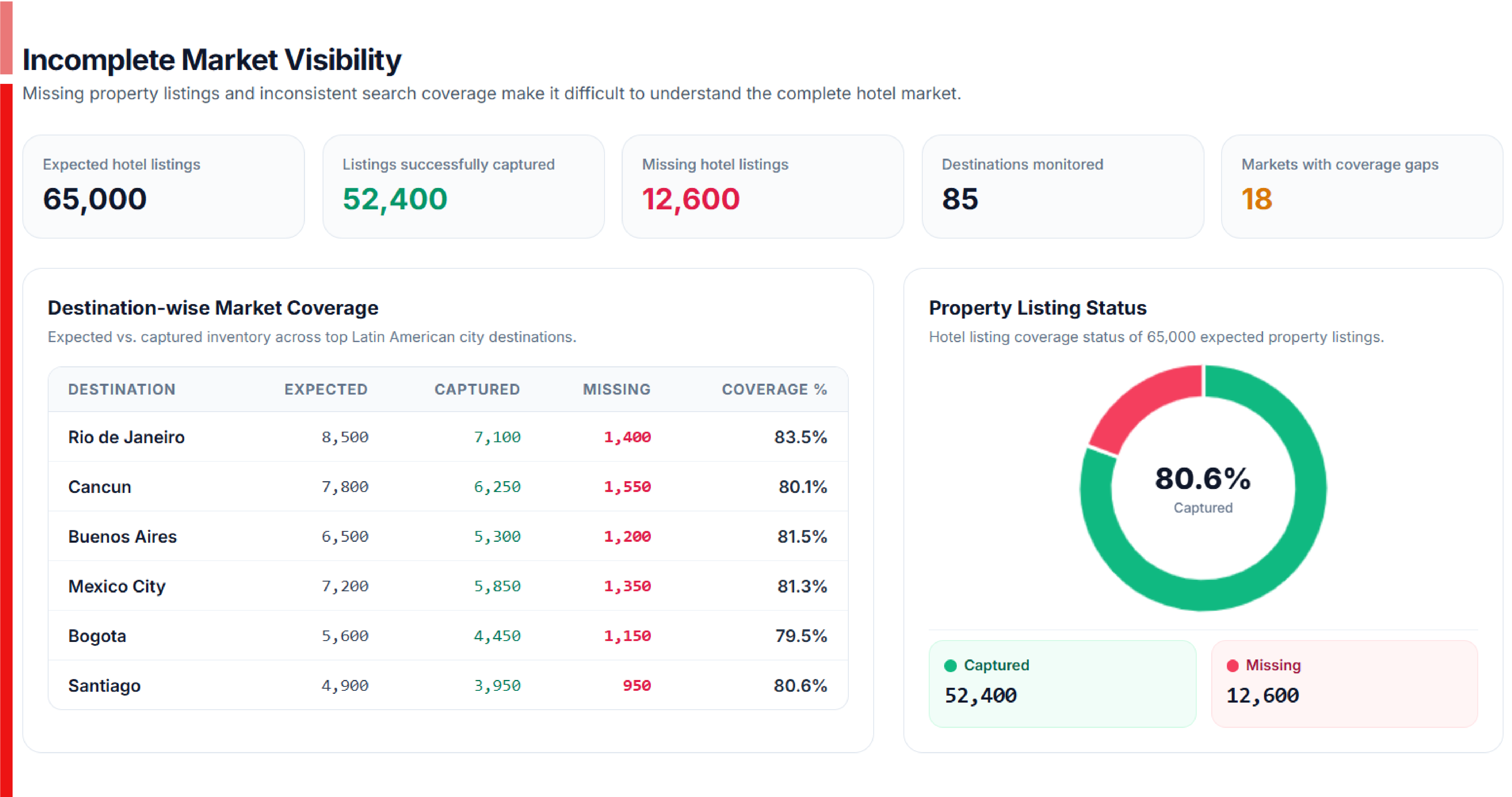
Incomplete Market Visibility
Trivago market coverage monitoring across Latin America required tracking hotel listings across multiple destinations and identifying changes in available properties. Inconsistent listing information and varying search results created difficulties in measuring coverage, identifying missing records, and maintaining comprehensive market visibility.
Limited Demand Understanding
Developing meaningful Booking Trend Insights was difficult without historical pricing and availability observations. The client lacked consolidated information to understand seasonal fluctuations, destination-level demand patterns, and accommodation preferences. This restricted its ability to recognize emerging travel trends and evaluate market opportunities effectively.
Our Approach
Multi-Country Data Collection
We developed a structured scraping framework to collect hotel information from selected Latin American markets. The process captured property names, locations, displayed prices, ratings, and relevant listing attributes, establishing a consistent foundation for regional accommodation intelligence.
Standardized Pricing Extraction
We implemented systematic extraction processes to capture hotel pricing information alongside relevant search conditions. Collected records were organized using standardized fields, supporting comparisons across destinations, travel dates, accommodation categories, and displayed booking options.
Geographical Market Classification
We organized hotel records according to countries, cities, and destination locations. This classification enabled the client to evaluate geographical pricing differences, identify regional market variations, and compare accommodation costs across multiple Latin American destinations.
Availability and Listing Tracking
We established recurring monitoring processes to observe hotel listings and displayed availability information. The collected data helped identify changes in property visibility, accommodation options, and listing conditions, providing the client with a more consistent understanding of market coverage.
Data Cleaning and Structuring
We applied data validation, normalization, duplicate identification, and formatting procedures to improve dataset consistency. Hotel information was organized into structured records, making it easier for the client to integrate the extracted information into analytics systems and reporting workflows.
Multi-Country Trivago Monitoring – Data Extraction Overview
| Parameters | Mexico | Brazil | Argentina | Colombia | Chile | Total |
|---|---|---|---|---|---|---|
| Cities Covered | 18 | 22 | 14 | 16 | 12 | 82 |
| Hotel Listings Collected | 12,850 | 15,620 | 9,480 | 11,350 | 8,720 | 58,020 |
| Hotel Properties Monitored | 4,250 | 5,180 | 3,120 | 3,750 | 2,890 | 19,190 |
| Price Records Extracted | 38,550 | 46,860 | 28,440 | 34,050 | 26,160 | 174,060 |
| Availability Records | 25,700 | 31,240 | 18,960 | 22,700 | 17,440 | 116,040 |
| Hotel Ratings Collected | 11,560 | 14,058 | 8,532 | 10,215 | 7,848 | 52,213 |
| Room Categories Identified | 8,450 | 10,280 | 6,240 | 7,500 | 5,780 | 38,250 |
| Daily Monitoring Cycles | 30 | 30 | 30 | 30 | 30 | 150 |
| Pricing Attributes Captured | 12 | 12 | 12 | 12 | 12 | 60 |
| Data Validation Checks | 9,500 | 11,550 | 7,020 | 8,400 | 6,450 | 42,920 |
| Duplicate Records Identified | 620 | 750 | 460 | 540 | 420 | 2,790 |
| Structured Data Fields | 35 | 35 | 35 | 35 | 35 | 175 |
Table Overview: The illustrative dataset represents a five-country monitoring framework covering 82 cities, 19,190 hotel properties, and 174,060 price records. It demonstrates how multi-country hotel extraction can organize pricing, availability, ratings, and property information into a structured travel intelligence resource.
Results Achieved
The implemented solution provided the client with consolidated market intelligence, improved competitor visibility, and structured datasets for evaluating hotel pricing and availability across Latin America.
Improved Regional Visibility
The client gained a consolidated understanding of hotel listings across selected Latin American markets. Structured geographical records improved destination-level visibility and supported more organized evaluations of accommodation availability, property distribution, and competitive positioning.
Better Pricing Comparisons
Standardized hotel pricing records enabled the client to compare displayed accommodation rates across destinations and travel conditions. This improved its ability to recognize pricing differences, evaluate competitor positioning, and identify potential opportunities for market-level benchmarking.
Enhanced Availability Intelligence
Regularly collected listing and availability information provided better visibility into changing accommodation options. The client could examine property presence across destinations, observe listing variations, and strengthen its understanding of hotel availability patterns.
Stronger Market Research
The structured dataset supported deeper research into regional hospitality markets. By combining hotel attributes, geographical classifications, and pricing observations, the client could evaluate competitive conditions and identify useful information for destination-level business analysis.
Data-Driven Decision-Making
Organized hotel intelligence provided a stronger foundation for strategic planning and reporting. The client could use consolidated information to support pricing evaluations, competitive research, market comparisons, and future expansion assessments across Latin American travel destinations.
Client's Testimonial
"Partnering with the data intelligence team for our Multi-Country Trivago Monitoring project has significantly improved how we collect and analyze hotel market information across Latin America. Their structured approach to hotel data extraction helped us access valuable information about property listings, pricing variations, availability, and geographical coverage across multiple destinations. The standardized datasets have made competitor benchmarking and regional price comparisons considerably easier. We particularly appreciate the attention given to data consistency, accuracy, and organized delivery. The solution has strengthened our market research capabilities and provided useful insights for evaluating accommodation trends and business opportunities. We look forward to expanding this collaboration into additional travel markets and developing more comprehensive hospitality intelligence solutions."
Conclusion
The Multi-Country Trivago Monitoring project helped the client establish a structured approach to collecting and analyzing hotel information across Latin America. By implementing a dedicated data extraction framework, the organization gained improved visibility into accommodation listings, displayed prices, property information, and availability patterns across selected destinations. The initiative addressed important challenges associated with fragmented travel information, regional pricing differences, inconsistent listing records, and limited market visibility. Standardized datasets made it easier to compare hotel rates, evaluate competitive positioning, and understand geographical variations in accommodation markets. With organized hotel intelligence available for analytical applications, the client strengthened its ability to conduct market research, identify pricing opportunities, and support informed business decisions. The solution also created a scalable foundation for expanding monitoring coverage to additional destinations and travel markets. Overall, the project demonstrated how structured travel data collection can improve hospitality intelligence, competitive benchmarking, and strategic planning in Latin America's evolving tourism industry.
FAQs
Unlock the Full Report
Enter your details to access premium pricing intelligence insights