
India Wedding Season Travel Prices Intelligence Report 2026 for Hotel & Flight Pricing Intelligence
Introduction
India's wedding industry generates substantial travel demand every year, influencing hotel occupancy, domestic airfare, intercity transportation, and destination tourism. The 2026 wedding season presents significant opportunities for airlines, hotel operators, travel agencies, online travel platforms, and hospitality investors to understand how wedding-related travel affects pricing and booking behaviour.
Wedding celebrations increasingly involve guests travelling across cities, families booking multiple hotel rooms, and couples selecting destination wedding locations. Popular destinations such as Jaipur, Udaipur, Goa, Jodhpur, Mumbai, Delhi, Bengaluru, and Hyderabad experience varying levels of demand depending on wedding dates, regional celebrations, venue availability, and flight connectivity.
India Wedding Season Travel Price Intelligence helps businesses evaluate changing travel costs, identify demand patterns, and understand pricing differences across destinations. Through Seasonal Trend Analysis, companies can identify high-demand wedding periods, compare historical booking patterns, and anticipate price fluctuations.
Combining Wedding Season Hotel and Flight Price Monitoring with structured market datasets enables travel businesses to examine room rates, airfare movements, occupancy indicators, booking windows, and competitor pricing throughout the wedding calendar.
Research note: The numerical tables below are illustrative market intelligence estimates and analytical benchmarks for 2026, not verified live transaction records or official nationwide averages. Actual prices vary by date, property, airline, route, and booking conditions.
India Wedding Season 2026: Market Overview and Travel Demand
The scale of wedding-related economic activity highlights why travel pricing deserves closer attention. According to the Confederation of All India Traders (CAIT), approximately 52 lakh weddings are expected between November 21 and December 15, 2026, generating an estimated ₹7.5 lakh crore in business activity. Delhi-NCR alone is projected to account for approximately 5 lakh weddings and ₹2.5 lakh crore in business.
This demand creates opportunities for hotels, airlines, travel aggregators, and destination management companies. Unlike conventional leisure travel, wedding travel often involves coordinated group bookings, extended stays, multiple family arrivals, and specific event dates. Consequently, demand can concentrate around a limited number of weekends and auspicious wedding dates.
Hotels in Jaipur, Udaipur, Goa, and other destination markets may experience increased room demand, particularly where wedding venues and accommodation are booked together. Metropolitan cities also attract substantial demand because relatives and guests travel from different regions to attend ceremonies.
The hospitality sector is already experiencing strong advance booking activity. An Economic Times report published in September 2026 highlighted that popular wedding destinations were receiving bookings four to six months ahead, with several prime dates already reserved.
Seasonal Wedding Calendar and Travel Pricing Movements
Wedding travel demand in India follows cultural calendars, regional traditions, auspicious dates, and holiday schedules. November and December generally attract significant wedding-related movement, while January and February provide additional opportunities for hotel and airline businesses.
The 2026–27 wedding calendar requires particular attention because demand is not distributed evenly across months. The wedding season also overlaps with winter holidays, festive travel, and year-end vacations.
A city-level wedding calendar published in November 2026 identifies January 2027 as an important month, with four qualifying wedding dates in several major cities under its stated calculation rules.
Travel businesses can use these calendar indicators to understand booking concentration and prepare pricing strategies.
| Wedding Travel Period | Expected Demand | Hotel Pricing Pressure | Flight Pricing Pressure | Booking Priority |
|---|---|---|---|---|
| November 2026 | Very High | High | Very High | 30–60 days |
| December 2026 | High | Very High | High | 45–75 days |
| January 2027 | Very High | High | High | 30–60 days |
| February 2027 | High | High | High | 30–60 days |
| March 2027 | Moderate | Moderate | Moderate | 20–45 days |
| April 2027 | Moderate | Moderate | Moderate | 20–40 days |
| May 2027 | High | High | High | 30–60 days |
| June 2027 | Moderate | Moderate | Moderate | 20–40 days |
Indicative analytical demand and booking-planning classifications, not measured national booking statistics.
Understanding these seasonal variations supports Demand Forecasting by allowing businesses to identify periods when hotel rooms and airline seats may become difficult to secure.
Destination-Wise Hotel Price Intelligence
Hotel pricing is one of the most important components of wedding travel expenditure. Families frequently reserve multiple rooms for relatives, wedding guests, photographers, event coordinators, and other participants.
Destination wedding markets have different pricing characteristics. Udaipur and Jaipur attract premium celebrations, while Goa combines wedding demand with leisure tourism. Mumbai and Delhi experience demand from large family gatherings, corporate-related celebrations, and metropolitan events.
A 2026 Sciative Solutions analysis reported that average mid-scale hotel rates increased by 26.94% above pre-festival levels during November 11–15 across 3,114 properties in 13 Indian destinations. This demonstrates how overlapping seasonal demand can influence hotel pricing.
The following destination comparison provides an illustrative hotel pricing intelligence framework.
| Destination | Budget Hotel (₹) | Mid-Scale Hotel (₹) | Premium Hotel (₹) | Indicative Peak Increase |
|---|---|---|---|---|
| Jaipur | 2,500 | 5,500 | 12,000 | 25–35% |
| Udaipur | 3,500 | 7,500 | 18,000 | 20–30% |
| Goa | 3,000 | 7,000 | 16,000 | 20–30% |
| Jodhpur | 2,800 | 6,000 | 14,000 | 15–25% |
| Delhi | 2,500 | 5,000 | 11,000 | 10–20% |
| Mumbai | 3,500 | 7,500 | 17,000 | 15–25% |
| Bengaluru | 2,200 | 4,800 | 10,000 | 10–20% |
| Hyderabad | 2,000 | 4,500 | 9,500 | 10–20% |
| Pune | 2,200 | 4,700 | 10,500 | 10–20% |
| Ahmedabad | 2,000 | 4,200 | 9,000 | 10–20% |
| Lucknow | 1,800 | 3,800 | 8,500 | 10–20% |
| Kolkata | 2,000 | 4,000 | 9,000 | 10–20% |
Illustrative one-night room-rate benchmarks in INR. Price increases are analytical scenarios, not observed destination-specific 2026 results.
For hotel operators, Hotel Competitor Price tracking During Wedding Season provides a structured way to compare room categories, refundable rates, breakfast inclusions, cancellation policies, and minimum-stay restrictions.
Flight Pricing Trends and Route-Level Intelligence
Airfare is another major expense for wedding guests travelling between metropolitan cities, regional destinations, and hometowns. Demand can rise sharply when multiple wedding events occur during the same weekend.
Popular domestic routes include Delhi–Jaipur, Delhi–Udaipur, Delhi–Mumbai, Mumbai–Goa, Bengaluru–Delhi, and Delhi–Patna. Routes connecting metropolitan centres with smaller cities can experience concentrated demand because families often travel together.
A November 2026 report highlighted that airfares on several routes had increased by up to 50% amid Chhath and wedding-season demand. A reported Delhi–Patna ticket price reached approximately ₹18,000, while Delhi–Darbhanga fares reached approximately ₹20,000 in the cited survey. These are reported peak-price examples, not average route fares.
The following table provides an illustrative route-level pricing comparison for market analysis.
| Domestic Flight Route | Regular Fare (₹) | Peak Scenario (₹) | Indicative Increase | Journey Distance (km) |
|---|---|---|---|---|
| Delhi–Jaipur | 3,500 | 5,000 | 43% | 230 |
| Delhi–Udaipur | 4,500 | 7,000 | 56% | 540 |
| Delhi–Goa | 5,500 | 8,500 | 55% | 1,500 |
| Mumbai–Goa | 3,500 | 5,500 | 57% | 430 |
| Delhi–Mumbai | 5,000 | 7,500 | 50% | 1,150 |
| Delhi–Patna | 5,500 | 8,500 | 55% | 850 |
| Delhi–Darbhanga | 6,000 | 9,000 | 50% | 880 |
| Bengaluru–Delhi | 6,000 | 9,000 | 50% | 1,740 |
| Hyderabad–Jaipur | 5,000 | 7,500 | 50% | 1,100 |
| Mumbai–Udaipur | 4,500 | 7,000 | 56% | 620 |
| Kolkata–Delhi | 5,000 | 7,500 | 50% | 1,300 |
| Pune–Delhi | 5,000 | 7,500 | 50% | 1,170 |
Illustrative one-way economy airfare scenarios in INR. Distances are approximate direct-route distances; fares are not live airline quotations.
Structured Flight Price Data Intelligence enables businesses to examine fare movements, seat availability, airline competition, baggage inclusions, and booking lead times. A Wedding Season Airfare Price Comparison dataset can further reveal differences between regular travel periods and high-demand wedding dates.
Hotel and Flight Booking Behaviour During Wedding Season
Wedding travel booking behaviour differs from individual leisure travel. Families often coordinate travel schedules around ceremony dates, accommodation requirements, venue locations, and guest arrival times.
Some families book flights several weeks in advance, while others wait for wedding invitations or final event confirmations. Hotels may receive group enquiries months before the actual celebration, particularly for destination weddings.
The Wedding Season Travel Booking Trends analytics approach helps businesses understand:
- Advance booking patterns across domestic travel routes.
- Average hotel booking lead times.
- Weekend versus weekday demand differences.
- Group accommodation requirements.
- Cancellation and rescheduling behaviour.
- Price differences between refundable and non-refundable bookings.
- Seasonal changes in flight and hotel availability.
The following framework demonstrates how booking data can be structured for commercial analysis.
| Booking Indicator | Budget Segment | Mid-Scale Segment | Premium Segment | Measurement Unit |
|---|---|---|---|---|
| Hotel booking lead time | 21 | 35 | 60 | Days |
| Flight booking lead time | 25 | 40 | 55 | Days |
| Average stay duration | 2 | 3 | 4 | Nights |
| Average rooms per group | 3 | 5 | 8 | Rooms |
| Average guests per group | 6 | 12 | 20 | Guests |
| Weekend demand index | 115 | 130 | 145 | Base 100 |
| Weekday demand index | 95 | 105 | 115 | Base 100 |
| Cancellation benchmark | 18 | 15 | 12 | Percentage |
| Peak booking window | 30 | 45 | 60 | Days |
| Average hotel occupancy scenario | 65 | 75 | 85 | Percentage |
| Group booking share | 20 | 30 | 45 | Percentage |
| Repeat booking share | 15 | 22 | 30 | Percentage |
Illustrative planning benchmarks for segment-level analysis, not measured industry-wide booking statistics.
Competitive Pricing Intelligence and Market Opportunities
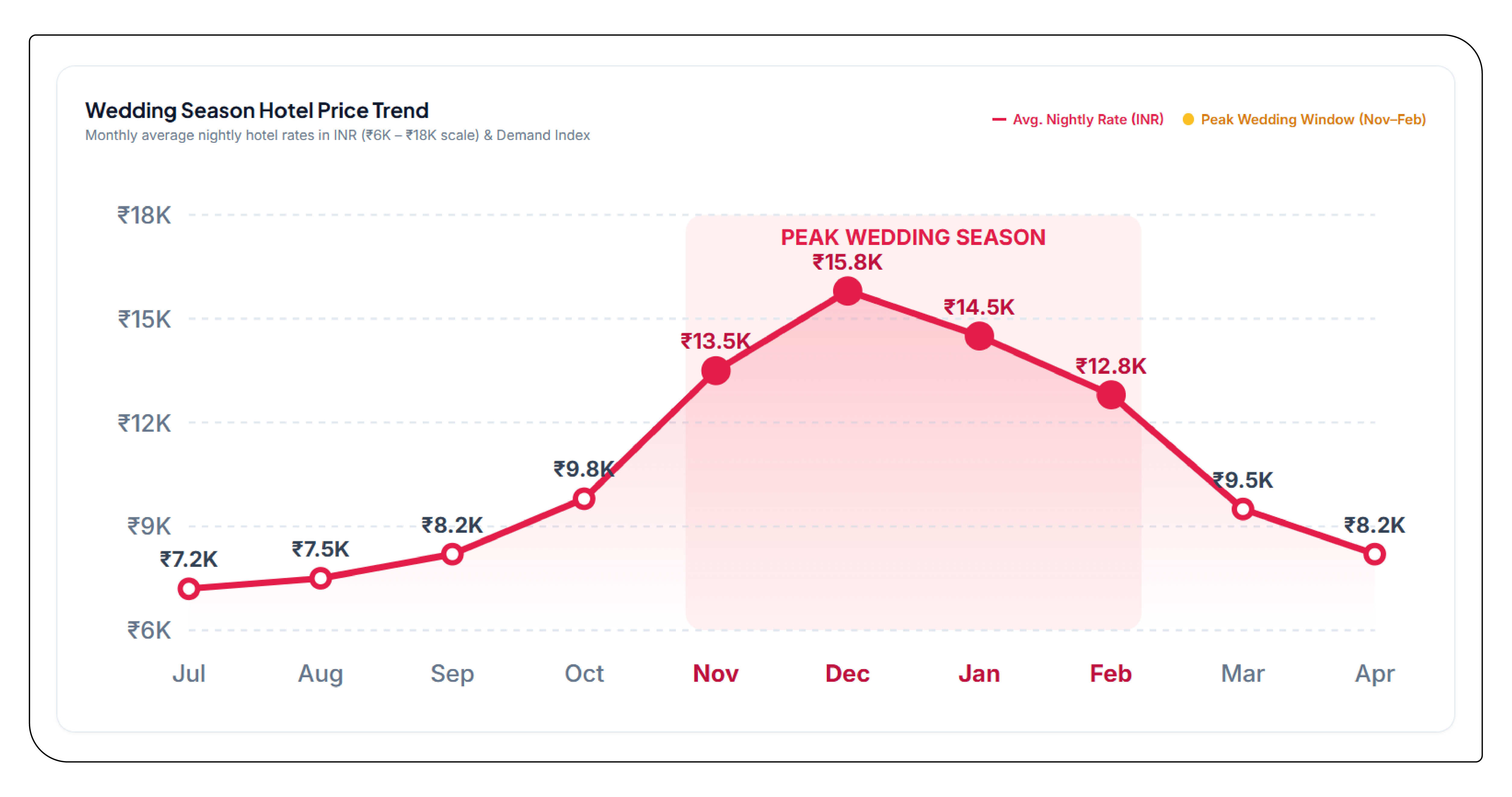
The wedding season creates opportunities for businesses that can combine hotel and flight pricing information into a unified market intelligence system.
India Wedding season Travel Market Data analysis helps travel companies understand geographical demand concentration, pricing movements, and competitive positioning.
Hotels can evaluate competitor room prices across different accommodation categories, while airlines and travel platforms can compare available fares across competing routes.
A comprehensive intelligence framework can include:
- Destination Pricing: Compare accommodation prices across wedding destinations and metropolitan markets.
- Competitor Monitoring: Track hotel rates, room availability, airline fares, and promotional offers.
- Inventory Gap Analysis: Identify destinations where room availability declines faster than competing markets.
- Seasonal Performance: Compare wedding-season prices with regular-month and festive-period benchmarks.
- Revenue Optimization: Identify opportunities to adjust room prices, package rates, and travel promotions.
Hotel Data Intelligence also helps hospitality companies understand how different property categories respond to seasonal demand. Luxury resorts may prioritize wedding packages and exclusive accommodation blocks, whereas mid-scale hotels can focus on group reservations and affordable guest stays.
Technology and Data Collection for Travel Pricing Intelligence
A structured data collection system can consolidate information from airline websites, hotel booking platforms, travel aggregators, and hospitality portals.
The collected information can be organized into standardized datasets for daily, weekly, and monthly analysis.
| Data Category | Information Collected | Update Frequency | Business Application |
|---|---|---|---|
| Hotel Pricing | Room rates and taxes | Daily | Price comparison |
| Hotel Inventory | Available rooms | Daily | Inventory monitoring |
| Hotel Categories | Budget, mid-scale, luxury | Weekly | Market segmentation |
| Flight Pricing | One-way and return fares | Multiple times daily | Airfare analysis |
| Flight Availability | Available seats and fare classes where exposed | Multiple times daily | Capacity monitoring |
| Airline Information | Carrier and route details | Daily | Competitor analysis |
| Booking Conditions | Refund and cancellation policies | Daily | Booking comparison |
| Destination Data | City and location information | Weekly | Geographic analysis |
| Seasonal Information | Wedding dates and holiday calendars | Monthly or as updated | Demand planning |
| Historical Pricing | Previous observed rates | Continuous archival | Trend analysis |
This approach allows companies to build a centralized database connecting destination demand, accommodation prices, airfare changes, and booking availability.
Dashboards can present destination-wise price comparisons, booking lead-time patterns, route-level fare movements, and historical seasonal performance. Predictive models can also use historical observations and upcoming wedding calendars to estimate potential demand pressure.
Data collection should account for currency, taxes, room occupancy, fare conditions, and differences in booking policies to ensure meaningful comparisons.
Business Opportunities and Future Market Outlook
India's wedding travel ecosystem offers opportunities for multiple stakeholders.
- Hotels and Resorts: Improve revenue management through advance demand identification and competitor pricing analysis.
- Airlines: Understand route-level booking concentration and anticipate seasonal passenger demand.
- Travel Agencies: Develop coordinated flight and accommodation packages for wedding groups.
- OTAs: Improve destination recommendations and promotional strategies using historical pricing information.
- Wedding Planners: Estimate guest accommodation expenses and identify suitable destinations.
- Investors: Evaluate hospitality markets where seasonal demand creates opportunities for additional accommodation capacity.
ICRA projected Indian hospitality industry revenue growth of 7–9% in FY2027, supported by domestic leisure travel, weddings, MICE, and business travel. It also projected premium hotel occupancy of 72–74% for FY2027. These industry-level expectations provide useful context for evaluating wedding-related hospitality opportunities.
As travel platforms expand their data capabilities, combining historical pricing, real-time availability, and seasonal demand indicators will become increasingly important for competitive decision-making.
Conclusion
India's wedding season represents an important demand driver for the country's hotel and domestic aviation markets. The concentration of wedding dates, destination celebrations, group accommodation requirements, and intercity travel creates substantial opportunities for pricing analysis and revenue optimization.
For 2026, the projected 52 lakh weddings during the November 21–December 15 period underline the scale of the opportunity. Hotels, airlines, travel agencies, and booking platforms can benefit from monitoring price fluctuations, competitor inventory, route-level airfare movements, and advance booking behaviour.
A comprehensive Travel Data Intelligence framework can transform scattered travel pricing information into structured market insights. By combining hotel rate monitoring, flight fare comparisons, seasonal demand indicators, and historical booking datasets, businesses can make better-informed pricing decisions, identify emerging opportunities, and strengthen their competitive position throughout the wedding season.
Ready to elevate your travel business with cutting-edge data insights? Scrape Aggregated Flight Fares to identify competitive rates and optimize your revenue strategies efficiently. Discover emerging opportunities with tools to Extract Travel Website Data, leveraging comprehensive data to forecast market shifts and enhance your service offerings. Real-Time Travel App Data Scraping Services helps stay ahead of competitors, gaining instant insights into bookings, promotions, and customer behavior across multiple platforms. Get in touch with Travel Scrape today to explore how our end-to-end data solutions can uncover new revenue streams, enhance your offerings, and strengthen your competitive edge in the travel market.
Unlock the Full Report
Enter your details to access premium pricing intelligence insights