
European Airline Fare Data Scraping: Low-Cost vs Full-Service Pricing on Top Routes
Introduction
The European aviation industry operates in a highly competitive environment where airline ticket prices fluctuate according to passenger demand, booking periods, seasonal travel patterns, fuel costs, route availability, and competitor pricing strategies. From international business routes connecting London, Paris, Frankfurt, and Amsterdam to popular leisure destinations such as Rome, Barcelona, Athens, and Lisbon, airfare variations create important opportunities for airlines, travel agencies, online travel platforms, and market researchers.
European Airline Fare Data Scraping enables businesses to collect structured flight pricing information from airline websites, online travel agencies, flight comparison platforms, and booking portals. This information provides visibility into ticket prices, departure schedules, baggage allowances, fare classes, airline availability, and promotional offers across different European markets.
Through Airline Data Scraping, businesses can monitor changing ticket prices, compare airline services, and identify competitive advantages across domestic and international routes. Analysing European airfare trends by destination data scraping also helps identify how passenger demand, tourism seasons, major events, and booking behaviour influence ticket prices across European countries.
This research report examines the European airline pricing landscape, competitive fare structures, dynamic pricing mechanisms, route-level opportunities, and the role of structured flight datasets in improving commercial decision-making.
European Airline Industry Landscape and Passenger Demand
Europe's airline market includes a combination of full-service international carriers, regional airlines, low-cost operators, and hybrid aviation businesses. Airlines compete through ticket pricing, flight frequency, destination coverage, loyalty programmes, baggage policies, and additional passenger services.
The market's recovery and expansion have increased the importance of continuous airfare monitoring. According to Eurostat, EU airports handled approximately 1.1 billion air passengers in 2024, representing an 8.3% increase compared with 2023. Passenger volumes exceeded the previous pre-pandemic benchmark, highlighting the growing scale of European air travel.
This growth creates opportunities for data-driven airline research. Businesses can examine passenger demand across major airports, identify popular travel corridors, and compare pricing movements across different airline categories.
Major European Airports and Passenger Traffic
The following table highlights the ten leading EU passenger airports and their reported passenger volumes.
| Rank | Airport | Country | Passengers 2023 (Millions) | Passengers 2024 (Millions) | Growth (%) |
|---|---|---|---|---|---|
| 1 | Paris Charles de Gaulle | France | 67.0 | 70.0 | 4.5 |
| 2 | Amsterdam Schiphol | Netherlands | 62.0 | 67.0 | 8.1 |
| 3 | Madrid Barajas | Spain | 60.0 | 66.0 | 10.0 |
| 4 | Frankfurt Airport | Germany | 59.0 | 61.5 | 4.2 |
| 5 | Barcelona El Prat | Spain | 50.0 | 55.0 | 10.0 |
| 6 | Rome Fiumicino | Italy | 40.0 | 48.5 | 21.3 |
| 7 | Munich Airport | Germany | 37.0 | 41.5 | 12.2 |
| 8 | Lisbon Airport | Portugal | 33.5 | 35.0 | 4.5 |
| 9 | Dublin Airport | Ireland | 33.0 | 35.0 | 6.1 |
| 10 | Athens International | Greece | 28.0 | 33.5 | 19.6 |
Source: Eurostat, 2025 transport statistics publication. Growth percentages calculated from rounded passenger figures; figures are approximate.
The figures demonstrate the importance of major European aviation hubs. Rome and Athens recorded particularly strong passenger growth, while Madrid and Barcelona benefited from substantial tourism and international connectivity.
For airline businesses, monitoring these airports helps identify markets where passenger demand may influence ticket availability and pricing. For travel platforms, this information can support destination recommendations, route comparisons, and competitive fare analysis.
Dynamic Pricing Intelligence Across European Airlines
Airline ticket prices are rarely fixed. Carriers use revenue management systems to adjust fares according to booking activity, remaining seat inventory, expected demand, departure dates, and competitor prices.
Dynamic Pricing Intelligence helps businesses understand these changes by collecting airfare information at regular intervals. Instead of relying on a single price observation, companies can build historical records showing how fares change over days, weeks, and months.
For example, a flight from London to Barcelona may display different prices depending on whether a passenger searches three months, one month, or three days before departure. The same flight can also have multiple fare categories with different baggage allowances, cancellation conditions, and seat-selection benefits.
Airfare datasets can capture:
- Original and discounted ticket prices.
- One-way and return ticket costs.
- Economy, premium economy, business, and first-class fares.
- Departure and arrival dates.
- Available seats and fare classes, where displayed.
- Airline-specific promotional offers.
- Booking restrictions and cancellation policies.
- Additional baggage and seat-selection charges.
These observations help businesses distinguish between genuine price reductions and changes caused by fare availability or booking conditions.
Low-Cost vs Full-Service European Airline Pricing
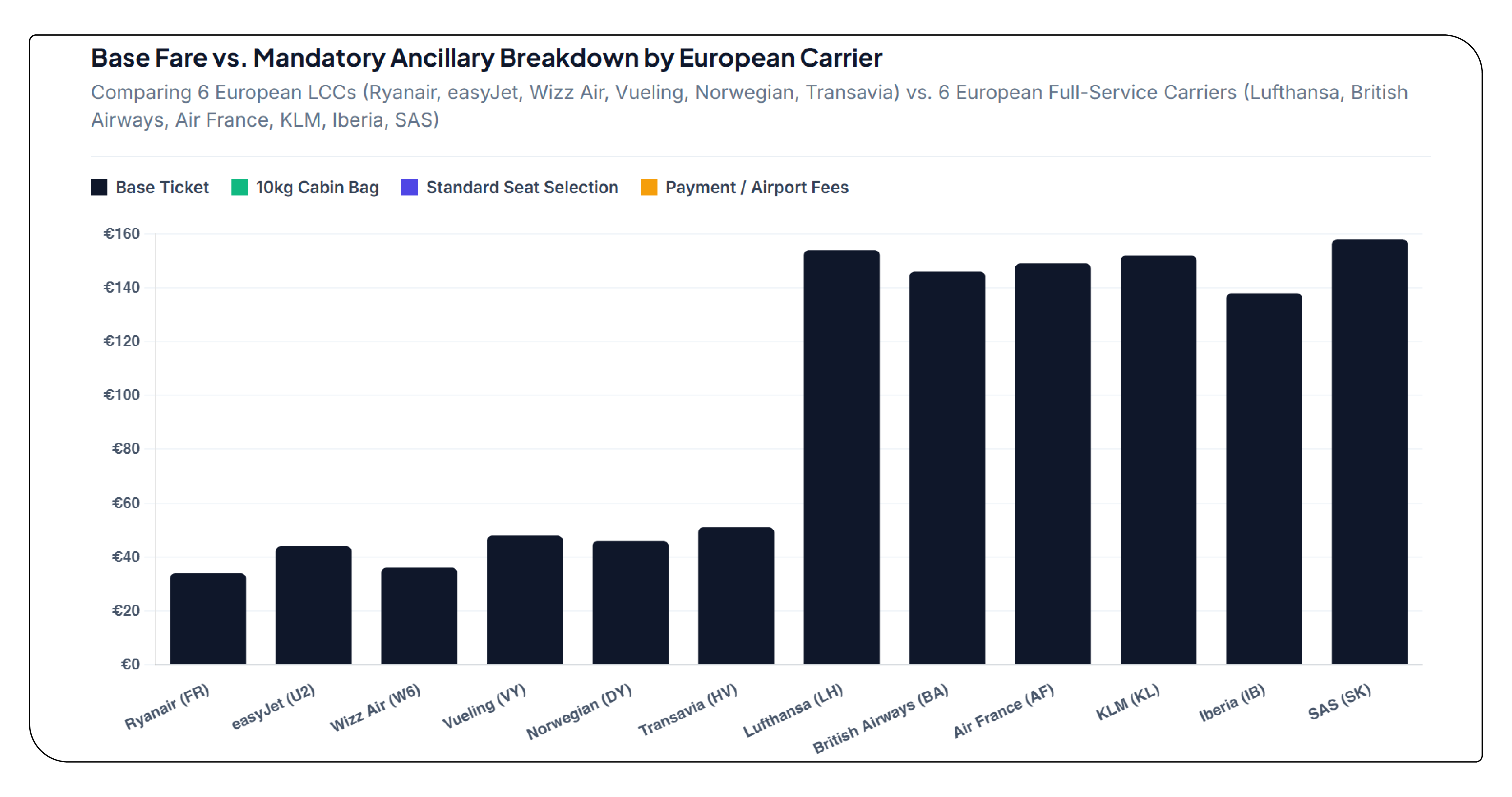
European aviation competition is strongly influenced by low-cost carriers and established full-service airlines. Low-cost operators generally attract price-conscious travellers through simplified ticket products, while traditional carriers differentiate themselves through connectivity, flexibility, loyalty benefits, and additional services.
According to EUROCONTROL's 2024 aviation overview, low-cost airlines increased their European traffic by 8% and reached a 34% market share. Mainline airlines accounted for 36% of traffic.
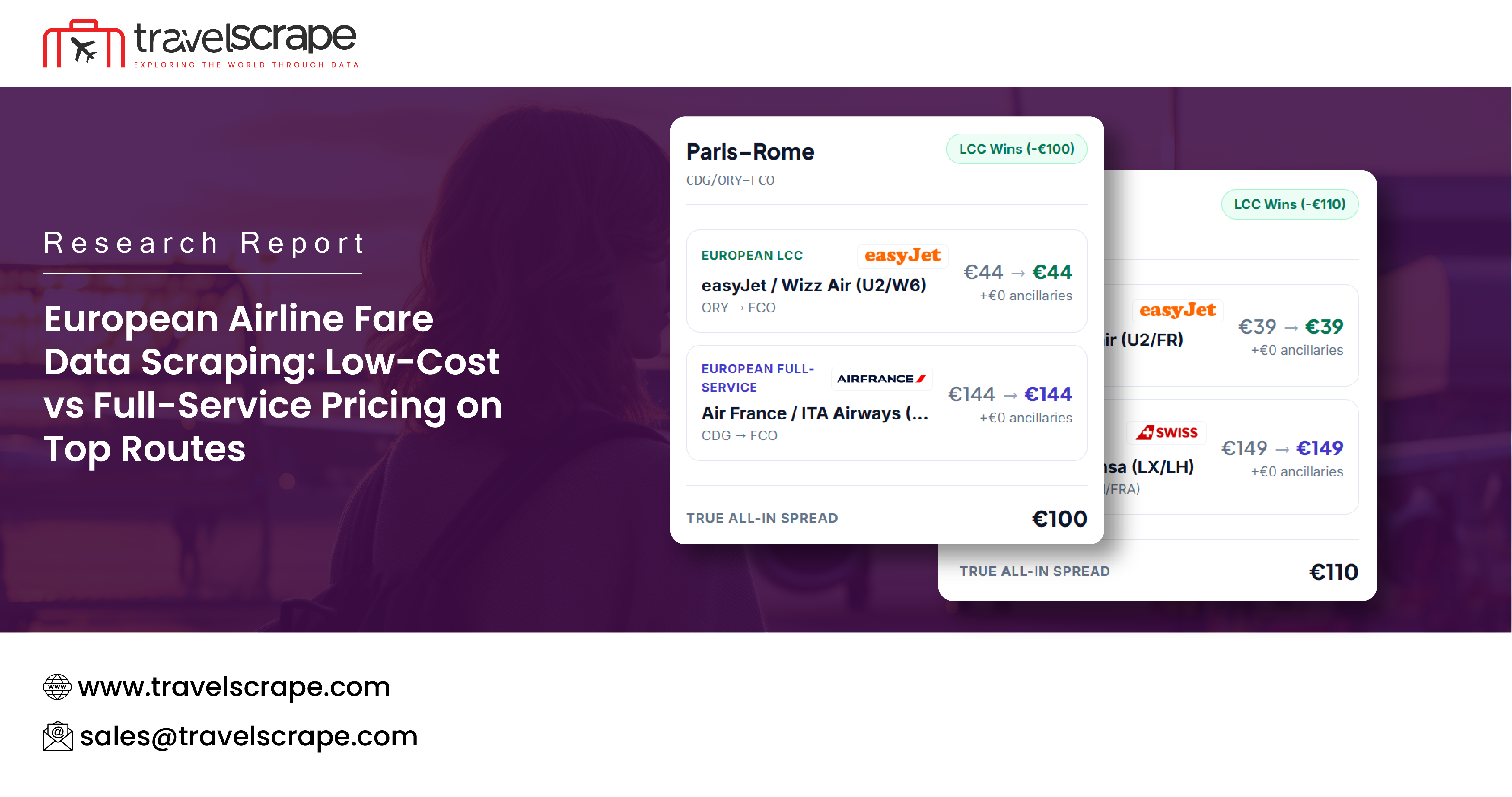
Extract low-cost vs full-service European airline pricing to understand differences in base fares, optional services, and total passenger expenditure.
| Comparison Parameter | Low-Cost Airlines | Full-Service Airlines |
|---|---|---|
| Representative airlines | Ryanair, easyJet, Wizz Air | Lufthansa, Air France, KLM |
| Base ticket price | Generally lower | Generally higher |
| Cabin baggage | Fare-dependent | Fare-dependent |
| Checked baggage | Frequently charged separately | Often included in selected fares |
| Seat selection | Frequently additional | Depends on fare category |
| Flight network | Strong point-to-point coverage | Extensive connecting networks |
| Loyalty programmes | Vary by airline | Established frequent-flyer programmes |
| Flexible tickets | Usually paid upgrades | Multiple flexible fare categories |
| Business travel | Selected routes and products | Broader corporate travel offerings |
| Pricing strategy | Competitive base fares and add-ons | Fare segmentation and service differentiation |
The comparison represents general commercial positioning, not universal conditions for every airline or ticket.
Scraping these attributes allows businesses to calculate the actual cost of travelling rather than comparing headline ticket prices alone. A low-cost ticket may become more expensive after adding baggage, priority boarding, and seat selection. A full-service ticket may offer better overall value when these services are included.
European Airfare Market Intelligence and Seasonal Price Movements
Seasonality is one of the strongest influences on European airline pricing. Summer holidays, Christmas travel, Easter breaks, school vacations, sporting events, and international festivals can create significant variations in airfare demand.
International routes connecting major tourism markets often experience different pricing patterns from domestic business routes. For example, flights to Mediterranean destinations may attract higher demand during summer, while routes connecting financial centres can experience weekday business travel fluctuations.
Eurostat's July 2026 analysis highlights substantial volatility in European air transport prices. In April 2025, the annual price increase reached 13.7%. International air transport prices increased by 14.1% in that month, while international fares rose by 8.7% year-on-year in May 2026.
European Airfare Price Movement Indicators
| Period | Air Transport Price Change | International Air Travel | Market Observation |
|---|---|---|---|
| April 2025 | +13.7% | +14.1% | Strong annual price increase |
| Summer 2025 | Variable | Variable | Seasonal demand fluctuations |
| January 2026 | Decrease | Decrease | Annual price contraction |
| April 2026 | -4.7% | Variable | Sharp annual decline |
| May 2026 | +8.1% | +8.7% | Price recovery |
| June 2026 | +3.1% | +4.5% | Continued international fare growth |
Source: Eurostat, High fluctuation in EU air transport prices, published 23 July 2026. Percentages represent annual changes in air transport service prices, not individual flight ticket quotations.
This information from European airfare market intelligence demonstrates why businesses need historical pricing records. A single airfare observation cannot explain whether a ticket is expensive, competitively priced, or experiencing a temporary seasonal increase.
By collecting fares across different booking windows, businesses can identify recurring patterns and evaluate the relationship between booking lead time and ticket prices.
Route-Level Airline Price Benchmarking
Route-level analysis provides a more detailed understanding of airline competition. Instead of comparing carriers across entire countries, businesses can examine individual city pairs and identify which airlines offer competitive fares on specific routes.
Popular European corridors include:
- London–Paris
- London–Amsterdam
- Madrid–Barcelona
- Rome–Milan
- Paris–Rome
- Frankfurt–London
- Amsterdam–Barcelona
- Barcelona–Palma de Mallorca
- Madrid–Rome
- Athens–London
For meaningful comparisons, collected data should include the departure airport, arrival airport, airline, flight duration, departure time, ticket class, baggage conditions, and total fare.
An important consideration is that two flights on the same route may not offer equivalent services. Direct flights, connecting flights, different departure times, and different fare restrictions should be evaluated separately.
Route-level monitoring also helps identify markets where multiple airlines compete for similar passengers. Businesses can compare the lowest available fare, median fare, highest observed fare, and price difference between competing operators.
Price Optimization Through Historical Fare Analysis
Price Optimization becomes more effective when airlines and travel businesses understand how competitors adjust their fares over time. Historical airfare datasets help identify pricing opportunities, evaluate competitive positioning, and develop better revenue management strategies.
For example, an airline operating between Paris and Rome can compare its ticket prices against competing carriers across different departure dates. If competitors consistently offer lower fares during particular booking periods, the airline can investigate whether its pricing strategy requires adjustment.
Historical datasets can support several analytical activities:
- Competitor Fare Monitoring: Compare airline ticket prices across identical routes and departure dates.
- Booking Window Analysis: Examine fare differences between advance bookings and last-minute reservations.
- Promotional Tracking: Identify discount campaigns, limited-time offers, and seasonal promotions.
- Revenue Management: Evaluate pricing movements against available seat inventory and passenger demand.
- Market Segmentation: Compare economy, premium, and business-class fare structures.
Combining these insights with historical demand patterns helps businesses understand the relationship between passenger behaviour and airline pricing decisions.
Building a Global Flight Price Trends Dataset
A structured airfare database should combine information from multiple airlines, booking platforms, and flight comparison websites. This provides a broader understanding of the European aviation market and supports comparisons across countries.
A comprehensive Global Flight Price Trends Dataset can contain the following information:
| Data Category | Collected Data Fields | Analytical Purpose |
|---|---|---|
| Airline Information | Airline name, IATA code, airline category | Carrier identification |
| Route Information | Origin, destination, airport codes | Route comparison |
| Flight Schedule | Departure, arrival, flight duration | Schedule benchmarking |
| Ticket Pricing | Base fare, final fare, taxes | Price analysis |
| Fare Categories | Economy, premium economy, business | Class-level comparison |
| Baggage Information | Cabin baggage, checked baggage | Total travel cost |
| Booking Information | Search date, booking date, departure date | Booking window analysis |
| Availability | Available fare options, displayed inventory | Supply monitoring |
| Promotions | Discount percentage, coupon, offer validity | Campaign analysis |
| Additional Services | Seat selection, priority boarding, meals | Ancillary revenue analysis |
| Journey Details | Direct flight, connecting flight, stopover | Travel convenience |
| Currency Information | Original currency, converted fare | Cross-country comparison |
This dataset can be refreshed at scheduled intervals, depending on business requirements and source accessibility.
Data standardization is equally important. Different airline websites may display prices in different currencies, use different airport formats, or classify baggage allowances differently. Standardizing these fields makes cross-platform comparisons more reliable.
How European Airline Data Scraping Supports Business Decisions?
Airline data collection offers practical advantages for several business categories.
- Airlines and Aviation Companies: Airlines can monitor competitors, evaluate route-level pricing, and identify opportunities to improve fare positioning.
- Online Travel Agencies: Travel platforms can compare available flights, improve fare discovery, and provide customers with more comprehensive booking information.
- Travel Management Companies: Corporate travel providers can analyse airfare fluctuations, identify economical booking periods, and compare business travel routes.
- Tour Operators: Travel companies can monitor flight costs for popular destinations and develop competitive holiday packages.
- Market Research Firms: Researchers can study airline competition, regional demand, seasonal fluctuations, and changing travel preferences.
- Revenue Management Teams: Pricing professionals can use historical fare information to evaluate market movements and support demand-based pricing decisions.
Data Collection Methodology and Accuracy Considerations
A reliable airline fare monitoring system requires a consistent data collection methodology. Businesses should identify relevant airline websites, flight booking platforms, comparison portals, and accessible aviation data sources before developing their collection framework.
The process generally involves five stages:
- Source Identification: Select European airline websites, booking portals, and flight comparison platforms relevant to the research scope.
- Data Extraction: Collect available fares, schedules, airline information, baggage conditions, and promotional details.
- Data Cleaning: Remove duplicate records, standardize currencies, and normalize airport and airline identifiers.
- Data Validation: Check missing values, inconsistent prices, unusual fare changes, and conflicting flight details.
- Dataset Delivery: Organize the information into structured CSV, Excel, JSON, or database-ready formats.
Businesses should also account for important limitations. Airfares can change between searches, displayed prices may exclude optional services, and availability can differ by passenger count or booking conditions. Data collection should respect website terms, applicable privacy regulations, and permitted access methods.
Conclusion
European aviation is a dynamic marketplace where passenger demand, airline competition, seasonal travel, and revenue management continuously influence ticket prices. Structured airfare datasets provide businesses with the visibility needed to understand these changes and evaluate pricing opportunities across different destinations.
Through method to Scrape top European flight routes by passenger demand, businesses can identify important travel corridors, evaluate destination popularity, and understand where airline competition is strongest.
Route-level airline price benchmarking enables companies to compare competing carriers, identify fare differences, and assess pricing strategies across domestic and international European routes.
Finally, Flight Price Data Intelligence helps transform continuously changing airfare information into structured market insights. By combining historical ticket prices, flight availability, booking windows, and airline service information, businesses can strengthen pricing research, improve travel recommendations, and make more informed commercial decisions.
Research takeaway: Consistent airfare monitoring, standardized flight information, and historical price comparisons provide a strong foundation for understanding Europe's competitive airline market.
Ready to elevate your travel business with cutting-edge data insights? Scrape Aggregated Flight Fares to identify competitive rates and optimize your revenue strategies efficiently. Discover emerging opportunities with tools to Extract Travel Website Data, leveraging comprehensive data to forecast market shifts and enhance your service offerings. Real-Time Travel App Data Scraping Services helps stay ahead of competitors, gaining instant insights into bookings, promotions, and customer behavior across multiple platforms. Get in touch with Travel Scrape today to explore how our end-to-end data solutions can uncover new revenue streams, enhance your offerings, and strengthen your competitive edge in the travel market.
Unlock the Full Report
Enter your details to access premium pricing intelligence insights