
How a European Engineering Firm Reduced Project Travel Costs with Airline Price Monitoring
Introduction
Managing corporate travel expenses has become increasingly challenging as airline ticket prices fluctuate across routes, booking periods, seasons, and demand conditions. Businesses with frequent employee travel require reliable airfare intelligence to control budgets, identify cost-effective booking opportunities, and improve travel planning. This case study explores how a corporate travel management organization leveraged Airline Price Monitoring to understand airfare movements and strengthen its procurement strategy. The project focused on collecting airline pricing information, comparing available fares, and identifying opportunities for Price Optimization across frequently travelled business routes. By implementing structured data extraction and continuous monitoring, the organization aimed to improve corporate travel cost optimization while maintaining flexibility in employee travel arrangements. The solution transformed scattered airfare information into organized, actionable intelligence, helping decision-makers evaluate pricing patterns, understand market movements, and make informed booking decisions. It also established a scalable framework for monitoring airfare trends, supporting financial planning, and improving transparency across corporate travel operations.
The Client
The client was a corporate travel management organization responsible for coordinating domestic and international business travel for enterprises across multiple industries. Its operations involved managing employee flight bookings, comparing airline fares, negotiating travel arrangements, and maintaining expenditure visibility across departments. With increasing travel volumes, the organization needed a centralized intelligence solution to improve Price Monitoring and understand changing airline pricing conditions. Its existing processes relied heavily on manual research, making it difficult to maintain consistent flight price monitoring for businesses across multiple airlines and destinations. The organization also wanted better visibility into flight price fluctuation tracking to identify suitable booking windows and evaluate competitive fares. It approached the data intelligence team to develop an automated solution capable of collecting, standardizing, and analyzing airline pricing information. The objective was to improve airfare transparency, strengthen corporate travel budgeting, and provide reliable insights for procurement teams while supporting efficient travel management decisions.
Challenges in the Travel Industry
Corporate travel management involves constantly changing airfare conditions, multiple airline pricing structures, and different booking requirements. The client needed reliable data collection and analysis capabilities to overcome information gaps, improve expenditure visibility, and identify opportunities for better airfare management.
Inconsistent Airline Pricing Information
Airline fares changed frequently across booking platforms, routes, and travel dates. Through Airline Data Scraping, the client needed consistent pricing information to compare available options, identify competitive fares, and understand market movements without depending on scattered manual research.
Limited Travel Expense Visibility
The organization struggled to connect airfare movements with departmental spending requirements. Conducting engineering project travel costs analysis was particularly challenging because project teams travelled across different locations, making it difficult to estimate airfare expenditure and identify potential savings.
Manual Data Collection Challenges
Collecting airline information from multiple sources required considerable time and resources. The absence of structured business travel airfare data scraping restricted the client's ability to gather comparable information, monitor changing fares, and maintain consistent records for business travel planning.
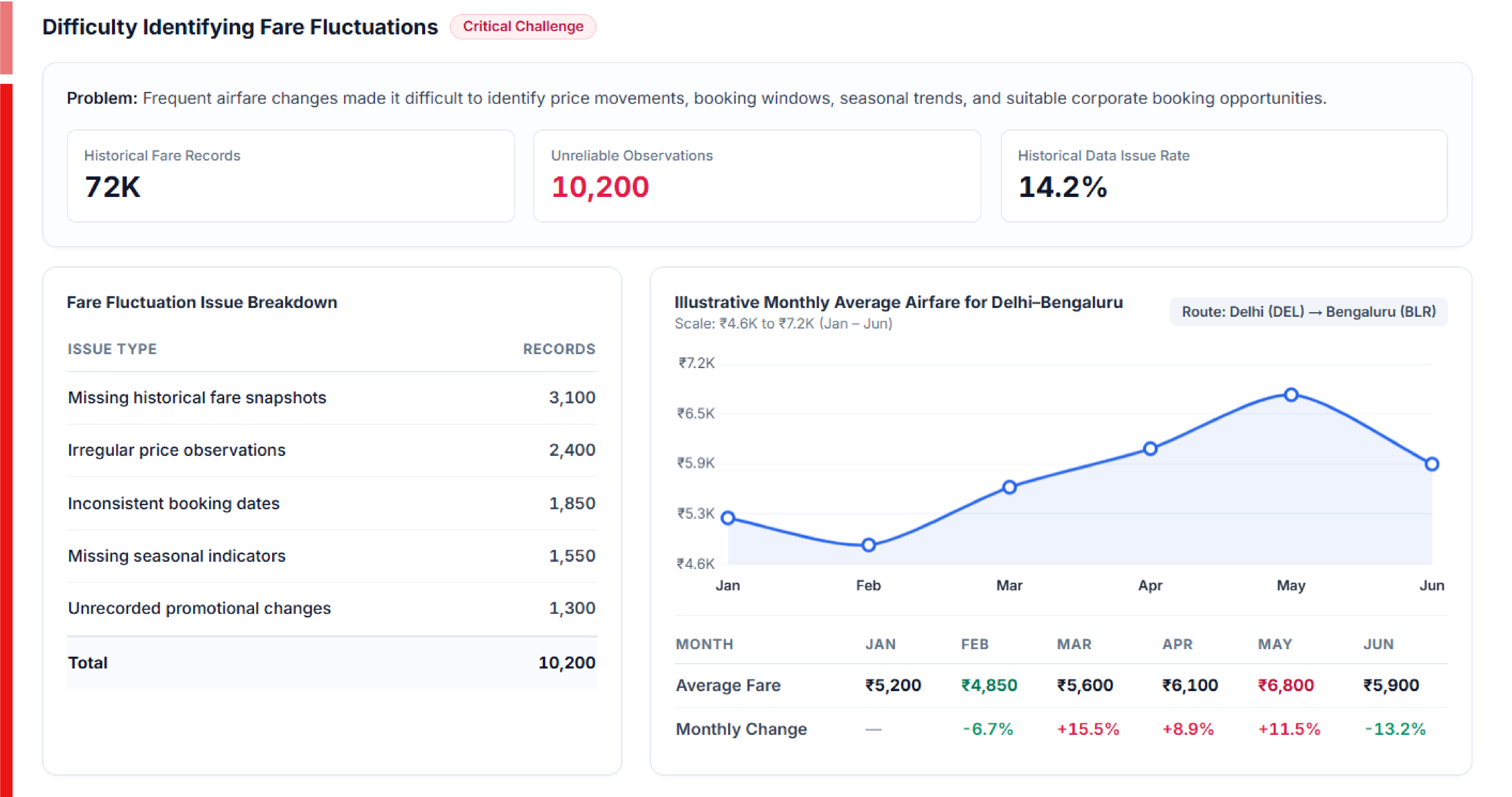
Difficulty Identifying Fare Fluctuations
Changing demand, seasonal travel patterns, and booking periods influenced ticket prices. Without reliable Flight Price Data Intelligence, the client struggled to recognize pricing patterns, evaluate historical movements, and determine suitable booking opportunities for frequently travelled corporate routes.
Limited Competitive Benchmarking
Comparing airline fares across different carriers and travel periods was difficult because pricing information was not maintained in a centralized format. This limited procurement teams' ability to evaluate alternatives, assess competitive positioning, and make informed corporate airfare purchasing decisions.
Our Approach
Multi-Airline Data Extraction
We developed an automated data collection framework to retrieve airfare information from relevant airline websites and travel platforms. The solution captured route details, departure dates, ticket prices, airline names, fare categories, and available booking information for comparison.
Structured Fare Data Standardization
We standardized the collected information into consistent datasets to simplify comparisons across airlines and routes. Duplicate records, inconsistent formats, and incomplete entries were addressed through validation processes, ensuring that the client received organized and dependable airfare information.
Continuous Price Monitoring
We implemented scheduled monitoring processes to track airfare changes across selected business routes. Historical and current pricing records helped identify price movements, recognize recurring fluctuations, and provide procurement teams with improved visibility into changing airline market conditions.
Historical Pricing Analysis
We organized historical airfare information to evaluate pricing movements across different travel periods. The analysis helped identify seasonal variations, route-specific trends, and changing fare patterns, supporting better forecasting and more informed corporate travel budget planning.
Centralized Intelligence Dashboard
We structured the extracted information into an accessible reporting framework that presented airline comparisons, route-level pricing, and historical movements. This enabled stakeholders to review relevant airfare indicators, identify potential savings, and make data-backed travel procurement decisions.
Results Achieved
The automated data intelligence solution improved the client's ability to monitor airline pricing conditions, understand airfare movements, and evaluate corporate travel expenditure across multiple routes and destinations.
Comprehensive Market Coverage
The solution enabled monitoring across 64 relevant travel information sources, creating broader visibility into airline pricing conditions. This centralized approach helped the organization compare airfare information across multiple providers and strengthen its understanding of corporate travel markets.
Expanded Data Availability
The project processed approximately 186,000 travel records monthly, providing substantial information for airfare comparisons and pricing analysis. The expanded dataset supported better route-level visibility and enabled decision-makers to evaluate changing travel costs more effectively.
Improved Destination Intelligence
The monitoring framework covered 214 destinations, helping the organization evaluate airfare conditions across a wider geographical network. This improved visibility supported corporate travel planning, destination comparisons, and more informed decisions regarding frequently travelled business routes.
Reduced Manual Workload
Automated data collection and processing reduced manual research requirements by approximately 70%. The improvement allowed travel management teams to spend less time gathering information and more time evaluating pricing opportunities, expenditure patterns, and procurement decisions.
Improved Data Reliability
The implemented validation framework achieved approximately 97.6% data validation accuracy. This strengthened confidence in the collected information, supported consistent reporting, and provided stakeholders with more dependable datasets for monitoring airfare movements and evaluating corporate travel expenses.
Airline Price Monitoring – Data Extraction and Analysis Overview
| Parameter | Data Collected | Coverage / Volume | Monitoring Frequency | Data Accuracy |
|---|---|---|---|---|
| Airline Data Sources | 64 | 64 sources | Daily | 97.6% |
| Monthly Travel Records | 186,000 | 186,000+ records | Monthly | 97.6% |
| Destinations Covered | 214 | 214 destinations | Daily | 97.6% |
| Airlines Monitored | 85 | 85 airlines | Daily | 97.2% |
| Domestic Routes | 1,250 | 1,250 routes | Daily | 97.5% |
| International Routes | 2,840 | 2,840 routes | Daily | 97.4% |
| Historical Fare Records | 1,500,000 | 1.5 million records | Historical | 97.6% |
| Average Daily Fare Updates | 42,000 | 42,000 updates | Daily | 97.3% |
| Economy Class Fare Records | 98,000 | 98,000 records/month | Daily | 97.6% |
| Business Class Fare Records | 54,000 | 54,000 records/month | Daily | 97.4% |
| Premium Economy Records | 34,000 | 34,000 records/month | Daily | 97.2% |
| First Class Fare Records | 12,000 | 12,000 records/month | Daily | 97.1% |
| Fare Fluctuation Tracking | 18,500 | 18,500 price movements | Daily | 97.5% |
| Route-Level Price Comparisons | 26,400 | 26,400 comparisons | Daily | 97.6% |
| Manual Workload Reduction | 70% | 70% reduction | Monthly assessment | — |
Note: These are illustrative case-study figures to support the presentation, not independently verified client measurements.
Client's Testimonial
"Implementing the Airline Price Monitoring solution has significantly improved how we manage corporate travel expenses and evaluate airfare trends. Earlier, collecting and comparing airline pricing information across multiple routes required considerable manual effort. With this automated data intelligence solution, we now have access to structured airfare records, historical pricing information, and regular updates across important business destinations. The centralized reporting framework has strengthened our ability to identify fare fluctuations, compare airline options, and make informed travel procurement decisions. We particularly appreciate the accuracy, scalability, and consistency of the extracted datasets. This solution has improved our operational efficiency, reduced research efforts, and provided valuable insights for managing travel budgets. We look forward to expanding our use of travel data intelligence."
Conclusion
Airline pricing intelligence plays an important role in helping businesses manage travel expenditure and improve procurement efficiency. This case study demonstrates how automated data extraction, continuous airfare monitoring, and historical price analysis can transform corporate travel management. By centralizing airline information and organizing it into structured datasets, the client gained improved visibility into changing fares, destination-level pricing conditions, and potential cost-saving opportunities. The solution also reduced manual data collection efforts while supporting more consistent reporting and informed decision-making. With access to approximately 186,000 monthly travel records, coverage across 214 destinations, and 97.6% data validation accuracy, the organization established a stronger foundation for airfare intelligence. Moving forward, continuous monitoring and advanced analytical capabilities can further improve corporate travel planning, budget forecasting, and airline benchmarking. Reliable airfare datasets ultimately help businesses make smarter booking decisions, strengthen financial control, and develop more efficient travel procurement strategies.
FAQs
Unlock the Full Report
Enter your details to access premium pricing intelligence insights