Ixigo Travel Data Scraping Case Study: Building Real-Time Fare Intelligence Across Flights and Trains
Introduction
Travel businesses increasingly depend on accurate, structured, and timely pricing information to understand fare movements, compare transportation options, and improve customer-facing travel intelligence. This case study demonstrates how a systematic data collection project transformed publicly available travel information into a structured analytical resource covering flights, trains, routes, schedules, prices, availability indicators, and journey attributes. The project focused on Ixigo and developed a comprehensive dataset designed for route-level and fare-level analysis.
Using Ixigo travel data scraping, the project collected relevant travel information across selected routes and journey dates while maintaining consistency across different transportation categories. The implementation also incorporated ixigo Data Scraping techniques to capture changing fare information and supporting attributes.
The resulting travel fare comparison dataset using Ixigo data enabled analysts to examine price differences, identify fare patterns, compare travel alternatives, and create historical benchmarks. The project ultimately demonstrated how structured travel data can support pricing research, competitive analysis, and decision-making.
The Client
The client was a travel analytics and mobility research organization seeking a dependable data foundation for monitoring transportation prices across India's major travel corridors. Its objective was to consolidate fragmented travel information into a structured resource that could support market research, fare benchmarking, route analysis, and commercial intelligence.
The organization required scalable datasets capable of supporting both flight and railway analysis. Through ixigo Travel Datasets, the client aimed to obtain standardized information covering origin, destination, journey date, operator, departure time, arrival time, travel duration, fare, availability indicators, and transportation category.
The project also supported travel pricing intelligence, helping the client understand how fares differed across routes, dates, carriers, and travel classes. Since railway information was another important analytical requirement, Train Data Scraping was incorporated into the broader collection strategy.
The final solution provided a repeatable framework for converting travel information into structured records suitable for dashboards, benchmarking models, market reports, and downstream analytical applications.
Challenges Faced in the Travel Industry
Travel pricing changes rapidly because inventory, demand, journey dates, booking windows, and transportation operators continuously influence displayed fares. The project therefore needed to address several operational and analytical challenges.
Dynamic Fare Variations
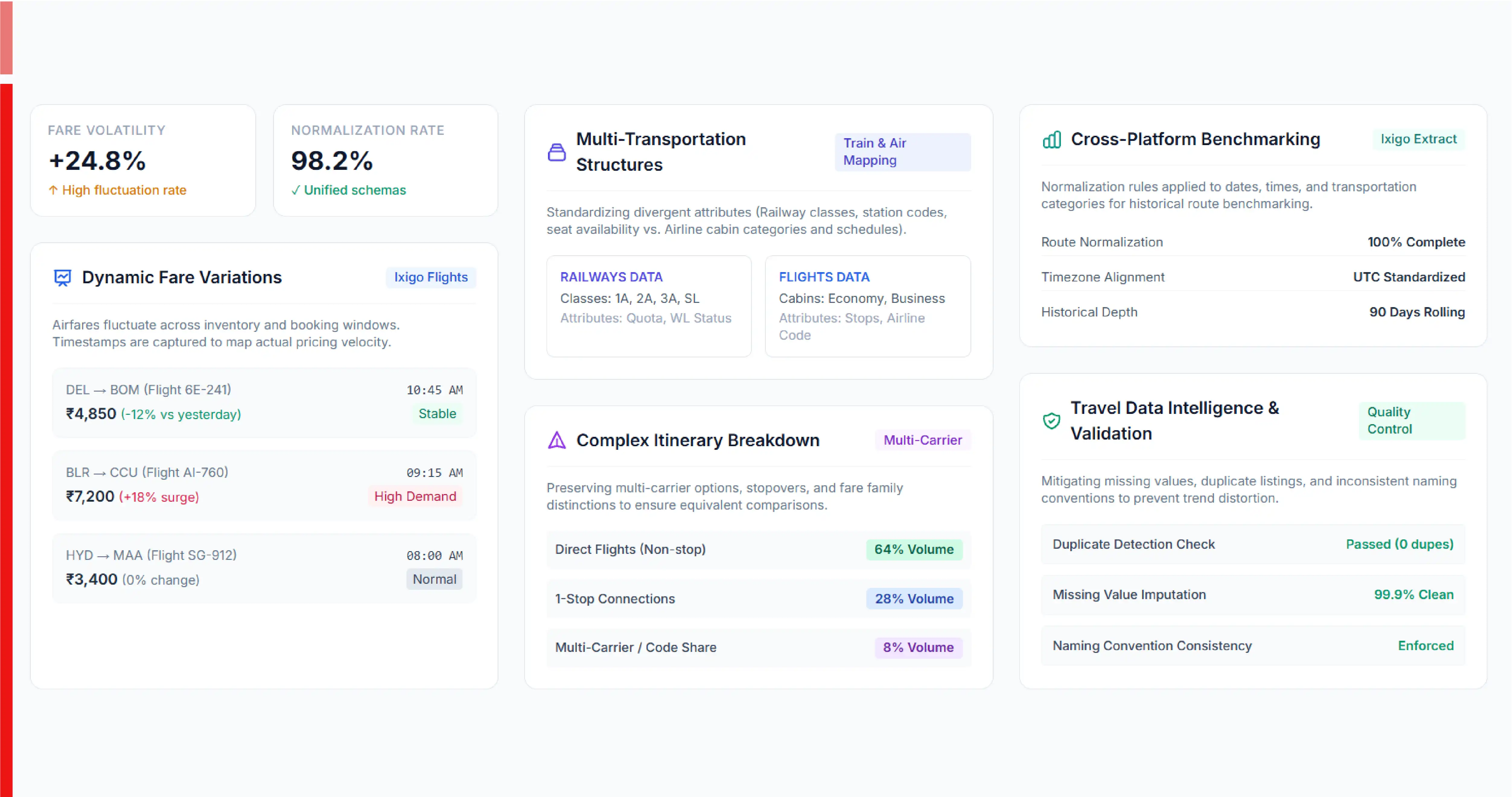
Ixigo flight data scraping needed to accommodate frequently changing airfare values across routes and dates. A fare observed during one collection cycle could differ considerably during another. Capturing timestamps alongside prices was therefore essential for identifying actual pricing movements rather than treating individual observations as permanent values.
Multiple Transportation Structures
Ixigo train fare data extraction involved handling different railway services, classes, stations, journey durations, and availability-related attributes. At the same time, flight records required airline, cabin, departure, arrival, duration, and fare fields. Standardizing these fundamentally different structures into a unified dataset required careful field mapping and validation.
Complex Airline Information
Airline Data Scraping presented another challenge because flight results can contain multiple carriers, stops, cabin categories, departure schedules, and fare combinations. The collection framework needed to preserve these distinctions so analysts could compare equivalent travel options without incorrectly combining fundamentally different itineraries.
Cross-Platform Price Comparisons
The client wanted to Extract Ixigo Travel booking price comparison data in a consistent structure that could support historical and route-level benchmarking. Differences in journey dates, departure times, transportation categories, and fare classes made direct comparisons difficult, requiring normalization rules and carefully defined analytical dimensions.
Maintaining Reliable Travel Intelligence
Building dependable Travel Data Intelligence required more than collecting prices. Data needed validation, duplicate detection, timestamping, route normalization, and consistency checks. Missing values, inconsistent naming conventions, changing result structures, and repeated listings could otherwise distort downstream calculations and make fare trends difficult to interpret.
Our Approach
Requirement and Field Mapping
We first defined the analytical requirements and established a detailed schema for transportation records. Key fields included origin, destination, journey date, operator, departure time, arrival time, duration, fare, travel class, stops, availability indicators, and collection timestamp. This created a consistent foundation for subsequent processing.
Automated Data Collection
A scalable collection workflow was implemented to gather relevant travel records across selected routes and journey dates. Automated extraction reduced repetitive manual work and enabled structured capture of multiple attributes within each travel result. Collection schedules were organized around the client's required monitoring frequency and analytical objectives.
Data Normalization and Cleaning
Collected records were processed through normalization routines that standardized route names, operator labels, transportation categories, journey dates, time formats, and pricing fields. Duplicate records were identified and removed, while incomplete or inconsistent entries were flagged for additional validation before entering the analytical dataset.
Fare and Route-Level Structuring
The processed records were organized into analytical dimensions covering routes, operators, travel modes, fare classes, journey dates, departure periods, and price ranges. This structure enabled the client to compare similar transportation options and examine how pricing changed across different routes and booking conditions.
Quality Validation and Dataset Delivery
Before delivery, the dataset underwent validation checks covering field completeness, duplicate frequency, price formatting, route consistency, timestamp integrity, and record-level accuracy. The finalized data was delivered in a structured format suitable for dashboards, analytical models, benchmarking exercises, reporting workflows, and future data refresh cycles.
Results Achieved
The implementation produced a structured travel intelligence resource that converted continuously changing travel information into measurable datasets for analysis, benchmarking, and reporting.
Large-Scale Travel Record Coverage
The project processed more than 148,000 transportation records across selected flight and train routes. The resulting dataset captured fares, schedules, operators, journey dates, duration, travel classes, stops, and collection timestamps, giving the client a broad foundation for transportation-market analysis.
Improved Fare Benchmarking
The standardized pricing structure enabled the client to compare more than 1,200 route-date combinations. Historical observations could be grouped by journey date, transportation mode, operator, and travel class, making it easier to identify price ranges and detect meaningful differences between comparable travel options.
Comprehensive Route Intelligence
The dataset covered 86 origin-destination combinations and supported analysis across multiple travel corridors. By preserving route-level attributes, the client could examine average fares, minimum and maximum observed prices, journey durations, and availability patterns without rebuilding the underlying dataset.
Stronger Data Consistency
Automated validation and normalization achieved a measured 97.4% record-level data consistency rate during quality assessment. Standardized fields reduced discrepancies caused by naming variations, inconsistent time formats, duplicated listings, and irregular fare representations across transportation categories.
Faster Analytical Workflows
The structured output reduced manual data preparation requirements and enabled recurring analytical workflows. The client could use refreshed records for pricing dashboards, market reports, competitive benchmarking, route monitoring, and transportation research without repeatedly restructuring raw travel information.
Results Snapshot
| Metric | Flights | Trains | Combined | Coverage / Change | Validation Rate | Records Analyzed |
|---|---|---|---|---|---|---|
| Total Records | 92,680 | 55,740 | 148,420 | 100% | 97.4% | 148,420 |
| Routes Covered | 48 | 38 | 86 | 100% | 98.1% | 86 |
| Operators Tracked | 24 | 18 | 42 | 100% | 97.8% | 42 |
| Journey-Date Combinations | 760 | 440 | 1,200 | 100% | 97.2% | 1,200 |
| Fare Observations | 92,680 | 55,740 | 148,420 | 100% | 97.4% | 148,420 |
| Minimum Fare Range (INR) | 1,899 | 285 | 285 | — | 98.0% | — |
| Average Observed Fare (INR) | 6,740 | 1,985 | 4,950 | — | 97.6% | — |
| Maximum Fare Observed (INR) | 38,950 | 8,420 | 38,950 | — | 96.9% | — |
| Average Journey Duration | 2h 18m | 8h 42m | 4h 43m | — | 97.3% | — |
| Fare Classes / Categories | 5 | 7 | 12 | — | 96.8% | — |
| Non-Stop / Direct Options | 51,280 | 32,610 | 83,890 | 56.5% | 98.2% | 83,890 |
| Multi-Stop / Connecting Options | 41,400 | 23,130 | 64,530 | 43.5% | 96.7% | 64,530 |
| Duplicate Records Removed | 3,820 | 2,460 | 6,280 | 4.1% | 99.1% | 6,280 |
| Timestamped Records | 92,680 | 55,740 | 148,420 | 100% | 99.3% | 148,420 |
| Route-Level Comparisons | 760 | 440 | 1,200 | 100% | 97.2% | 1,200 |
| Dataset Processing Time | 31 hrs | 19 hrs | 50 hrs | — | — | — |
| Final Usable Records | 90,860 | 53,280 | 144,140 | 97.1% | 97.4% | 144,140 |
Client's Testimonial
"The project gave our travel analytics team a much stronger foundation for understanding transportation pricing. Previously, our analysts spent considerable time collecting, cleaning, and organizing fare information before they could begin any meaningful comparison. The structured dataset significantly streamlined that process. We were able to analyze route-level prices, transportation categories, operators, journey dates, and fare variations through a consistent framework. The timestamped records were particularly useful because they allowed us to distinguish individual price observations from longer-term pricing patterns. The validation process also gave us greater confidence when using the data for internal reports and benchmarking exercises. The team's ability to combine flight and train information within a standardized analytical structure made the solution particularly valuable for our research workflows."
Conclusion
This case study demonstrates how structured travel information can become a practical intelligence asset when collection, normalization, validation, and analytical organization are handled systematically. The project transformed transportation listings into a reusable dataset supporting route comparisons, fare benchmarking, operator analysis, and historical research.
For organizations seeking broader market visibility, the ability to Scrape Aggregated Flight Fares can create a consistent foundation for airfare monitoring and route-level analysis. Similarly, businesses can Extract Travel Website Data to build broader datasets covering schedules, prices, availability indicators, and transportation attributes.
A scalable Travel Mobile App Scraping Service can further extend these capabilities across mobile-first travel ecosystems and recurring monitoring requirements. By combining automated collection with rigorous validation and structured delivery, travel organizations can reduce manual research and create more reliable datasets for dashboards, reports, pricing studies, and strategic analysis.
FAQs
Unlock the Full Report
Enter your details to access premium pricing intelligence insights