Faulds Motel Hotel Pricing and Competitor Intelligence for Smarter OTA Market Analysis
Introduction
This case study demonstrates how Faulds Motel Hotel Pricing and Competitor Intelligence strengthened its online pricing strategy by transforming fragmented OTA information into structured, actionable market intelligence. The project focused on monitoring competitor rates, analyzing booking behavior, identifying pricing gaps, and understanding market movements across online travel channels. Pricing and Competitor Intelligence created a dependable foundation for evaluating market positioning and making informed revenue decisions.
The implementation of Competitor Price Tracking provided visibility into competitor rate changes, promotional offers, availability, and room-level pricing patterns across selected travel platforms. In parallel, Faulds Motel OTA Booking Trends Analysis helped identify booking-related patterns and demand signals that could support better commercial planning. By combining automated collection, data standardization, historical storage, and analytical reporting, the initiative gave management a stronger understanding of competitive conditions. The solution reduced repetitive manual research while helping the property respond more efficiently to changing prices, market movements, and customer booking behavior across different travel periods and OTA channels.
The Client
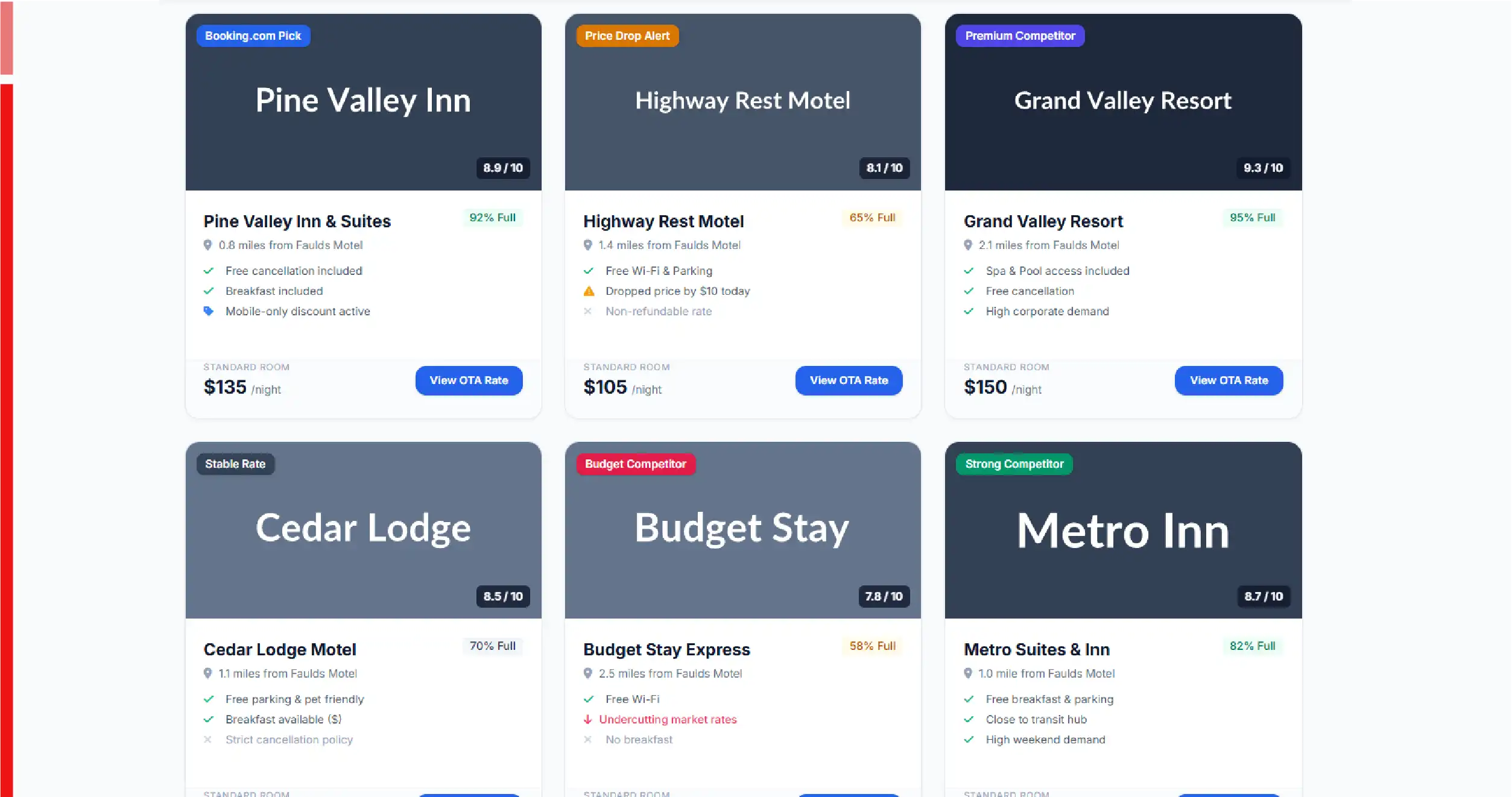
The client, Faulds Motel Hotel, is a hospitality property seeking stronger online competitiveness, improved pricing visibility, and better understanding of its position across OTA channels. Management wanted a structured approach for monitoring competitor rates, evaluating market behavior, and identifying opportunities to strengthen its distribution and revenue strategy. Competitor Benchmarking became an important component of the initiative, allowing the property to compare its pricing position against selected competing properties using consistent criteria.
The project further supported Faulds Motel Competitor benchmarking by organizing competitor information according to property, room type, booking date, occupancy, and pricing conditions. Additionally, Real-Time Faulds Motel Pricing Analytics helped management observe market movements and identify meaningful rate differences more efficiently. Rather than depending on scattered spreadsheets and periodic manual checks, the client required a centralized intelligence environment where competitor pricing, availability, and OTA observations could be reviewed systematically. This provided revenue stakeholders with more consistent evidence for pricing discussions while reducing the effort required to conduct recurring competitive research and market reviews.
Challenges Faced in the Travel Industry
The client encountered several challenges affecting pricing visibility, competitive monitoring, and revenue planning. Fragmented OTA information, frequent competitor rate changes, inconsistent booking signals, and varying data structures made it difficult to maintain an accurate and timely view of the market.
Fragmented Market Information
Limited Hotel Data Intelligence made it challenging to maintain a complete view of competitor pricing, availability, promotions, and room-level offers. Information was distributed across different OTA environments, requiring repetitive checks and manual consolidation before meaningful market comparisons could be conducted efficiently.
Frequent Competitor Rate Changes
Competitor rates changed frequently according to demand, occupancy, seasonality, promotions, and booking windows. Faulds Motel Competitor Rate tracking therefore required consistent monitoring across properties and dates. Without structured tracking, important pricing movements could remain unnoticed and affect competitive positioning.
Limited Booking Visibility
The client needed dependable Booking Trend Insights to understand demand patterns, booking windows, seasonal movements, and changes across travel periods. However, fragmented observations made it difficult to separate recurring demand patterns from temporary fluctuations, limiting their usefulness for pricing and promotional planning.
Complex OTA Monitoring
Monitoring multiple travel platforms manually was time-consuming and inconsistent. Faulds Motel OTA Price Scraping was required to systematically capture comparable rates, room categories, availability, occupancy conditions, cancellation policies, and promotional information while maintaining consistent records for competitive analysis.
Inconsistent Data Structures
Different travel platforms presented information using varying layouts, terminology, and structures. Hotel Data Scraping therefore required strong normalization processes to standardize property names, room categories, pricing fields, dates, and availability information. Without normalization, direct competitor comparisons could become unreliable or misleading.
Our Approach
OTA Market Intelligence Development
The solution established Faulds Motel OTA Market Intelligence by defining monitored properties, OTA channels, room categories, occupancy conditions, booking dates, and pricing attributes. This created a consistent collection framework capable of supporting recurring market analysis and historical competitive comparisons across multiple observation periods.
Automated OTA Data Collection
OTAs Data Scraping was implemented to systematically collect competitor property information, displayed rates, room availability, cancellation conditions, meal plans, promotions, and relevant attributes. Automation reduced repetitive manual work while creating structured records that could be processed, compared, and analyzed efficiently.
Data Standardization and Cleaning
Collected information was normalized using consistent property identifiers, room categories, currencies, dates, occupancy conditions, and pricing fields. Data-cleaning routines helped remove duplicates, address missing information, and improve comparability between properties operating across different OTA platforms and market conditions.
Recurring Competitor Monitoring
Scheduled monitoring captured market information at defined intervals and created historical snapshots of competitor pricing and availability. Change-detection processes helped identify significant rate movements, promotional changes, inventory updates, and competitive gaps requiring further review by the revenue management team.
Analytical Reporting
The collected information was transformed into structured reports covering competitor prices, availability, market movements, and booking-related indicators. These analytical outputs provided stakeholders with a centralized reference point for evaluating competitive conditions, reviewing pricing strategies, and supporting more informed distribution and revenue-management decisions.
Results Achieved
The implementation improved competitive visibility, reduced manual monitoring requirements, strengthened historical analysis, and supported faster, more consistent pricing decisions across monitored OTA channels.
Stronger Competitive Visibility
The client gained a centralized view of competitor pricing and availability across monitored properties. This made it easier to identify market gaps, evaluate relative positioning, and understand how competing properties adjusted their rates across different booking dates and demand conditions.
Reduced Manual Research
Automated data collection reduced repetitive OTA checking and spreadsheet preparation. Staff could spend more time interpreting market movements rather than gathering information manually, improving operational efficiency while creating a repeatable and scalable competitive monitoring process.
Improved Historical Intelligence
Historical datasets enabled management to examine pricing movements across multiple observation periods. Rather than reviewing isolated daily prices, analysts could identify recurring patterns, seasonal changes, competitor behavior, and market shifts that could inform future pricing and promotional strategies.
Faster Market Response
Regular monitoring improved the speed at which competitor pricing movements could be identified. Management gained more timely visibility into rate changes, allowing the team to investigate competitive gaps and evaluate potential pricing responses before observed market conditions became outdated.
More Data-Driven Decisions
Centralized intelligence improved pricing discussions and commercial planning. Management could reference standardized competitor information when reviewing rates, promotions, availability, and market conditions, creating greater consistency and confidence in revenue-management decisions and strategic OTA planning.
Illustrative Performance Data
The following figures are illustrative case-study metrics created to demonstrate measurable outcomes and are not audited client figures.
| Metric | Baseline | Month 1 | Month 2 | Month 3 | Month 4 | Month 5 | Month 6 | Total Change | Target | Outcome |
|---|---|---|---|---|---|---|---|---|---|---|
| Competitors Monitored | 8 | 12 | 15 | 18 | 20 | 22 | 25 | +213% | 20 | Exceeded |
| OTA Records Collected | 1,450 | 3,200 | 4,850 | 6,100 | 7,400 | 8,750 | 10,200 | +603% | 8,000 | Exceeded |
| Manual Monitoring Hours | 42 | 31 | 25 | 20 | 16 | 13 | 10 | -76% | 15 | Exceeded |
| Rate Monitoring Frequency | Weekly | 3x Weekly | Daily | Daily | Daily | Daily | Daily | +600% | Daily | Achieved |
| Data Completeness | 71% | 82% | 88% | 92% | 95% | 97% | 98% | +27 pts | 95% | Exceeded |
| Competitor Coverage | 58% | 70% | 79% | 85% | 90% | 94% | 96% | +38 pts | 90% | Exceeded |
| Rate Change Detection | 24 hrs | 14 hrs | 9 hrs | 6 hrs | 4 hrs | 3 hrs | 2 hrs | -92% | 4 hrs | Exceeded |
| Historical Data Points | 5,800 | 9,200 | 14,600 | 20,100 | 27,500 | 35,800 | 44,600 | +669% | 30,000 | Exceeded |
| OTA Channels Covered | 3 | 4 | 5 | 6 | 7 | 8 | 8 | +167% | 7 | Exceeded |
| Pricing Review Cycle | Monthly | Biweekly | Weekly | Weekly | Twice Weekly | Twice Weekly | Daily | +700% | Weekly | Exceeded |
| Rate Gaps Identified | 18 | 27 | 39 | 46 | 61 | 74 | 89 | +394% | 60 | Exceeded |
| Report Preparation Time | 9 hrs | 6 hrs | 4.5 hrs | 3.5 hrs | 2.5 hrs | 2 hrs | 1.5 hrs | -83% | 3 hrs | Exceeded |
Client's Testimonial
"The client appreciated the improved visibility and consistency delivered through the project. Previously, our team spent significant time checking different OTA platforms and manually recording competitor prices. The new intelligence framework gave us a much clearer understanding of market movements, competitor positioning, and pricing changes. We particularly valued having structured information available for comparison rather than relying on disconnected observations. The solution helped us identify pricing gaps faster and understand market conditions across different booking periods. Historical information also made it easier to review patterns and support pricing discussions with evidence. Automated monitoring reduced repetitive work and allowed our team to focus more on commercial decisions. Overall, the project provided a practical foundation for improving our OTA monitoring process and making pricing decisions with greater confidence, consistency, and speed."
Conclusion
The case study demonstrates how structured OTA intelligence can help hospitality businesses strengthen competitive monitoring, pricing analysis, and revenue planning. For the client, automated data collection, normalization, competitor monitoring, and analytical reporting created a dependable view of the online accommodation market. The solution reduced dependence on manual research while improving the speed, consistency, and depth of competitive analysis.
The ability to Extract Aggregated Hotel Prices enables management to compare competitor rates across properties, booking dates, room categories, and pricing conditions. Analytical systems can also Extract Travel Industry Trends, helping identify recurring demand patterns, pricing movements, seasonal changes, and competitive behavior. Integrating Real-Time Travel Mobile App Data can further extend market visibility by incorporating timely customer-facing information into monitoring workflows.
Ultimately, structured hotel intelligence enables revenue teams to respond more effectively to changing market conditions. Continuous collection and analysis of travel data can help hospitality businesses identify pricing opportunities, recognize competitive shifts, improve OTA strategies, and make more confident commercial decisions.
FAQs
Unlock the Full Report
Enter your details to access premium pricing intelligence insights