
Direct vs OTA Hotel Price Data Scraping for Analyzing Price Gaps Across European Hotel Chains and Booking Platforms
Introduction
The hotel industry operates through multiple booking channels, including official hotel websites, online travel agencies (OTAs), metasearch platforms, and third-party travel applications. Although these channels frequently display the same property and room categories, their advertised prices can differ because of commissions, promotional discounts, loyalty benefits, taxes, cancellation policies, and channel-specific pricing strategies. Understanding these differences is essential for hotels seeking to improve profitability, maintain rate consistency, and strengthen their distribution strategies.
Direct vs OTA Hotel Price Data Scraping enables businesses to collect, organize, and compare hotel prices published across official booking websites and third-party reservation platforms. This process provides visibility into how room rates change across distribution channels, destinations, booking dates, and customer segments. It also helps identify instances where third-party platforms advertise lower prices than the hotel's official website.
OTAs Data Scraping supports systematic extraction of hotel listings, room categories, available rates, promotional offers, taxes, cancellation conditions, and booking availability from online travel agencies. When combined with hotel-owned website information, these insights create a comprehensive view of hotel distribution performance.
A structured direct vs OTA hotel price comparison dataset helps revenue managers, hotel chains, travel technology providers, and hospitality analysts evaluate pricing differences using consistent parameters. It supports channel benchmarking, promotional monitoring, revenue optimization, and distribution strategy development across domestic and international hotel markets.
Understanding Direct Hotel Booking and OTA Pricing Structures
Direct hotel booking refers to reservations completed through a property's official website, mobile application, call center, or authorized direct sales channel. Hotels generally use direct channels to maintain greater control over customer relationships, booking conditions, loyalty incentives, and guest communication.
Online travel agencies such as Booking.com, Expedia, Agoda, and Hotels.com provide another important distribution channel. They aggregate accommodation inventory and allow travelers to compare properties, room categories, amenities, and prices through centralized booking interfaces.
The difference between direct and OTA pricing is not always straightforward. A hotel may advertise a standard room for €150 on its website while an OTA displays it for €142 after applying a promotional discount. Another OTA might display €155 but include breakfast or flexible cancellation.
Therefore, meaningful price comparisons require more than collecting headline prices. Businesses must examine the complete booking conditions associated with every displayed rate.
Important comparison parameters include:
- Base room price and discounted selling price.
- Taxes, service charges, and additional fees.
- Breakfast and other meal inclusions.
- Refundable and non-refundable conditions.
- Room category and occupancy limits.
- Loyalty discounts and membership benefits.
- Mobile-only and app-exclusive promotions.
- Currency conversion and regional pricing.
- Booking dates and length of stay.
- Availability and minimum-stay restrictions.
How Direct vs OTA Hotel Price Data Scraping Works?
The data collection process begins by identifying official hotel booking websites and relevant OTA platforms. These sources are monitored using predefined search parameters, including destination, property name, check-in date, check-out date, room occupancy, and currency.
The extraction system collects available pricing information from each source and organizes it into a standardized structure. This allows analysts to compare identical or equivalent room products across booking channels.
The process generally involves five stages.
- Source Identification: Identify hotel websites, OTA platforms, regional booking portals, and metasearch sources relevant to the target market.
- Data Extraction: Collect property names, room categories, nightly rates, promotional discounts, taxes, availability, and booking conditions.
- Data Standardization: Normalize currencies, occupancy details, room descriptions, meal inclusions, and cancellation policies to make comparisons consistent.
- Price Matching: Match equivalent hotels, room types, occupancy configurations, and booking dates across different channels.
- Analysis and Reporting: Calculate pricing differences, identify discount patterns, monitor channel competitiveness, and generate structured reports for revenue management teams.
This approach makes Hotel Data Scraping particularly valuable for identifying pricing inconsistencies that may remain unnoticed when hotel and OTA rates are monitored separately.
Direct vs OTA Hotel Price Comparison: Key Market Observations
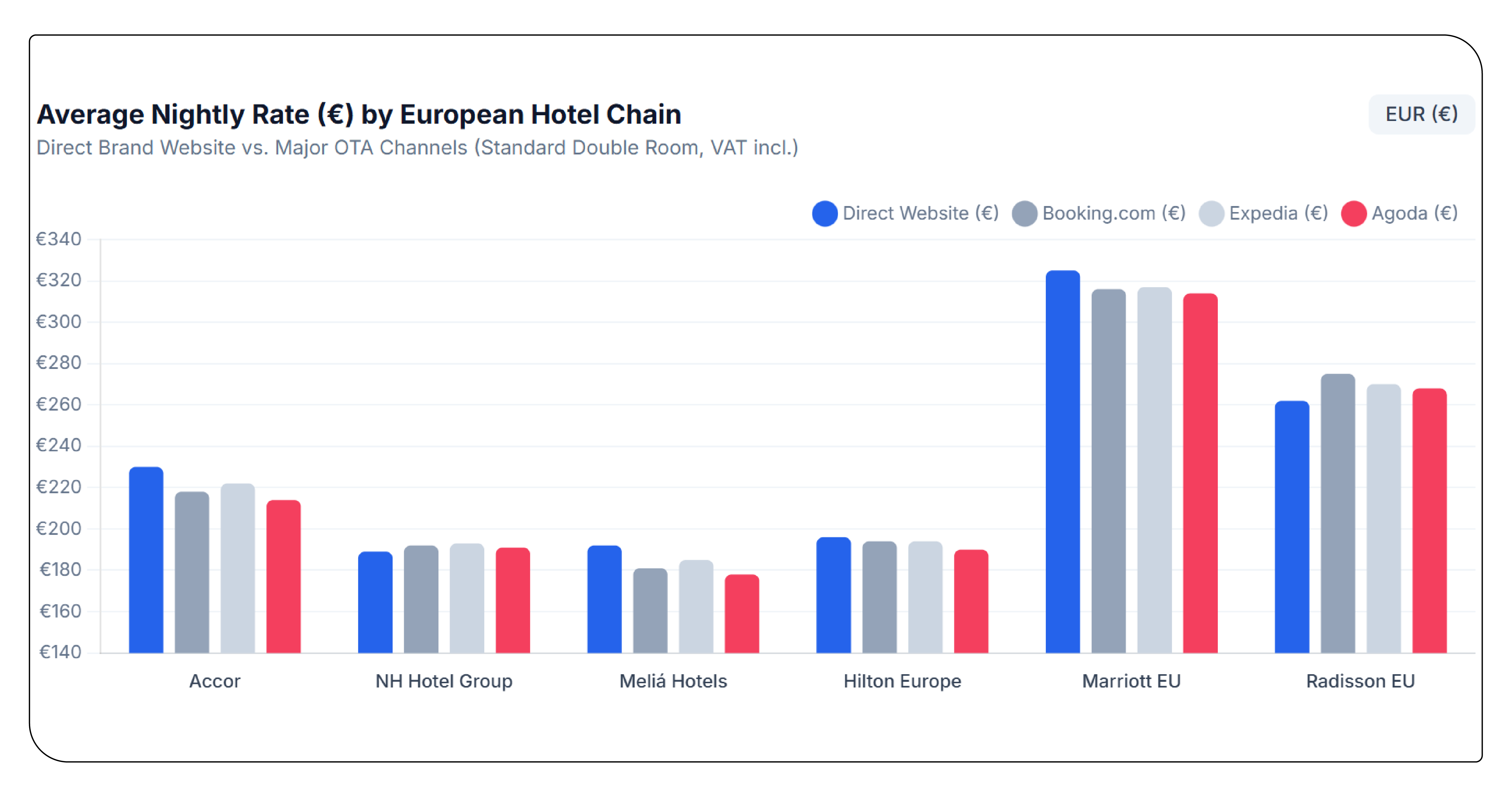
Direct and OTA booking prices can vary considerably depending on the destination, hotel category, booking period, promotional strategy, and distribution agreement.
For example, an international hotel chain may maintain a standard rate across its official website and several OTA platforms while providing additional discounts through loyalty membership. Similarly, an OTA may offer a platform-funded coupon that reduces the customer's final payable amount without changing the hotel's underlying contracted rate.
Three important pricing situations frequently emerge.
- Direct Channel Advantage: Official websites provide lower prices through loyalty discounts, member-only offers, or direct booking promotions.
- OTA Channel Advantage: Third-party platforms display lower customer-facing prices through promotional campaigns, coupons, or app-exclusive discounts.
- Rate Parity: Equivalent room products maintain similar prices across official and third-party booking channels.
A hotel should not automatically interpret every difference as a distribution problem. Differences in taxes, inclusions, cancellation flexibility, and promotional eligibility can explain variations between displayed prices.
Illustrative Direct vs OTA Hotel Price Comparison Dataset
The following hypothetical dataset demonstrates how hotel rates can be collected and compared across different booking channels. Prices are expressed in euros (€) for a one-night stay, based on two adults.
| Hotel | Direct Rate (€) | Booking.com (€) | Expedia (€) | Agoda (€) | Lowest Rate (€) | Direct vs Lowest Gap (€) | Direct Premium (%) |
|---|---|---|---|---|---|---|---|
| ibis Paris Gare de Lyon | 150 | 145 | 148 | 142 | 142 | 8 | 5.63% |
| Novotel London West | 180 | 175 | 169 | 172 | 169 | 11 | 6.51% |
| Holiday Inn Express Berlin City Centre | 125 | 120 | 123 | 118 | 118 | 7 | 5.93% |
| Hilton Garden Inn Frankfurt City Centre | 220 | 210 | 215 | 205 | 205 | 15 | 7.32% |
| Premier Inn London City (Aldgate) | 160 | 155 | 158 | 152 | 152 | 8 | 5.26% |
| Mercure Amsterdam City Hotel | 195 | 188 | 190 | 185 | 185 | 10 | 5.41% |
| Holiday Inn Paris Gare de l'Est | 140 | 135 | 132 | 138 | 132 | 8 | 6.06% |
| Radisson Blu Hotel, Berlin | 250 | 240 | 245 | 235 | 235 | 15 | 6.38% |
| Hampton by Hilton Amsterdam Centre East | 175 | 168 | 172 | 165 | 165 | 10 | 6.06% |
| NH Collection Barcelona Gran Hotel Calderón | 205 | 198 | 200 | 192 | 192 | 13 | 6.77% |
Note: Hotel names are real property examples, but all prices and calculated comparisons are hypothetical, not verified live rates. Actual prices vary by booking date, room type, occupancy, taxes, and cancellation conditions.
Illustrative research data, not live hotel quotations. Direct premium is calculated against the lowest OTA rate.
The comparison demonstrates how direct prices can exceed the lowest OTA-listed prices even when the same property is being evaluated. Hotel Hilton Garden Inn Frankfurt City Centre and Hotel Radisson Blu Hotel, Berlin show relatively large absolute differences, indicating opportunities for closer examination of promotional and distribution strategies.
Hotels can use such comparisons to identify properties with recurring pricing gaps, investigate third-party discounts, and determine whether direct booking incentives require adjustment.
Major Factors Influencing Direct and OTA Price Differences
Several commercial and operational factors influence hotel pricing across booking channels.
Distribution Commissions: OTAs generally operate through commission-based or other commercial distribution arrangements. These costs influence hotel profitability and can affect how properties manage their pricing strategies.
Promotional Campaigns: OTAs frequently introduce seasonal promotions, coupon codes, flash sales, and targeted discounts. These campaigns can create temporary differences between official hotel prices and third-party offers.
Loyalty Programs: Hotel chains provide exclusive benefits to registered members, including discounted rates, reward points, complimentary upgrades, and additional services. These benefits can make direct booking more attractive.
Geographic Pricing: Hotels and booking platforms may present different prices depending on currency, market, customer location, or regional promotional eligibility.
Demand Fluctuations: During holidays, festivals, major exhibitions, and sporting events, hotel prices can change rapidly. Different booking channels may update their displayed rates at different times.
Cancellation Conditions: Flexible and non-refundable bookings often carry different prices. Comparing these products without considering their conditions can produce misleading conclusions.
Monitoring these factors through direct vs OTA hotel price gap analysis provides a more accurate understanding of competitive positioning and distribution-channel performance.
Hotel Chain Benchmarking and Direct Booking Rate Monitoring
Hotel chains operate across multiple destinations, property categories, and distribution networks. Their pricing strategies must accommodate different demand conditions while maintaining consistency in brand positioning.
For example, a hotel group may offer similar room categories across several properties but use different direct booking discounts depending on local demand and competitive pressure.
Monitoring competitor rates across these properties helps revenue managers identify pricing opportunities and potential distribution weaknesses.
Hotel Chains Data Scraping makes it possible to collect structured information from multiple hotel brands and their associated booking channels. This includes property-level prices, room availability, promotional offers, loyalty benefits, and booking conditions.
Important applications include:
- Comparing room prices across competing hotel brands.
- Monitoring direct booking discounts by property and destination.
- Identifying recurring OTA promotional campaigns.
- Evaluating rate differences between premium and economy properties.
- Tracking seasonal pricing changes across hotel portfolios.
- Comparing loyalty-member rates with publicly displayed prices.
Hotels can also use these datasets for hotel direct booking rates tracking, helping them evaluate whether their official websites remain competitive against third-party booking platforms.
Illustrative Hotel Channel Performance and Pricing Intelligence Dataset
This hypothetical dataset demonstrates how hotel businesses can monitor direct and OTA rates alongside additional operational and commercial indicators.
| Hotel Chain | Properties Monitored | Direct Avg. Rate (€) | OTA Avg. Rate (€) | Average Gap (€) | OTA Discount (%) | Direct Booking Share (%) | Availability (%) | Monthly Price Updates |
|---|---|---|---|---|---|---|---|---|
| Accor | 85 | 165 | 158 | 7 | 4.24% | 38 | 91 | 2,550 |
| Marriott International | 120 | 190 | 181 | 9 | 4.74% | 42 | 88 | 3,600 |
| IHG Hotels & Resorts | 65 | 135 | 129 | 6 | 4.44% | 35 | 94 | 1,950 |
| Hilton | 150 | 210 | 198 | 12 | 5.71% | 46 | 86 | 4,500 |
| Premier Inn | 95 | 175 | 169 | 6 | 3.43% | 41 | 92 | 2,850 |
| Radisson Hotel Group | 110 | 155 | 147 | 8 | 5.16% | 33 | 89 | 3,300 |
| Hyatt Hotels Corporation | 75 | 225 | 214 | 11 | 4.89% | 49 | 87 | 2,250 |
| Wyndham Hotels & Resorts | 130 | 185 | 176 | 9 | 4.86% | 44 | 90 | 3,900 |
| Choice Hotels International | 55 | 145 | 139 | 6 | 4.14% | 37 | 93 | 1,650 |
| NH Hotel Group | 100 | 200 | 189 | 11 | 5.50% | 47 | 85 | 3,000 |
Note: Hotel chain names are real brands. All numerical values are illustrative research figures, not verified company-reported statistics or live pricing data.
Illustrative dataset for analytical purposes. OTA discount is calculated relative to the direct average rate. Property counts, booking shares, availability, and update volumes are hypothetical.
This dataset illustrates how pricing intelligence can extend beyond individual hotel comparisons. Revenue managers can evaluate average rate differences, direct booking contribution, OTA discount intensity, and property availability across entire hotel portfolios.
For example, Chain Hilton has the highest average price gap in this sample, while Chain Hyatt Hotels Corporation records the highest direct booking share. Such observations can help identify areas requiring further investigation, although actual commercial performance would also depend on booking volumes, margins, occupancy, and customer acquisition costs.
Role of Hotel Pricing Data APIs in Automated Monitoring
Manual hotel price monitoring becomes increasingly difficult when businesses need to track hundreds of properties across several booking platforms and multiple travel dates.
An automated OTA hotel pricing data API can provide structured access to collected hotel pricing information through standardized data formats such as JSON or CSV.
These integrations allow businesses to connect pricing datasets with revenue management systems, business intelligence dashboards, internal databases, and hotel performance applications.
Common API data fields include:
- Hotel identification and property location.
- Booking platform and source information.
- Check-in and check-out dates.
- Room type and occupancy.
- Published price and discounted price.
- Taxes and additional charges.
- Cancellation and refund conditions.
- Availability and booking restrictions.
- Currency and timestamp.
- Promotional offer details.
Automated integrations can also support scheduled collection, historical price storage, competitor monitoring, and alert generation when significant rate differences emerge.
For larger hotel portfolios, API-based monitoring reduces repetitive data collection and makes pricing intelligence easier to distribute across revenue management and commercial teams.
Business Applications of Direct vs OTA Hotel Pricing Intelligence
Structured hotel pricing information supports several important business decisions.
- Revenue Management: Hotels can evaluate competitor rates and adjust room pricing according to demand, occupancy, booking windows, and seasonal patterns.
- Distribution Optimization: Comparing direct and third-party rates helps businesses understand how effectively different channels contribute to their distribution strategy.
- Promotional Evaluation: Historical pricing information reveals whether OTA campaigns create meaningful customer-facing discounts or temporary pricing differences.
- Competitor Benchmarking: Hotel operators can compare similar properties within specific destinations, star categories, and customer segments.
- Market Research: Travel technology companies and hospitality analysts can examine price movements across destinations, brands, and booking platforms.
- Customer Experience: Comparing room inclusions, cancellation policies, and final payable amounts helps hotels develop more transparent and competitive direct booking experiences.
Challenges in Direct vs OTA Hotel Price Data Scraping
Despite its advantages, hotel pricing data collection presents several technical and analytical challenges.
- Dynamic Pricing: Hotel prices can change multiple times throughout the day, requiring consistent monitoring and accurate timestamps.
- Room Matching: Different platforms may use different descriptions for equivalent room categories, making accurate product matching essential.
- Promotional Complexity: Member-only discounts, mobile offers, coupon codes, and regional campaigns can create pricing differences that require additional classification.
- Currency Standardization: International hotel comparisons require consistent currency conversion and clear separation of exchange-rate movements from actual price changes.
- Availability Changes: A displayed rate may disappear when room inventory changes, making historical availability tracking important.
- Data Quality: Duplicate listings, incomplete room descriptions, missing taxes, and inconsistent property identifiers can affect analysis.
Businesses should also respect website terms, applicable laws, access restrictions, and privacy requirements when collecting publicly available commercial information. Reliable monitoring requires appropriate technical infrastructure, validation procedures, and responsible collection practices.
Conclusion
Comparing direct hotel booking prices with OTA rates provides valuable insights into distribution performance, competitive positioning, and hospitality pricing strategies. Hotels need visibility into how their official website rates compare with third-party platforms, particularly when promotional campaigns, loyalty discounts, and seasonal demand create changing price differences.
A well-organized hotel pricing dataset helps revenue managers identify pricing gaps, evaluate booking-channel performance, monitor competitor promotions, and understand how different distribution platforms influence customer-facing prices.
Real-Time Price Intelligence enables hospitality businesses to observe changing hotel rates and identify important pricing movements across booking channels.
Hotel competitor pricing analytics helps revenue management teams evaluate competitor positioning, benchmark similar properties, and develop informed pricing strategies.
Finally, OTA Price Intelligence provides a structured understanding of third-party promotions, room availability, rate differences, and distribution-channel competitiveness. By combining direct website monitoring with OTA data collection, hotels can strengthen their pricing decisions, improve distribution efficiency, and develop more competitive booking experiences.
Ready to elevate your travel business with cutting-edge data insights? Scrape Aggregated Flight Fares to identify competitive rates and optimize your revenue strategies efficiently. Discover emerging opportunities with tools to Extract Travel Website Data, leveraging comprehensive data to forecast market shifts and enhance your service offerings. Real-Time Travel App Data Scraping Services helps stay ahead of competitors, gaining instant insights into bookings, promotions, and customer behavior across multiple platforms. Get in touch with Travel Scrape today to explore how our end-to-end data solutions can uncover new revenue streams, enhance your offerings, and strengthen your competitive edge in the travel market.
Unlock the Full Report
Enter your details to access premium pricing intelligence insights