Taj Hotel Mumbai Market Analysis — Pricing, Demand, Reviews & Booking Trends
Introduction
Mumbai's luxury hospitality market has evolved into one of Asia's most competitive accommodation sectors, supported by consistent domestic travel, expanding international tourism, corporate headquarters, financial institutions, entertainment industries, and world-class event infrastructure. Among all luxury hotel brands, Taj Hotels continues to command significant influence because of its historic reputation, premium guest experiences, diversified property portfolio, and customer loyalty.
This Taj hotel Mumbai Market Analysis evaluates the operational and commercial performance of Taj properties by examining pricing behavior, occupancy patterns, booking demand, competitor positioning, and customer satisfaction. A detailed Market Share Analysis further explains Taj's standing within Mumbai's luxury accommodation landscape, while Taj Hotel Mumbai dynamic pricing intelligence demonstrates how advanced pricing models help maximize revenue by responding to demand fluctuations, competitor pricing, and booking trends.
Mumbai Luxury Hospitality Market Overview
Mumbai remains India's commercial capital and welcomes millions of travelers annually for business meetings, financial conferences, exhibitions, entertainment events, weddings, healthcare services, and leisure vacations. Luxury hotels benefit from year-round demand, although occupancy levels vary depending on festivals, holiday seasons, international conferences, and corporate travel cycles.
Unlike many metropolitan markets, Mumbai experiences a balanced mix of domestic and international travelers. Business visitors dominate weekdays, while weekends increasingly attract leisure travelers seeking premium staycations and heritage experiences. This balanced customer profile allows luxury hotels to maintain relatively stable occupancy throughout the year while implementing flexible pricing strategies to capitalize on peak demand periods.
The Taj portfolio benefits significantly from its iconic brand value, waterfront locations, premium dining experiences, wellness facilities, banquet infrastructure, and long-standing reputation among international travelers. These advantages enable the brand to maintain higher average daily rates compared to several competing luxury properties.
Competitive Landscape and Market Position
Competition within Mumbai's luxury hospitality market has intensified as both domestic and international hotel brands continue expanding their premium offerings. Hotels compete not only through room quality but also through personalized guest experiences, loyalty programs, dining excellence, digital booking convenience, and conference facilities.
Major competitors include The Oberoi Mumbai, Trident Nariman Point, St. Regis Mumbai, Four Seasons Mumbai, JW Marriott Mumbai, ITC Maratha, Grand Hyatt Mumbai, and Sofitel BKC. While each property targets premium travelers, Taj differentiates itself through heritage appeal, exceptional customer service, luxury experiences, and extensive brand loyalty.
Revenue managers continuously monitor competitor pricing, occupancy levels, promotional campaigns, and booking pace to maintain pricing competitiveness without compromising brand positioning. This competitive intelligence has become increasingly important as travelers compare multiple booking platforms before making reservations.
Pricing Intelligence and Revenue Strategy
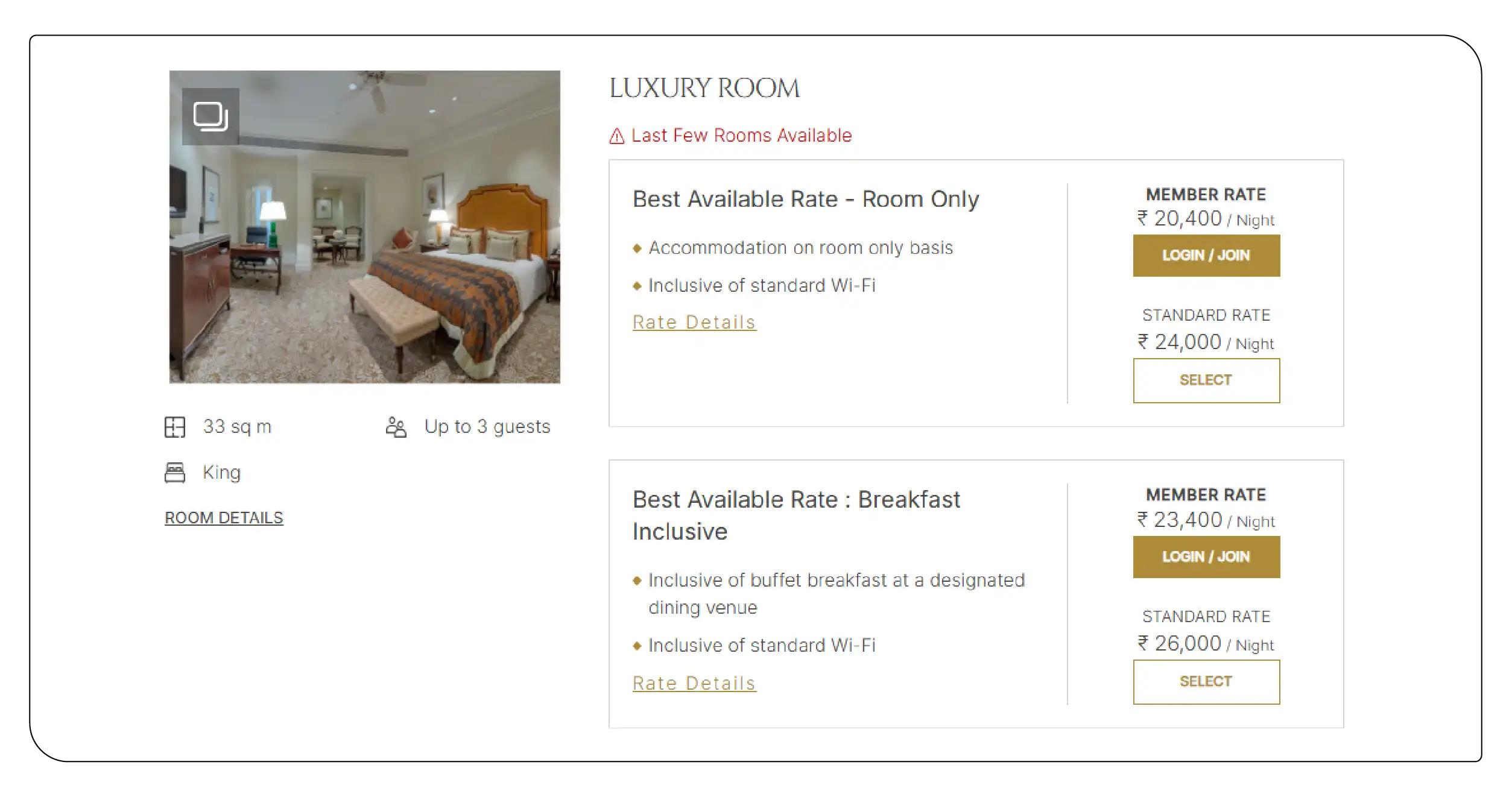
Luxury hotel pricing has become significantly more dynamic than traditional seasonal pricing models. Instead of fixed room rates, hotels now adjust prices several times daily according to occupancy forecasts, competitor prices, local events, airline arrivals, booking windows, customer segments, and online demand signals.
Modern revenue management systems process thousands of pricing variables simultaneously, enabling hotels to maximize revenue while maintaining healthy occupancy. Corporate contracts, loyalty memberships, advance purchase discounts, flash promotions, and mobile-exclusive offers further contribute to pricing complexity.
Continuous Booking Trend Insights enable revenue managers to identify emerging booking patterns and adjust inventory allocation across multiple distribution channels. Comparing Taj Hotel Mumbai room rates comparison across official websites and online travel agencies also helps identify pricing inconsistencies and optimize rate parity.
Key Metrics Used in Vietnam Travel Review Analysis
The following dataset illustrates representative review intelligence metrics collected across Vietnam's major tourism destinations.
Mumbai Luxury Hotel Performance Benchmark
| Hotel | Avg. Weekday Rate (₹) | Weekend Rate (₹) | Peak Season Rate (₹) | Occupancy % | ADR (₹) | RevPAR (₹) | OTA Visibility Score | Avg. Rating | Advance Booking (Days) | Cancellation % | Business Guests % | Leisure Guests % |
|---|---|---|---|---|---|---|---|---|---|---|---|---|
| Taj Mahal Palace | 19,500 | 24,800 | 34,900 | 89 | 24,100 | 21,449 | 98 | 4.8 | 25 | 12 | 56 | 44 |
| Taj Lands End | 16,700 | 21,500 | 30,200 | 85 | 20,700 | 17,595 | 95 | 4.7 | 21 | 14 | 51 | 49 |
| Oberoi Mumbai | 18,900 | 23,900 | 33,600 | 87 | 23,200 | 20,184 | 97 | 4.8 | 24 | 11 | 58 | 42 |
| Trident Nariman Point | 15,400 | 19,900 | 28,700 | 83 | 18,600 | 15,438 | 94 | 4.7 | 19 | 15 | 61 | 39 |
| St. Regis Mumbai | 20,400 | 26,100 | 36,800 | 90 | 25,300 | 22,770 | 98 | 4.8 | 26 | 10 | 54 | 46 |
| Four Seasons Mumbai | 17,800 | 22,700 | 31,900 | 84 | 21,500 | 18,060 | 94 | 4.7 | 20 | 14 | 53 | 47 |
| JW Marriott Mumbai | 17,300 | 22,300 | 31,500 | 85 | 21,200 | 18,020 | 95 | 4.7 | 22 | 13 | 49 | 51 |
| ITC Maratha | 15,900 | 20,400 | 29,300 | 84 | 19,400 | 16,296 | 93 | 4.6 | 18 | 16 | 63 | 37 |
| Grand Hyatt Mumbai | 16,800 | 21,600 | 30,500 | 83 | 20,100 | 16,683 | 93 | 4.6 | 20 | 15 | 55 | 45 |
| Sofitel BKC | 15,100 | 19,200 | 27,900 | 82 | 18,400 | 15,088 | 92 | 4.6 | 17 | 17 | 64 | 36 |
Booking Demand and Consumer Behavior
Booking behavior within Mumbai's luxury hotel market has become increasingly influenced by digital travel platforms, loyalty programs, mobile booking applications, airline partnerships, and personalized promotional campaigns. International travelers generally reserve accommodations several weeks in advance, while domestic leisure guests frequently make bookings within shorter timeframes, especially during weekends and holiday periods.
Business travelers continue to represent a significant portion of weekday occupancy because Mumbai serves as India's financial and commercial center. Large corporate conferences, investment meetings, product launches, and international exhibitions generate substantial room demand throughout the year. In contrast, leisure travelers contribute strongly during festive seasons, school vacations, and long weekends.
Detailed Taj Hotel Mumbai booking demand analysis enables hotel operators to understand fluctuations across customer segments, booking channels, room categories, and travel seasons. These insights help optimize inventory allocation while minimizing unsold premium rooms during high-demand periods.
Demand Forecasting and Revenue Optimization
Forecasting future demand has become one of the most valuable capabilities within luxury hospitality revenue management. Advanced predictive models combine historical reservations, booking pace, airline schedules, economic indicators, holiday calendars, weather conditions, conference schedules, and competitor pricing to estimate future occupancy.
Effective Demand Forecasting supports proactive pricing adjustments rather than reactive discounting. Hotels can increase rates before anticipated demand peaks or introduce targeted promotions during expected occupancy declines.
Similarly, Taj Hotel Mumbai demand forecasting enables revenue teams to anticipate seasonal booking surges, optimize staffing levels, manage inventory efficiently, and maximize profitability without compromising guest satisfaction. Predictive analytics also supports long-term strategic planning by identifying emerging travel trends across domestic and international markets.
Monthly Hotel Performance Trends
| Month | Occupancy % | ADR (₹) | RevPAR (₹) | Booking Growth % | Direct Bookings % | OTA Share % | Corporate Guests % | International Guests % | Avg. Stay (Nights) | Cancellation % | Revenue Index |
|---|---|---|---|---|---|---|---|---|---|---|---|
| January | 91 | 24,600 | 22,386 | 12 | 43 | 41 | 56 | 39 | 2.8 | 11 | 101 |
| February | 89 | 23,900 | 21,271 | 10 | 42 | 42 | 57 | 38 | 2.7 | 12 | 98 |
| March | 87 | 22,800 | 19,836 | 8 | 41 | 43 | 59 | 36 | 2.6 | 13 | 95 |
| April | 82 | 20,300 | 16,646 | 5 | 40 | 44 | 60 | 33 | 2.5 | 15 | 88 |
| May | 79 | 19,100 | 15,089 | 4 | 39 | 45 | 58 | 31 | 2.5 | 16 | 84 |
| June | 74 | 18,000 | 13,320 | 2 | 38 | 46 | 56 | 29 | 2.4 | 18 | 79 |
| July | 73 | 17,700 | 12,921 | 2 | 38 | 46 | 55 | 28 | 2.4 | 18 | 78 |
| August | 76 | 18,400 | 13,984 | 3 | 39 | 45 | 56 | 29 | 2.5 | 17 | 81 |
| September | 81 | 19,600 | 15,876 | 5 | 40 | 44 | 58 | 32 | 2.6 | 15 | 87 |
| October | 87 | 22,500 | 19,575 | 9 | 41 | 43 | 57 | 35 | 2.7 | 13 | 94 |
| November | 92 | 25,900 | 23,828 | 14 | 43 | 41 | 55 | 40 | 2.9 | 10 | 103 |
| December | 95 | 29,100 | 27,645 | 18 | 44 | 40 | 53 | 42 | 3.1 | 9 | 108 |
Future Market Outlook
Mumbai's luxury hospitality market is expected to witness sustained growth driven by expanding international tourism, premium domestic travel, luxury weddings, business conferences, and digital transformation across hotel operations. Revenue management platforms powered by artificial intelligence will increasingly automate pricing decisions by processing millions of market signals in real time.
Hotels are also investing heavily in personalization technologies, sustainability initiatives, contactless services, and customer relationship management systems to improve guest satisfaction and long-term loyalty. As competition intensifies, hotels that combine pricing intelligence with predictive analytics and operational excellence will remain better positioned to achieve higher occupancy and stronger revenue performance.
Conclusion
The Mumbai luxury hospitality sector continues to evolve through data-driven pricing strategies, advanced revenue management, predictive analytics, and customer-centric service innovation. Taj Hotels remains one of the strongest brands in this competitive environment due to its heritage, premium positioning, operational excellence, and ability to adapt to changing traveler expectations. Continuous Price Monitoring enables revenue managers to respond rapidly to market fluctuations, competitor pricing, and booking behavior while protecting rate integrity.
Beyond pricing and occupancy metrics, Taj Hotel Mumbai review sentiment analysis provides valuable insight into guest satisfaction by identifying recurring themes related to service quality, cleanliness, dining experiences, and staff performance. Similarly, Taj Hotel Mumbai traveler feedback analytics helps management evaluate customer expectations across digital booking platforms, while Guest Review Intelligence supports informed operational improvements that strengthen brand reputation, increase guest loyalty, and sustain long-term competitiveness within Mumbai's luxury hospitality market.
Ready to elevate your travel business with cutting-edge data insights? Scrape Aggregated Flight Fares to identify competitive rates and optimize your revenue strategies efficiently. Discover emerging opportunities with tools to Extract Travel Website Data, leveraging comprehensive data to forecast market shifts and enhance your service offerings. Real-Time Travel App Data Scraping Services helps stay ahead of competitors, gaining instant insights into bookings, promotions, and customer behavior across multiple platforms. Get in touch with Travel Scrape today to explore how our end-to-end data solutions can uncover new revenue streams, enhance your offerings, and strengthen your competitive edge in the travel market.
Unlock the Full Report
Enter your details to access premium pricing intelligence insights