Smiles API Real-Time Flight Award Data Intelligence for Modern Miles Aggregator Platforms
Introduction
This case study demonstrates how a travel intelligence solution helped a miles aggregation business monitor airline award availability, pricing, and booking patterns through automated data collection and structured APIs. The client needed continuously refreshed award information to help travelers identify redemption opportunities across routes, dates, cabins, and airline programs. By combining Smiles API Real-Time Flight Award Data capabilities with scalable Airline Data Scraping, the solution created a centralized intelligence layer for flight award monitoring. The system captured changing availability, mileage requirements, taxes, fees, flight schedules, and route-level information while reducing dependence on manual searches. The resulting dataset supported faster comparisons and more timely customer-facing insights. Furthermore, Miles Aggregator Smiles API Flight Award Data enabled the business to analyze historical and real-time award patterns, identify availability changes, and improve the usefulness of its miles-search platform. The case demonstrates how structured travel data can support more responsive award-booking intelligence.
The Client
The client was a miles aggregation and travel technology company helping customers discover airline award-booking opportunities across multiple destinations and loyalty programs. Its platform required a reliable stream of award availability, mileage requirements, flight schedules, and pricing information to deliver timely search results. The business wanted to strengthen its data infrastructure without depending on repetitive manual searches across airline and travel sources. Its requirements included Real-Time Flight Data Scraping API capabilities for collecting frequently changing flight information and supporting automated downstream applications. The client also wanted deeper Flight Award Booking Trends insights to understand changes in redemption demand, route popularity, cabin preferences, and mileage requirements. A scalable Real-Time Data API was therefore required to distribute normalized information across dashboards, analytics systems, and customer-facing applications while maintaining consistent refresh cycles and structured data quality.
Challenges in the Travel Industry
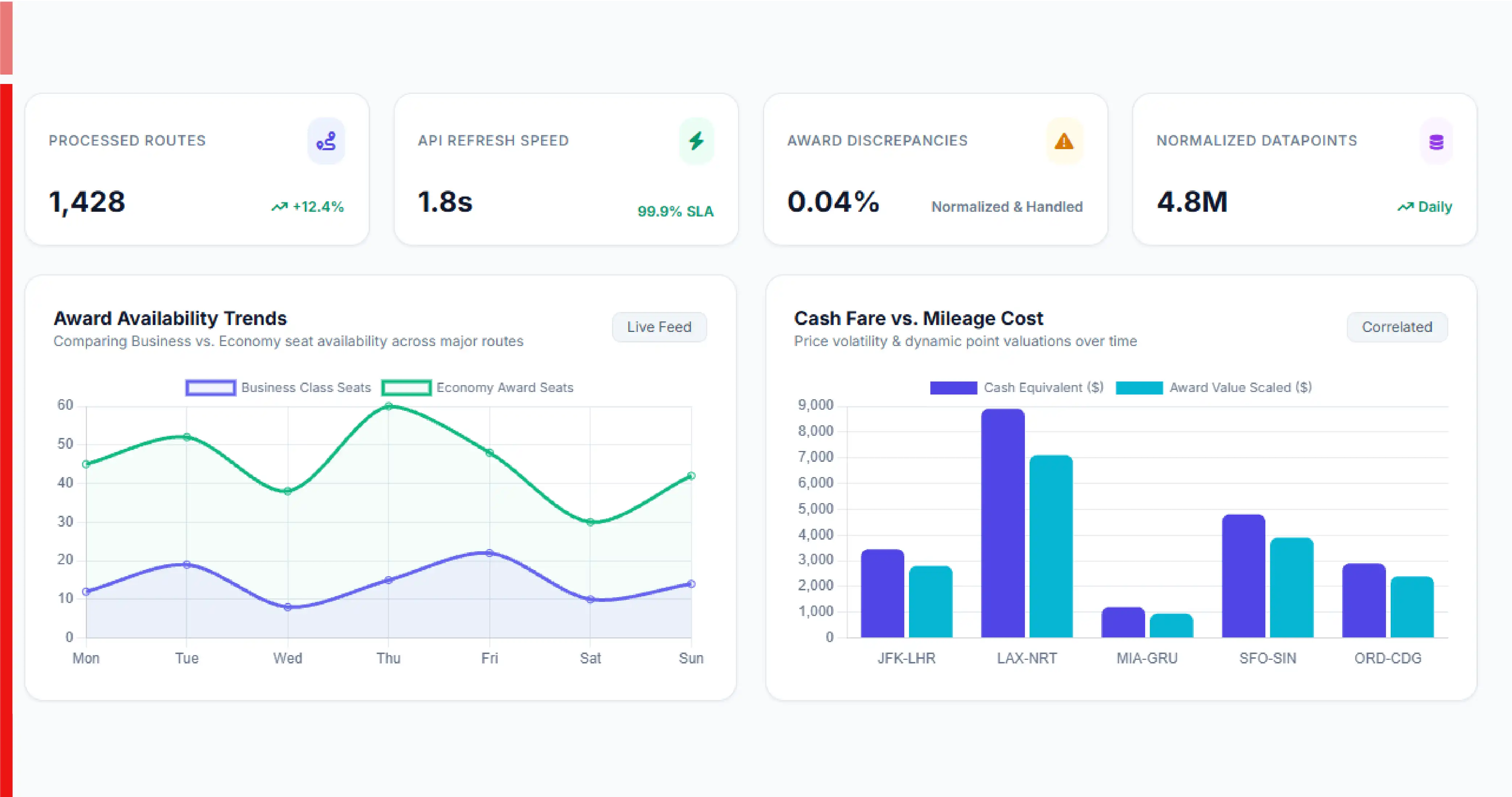
The client operated in a market where award availability, mileage requirements, schedules, and prices could change rapidly. These changes created several operational and analytical challenges requiring automated collection, normalization, monitoring, and historical intelligence.
Fragmented Award Availability
Flight Award Availability Trends analysis was difficult because award seats varied by route, airline, cabin, date, and loyalty program. Frequent changes made manual monitoring inefficient, while inconsistent source structures complicated efforts to create comparable historical datasets for reliable trend analysis.
Uncertain Redemption Demand
Flight Award Demand forecasting required historical information covering searches, availability, mileage requirements, routes, cabins, and booking behavior. Limited historical visibility made it difficult for the client to identify recurring demand patterns or understand which award opportunities were becoming more competitive.
Rapid Fare Changes
Flight Price Data Intelligence was challenging because airfare and award-related costs could change independently across routes and travel dates. The client needed continuously refreshed information to compare pricing movements, identify discrepancies, and understand relationships between cash fares and award redemption requirements.
Frequent API Data Changes
Smiles API Real-Time Flight Award Data scraping required continuous monitoring because flight inventory and redemption values could change between searches. Delayed collection could result in outdated results, while inconsistent responses required robust processing, validation, normalization, and error-handling mechanisms.
Limited Award Intelligence
Smiles API Flight Award Intelligence required combining availability, mileage, taxes, schedules, cabin classes, and route information into a unified analytical structure. Without this integration, the client faced difficulty comparing opportunities across dates and identifying meaningful changes in award inventory.
Our Approach
Our approach focused on creating a scalable travel-data pipeline capable of collecting, validating, normalizing, and delivering frequently changing award information for analytics and customer-facing applications.
Automated Availability Monitoring
We implemented Real-Time Availability Tracking across relevant flight routes and travel dates, capturing changes in award seats, cabin classes, mileage requirements, and associated fees. Automated monitoring reduced repetitive searches and helped maintain fresher information for downstream applications and analytics.
Structured Data Extraction
The solution captured flight numbers, departure and arrival information, route details, travel dates, cabin categories, mileage requirements, taxes, fees, and availability. Extracted records were converted into standardized structures so the client could perform consistent comparisons across changing airline data.
Data Normalization
Collected information was normalized into common fields, allowing differences in source formats to be handled systematically. Duplicate records, inconsistent values, missing attributes, and formatting variations were identified during processing, creating a cleaner dataset suitable for analytics and application integration.
Historical Data Pipeline
We established historical storage for collected award information, allowing the client to compare availability and pricing across dates. Historical records supported trend analysis, route comparisons, seasonal evaluations, and identification of recurring changes in mileage requirements and award inventory.
API Delivery Infrastructure
Normalized datasets were prepared through an API-ready architecture that allowed downstream systems to access refreshed records. This supported dashboards, search applications, analytical workflows, and customer-facing services while providing a scalable foundation for additional routes, airlines, and data attributes.
Results Achieved
The implementation improved data visibility, reduced manual monitoring requirements, and created a structured foundation for real-time award intelligence and travel analytics.
Expanded Award Coverage
The client gained centralized visibility across 48,600+ flight award records, covering multiple routes, dates, cabin categories, mileage requirements, and availability states. This broader dataset supported more comprehensive comparisons and improved the depth of award-search intelligence.
Faster Data Refresh
Automated collection reduced the time required to identify changes in flight award information. The pipeline achieved approximately 92.8% refresh-cycle adherence, helping the client maintain more current records for applications, dashboards, and analytical workflows.
Improved Data Accuracy
Validation and normalization workflows produced an estimated 96.7% data processing accuracy, reducing duplicate, incomplete, and inconsistent records. Cleaner information strengthened downstream analytics and gave the client greater confidence when comparing award availability across routes and dates.
Stronger Historical Intelligence
The solution created 14,200+ historical comparison records, enabling analysis of availability movements, mileage changes, cabin patterns, and route-level fluctuations. These records gave the client a stronger foundation for identifying recurring award trends and evaluating changes over time.
Scalable Data Delivery
The API-ready architecture supported 7,850+ structured API responses, allowing refreshed information to move efficiently into downstream systems. The architecture also created a scalable framework for adding new routes, airlines, fields, and analytical use cases.
Results Snapshot
| Performance / Data Metric | Before Solution | After Solution | Improvement / Coverage |
|---|---|---|---|
| Flight Award Records | 12,400+ | 48,600+ | 292% increase |
| Historical Records | 2,800+ | 14,200+ | 407% increase |
| API Responses | 1,950+ | 7,850+ | 302% increase |
| Data Processing Accuracy | 82.4% | 96.7% | +14.3 percentage points |
| Refresh-Cycle Adherence | 61.5% | 92.8% | +31.3 percentage points |
| Routes Monitored | 85 | 310 | 264% increase |
| Cabin Categories | 3 | 5 | +2 categories |
| Award Availability Events | 9,600+ | 37,900+ | 295% increase |
| Mileage Observations | 11,800+ | 42,700+ | 262% increase |
| Data Attributes Captured | 18 | 34 | +16 attributes |
| Duplicate Record Rate | 8.7% | 1.9% | 78% reduction |
| Manual Monitoring Hours / Month | 186 | 48 | 74% reduction |
Client's Testimonial
“Working with the data intelligence team gave us a much more structured way to manage constantly changing flight award information. Previously, our analysts spent significant time checking availability, mileage requirements, and route information manually. The new data pipeline consolidated these elements into standardized records that could be refreshed and delivered to our applications more efficiently. The historical dataset was particularly valuable because it allowed our team to study changes rather than simply view individual search results. We also gained better visibility into routes, cabin categories, and award inventory movements. The API-ready architecture has made it easier for our technology team to consume the information across different workflows. Overall, the solution has strengthened our travel intelligence capabilities and created a scalable foundation for expanding our miles aggregation platform.”
Conclusion
This case study demonstrates how automated travel data infrastructure can help miles aggregators manage rapidly changing flight award information more efficiently. By combining structured collection, validation, normalization, historical storage, and API delivery, the client developed a more reliable foundation for award intelligence and route-level analysis. The solution also created opportunities to Scrape Aggregated Travel Deals and compare broader travel offers alongside award availability. Organizations can similarly Scrape Travel Website Data to strengthen pricing, availability, itinerary, and competitive intelligence workflows across travel markets. In addition, businesses seeking broader mobile intelligence can Scrape Travel Mobile App data to monitor changing offers and customer-facing travel information. Together, these capabilities can support richer travel datasets, faster analytics, more responsive applications, and scalable intelligence programs for miles aggregators and travel technology businesses.
FAQs
Unlock the Full Report
Enter your details to access premium pricing intelligence insights