Search Demand Tracking Across Platforms for Real-Time Travel Trend Intelligence and Destination Forecasting
Introduction
The global travel industry has become increasingly dependent on predictive analytics and traveler intent monitoring to understand future tourism demand. Businesses across aviation, hospitality, online travel agencies, and tourism boards now rely heavily on Search Demand Tracking Across Platforms to identify traveler behavior before actual bookings occur. Search activity across major digital platforms provides early visibility into destination popularity, seasonal spikes, and evolving traveler preferences.
Travel companies are investing aggressively in data intelligence systems that combine search insights from Google, Skyscanner, and Booking.com to improve route planning, hotel inventory management, tourism forecasting, and pricing optimization. This growing adoption of travel analytics significantly strengthens Demand Forecasting models by enabling businesses to anticipate demand fluctuations weeks or even months in advance.
Organizations increasingly scrape travel search volume and destination trends to compare destinations, evaluate market growth, and detect changes in traveler interest patterns. Unlike traditional booking datasets, search demand analytics reveal intent much earlier in the traveler journey, making them one of the most valuable indicators for future travel demand.
As global tourism rebounds and competition intensifies, travel brands are using search intelligence to optimize digital marketing campaigns, improve customer acquisition strategies, and forecast occupancy trends with greater precision.
Understanding Travel Search Demand Intelligence
Travel search demand intelligence involves collecting and analyzing search activity across multiple travel-related digital platforms. These platforms include search engines, airline comparison websites, hotel booking portals, and travel marketplaces.
The primary objective is to identify travel demand signals before travelers finalize purchases.
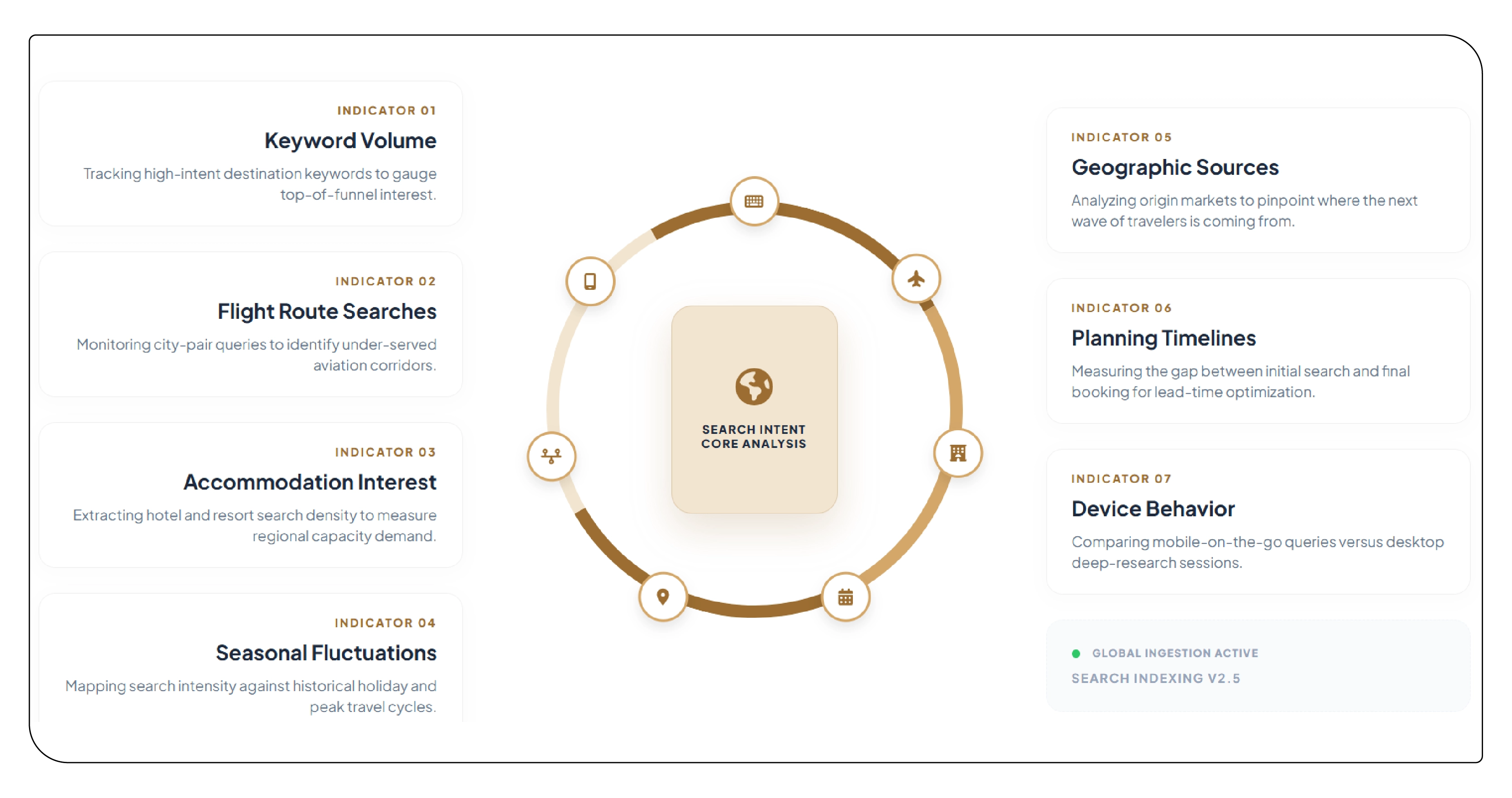
Key search indicators include:
- Destination keyword volume
- Flight route searches
- Hotel accommodation interest
- Seasonal search fluctuations
- Geographic demand sources
- Traveler planning timelines
- Device-based search behavior
Search data often acts as an early warning system for future travel demand changes. Airlines, hotels, and tourism boards use these insights to adjust strategies proactively rather than reacting after booking trends emerge.
Major Platforms Used in Search Demand Tracking
Google Destination Search Monitoring
Google remains the largest source of traveler intent data globally. Destination-related searches provide immediate visibility into traveler interest patterns and tourism momentum.
Examples of monitored queries include:
- “Best beaches in Bali”
- “Vietnam travel packages”
- “Cheap Europe flights”
- “Hotels in Dubai”
- “Japan cherry blossom tours”
Google search trend monitoring helps businesses understand:
- Seasonal destination popularity
- Emerging travel markets
- Luxury vs budget travel intent
- Domestic tourism growth
- International travel recovery
Search volumes often rise several weeks before booking increases occur, making Google data highly valuable for tourism forecasting.
Google Destination Search Trends Dataset
| Month 2026 | Bali Searches | Vietnam Searches | Thailand Searches | Dubai Searches | Japan Searches | Maldives Searches | YoY Growth % | Peak Search Region |
|---|---|---|---|---|---|---|---|---|
| January | 182,000 | 144,000 | 201,000 | 175,000 | 224,000 | 96,000 | 18% | Europe |
| February | 194,000 | 151,000 | 212,000 | 181,000 | 236,000 | 101,000 | 21% | North America |
| March | 221,000 | 173,000 | 238,000 | 205,000 | 259,000 | 114,000 | 24% | Southeast Asia |
| April | 267,000 | 214,000 | 281,000 | 244,000 | 302,000 | 139,000 | 29% | Europe |
| May | 324,000 | 291,000 | 338,000 | 286,000 | 377,000 | 171,000 | 38% | United States |
| June | 352,000 | 338,000 | 361,000 | 311,000 | 401,000 | 184,000 | 42% | United Kingdom |
| July | 368,000 | 351,000 | 379,000 | 328,000 | 418,000 | 191,000 | 44% | Australia |
| August | 347,000 | 336,000 | 365,000 | 314,000 | 395,000 | 182,000 | 39% | Germany |
| September | 286,000 | 302,000 | 311,000 | 273,000 | 344,000 | 151,000 | 31% | India |
| October | 244,000 | 276,000 | 282,000 | 251,000 | 319,000 | 132,000 | 27% | Canada |
| November | 217,000 | 254,000 | 261,000 | 226,000 | 288,000 | 119,000 | 22% | France |
| December | 301,000 | 318,000 | 347,000 | 299,000 | 388,000 | 177,000 | 36% | Global |
The dataset above clearly demonstrates how travel demand increases sharply during May–July, reflecting strong summer travel planning behavior. Japan consistently maintains the highest destination search volume, while Vietnam shows the fastest year-over-year growth among Southeast Asian destinations.
Skyscanner Flight Search Analytics
Skyscanner flight searches provide highly predictive insights into airline demand trends because travelers typically search flights before making bookings.
Airlines and travel companies monitor:
- Route-level search demand
- Departure date flexibility
- One-way vs roundtrip trends
- Advance booking searches
- Multi-city itinerary interest
- Domestic vs international demand
Flight search analytics are especially valuable for:
- Dynamic pricing
- Route planning
- Capacity optimization
- Seasonal scheduling
- Revenue forecasting
Search demand growth across Skyscanner often signals increasing airline demand several weeks before actual ticket purchases occur.
Booking.com Hotel Search Intelligence
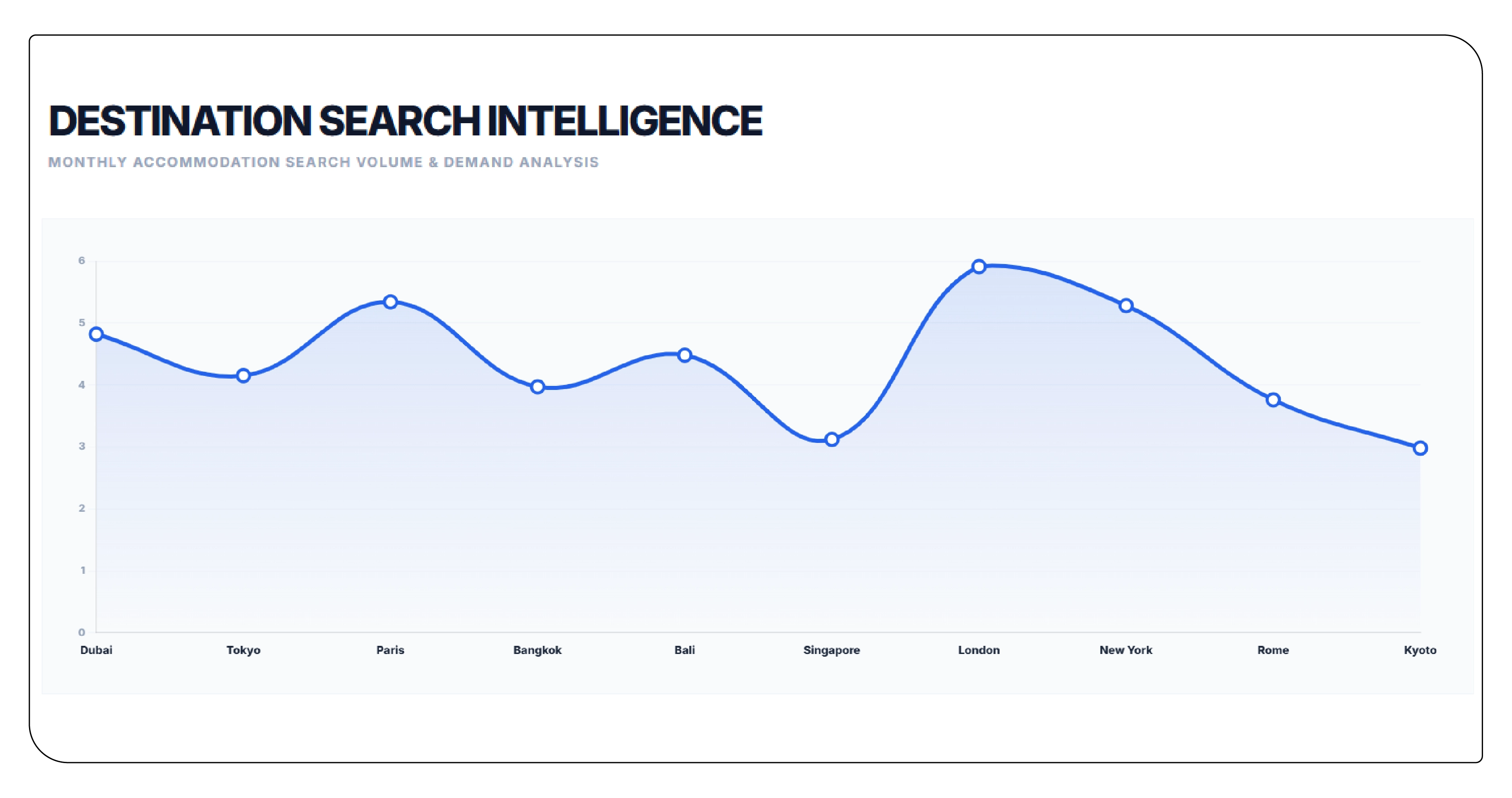
Booking.com search behavior offers valuable insights into accommodation demand across global tourism markets.
Hotel operators monitor:
- Destination-level accommodation searches
- Stay duration trends
- Luxury vs budget preferences
- Family vs solo traveler patterns
- Weekend travel demand
- Last-minute accommodation searches
These datasets help hotel brands optimize pricing strategies, occupancy management, staffing plans, and marketing campaigns.
The growing importance of hotel search monitoring has made accommodation analytics a major component of modern travel intelligence systems.
Cross-Platform Travel Search Demand Analytics Dataset
| Destination | Google Search Volume | Skyscanner Flight Searches | Booking.com Hotel Searches | Avg CPC ($) | Search-to-Booking Ratio | Avg Stay (Days) | Seasonal Spike Month | Popularity Index |
|---|---|---|---|---|---|---|---|---|
| Bali | 3,303,000 | 1,482,000 | 926,000 | 1.92 | 14.8% | 6.4 | July | 83 |
| Vietnam | 3,148,000 | 1,621,000 | 971,000 | 1.61 | 16.1% | 7.1 | June | 85 |
| Thailand | 3,576,000 | 1,739,000 | 1,122,000 | 2.08 | 15.3% | 5.9 | July | 81 |
| Dubai | 2,993,000 | 1,412,000 | 1,041,000 | 2.41 | 18.4% | 4.7 | December | 82 |
| Japan | 4,351,000 | 2,086,000 | 1,381,000 | 2.67 | 19.2% | 8.3 | April | 91 |
| Maldives | 1,757,000 | 804,000 | 672,000 | 3.22 | 22.8% | 5.4 | January | 76 |
| Turkey | 2,284,000 | 1,093,000 | 714,000 | 1.44 | 13.7% | 6.2 | September | 76 |
| South Korea | 2,948,000 | 1,255,000 | 883,000 | 2.11 | 17.5% | 5.6 | October | 85 |
| Singapore | 2,616,000 | 1,184,000 | 911,000 | 2.53 | 20.1% | 4.2 | August | 80 |
| Switzerland | 1,984,000 | 923,000 | 744,000 | 3.08 | 21.6% | 7.4 | December | 79 |
| Greece | 2,211,000 | 1,047,000 | 782,000 | 1.87 | 15.8% | 6.9 | June | 78 |
| Malaysia | 2,038,000 | 951,000 | 706,000 | 1.52 | 14.9% | 5.1 | May | 74 |
This dataset highlights strong demand growth for Japan and Vietnam, while destinations such as Dubai and Switzerland maintain strong premium-travel search conversion ratios.
Use Case: Identifying Rising Destinations
One of the most important applications of travel search monitoring involves detecting emerging tourism destinations before booking surges occur.
For example, Bali has historically dominated Southeast Asian tourism demand. However, recent search analytics across Google and Skyscanner indicate rapid growth in traveler interest toward Vietnam destinations such as Da Nang, Hanoi, and Phu Quoc.
Several factors contribute to these shifts:
- Lower travel costs
- Expanded airline connectivity
- Simplified visa policies
- Increased influencer exposure
- Growth in luxury resort developments
Travel brands use these insights to optimize:
- Marketing budgets
- Destination promotions
- Flight schedules
- Hotel inventory allocation
- Tourism investment planning
This form of predictive demand monitoring gives companies significant competitive advantages in rapidly changing travel markets.
Detecting Early Seasonal Demand Spikes
Seasonality plays a major role in travel behavior, and search demand often increases well before actual travel dates.
May–June search spikes typically indicate:
- Summer vacation planning
- Family holiday preparation
- International leisure travel growth
- Beach destination demand increases
- Airline fare comparison activity
This type of Seasonal Trend Analysis enables travel companies to prepare operationally for upcoming tourism surges.
Travel brands increasingly rely on predictive search models to optimize pricing and capacity management during peak travel seasons.
Building Destination Popularity Indexes
Destination popularity indexes combine multiple search signals into a unified ranking framework.
These indexes usually include:
- Google search growth
- Flight demand increases
- Hotel search interest
- Social media visibility
- Search-to-booking conversion ratios
- Search momentum acceleration
This methodology supports advanced travel destination demand ranking analytics used by tourism boards, investors, and travel agencies.
Companies also leverage destination indexes for market expansion planning and competitive benchmarking.
AI-Powered Travel Search Intelligence

Artificial intelligence has transformed modern travel analytics by enabling large-scale processing of traveler behavior datasets.
AI-driven systems support:
- Dynamic airfare pricing
- Hotel occupancy forecasting
- Personalized destination recommendations
- Seasonal demand prediction
- Marketing optimization
- Real-time pricing adjustments
Machine learning models continuously analyze traveler searches to improve Booking Trend Insights and predict future travel demand with higher accuracy.
These technologies are becoming essential for travel businesses seeking competitive advantages in volatile tourism markets.
Advanced Travel Data Intelligence Systems
Modern travel intelligence platforms increasingly integrate search demand data with additional external variables such as:
- Weather patterns
- Economic indicators
- Airline pricing
- Social media engagement
- Currency fluctuations
- Geopolitical events
This integrated approach strengthens seasonal travel search trend analysis and improves forecasting accuracy across multiple tourism sectors.
The rise of advanced Travel Data Intelligence solutions has enabled travel companies to automate analytics pipelines and build predictive dashboards for faster decision-making.
Traveler Intent Analytics and Search Behavior
Search behavior provides direct insights into traveler intent and purchase readiness.
Travel companies now analyze:
- Repeated destination searches
- Search timing patterns
- Multi-device user journeys
- Flexible date behavior
- Price comparison activity
These insights improve traveler intent analytics using search behavior and allow travel brands to personalize marketing campaigns more effectively.
Behavioral analytics also help airlines and hotels improve conversion rates through targeted offers and dynamic pricing models.
Conclusion
Travel search intelligence has become one of the most important components of modern tourism analytics and forecasting systems. By combining search insights from Google, Skyscanner, and Booking.com, businesses gain early visibility into destination demand shifts, traveler intent patterns, and seasonal travel trends.
Cross-platform monitoring enables airlines, hotels, online travel agencies, and tourism boards to optimize operational planning, pricing strategies, inventory management, and customer acquisition initiatives. Organizations leveraging predictive analytics gain substantial competitive advantages through earlier visibility into future travel demand.
As travel analytics technology continues evolving, businesses increasingly depend on scalable systems supporting real time travel search demand tracking to identify market opportunities faster and improve forecasting accuracy. Simultaneously, advanced solutions for cross platform travel search trend monitoring are enabling organizations to compare traveler intent signals across multiple digital ecosystems more effectively.
The future of tourism analytics will increasingly rely on AI-driven predictive systems and Custom Scraping Pipelines capable of processing massive travel datasets in real time, helping businesses respond rapidly to changing traveler behavior and global tourism trends.
Ready to elevate your travel business with cutting-edge data insights? Scrape Aggregated Flight Fares to identify competitive rates and optimize your revenue strategies efficiently. Discover emerging opportunities with tools to Extract Travel Website Data, leveraging comprehensive data to forecast market shifts and enhance your service offerings. Real-Time Travel App Data Scraping Services helps stay ahead of competitors, gaining instant insights into bookings, promotions, and customer behavior across multiple platforms. Get in touch with Travel Scrape today to explore how our end-to-end data solutions can uncover new revenue streams, enhance your offerings, and strengthen your competitive edge in the travel market.
Unlock the Full Report
Enter your details to access premium pricing intelligence insights