Hotel Data Scraping in Egypt for Real-Time Inventory, Occupancy, and Revenue Intelligence Across Hospitality Markets
Introduction
Egypt’s hospitality sector has witnessed remarkable expansion over the last few years, driven by increasing international tourism, infrastructure development, luxury resort investments, and rising domestic travel demand. Major tourism hubs such as Cairo, Sharm El Sheikh, Hurghada, Alexandria, Luxor, and Aswan continue attracting millions of leisure and business travelers annually. As competition intensifies across hotels, resorts, serviced apartments, and online booking platforms, hospitality businesses increasingly rely on Hotel Data Scraping in Egypt to gain real-time visibility into pricing, inventory, occupancy, and market demand trends.
Modern hospitality intelligence systems leverage large-scale Hotel Data Scraping to extract structured information from hotel booking platforms, travel aggregators, and tourism websites. These insights help hotel operators, revenue managers, OTAs, tourism boards, and investors optimize pricing strategies, occupancy forecasting, inventory management, and customer acquisition initiatives.
The growing importance of Egypt hotel room availability monitoring has encouraged hospitality businesses to adopt advanced analytics solutions capable of tracking room inventory fluctuations, booking trends, seasonal demand changes, and competitive pricing movements across Egypt’s tourism ecosystem.
This report explores how hotel data scraping is transforming hospitality analytics in Egypt through inventory intelligence, occupancy monitoring, revenue optimization, pricing analytics, and market demand forecasting.
Egypt’s Expanding Hospitality Market
Egypt’s hospitality industry is one of the fastest-growing tourism sectors in the Middle East and North Africa region. Government-backed tourism initiatives, airport expansion projects, luxury resort developments, and cultural tourism growth have significantly increased hotel investments across the country.
The recovery of international tourism following global travel disruptions has accelerated hotel occupancy growth in major Egyptian destinations. Beach tourism in the Red Sea region, historical tourism in Luxor and Aswan, and urban tourism in Cairo continue generating strong booking demand throughout the year.
This growing tourism activity has also intensified competition among hospitality providers. Hotels now compete not only on pricing but also on room availability, online ratings, package offerings, and booking convenience. As a result, real-time hotel intelligence has become essential for maintaining market competitiveness.
Hotel data scraping allows businesses to continuously monitor competitor inventory, room rates, booking trends, occupancy levels, and customer demand patterns across multiple digital channels simultaneously.
Importance of Hotel Data Scraping in Egypt
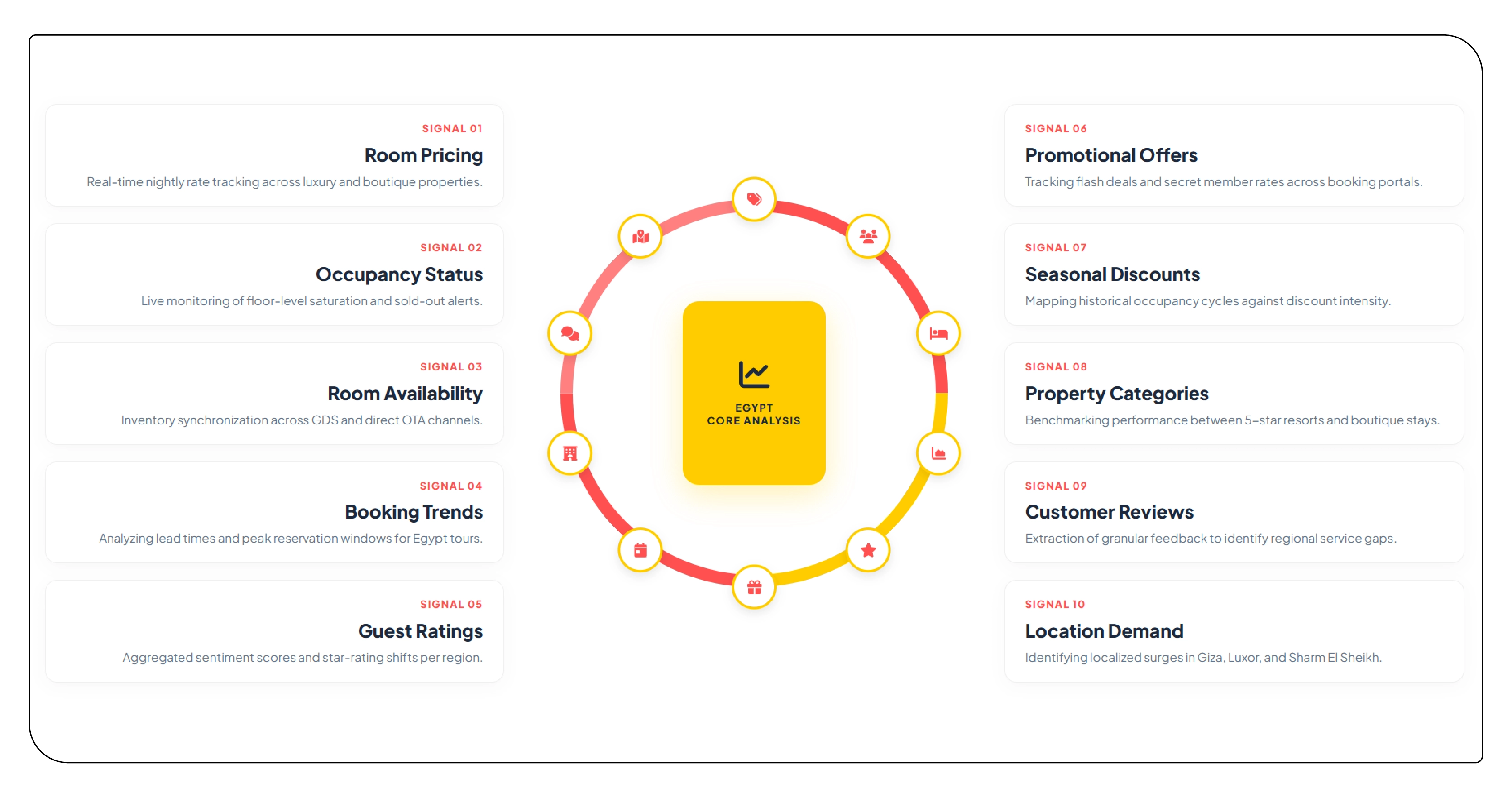
Hotel data scraping enables hospitality organizations to extract and analyze hotel-related information from booking platforms, hotel websites, travel aggregators, and online travel agencies.
The extracted datasets typically include:
- Room pricing
- Occupancy status
- Room availability
- Booking trends
- Guest ratings
- Promotional offers
- Seasonal discounts
- Property categories
- Customer reviews
- Location-based demand patterns
This intelligence helps hospitality businesses make faster and more accurate operational decisions.
Hotels increasingly use scraping systems to evaluate competitor pricing structures, understand traveler demand behavior, and identify occupancy fluctuations during peak tourism periods. Investors and tourism analysts also depend on hotel datasets to evaluate expansion opportunities and tourism growth trends in Egyptian cities.
Egypt Hotel Room Availability Monitoring
The hospitality industry operates in a highly dynamic environment where room availability changes rapidly depending on seasonal tourism activity, booking surges, festivals, and international travel demand.
Real-time room availability monitoring enables hotels and travel platforms to track:
- Available rooms
- Sold-out inventory
- Last-minute booking activity
- Seasonal inventory shortages
- Premium room demand
- Destination-specific booking spikes
Accurate room availability intelligence allows hotels to respond quickly to changing market conditions and optimize occupancy levels.
For example, luxury resorts in Sharm El Sheikh may experience near-full occupancy during holiday seasons, while business hotels in Cairo may witness stronger weekday demand due to corporate travel.
Continuous monitoring of room inventory also supports OTA optimization strategies and improves customer booking experiences.
Hotel Occupancy Trends Across Egypt
Occupancy analysis is one of the most critical applications of hotel intelligence systems. Hotels closely monitor occupancy fluctuations to improve operational planning, pricing decisions, staffing allocation, and revenue forecasting.
The increasing adoption of hotel occupancy data scraping in Egypt enables businesses to track occupancy trends at city, regional, and property-category levels.
Luxury hotels typically experience stronger occupancy rates during international tourism peaks, while budget accommodations often depend more heavily on domestic tourism and regional travelers.
Occupancy data also helps identify:
- Seasonal travel demand
- Event-driven booking surges
- Weekend vs weekday booking trends
- Business travel patterns
- Leisure tourism fluctuations
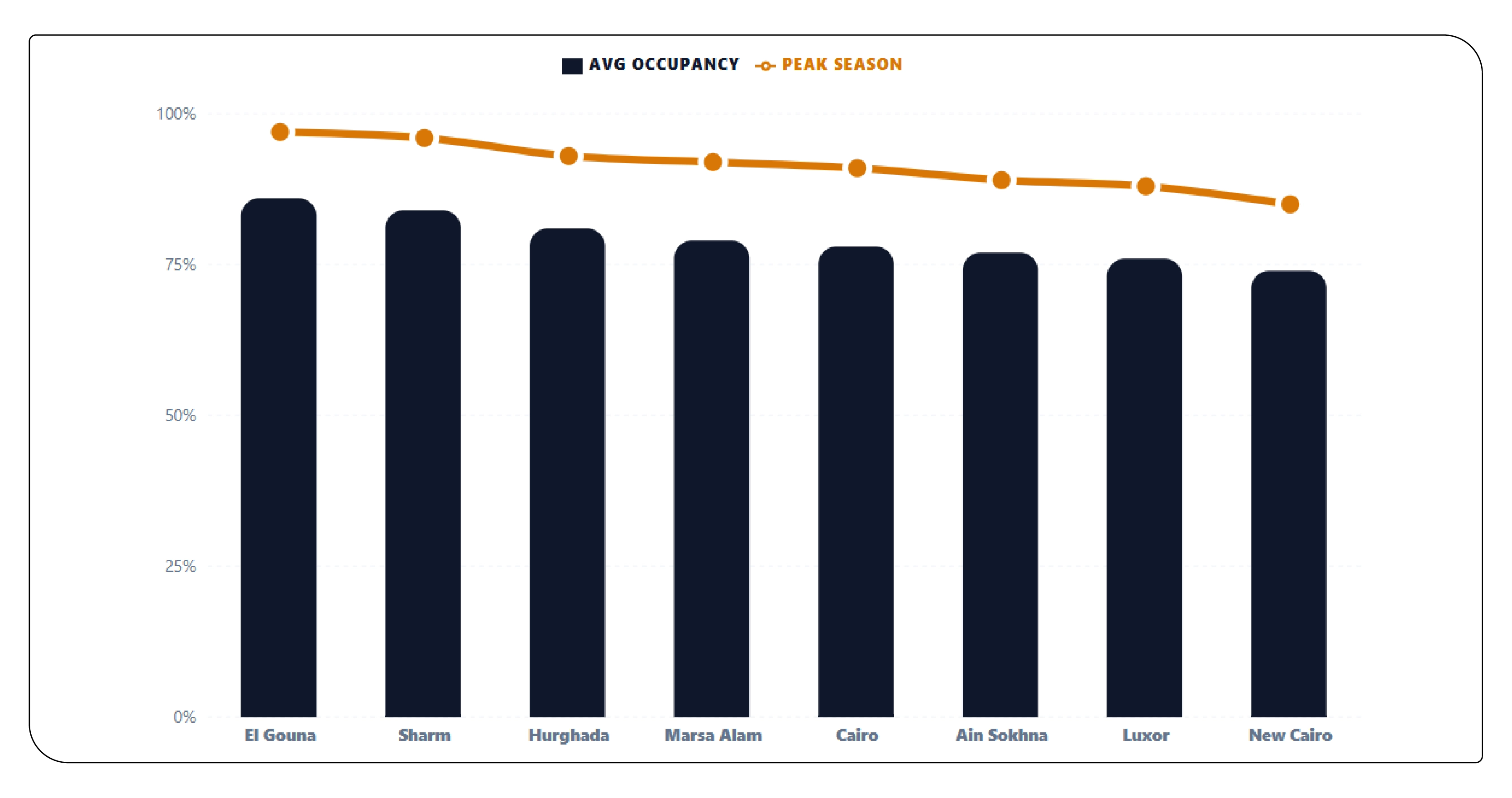
Egypt Hotel Occupancy & Revenue Performance Data
| City | Avg Occupancy Rate | Avg Daily Room Rate (USD) | Peak Season Occupancy | RevPAR Growth | Main Tourism Driver | Annual Booking Growth |
|---|---|---|---|---|---|---|
| Cairo | 78% | 145 | 91% | 18% | Business & cultural tourism | 21% |
| Sharm El Sheikh | 84% | 172 | 96% | 24% | Beach tourism | 27% |
| Hurghada | 81% | 158 | 93% | 22% | Resort tourism | 25% |
| Alexandria | 69% | 112 | 82% | 14% | Domestic tourism | 17% |
| Luxor | 76% | 138 | 88% | 19% | Historical tourism | 20% |
| Aswan | 72% | 126 | 84% | 16% | Nile tourism | 18% |
| El Gouna | 86% | 194 | 97% | 28% | Luxury tourism | 31% |
| Marsa Alam | 79% | 149 | 92% | 21% | Diving tourism | 23% |
| New Cairo | 74% | 136 | 85% | 15% | Corporate travel | 19% |
| Ain Sokhna | 77% | 142 | 89% | 20% | Weekend tourism | 22% |
Egypt Hotel Inventory Insights
Hospitality businesses increasingly rely on Egypt hotel inventory insights to understand room supply distribution, occupancy gaps, and competitive positioning across different property categories.
Inventory intelligence systems analyze:
- Total room capacity
- Room category availability
- Premium suite inventory
- Seasonal room shortages
- Family room demand
- Budget accommodation supply
This information helps hotels optimize inventory allocation during periods of fluctuating demand.
For example, during international tourism peaks, luxury suites and sea-view rooms may experience significantly higher booking rates compared to standard room categories. Hotels can use these insights to implement dynamic pricing strategies and maximize profitability.
Inventory monitoring also helps tourism investors identify underserved markets where hotel supply remains insufficient relative to traveler demand.
Inventory Gap Analysis in Egyptian Hospitality
The growing importance of Inventory Gap Analysis has encouraged hospitality organizations to continuously compare available room supply against traveler demand trends.
Inventory gaps frequently emerge during:
- International holiday seasons
- Religious tourism periods
- Business conferences
- Major cultural events
- Beach tourism peaks
- Cruise tourism surges
When hotels fail to anticipate inventory shortages, they risk revenue losses and customer dissatisfaction. Conversely, excess room supply during low-demand periods can reduce profitability.
Advanced inventory analytics systems help businesses forecast shortages and adjust pricing, marketing, and room allocation strategies proactively.
Hotel Price Optimization Strategies
Pricing intelligence has become one of the most valuable applications of hotel analytics. Hotels continuously monitor competitor pricing structures to maintain occupancy while maximizing revenue potential.
The implementation of Hotel Price Optimization strategies enables hotels to dynamically adjust room rates based on:
- Occupancy levels
- Competitor pricing
- Booking pace
- Seasonal demand
- Event-driven tourism
- Traveler demographics
Dynamic pricing models allow hotels to increase room rates during high-demand periods while offering promotional discounts during slower seasons.
Real-time pricing intelligence also helps OTAs and travel aggregators maintain competitive listings and improve booking conversions.
Hotel Availability Data Analytics Egypt
The rapid growth of travel aggregators and online booking platforms has increased demand for hotel availability data analytics Egypt solutions capable of monitoring hotel inventory changes across multiple booking channels.
Availability analytics systems help businesses understand:
- Booking velocity
- Sold-out periods
- Cancellation patterns
- Room-type popularity
- OTA performance
- Regional tourism demand
Hotels use this intelligence to improve booking management efficiency and optimize room allocation strategies across direct and third-party booking channels.
These analytics also support predictive forecasting models that estimate future occupancy and pricing performance.
Egypt Hotel Revenue Opportunity Analytics
Revenue intelligence systems play a major role in maximizing profitability across Egypt’s hospitality sector. Hotels increasingly implement Egypt hotel revenue opportunity analytics to identify untapped revenue streams and optimize financial performance.
Revenue analytics evaluate:
- Occupancy-to-revenue relationships
- Seasonal pricing opportunities
- Premium room profitability
- Ancillary revenue growth
- OTA commission impact
- Average booking value trends
These insights help hospitality operators improve revenue management strategies while minimizing dependency on discount-heavy pricing models.
Hotels also use revenue opportunity analytics to identify high-value traveler segments and optimize personalized promotional campaigns.
Egypt Hotel Pricing & Inventory Intelligence Data
| Hotel Segment | Avg Room Price (USD) | Occupancy Growth | Inventory Utilization | Seasonal Price Increase | Premium Room Demand | Revenue Growth |
|---|---|---|---|---|---|---|
| Luxury Resorts | 245 | 26% | 91% | 34% | Very High | 29% |
| Business Hotels | 168 | 18% | 82% | 19% | Moderate | 17% |
| Boutique Hotels | 154 | 21% | 79% | 24% | High | 20% |
| Budget Hotels | 82 | 15% | 74% | 11% | Low | 12% |
| Beach Resorts | 212 | 28% | 93% | 37% | Very High | 31% |
| Family Resorts | 176 | 20% | 84% | 22% | Moderate | 18% |
| Heritage Hotels | 189 | 23% | 81% | 27% | High | 22% |
| Serviced Apartments | 138 | 17% | 76% | 14% | Moderate | 15% |
| Eco Resorts | 162 | 19% | 78% | 20% | Growing | 18% |
| Wellness Resorts | 228 | 24% | 87% | 31% | High | 26% |
Role of AI and Predictive Analytics in Hotel Intelligence

Artificial intelligence is significantly improving the efficiency and accuracy of hotel data scraping systems. AI-powered analytics platforms can forecast occupancy trends, predict pricing fluctuations, detect booking anomalies, and optimize inventory allocation in real time.
Machine learning algorithms analyze historical booking data, seasonal travel patterns, social sentiment, and competitor activity to generate predictive hospitality insights.
AI-driven forecasting models help hotels:
- Predict occupancy surges
- Estimate booking demand
- Optimize room pricing
- Improve staffing allocation
- Reduce inventory inefficiencies
- Enhance revenue forecasting
These technologies are becoming increasingly important as hospitality competition intensifies across Egypt’s tourism market.
Challenges in Hotel Data Scraping
Despite its growing importance, hotel intelligence extraction involves several operational and technical challenges.
Hospitality platforms frequently modify website structures, pricing logic, and booking interfaces, making continuous scraping maintenance necessary. Dynamic pricing systems also create real-time fluctuations in room rates and inventory availability.
Other major challenges include:
- Data standardization complexities
- Multi-platform inventory synchronization
- OTA rate inconsistencies
- Duplicate property listings
- Regional demand volatility
- High-frequency pricing updates
Hotels and analytics providers must invest in scalable infrastructure and automated monitoring systems to maintain data accuracy.
Conclusion
Hotel intelligence extraction is transforming Egypt’s hospitality ecosystem by enabling real-time visibility into occupancy, pricing, inventory, and traveler demand patterns. As competition increases across hotels, resorts, and online booking platforms, businesses are increasingly relying on advanced analytics systems to optimize operational performance and revenue generation.
Real-time hotel datasets provide valuable insights into booking behavior, pricing fluctuations, occupancy trends, and tourism demand across Egypt’s major hospitality markets. Hotels and OTAs are leveraging predictive analytics and AI-driven forecasting to improve decision-making accuracy and maintain competitive positioning.
The future of hospitality intelligence in Egypt will increasingly depend on automated inventory monitoring, dynamic pricing systems, and advanced forecasting frameworks capable of processing large-scale tourism datasets. Greater emphasis on Room Type Availability analytics will further improve inventory allocation and customer experience optimization across luxury, business, and resort properties.
Similarly, the expansion of centralized Egypt hotel booking demand dataset platforms will enhance tourism forecasting capabilities and improve market-wide visibility into traveler demand trends. Advanced pricing intelligence powered by Hotel Room Price Trends Dataset solutions will continue supporting revenue optimization, competitive benchmarking, and strategic hospitality growth across Egypt’s rapidly evolving tourism industry.
Ready to elevate your travel business with cutting-edge data insights? Scrape Aggregated Flight Fares to identify competitive rates and optimize your revenue strategies efficiently. Discover emerging opportunities with tools to Extract Travel Website Data, leveraging comprehensive data to forecast market shifts and enhance your service offerings. Real-Time Travel App Data Scraping Services helps stay ahead of competitors, gaining instant insights into bookings, promotions, and customer behavior across multiple platforms. Get in touch with Travel Scrape today to explore how our end-to-end data solutions can uncover new revenue streams, enhance your offerings, and strengthen your competitive edge in the travel market.
Unlock the Full Report
Enter your details to access premium pricing intelligence insights