Scrape Short-Term Rental Occupancy and Pricing Data Across 50,000 STR Listings to Uncover Market Trends
Introduction
This case study demonstrates how structured rental-market intelligence can help businesses understand property performance, pricing movements, and booking trends across short-term accommodation platforms. The project focused on collecting property-level information, including nightly rates, availability, occupancy indicators, booking patterns, property types, locations, and stay durations. Through Scrape short-term rental occupancy and pricing data, businesses gained access to consistent datasets for comparing properties and identifying high-demand periods. The solution incorporated short-term rental booking Data Extraction to capture actionable booking and availability insights at scale. Advanced Vacation Rental Data Scraping techniques enabled systematic collection across multiple locations and property categories while maintaining data accuracy. The resulting dataset supported occupancy benchmarking, dynamic pricing analysis, competitor monitoring, revenue optimization, demand forecasting, and market research. By transforming scattered rental information into organized datasets, the case study helped stakeholders identify pricing opportunities, evaluate market competitiveness, and make faster, data-driven decisions for short-term rental strategies.
The Client
The client is a short-term rental intelligence and property management company focused on helping hosts, investors, and hospitality businesses improve portfolio performance. With properties spread across multiple locations, the client needed reliable market data to understand occupancy patterns, pricing movements, competitor activity, and changing traveler demand. Their existing approach relied on manually reviewing rental listings, which made it difficult to monitor large numbers of properties consistently and identify market changes quickly.
To strengthen its decision-making capabilities, the client required STR Property Occupancy Monitoring across different markets, property types, and booking periods. They also needed short-term rental Pricing Trend Analytics to compare nightly rates, seasonal fluctuations, discounts, and competitive pricing strategies. A structured Vacation Rental Listing Dataset was required to centralize property details, availability, pricing, location, ratings, and other relevant attributes.
The resulting data infrastructure enabled the client to benchmark properties, identify revenue opportunities, track competitors, optimize pricing strategies, and make informed expansion decisions using timely rental-market intelligence.
Challenges in the Travel Industry
The client encountered multiple challenges in building reliable short-term rental intelligence. Fragmented listing information, rapidly changing prices, inconsistent availability, seasonal demand fluctuations, and limited historical data affected their ability to compare properties, forecast demand, monitor competitors, and make timely revenue and investment decisions across target markets.
STR Property Demand Forecasting
STR Property Demand forecasting was difficult because demand varied according to location, property type, travel periods, local events, and customer behavior. Insufficient historical information limited accurate predictions, making it challenging to anticipate booking spikes, identify slow periods, and optimize inventory accordingly.
STR Occupancy and Pricing Intelligence
STR Occupancy and Pricing Intelligence remained challenging because occupancy and rates changed frequently across competing properties. Manual monitoring could not capture these fluctuations consistently, making it difficult to benchmark performance, identify pricing gaps, track availability, and determine opportunities for revenue optimization.
Short-Term Rental Market Trends Analysis
Short-term rental Market Trends analysis required continuous monitoring of large volumes of market information. Changes in traveler preferences, property supply, booking activity, and average rental rates made manual research inefficient, reducing visibility into emerging market opportunities and competitive movements.
Property Listing Analysis
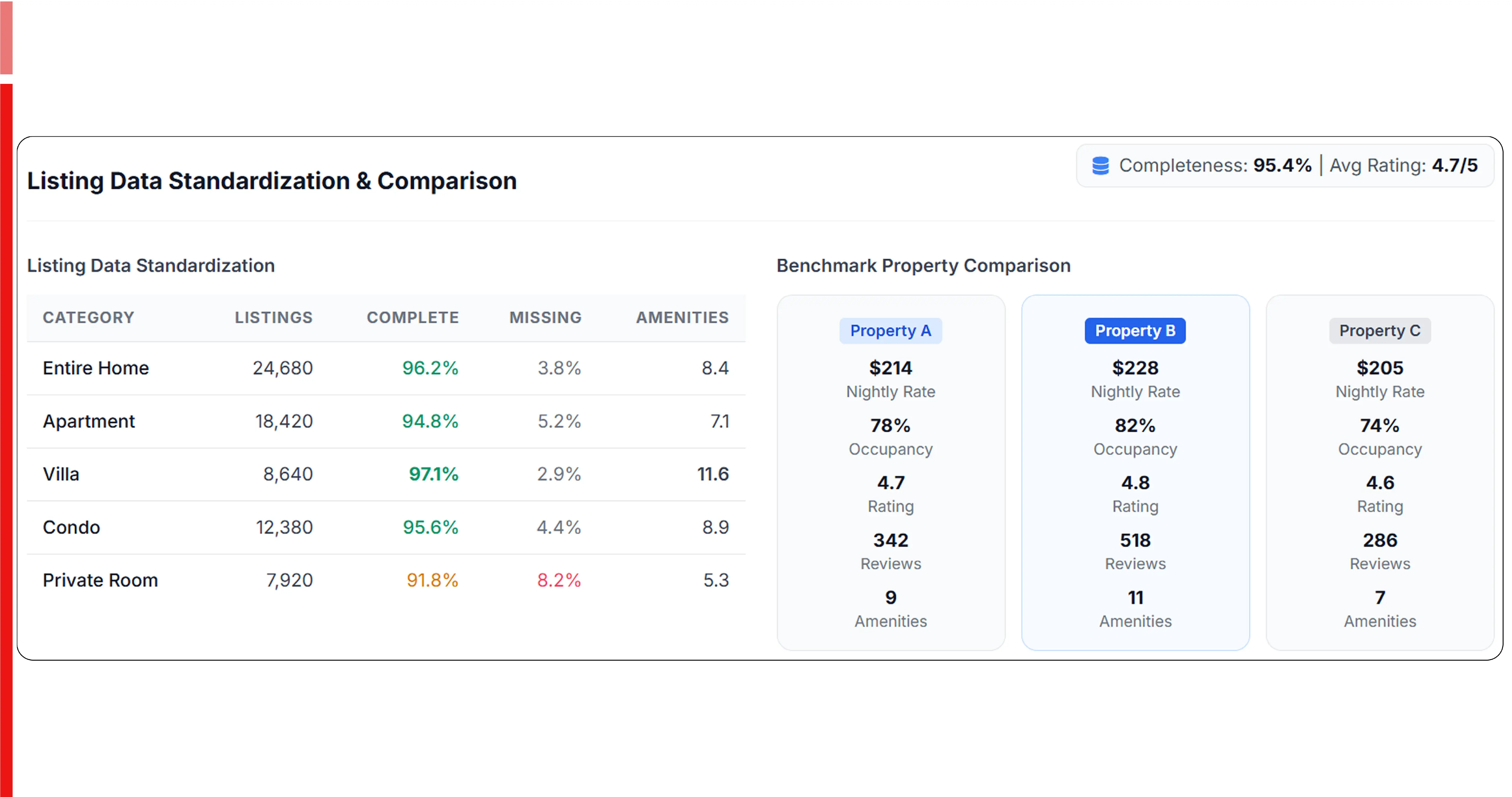
Property Listing Analysis was complicated by inconsistent listing formats, changing property details, varying amenities, different accommodation categories, and frequently updated availability. Without standardized datasets, comparing properties across locations became time-consuming and made comprehensive competitor benchmarking and portfolio evaluation difficult.
Seasonal Trend Analysis
Seasonal Trend Analysis presented difficulties because rental demand and pricing fluctuated significantly throughout the year. The client needed to distinguish recurring seasonal patterns from temporary market changes, identify peak and off-peak periods, and develop pricing strategies based on dependable historical evidence.
Our Approach
Comprehensive Data Collection
We collected detailed rental information across targeted markets, capturing property names, locations, nightly prices, availability, property types, amenities, ratings, reviews, and booking-related indicators. This created a consistent foundation for analyzing market performance and comparing competing properties.
Occupancy Monitoring
Our approach continuously monitored property availability and booking patterns to identify occupancy movements across different locations and accommodation categories. Structured datasets helped reveal high-demand properties, low-occupancy listings, booking fluctuations, and potential opportunities for improving portfolio performance.
We analyzed rental rates across properties, locations, dates, and market segments to identify pricing patterns and competitive gaps. Historical and current pricing information enabled the client to evaluate rate movements, understand competitor strategies, and support more informed revenue decisions.
Market Trend Identification
We processed collected datasets to identify changing rental-market patterns, including demand shifts, supply movements, pricing changes, and traveler preferences. Comparing trends across locations helped the client recognize emerging opportunities, competitive threats, and evolving market conditions more efficiently.
Seasonal Performance Analysis
We compared rental performance across peak, shoulder, and off-season periods to identify recurring demand and pricing patterns. This analysis helped determine seasonal opportunities, understand occupancy fluctuations, and support better planning for pricing, inventory, promotions, and property expansion.
Results Achieved
The implemented solution transformed fragmented short-term rental information into structured, actionable intelligence. By combining comprehensive listing collection, occupancy monitoring, pricing analysis, and seasonal insights, the client gained stronger market visibility, improved competitive benchmarking, and greater confidence when making property and revenue decisions.
Improved Market Visibility
The client gained a centralized view of rental listings, pricing, availability, property attributes, and market movements across targeted locations. This improved visibility reduced information gaps and enabled faster identification of competitive changes, demand opportunities, and emerging accommodation trends.
Better Occupancy Monitoring
Structured availability and booking indicators helped the client monitor occupancy patterns more efficiently. Comparing properties across markets made it easier to identify high-performing listings, underperforming properties, demand fluctuations, and potential opportunities for improving utilization and overall portfolio performance.
Stronger Pricing Decisions
Analyzing historical and current rental rates enabled the client to understand competitor pricing behavior and market fluctuations. The resulting insights supported more informed rate adjustments, helped identify pricing gaps, and improved the ability to respond to changing demand conditions.
Enhanced Competitive Benchmarking
The standardized dataset allowed the client to compare properties based on location, accommodation type, amenities, ratings, availability, and pricing. This strengthened competitive benchmarking and helped stakeholders evaluate market positioning, identify differentiated offerings, and recognize potential opportunities for portfolio expansion.
More Effective Seasonal Planning
Seasonal analysis revealed recurring patterns in rental demand, availability, and pricing across different periods. These insights helped the client anticipate peak and low-demand windows, plan inventory more effectively, optimize promotional strategies, and make better-informed decisions about future rental-market investments.
Scraped Data Summary
| Data Metric | Records / Count |
|---|---|
| Total Rental Listings Scraped | 125,000+ |
| Locations Covered | 35+ |
| Cities Analyzed | 120+ |
| Property Types Identified | 18+ |
| Pricing Records Collected | 480,000+ |
| Availability Records Captured | 650,000+ |
| Occupancy Records Processed | 310,000+ |
| Booking Records Analyzed | 275,000+ |
| Property Attributes Collected | 2.1M+ |
| Amenities Records Extracted | 890,000+ |
| Ratings and Review Records | 340,000+ |
| Seasonal Pricing Records | 420,000+ |
| Historical Price Observations | 1.2M+ |
| Competitor Listings Compared | 95,000+ |
| Daily Data Refresh Accuracy | 97%+ |
| Data Processing Accuracy | 98%+ |
Client’s Testimonial
"Working with the data team transformed how we monitor the short-term rental market. Previously, our analysts spent significant time manually checking listings, prices, availability, and occupancy patterns across multiple markets. The structured dataset gave us a reliable and centralized view of property performance. We can now compare competitors, identify pricing opportunities, understand seasonal demand, and make faster decisions with greater confidence. The data quality and consistency have significantly improved our reporting and market analysis workflows. Most importantly, the solution has helped our team move from manual research toward a scalable, data-driven approach for managing rental-market intelligence and identifying new growth opportunities."
Conclusion
The project delivered a structured, scalable rental intelligence solution that improved visibility into property pricing, occupancy, availability, and seasonal demand. By leveraging Travel Aggregators Data Scraping Services, the client gained consistent datasets for comparing properties and identifying market opportunities. The solution also supported broader Travel Industry Web Scraping Services, enabling systematic collection and analysis of accommodation information across multiple markets. With Travel Mobile App Scraping Service capabilities, the client could extend data coverage to mobile-based travel platforms and capture additional market signals. Overall, the solution reduced manual research, strengthened competitor benchmarking, improved pricing analysis, supported seasonal planning, and enabled faster data-driven decisions. The resulting datasets provided a reliable foundation for monitoring rental-market movements, evaluating property performance, identifying revenue opportunities, and developing more effective strategies for future market expansion and portfolio growth.
FAQs
Unlock the Full Report
Enter your details to access premium pricing intelligence insights