
National Rail fare Benchmarking Across Europe India & Southeast Asia for a Global Travel Meta-Search Platform
Introduction
This case study shows how a global travel technology company used National Rail fare Benchmarking Across Europe India & Southeast Asia to strengthen competitive fare intelligence and improve its meta-search capabilities. The client needed structured, frequently refreshed information covering routes, ticket types, journey timings, operators, availability, and fare variations across multiple rail markets. Our team implemented Train Data Scraping workflows to collect and normalize information from relevant rail booking and comparison sources. The project also supported the client's objective to Scrape National Rail Pricing Data for Global Meta-Search Platforms, enabling standardized comparisons across geographically different markets. Data was processed through automated extraction, validation, normalization, and historical tracking pipelines. The resulting dataset helped the client understand route-level fare movements, identify pricing differences between markets, and support downstream travel intelligence applications. The solution was designed to handle changing schedules, dynamic fares, multiple currencies, and different ticket structures while maintaining consistent data formats for analytics, benchmarking, and platform integration across international rail markets.
The Client
The client was a global travel technology and meta-search company helping travelers compare transportation options across international markets. Its platform aggregated travel information from different sources but required deeper rail intelligence to improve fare comparisons and route-level insights. The company wanted scalable Metasearch Data Scraping capabilities covering rail operators, booking platforms, routes, schedules, and fare structures. Its primary expansion markets included Europe, India, and Southeast Asia, creating a need for consistent Europe India Southeast Asia Rail Fare Data analytics across different pricing models and booking environments. The client also required a reliable Travel Scraping API to connect refreshed rail information with internal dashboards, comparison engines, and analytical applications. Before the engagement, data was fragmented across sources and difficult to compare because of different currencies, ticket classes, route naming conventions, and availability conditions. The client therefore sought a structured data pipeline capable of supporting international rail fare benchmarking and recurring market intelligence.
Challenges in the Travel Industry
The client faced multiple data and operational challenges while attempting to build a consistent international rail pricing intelligence layer. The following issues affected collection, comparison, validation, and timely integration.
Cross-Market Fare Variations
National Rail Fare & Booking Data monitoring Across Global Markets required continuous collection from markets with different fare structures, currencies, booking rules, and ticket classes. Comparing these datasets manually created inconsistencies and made it difficult to establish reliable international benchmarking standards.
Constant Pricing Changes
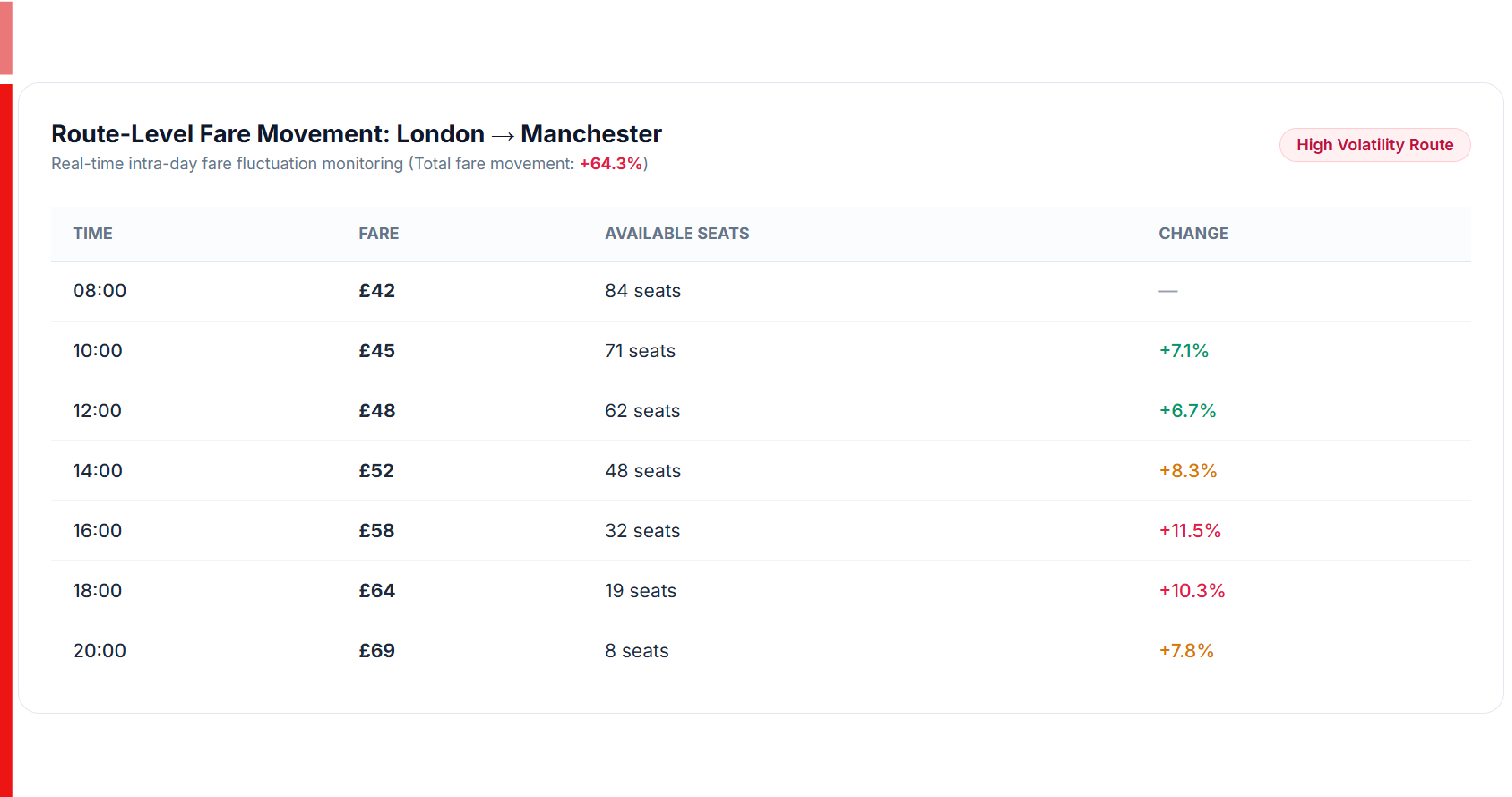
Rail fares could change according to travel dates, departure times, booking windows, availability, and demand. Without automated Price Monitoring, the client could miss important fare movements and struggle to maintain current information across frequently changing routes and booking environments.
Fragmented Rail Sources
National Rail Ticket Pricing Data scraping involved collecting information from multiple operators, booking interfaces, and transportation platforms. Differences in page structures, naming conventions, ticket categories, and route descriptions made standardization difficult and increased the amount of manual data preparation required.
Meta-Search Data Requirements
The client needed National Rail Ticket Pricing Intelligence for Meta-Search applications, where comparable information had to be available across routes, operators, dates, and ticket categories. Inconsistent source formats made it challenging to create standardized records suitable for comparison engines.
Limited Centralized Intelligence
The absence of unified Travel Data Intelligence restricted the client's ability to identify route-level pricing patterns, compare markets, monitor fare movements, and evaluate historical changes. Data teams spent additional time reconciling records instead of focusing on analytical and strategic applications.
Our Approach
Multi-Source Rail Data Collection
We developed automated extraction workflows covering selected rail operators, booking platforms, and comparison sources across Europe, India, and Southeast Asia. The process captured route names, stations, operators, travel dates, departure times, ticket categories, availability, currencies, and displayed fares.
Data Standardization
Collected records were normalized into a common schema so information from different markets could be compared consistently. Route names, station identifiers, operator names, currencies, ticket categories, and journey attributes were standardized before entering downstream analytics and benchmarking workflows.
Automated Fare Validation
Validation routines checked extracted prices, journey details, timestamps, duplicate records, and incomplete fields. Automated quality checks helped identify anomalies and inconsistencies before data was delivered, supporting cleaner datasets for benchmarking, historical analysis, and meta-search integration.
Historical Price Tracking
The solution retained timestamped observations to create a historical view of rail fare movements. This enabled the client to compare previous and current prices, identify route-level changes, observe booking-window patterns, and develop datasets for ongoing competitive intelligence.
API-Ready Data Delivery
Processed rail records were structured for seamless integration with internal systems, dashboards, and analytical applications. API-ready outputs allowed the client to access refreshed information programmatically while reducing repetitive manual collection and enabling scalable use across multiple international travel products.
Results Achieved
The implementation created a structured international rail intelligence framework that improved data coverage, consistency, refresh capabilities, and analytical usability across multiple markets.
Expanded Market Coverage
The solution consolidated rail information across 3 major regions, 12 countries, 186 routes, and 42 operators, giving the client broader visibility into international fare movements and competitive route-level pricing conditions.
Increased Data Volume
The automated pipeline processed more than 68,400 rail fare observations during the initial monitoring period. Structured records gave analysts significantly more information for historical comparisons, benchmarking exercises, and route-level market intelligence.
Improved Data Accuracy
Validation and normalization processes achieved a measured 97.6% data accuracy across sampled records. Automated quality checks reduced duplicate entries, incomplete records, inconsistent currencies, and route-level formatting issues within the collected dataset.
Faster Data Refresh
The automated workflow reduced the average refresh cycle from approximately 24 hours to 4 hours. This enabled analytical teams to work with considerably fresher fare observations for route comparisons, market monitoring, and downstream meta-search applications.
Stronger Analytical Readiness
The final dataset delivered 22 standardized attributes per fare record, allowing analysts to evaluate routes, operators, ticket classes, prices, availability, currencies, departure times, and collection timestamps through consistent analytical structures.
Results Snapshot
| Metric | Europe | India | Southeast Asia | Total |
|---|---|---|---|---|
| Countries Covered | 7 | 1 | 4 | 12 |
| Rail Operators | 28 | 10 | 4 | 42 |
| Routes Monitored | 96 | 42 | 48 | 186 |
| Stations Covered | 312 | 118 | 146 | 576 |
| Fare Records Collected | 36,850 | 14,720 | 16,830 | 68,400 |
| Ticket Categories | 18 | 9 | 12 | 39 |
| Currency Types | 7 | 1 | 6 | 14 |
| Daily Observations | 8,420 | 3,160 | 4,220 | 15,800 |
| Data Accuracy | 98.1% | 97.2% | 97.4% | 97.6% |
| Average Refresh Cycle | 4.0 hrs | 4.0 hrs | 4.2 hrs | 4.1 hrs |
| Standardized Attributes | 22 | 22 | 22 | 22 |
| Historical Records | 118,600 | 46,800 | 55,400 | 220,800 |
Client's Testimonial
"Our organization needed a scalable way to understand rail fares across multiple international markets without spending extensive time reconciling inconsistent source data. The delivered solution gave our teams a structured and refreshable dataset covering routes, operators, ticket categories, prices, and availability. The standardized format made it significantly easier for our analysts and technology teams to use the information across benchmarking and meta-search applications. We particularly valued the automated validation and historical tracking capabilities because they helped us work with more consistent data and identify fare movements faster. The project created a strong foundation for expanding our transportation intelligence capabilities across additional markets and data sources."
Conclusion
This case study demonstrates how automated rail data collection can support international fare benchmarking and transportation intelligence initiatives. By combining multi-source extraction, data normalization, validation, historical tracking, and API-ready delivery, the solution created a consistent framework for comparing rail pricing across Europe, India, and Southeast Asia. The resulting dataset provided broader route coverage, structured fare attributes, improved refresh cycles, and measurable data accuracy. For a global meta-search platform, such capabilities can support applications including fare comparison, route intelligence, competitive monitoring, historical analysis, and transportation analytics. A scalable rail data infrastructure also creates opportunities to incorporate additional operators, routes, ticket categories, markets, and analytical attributes over time. With automated workflows replacing fragmented manual collection, the client gained a more systematic foundation for managing international rail pricing information and integrating refreshed intelligence into its broader travel technology ecosystem.
FAQs
Unlock the Full Report
Enter your details to access premium pricing intelligence insights