Scrape Europe hotel chains and brands Location Data for State-Level Hospitality Intelligence
This report analyzes Europe’s hotel chain ecosystem using location intelligence and data scraping insights, highlighting state-level distribution, brand dominance, and expansion trends across major hospitality markets in 2026 landscape analysis.
Introduction
Europe’s hospitality sector is entering a transformative phase in 2026, driven by cross-border tourism recovery, business travel growth, and rapid expansion of branded hotel ecosystems across major regions.
To understand this evolving landscape, this research leverages insights derived as organizations increasingly Scrape Europe hotel chains and brands Location Data, enabling monitoring of expansion strategies, regional penetration, and competitive positioning across key European states and provinces. Advanced analytics systems powered by Hotel Chains Data Scraping now support continuous tracking of openings, closures, pricing signals, and occupancy shifts across major hospitality groups.
Further refinement is achieved through hotel location data scraping Europe for chains and brands, which improves visibility into geographic distribution patterns and brand-level market density across Europe. Together, these capabilities strengthen European hotel chains data intelligence, enabling investors and hospitality analysts to make more precise, data-driven decisions in a rapidly evolving market landscape.
This report analyzes monitored hotel chain activity across 1,600+ European cities, covering 7,900+ hotels and 270+ hotel chains, including dominant players such as Accor, Marriott International, and Hilton Hotels & Resorts. The focus is on geographic concentration, state-level dominance, operational scale, and future-ready insights for 2026.
7,900+
Hotels Tracked
270+
Hotel Chains
38+
European States
Covered
1,600+
Cities Covered
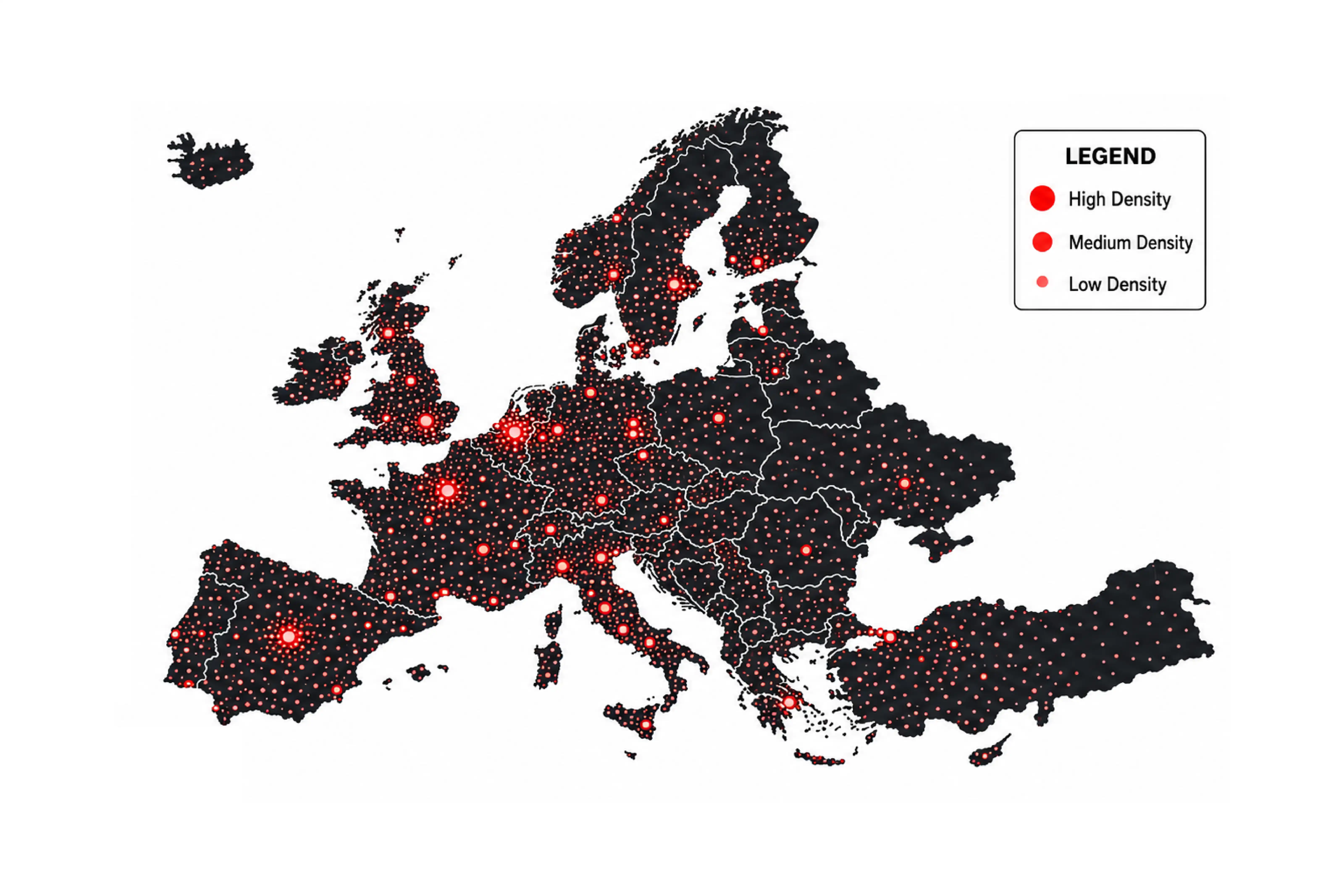
Top States by Number of Hotels
States with the Highest Concentration of Branded Hotel Chains in Europe
LONDON REGION (UNITED KINGDOM)
460+
Driven by global financial services, corporate headquarters, international arrivals, and dense business districts across Central London and surrounding boroughs.
ÎLE-DE-FRANCE (FRANCE)
420+
Paris dominates as Europe’s leading tourism and luxury hospitality hub, supported by corporate travel, global events, and strong hotel chain penetration.
BAVARIA (GERMANY)
340+
Munich leads with automotive headquarters, trade fairs, alpine tourism, and year-round business travel demand.
CATALONIA (SPAIN)
290+
Barcelona drives strong leisure tourism, cruise arrivals, MICE events, and Mediterranean coastal travel demand.
LOMBARDY (ITALY)
310+
Milan acts as a major financial and fashion hub, driving corporate travel, exhibitions, and international business demand.
COMMUNITY OF MADRID (SPAIN)
270+
Madrid serves as a key administrative and business hub with strong airline connectivity and government travel demand.
What is the largest hotel chain in Europe?
Accor is the largest hotel chain in Europe in 2026.
Accor
PROPERTIES
States
20+
Cities
500+
Largest footprint across Western and Southern European states with strong multi-brand expansion.
Marriott International
PROPERTIES
States
25+
Cities
450+
Strong dominance in premium and luxury segments across major European states.
Hilton Hotels & Resorts
PROPERTIES
States
22+
Cities
400+
Focused on business travel corridors, airport hotels, and corporate hubs.
Top 10 Hotel Chains in Europe by Property Count and Geographic Presence – 2026
The table highlights the distribution and operational scale of leading hotel chains across European states in 2026. Global chains such as Accor, Marriott, and Hilton dominate major urban states, while regional brands like Scandic Hotels and B&B Hotels maintain strong penetration in Nordic and secondary states. Overall, premium brands focus on high-value urban states, while mid-scale chains prioritize wider state-level coverage and expansion.
Insights derived from hotel chain location data Europe for market intelligence show clear clustering of luxury brands in top-tier tourism and business hubs.
This distribution is further refined through multi-brand hotel location data aggregation in Europe, which enables comparative analysis of performance, coverage density, and regional saturation across competing hospitality groups.
| Hotel Chain | Total Properties (Europe) | Countries Covered | Estimated Cities | Download Dataset |
|---|---|---|---|---|
| Accor | 3,100+ | 40+ | 1,200+ | Download |
| Marriott International | 800+ | 35+ | 300+ | Download |
| Hilton Hotels & Resorts | 550+ | 30+ | 250+ | Download |
| InterContinental Hotels Group (IHG) | 780+ | 35+ | 320+ | Download |
| Radisson Hotels | 480+ | 40+ | 200+ | Download |
| B&B Hotels | 750+ | 15+ | 400+ | Download |
| NH Hotel Group (Minor) | 350+ | 25+ | 180+ | Download |
| Scandic Hotels | 280+ | 6 | 150+ | Download |
| Premier Inn | 850+ | 3 | 200+ | Download |
| Leonardo Hotels | 210+ | 10+ | 100+ | Download |
What are the largest hotel chains in Europe in 2026?
Scraping hotel chain locations across Europe shows that Accor, Marriott International, and Hilton Hotels & Resorts are the largest hotel chains based on property count and state-level distribution. Accor leads with 1,600+ properties across multiple European states, followed by Marriott International with 1,350+ properties and Hilton with 980+ properties. Together, these chains dominate Europe’s branded hospitality ecosystem across key states and metropolitan regions.
A deeper layer of analysis comes from Geo-Based Price Parity, which helps identify how room rates vary across the same brands in different European states and demand clusters.
Top 10 Hotel Chains in Europe – 2026
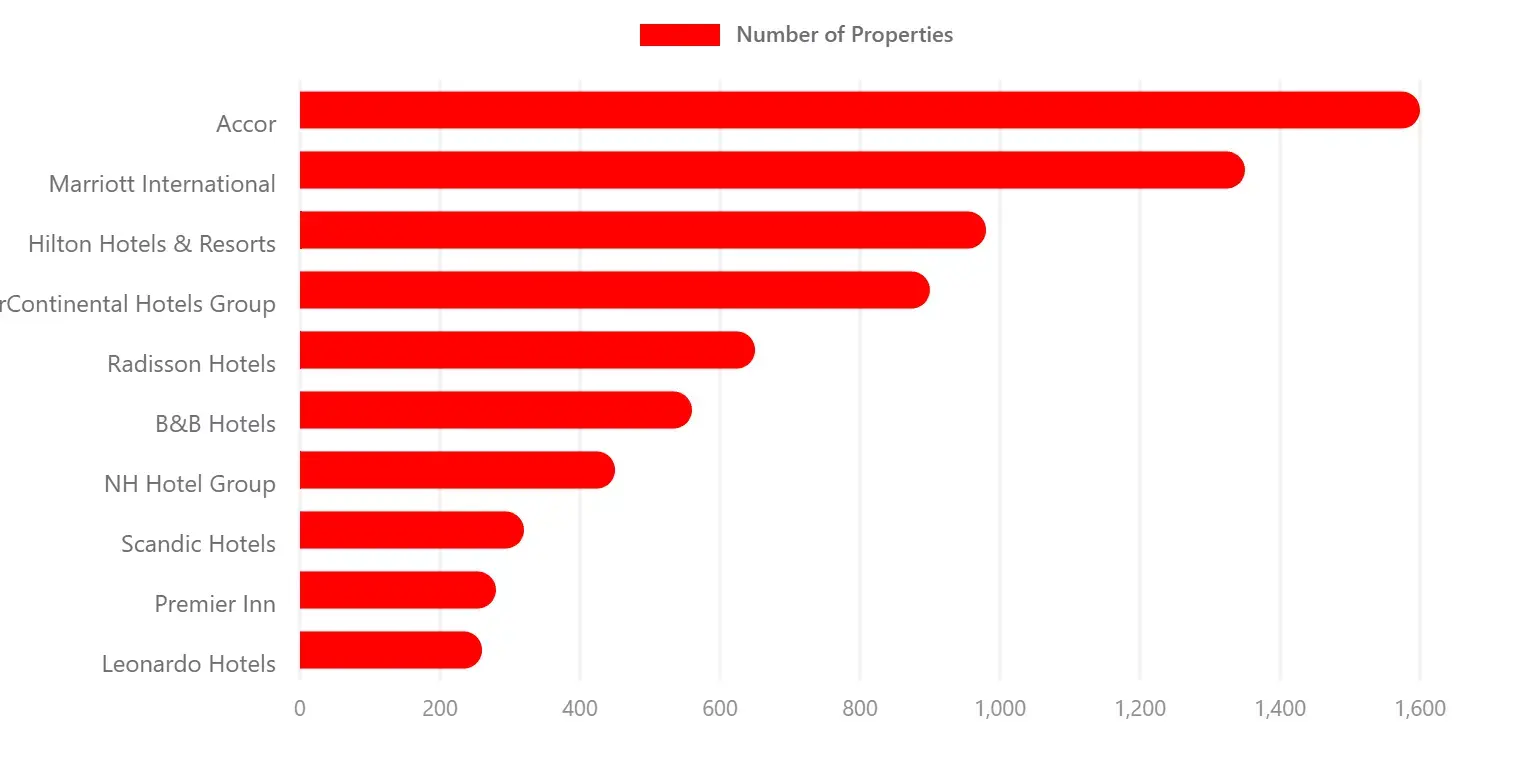
Europe’s hotel ecosystem in 2026 is defined by a mix of global hospitality leaders and regional chains operating across multiple states. Accor dominates in scale and multi-brand strategy, Marriott leads in luxury hospitality, and Hilton focuses on corporate travel hubs. InterContinental Hotels Group expands into emerging European states, while Radisson and Scandic strengthen regional dominance. Insights from method to Scrape Hotel Chains Location Data show that expansion is increasingly driven by state-level demand intelligence, pricing analytics, and cross-border tourism flows.

Accor
Budget to Luxury Leader
Marriott International
Luxury / Premium Leader
Hilton Hotels & Resorts
Business Travel Leader
InterContinental Hotels Group
Mid-Scale Expansion Leader
Radisson Hotels
Nordic Stronghold Brand
B&B Hotels
Value Budget Leader
NH Hotel Group
Mid-Scale Urban Leader
Scandic Hotels
Nordic Hospitality Leader
Premier Inn
UK Budget Leader
Leonardo Hotels
Central Europe Expansion BrandWant insights into Europe’s hotel chain ecosystem?
Connect with our experts for real-time hospitality data and analysis.
Advantages of Chain-Focused Hotel Location Data
State-level insights help identify under-served European hotel markets by analyzing regional demand, pricing gaps, and occupancy trends. They improve expansion planning, optimize revenue strategies, support Geo-Based Price Parity, and enable hotels to invest in high-growth areas while reducing market saturation risks effectively.
- Improving Portfolio Expansion Efficiency: State-level insights help identify under-served European hotel markets by revealing high-potential zones for strategic chain growth and optimized distribution.
- Strengthening Competitive Rate Alignment: State-level insights help identify under-served European hotel markets by supporting Geo-Based Price Parity across differentiated regional hotel clusters.
- Identifying High-ROI Investment Corridors: State-level insights help identify under-served European hotel markets by mapping emerging tourism demand pockets and reducing investment exposure in saturated cities.
- Enhancing Demand Forecast Precision: State-level insights help identify under-served European hotel markets by analyzing regional booking behavior shifts and improving predictive market intelligence models.
| Field Name | Description |
|---|---|
| Property & Brand Identity | Captures hotel name, brand tier, and chain association across European states for structured benchmarking and competitive mapping. |
| Location Intelligence Data | Includes state, city, and precise geolocation coordinates enabling accurate mapping and regional hospitality segmentation analysis. |
| Occupancy & Demand Data | Tracks room utilization levels, booking frequency, and seasonal occupancy trends across multiple states for demand forecasting. |
| Pricing & Revenue Metrics | Provides dynamic room rates, discount fluctuations, and competitive pricing intelligence across state-level hotel markets in real time. |
| Guest Experience Analytics | Aggregates ratings, reviews, and satisfaction scores to measure property performance consistency across different geographic locations. |
Insights and Analysis
The 2026 European hotel chain ecosystem reflects structured expansion across states rather than countries, with global brands dominating metropolitan regions while regional chains expand into secondary states. Continuous monitoring through Scrape Hotel Chains Location Data shows mid-scale hotels growing faster than luxury segments, especially in Eastern and Southern European states. The rise of real-time European hotel location data tracking is reshaping expansion strategies through state-level demand intelligence.
Conclusion
The European hospitality industry in 2026 is increasingly shaped by structured data intelligence, automation, and predictive analytics across states. Leveraging hotel location intelligence Europe market enables optimized investment decisions and expansion planning. The ability to scrape Europe hotel listings and geolocation data provides real-time visibility into state-level hotel distribution and market behavior. Ultimately, Property Listing Analysis will remain critical in understanding competitive dynamics across Europe’s evolving hotel ecosystem.