How to Scrape Cruise Data Delivery Strategies for Real-Time, Weekly, Monthly & Quarterly Itinerary Updates for Public Websites?
Introduction
The cruise industry produces extensive information covering sailing schedules, destinations, ships, ports, cabin categories, fares, availability, promotions, and itinerary changes. For travel agencies, cruise marketplaces, tour operators, travel technology companies, and market researchers, collecting this information is only one part of building a valuable intelligence system. Delivering accurate data at the right frequency is equally important.
Scrape Cruise Data Delivery Strategies help businesses determine how cruise information should be collected, processed, validated, stored, and distributed according to specific requirements. A Global Cruise Route Dataset can consolidate cruise lines, ships, departure ports, destinations, sailing dates, durations, and port sequences into a standardized resource. Organizations can also Extract Real-Time Cruise Itinerary Data to identify newly introduced sailings, schedule changes, cancellations, route modifications, and destination updates.
Different applications require different delivery intervals. Pricing platforms may need frequent updates, while research teams may prefer weekly, monthly, or quarterly datasets. A properly designed delivery framework ensures that businesses receive useful information without unnecessary processing costs or outdated records.
Understanding Cruise Data Collection
Cruise information is distributed across cruise operator websites, travel marketplaces, booking platforms, destination portals, and other publicly accessible sources. Automated collection allows organizations to gather these records consistently instead of relying on manual research.
Cruise Data Scraping can collect fields such as cruise line, vessel name, departure port, destination, sailing date, return date, duration, itinerary, cabin category, price, availability, promotional information, and port-of-call details.
After collection, raw information needs to be transformed into structured records. Dates should follow consistent formats, prices should be standardized, and cruise lines, ships, and ports should receive consistent identifiers.
The resulting information can be delivered as CSV, Excel, JSON, XML, database records, or API responses depending on how the receiving organization plans to use it.
Selecting the Appropriate Delivery Frequency
Data delivery frequency should reflect how quickly information changes and how quickly the business needs to respond.
| Frequency | Information Commonly Delivered | Typical Business Purpose |
|---|---|---|
| Real-time | Prices, availability, itinerary changes | Booking and alert systems |
| Daily | Prices, schedules, inventory | Competitive monitoring |
| Weekly | Routes, itineraries, promotions | Market intelligence |
| Monthly | Consolidated cruise records | Trend analysis |
| Quarterly | Historical itinerary information | Strategic research |
There is no universal delivery schedule. A company monitoring cabin availability may require frequent updates, whereas an organization studying annual destination trends may only need periodic datasets.
Supporting Public Website Research
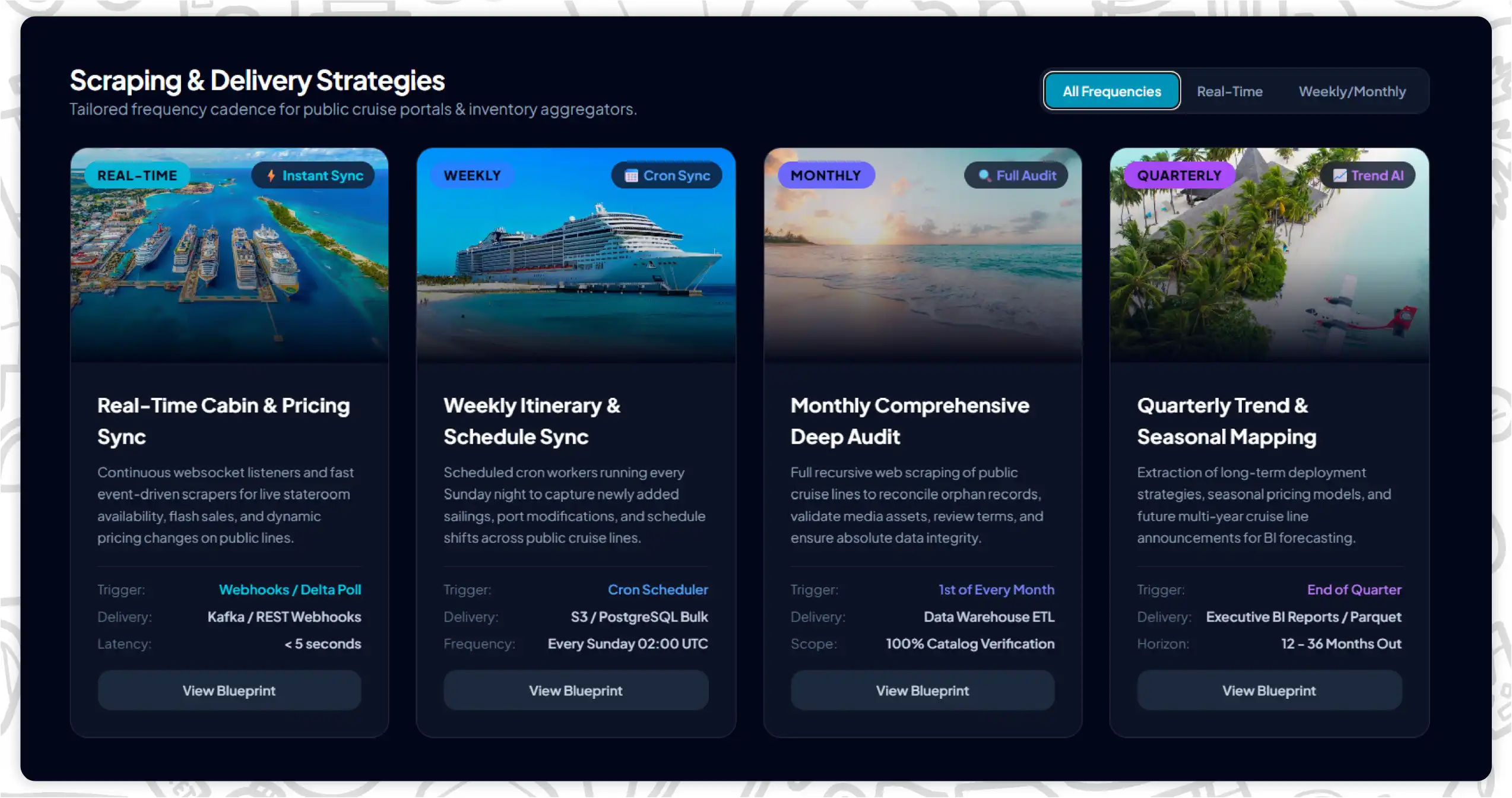
A Cruise Quarterly Itinerary Data API for Public Websites can provide structured information collected over a three-month period. This model is useful for research teams that need comprehensive itinerary information but do not require continuous updates.
Quarterly records can contain cruise lines, ships, sailing dates, departure ports, arrival destinations, itinerary sequences, cruise durations, and other publicly displayed details.
By comparing quarterly snapshots, analysts can identify changes in route structures, new destinations, discontinued sailings, seasonal adjustments, and differences in sailing frequency.
API-based delivery also makes it easier to integrate collected information into business intelligence platforms, databases, dashboards, and internal analytical systems.
Monitoring Weekly Changes
Weekly Cruise Itinerary Data Scraping provides a practical balance between freshness and processing requirements. It can capture itinerary changes that occur between recurring weekly collection cycles.
For example, a cruise operator may change a port of call, adjust a departure date, add a new sailing, or remove an itinerary. A weekly snapshot can help businesses identify these changes without maintaining a continuous real-time collection system.
Historical weekly datasets can also be compared to determine how cruise schedules evolve over time. This creates a valuable foundation for route analysis and seasonal research.
Analyzing Pricing Movements
Cruise Pricing Intelligence depends on collecting comparable pricing information across cruise lines, ships, destinations, sailing dates, cabin types, and passenger configurations.
A pricing dataset can contain:
- Displayed cruise fare
- Discounted fare
- Original fare
- Cabin category
- Sailing date
- Cruise duration
- Departure port
- Destination
- Promotional details
- Availability indicators
Historical pricing records can reveal changes across booking periods, seasons, destinations, and sailing types.
Travel businesses can compare competing cruise offerings, identify pricing differences, study promotional activity, and understand how fares change as sailing dates approach.
Delivering Recurring Datasets
Monthly Cruise Dataset Delivery is suitable for organizations that require recurring market information without the infrastructure associated with high-frequency monitoring.
A monthly dataset can combine schedules, ships, routes, destinations, fares, availability, and itinerary information into a standardized collection.
Because each monthly delivery can be archived, businesses can create a historical database. This allows analysts to compare current information against previous periods and identify longer-term trends.
Monthly delivery can also reduce unnecessary processing for applications where daily changes do not materially affect decision-making.
Connecting Applications Through APIs
A Real-Time Data API can provide applications with rapidly refreshed cruise information. This approach is particularly useful for booking platforms, comparison websites, monitoring systems, and alert applications.
Instead of waiting for a scheduled file, an application can request structured information when required. API-based delivery can support JSON responses, automated workflows, dashboards, and downstream analytics.
A reliable API architecture should include authentication, error handling, monitoring, validation, documentation, and appropriate rate controls. These components help maintain consistent access while protecting the stability of the data pipeline.
Managing Schedule Information
Cruise Schedule Data Delivery Extraction focuses on collecting and distributing structured sailing information.
Important fields can include:
- Cruise line
- Ship name
- Departure port
- Arrival port
- Sailing date
- Return date
- Cruise duration
- Port sequence
- Destination
- Itinerary status
The extraction workflow generally begins with source identification and automated collection. The data is then cleaned, normalized, validated, stored, and distributed according to the selected delivery model.
This approach enables organizations to maintain a standardized schedule database even when different sources present information in different formats.
Tracking Inventory Changes
Real-Time Availability Tracking can help businesses monitor changes in publicly displayed cruise inventory. Availability can fluctuate because of bookings, cancellations, inventory adjustments, or changes made by cruise operators.
When availability information is collected alongside price and itinerary data, analysts can develop a broader view of market conditions.
For example, decreasing availability combined with increasing fares may indicate stronger demand for a particular sailing. Such observations can support competitive monitoring and pricing analysis.
Real-time monitoring can also trigger alerts when specific conditions are detected, such as a sailing becoming available or an inventory level changing.
Designing a Flexible Delivery Framework
A strong Cruise Dataset Delivery Strategies framework should support multiple delivery frequencies rather than relying on one fixed approach.
A business could use real-time collection for pricing and availability, weekly collection for itinerary monitoring, monthly delivery for market analysis, and quarterly datasets for strategic research.
This layered approach allows each type of information to be delivered according to its importance and volatility.
Historical snapshots are also important. If only the latest information is retained, previous prices, routes, and availability conditions may disappear. Maintaining historical versions allows businesses to analyze changes over time.
Improving Data Quality
Cruise data can contain inconsistent terminology across different sources. A cruise ship may have variations in naming, while ports can appear under multiple names. Currency formats, dates, cabin categories, and promotional descriptions may also differ.
A reliable data pipeline should therefore include:
- Duplicate detection
- Date normalization
- Currency standardization
- Port normalization
- Cruise line identification
- Ship identification
- Missing-value checks
- Historical comparison
- Change detection
- Validation before delivery
These processes help ensure that downstream systems receive consistent and usable information.
Benefits of Automated Distribution
Automated distribution allows businesses to receive updated datasets without repeatedly requesting or manually downloading information.
A properly configured pipeline can provide:
- Consistent delivery schedules
- Reduced manual research
- Faster access to updated information
- Standardized data structures
- Historical records
- Easier API integration
- Scalable processing
- Improved competitive analysis
Automation also allows delivery frequency to be adjusted as business requirements change.
How Travel Scrape Can Help You?
Customized Collection
Travel Scrape can create cruise data collection workflows around selected sources, routes, fields, sailing schedules, pricing information, and availability requirements to support specific business intelligence objectives.
Flexible Scheduling
Travel Scrape can support different delivery frequencies, including frequent updates, daily monitoring, weekly datasets, monthly collections, and quarterly research files based on operational requirements.
Structured Data
Travel Scrape can organize cruise information into standardized datasets containing ships, ports, routes, prices, schedules, itineraries, and availability, making collected information easier to analyze and integrate.
Historical Monitoring
Travel Scrape can maintain recurring snapshots that help businesses compare cruise schedules, pricing movements, availability changes, and destination patterns across different periods.
Scalable Integration
Travel Scrape can deliver structured cruise information through automated data pipelines and APIs, helping travel companies connect collected intelligence with dashboards, databases, analytics platforms, and internal applications.
Conclusion
Effective cruise intelligence requires a combination of accurate collection, data quality management, historical preservation, and reliable distribution. Businesses need to determine whether their applications require frequent updates, weekly itinerary monitoring, monthly datasets, or quarterly research collections.
A flexible delivery architecture allows different information types to follow different schedules. Pricing and availability may require frequent monitoring, while itinerary and route research can often operate effectively through scheduled datasets.
Automation further reduces manual effort and creates a repeatable process for collecting, validating, transforming, and distributing cruise information. With the right infrastructure, businesses can turn fragmented public cruise information into structured intelligence for competitive analysis, route research, pricing studies, travel platforms, and market forecasting.
Scheduled Dataset Delivery can provide an additional layer of operational efficiency by automatically distributing validated cruise datasets according to predefined schedules, formats, and business requirements.
Ready to elevate your travel business with cutting-edge data insights? Scrape Aggregated Flight Fares to identify competitive rates and optimize your revenue strategies efficiently. Discover emerging opportunities with tools to Extract Travel Website Data, leveraging comprehensive data to forecast market shifts and enhance your service offerings. Real-Time Travel App Data Scraping Services helps stay ahead of competitors, gaining instant insights into bookings, promotions, and customer behavior across multiple platforms. Get in touch with Travel Scrape today to explore how our end-to-end data solutions can uncover new revenue streams, enhance your offerings, and strengthen your competitive edge in the travel market.
Unlock the Full Report
Enter your details to access premium pricing intelligence insights