Fixing Room & Rate Mapping for a Multi-Channel OTA: How Category Mismatches Were Costing Bookings
Introduction
This case study demonstrates how a multi-channel online travel agency improved hotel inventory visibility, room classification accuracy, and pricing intelligence by standardizing room and rate information collected across multiple booking sources. The OTA was experiencing inconsistencies between room names, occupancy rules, meal plans, cancellation policies, and displayed prices, making it difficult to compare equivalent inventory across channels. The project focused on Fixing Room & Rate Mapping for a Multi-Channel OTA across different hotel sources while establishing reliable Room Type Availability information for downstream booking and analytics workflows. A structured hotel room category mapping framework was implemented to normalize inconsistent room descriptions and connect equivalent room categories across platforms. The solution combined automated data collection, attribute normalization, validation rules, and cross-channel matching. This enabled the OTA to create a more consistent hotel inventory layer, improve comparison accuracy, reduce duplicate room representations, and strengthen the reliability of its pricing and availability intelligence for commercial decision-making.
The Client
The client was a multi-channel OTA managing hotel inventory aggregated from several online booking platforms, supplier feeds, direct hotel sources, and travel marketplaces. Its business model depended on presenting travelers with accurate room availability, comparable rates, occupancy information, and booking conditions across destinations. However, inconsistent room terminology and fragmented pricing information created difficulties in maintaining a unified inventory database. The client wanted to strengthen its competitive intelligence capabilities using a Hotel Room Price Trends Dataset covering room categories, rates, occupancy, meal plans, cancellation conditions, and availability patterns across multiple channels. It also required real time hotel rate scraping capabilities to monitor changing hotel prices and detect differences between competing sources. The project additionally focused on Multi-Channel OTA Room category data extraction, enabling the client to connect equivalent room types across suppliers and booking platforms while maintaining structured, analysis-ready hotel inventory records.
Challenges in the Travel Industry
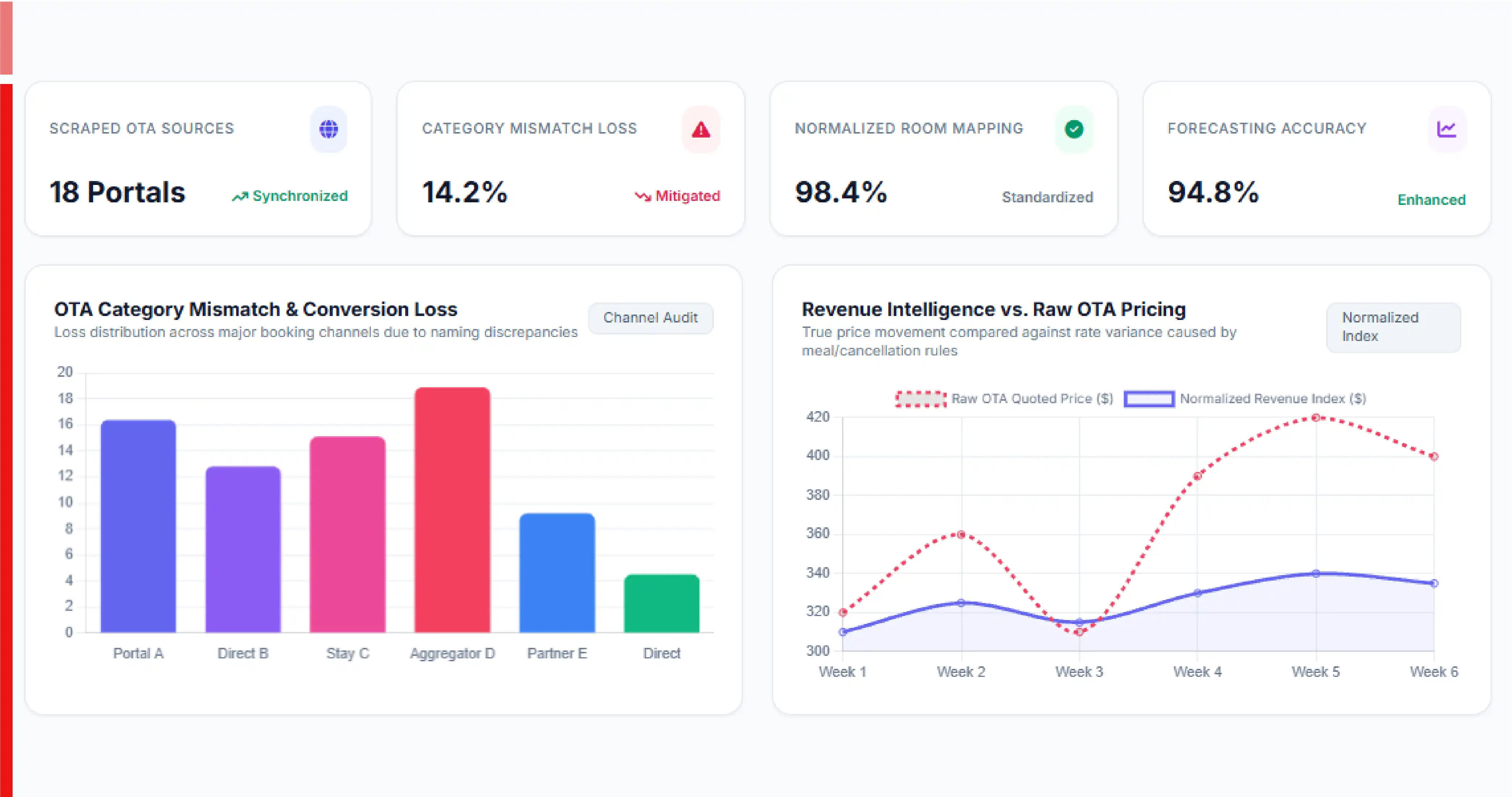
The client faced several operational and analytical challenges caused by fragmented hotel information, inconsistent room descriptions, changing rates, and differences between OTA inventory structures. These issues affected comparison accuracy, booking visibility, and revenue intelligence.
Fragmented Hotel Inventory
Large-scale Hotel Data Scraping generated room information from multiple platforms, but source websites used different naming conventions, occupancy formats, meal-plan descriptions, and cancellation policies. This created duplicate representations of the same room and made reliable cross-channel comparisons difficult.
Category Mismatch
The client needed detailed OTA Booking Loss from Category Mismatch analysis because similar rooms frequently appeared under different names across platforms. Incorrect matching could cause customers to overlook suitable inventory, reduce conversion opportunities, and create inaccurate comparisons between supposedly equivalent hotel products.
Limited Booking Visibility
Inconsistent historical room records made it difficult to generate reliable Booking Trend Insights across destinations, room categories, occupancy levels, and travel periods. The client lacked a standardized structure for identifying demand changes and understanding which room categories were gaining or losing booking visibility.
Revenue Intelligence Gaps
Different rate plans and room classifications complicated Hotel Booking Revenue management insights. The client needed to distinguish genuine price movements from changes caused by room-category differences, meal inclusions, occupancy restrictions, cancellation policies, or inventory availability across competing booking channels.
Forecasting Complexity
The absence of standardized historical room-level data weakened OTA hotel Booking Demand forecasting capabilities. Without consistent category mapping and comparable availability records, forecasting models could interpret duplicate rooms as separate products and produce distorted demand signals across destinations and booking periods.
Our Approach
The solution combined automated collection, room normalization, cross-platform matching, validation, and structured datasets to create a unified hotel intelligence framework.
Automated Data Collection
We established automated pipelines to collect hotel room names, prices, occupancy limits, meal plans, cancellation policies, availability indicators, and booking conditions from multiple travel sources. Data was captured at regular intervals to support consistent monitoring and downstream analytical workflows.
Room Attribute Normalization
We standardized room attributes using structured rules covering room names, bed configurations, occupancy, meal plans, cancellation conditions, and rate-plan characteristics. This reduced inconsistencies between supplier terminology and created a common structure for comparing equivalent hotel inventory.
Cross-Channel Matching
A dedicated matching framework connected rooms with similar characteristics across OTA channels. The system evaluated room names, occupancy, bed type, amenities, meal plans, and policy attributes before assigning normalized categories, reducing duplicate inventory and improving cross-channel comparison accuracy.
Dynamic Pricing Intelligence
The project incorporated Dynamic Pricing Intelligence by tracking room-level rate changes, availability movements, discounts, and booking conditions over time. This allowed the client to distinguish actual pricing changes from differences created by room categories, occupancy rules, or rate-plan configurations.
Quality Validation
Automated validation rules identified missing attributes, unusual price movements, inconsistent occupancy information, duplicate room records, and potential category mismatches. Exceptions were flagged for review, improving dataset reliability while enabling the client to maintain a continuously refreshed hotel inventory intelligence layer.
Results Achieved
The implementation improved room-level consistency, pricing visibility, cross-channel comparison, and the analytical foundation required for OTA commercial decision-making.
Improved Room Matching
The standardized mapping framework increased the consistency of equivalent room identification across multiple booking channels. Duplicate representations were reduced, allowing the OTA to compare room categories more accurately and present cleaner inventory relationships.
Stronger Price Monitoring
The client gained structured visibility into hotel room prices across channels, enabling analysts to monitor rate movements, discounts, occupancy-related pricing differences, and changes in booking conditions with greater consistency.
Better Availability Intelligence
Normalized availability records made it easier to identify which room categories were available, unavailable, restricted, or changing across monitored sources. This improved the reliability of hotel inventory comparisons and destination-level availability analysis.
Enhanced Revenue Analysis
The unified dataset enabled analysts to separate room-category effects from genuine pricing changes. This supported more reliable revenue analysis by connecting prices with occupancy, room attributes, cancellation rules, and channel-level availability conditions.
Scalable OTA Analytics
The resulting data architecture created a scalable foundation for adding hotels, destinations, suppliers, and booking platforms. The OTA could expand monitoring coverage while maintaining standardized room structures and comparable records across its growing hotel inventory.
Results Snapshot
| Metric | Before Implementation | After Implementation | Improvement |
|---|---|---|---|
| Hotel Sources Monitored | 18 | 42 | 133% |
| Hotels Tracked | 12,500 | 31,800 | 154% |
| Room Records Processed | 486,000 | 1,420,000 | 192% |
| Normalized Room Categories | 58,400 | 214,600 | 267% |
| Daily Rate Observations | 92,000 | 318,000 | 246% |
| Category Matching Accuracy | 78.4% | 96.7% | 18.3 pp |
| Duplicate Room Records | 14.8% | 3.6% | 75.7% reduction |
| Availability Accuracy | 81.6% | 95.9% | 14.3 pp |
| Average Processing Time | 9.2 hrs | 2.8 hrs | 69.6% reduction |
| Pricing Variance Detection | 72.5% | 94.8% | 22.3 pp |
| Data Refresh Frequency | Daily | Near Real-Time | Higher frequency |
| Markets Covered | 24 | 61 | 154% |
| Analytical Data Fields | 34 | 86 | 153% |
Client's Testimonial
"Before this project, our hotel inventory contained significant inconsistencies because every booking source represented rooms differently. Comparing rates and availability across channels required extensive manual validation and frequently produced unreliable results. The new data framework has transformed the way our team works with hotel inventory. We can now connect comparable room categories, monitor pricing changes, identify availability movements, and analyze booking conditions through a standardized dataset. The increased visibility has also helped our commercial and revenue teams understand competitive pricing patterns with greater confidence. The automated validation process has reduced repetitive data-cleaning work and allowed our analysts to focus more on market intelligence. Most importantly, the solution gives us a scalable foundation for expanding our hotel coverage without compromising data quality or comparison accuracy."
Conclusion
This case study demonstrates how structured room normalization and automated hotel intelligence can address complex inventory challenges faced by multi-channel OTAs. By standardizing room categories, occupancy attributes, rate plans, availability, and booking conditions, the client created a more dependable foundation for hotel comparison and commercial analytics. The solution also strengthened pricing visibility and reduced the operational burden associated with manually reconciling fragmented hotel information. Modern OTAs can use Scrape Aggregated Travel Deals to monitor competitive offers and identify meaningful pricing differences across channels. Similarly, businesses can Scrape Travel Website Data to build broader hotel, rate, and availability datasets for market analysis. Extending these capabilities to Scrape Travel Mobile App environments can further improve coverage of mobile-exclusive rates, availability signals, and promotional offers. Together, these capabilities provide a scalable framework for hotel intelligence and OTA optimization.
FAQs
Unlock the Full Report
Enter your details to access premium pricing intelligence insights