Car Rental Vehicle Listing Benchmarking for A Pre-Launch Data Sprint
Introduction
The global car rental market is increasingly influenced by changing travel demand, dynamic pricing, vehicle availability, location-specific preferences, and digital booking behavior. A leading travel intelligence company partnered with our team to benchmark rental listings across multiple markets and understand pricing and inventory movements. The project focused on Car Rental Vehicle Listing Benchmarking to compare vehicle categories, rental rates, availability, locations, and marketplace positioning across competing platforms. Our team implemented Car Rental Data Scraping workflows to collect structured information from online rental marketplaces, aggregators, and booking channels. The solution also supported real-time car rental availability data monitoring, enabling the client to identify inventory changes and pricing movements as they occurred. The resulting intelligence framework helped transform fragmented rental marketplace information into a standardized dataset suitable for competitive benchmarking, market analysis, inventory tracking, pricing research, and strategic planning. It provided consistent visibility into vehicle listings, rental rates, locations, availability status, and marketplace-level differences.
The Client
The client was a travel technology and market intelligence company serving rental businesses, travel platforms, mobility providers, and digital booking companies. Its objective was to develop a scalable intelligence system capable of tracking rental marketplace activity across multiple cities and vehicle categories. The organization wanted to strengthen Demand Forecasting capabilities by understanding how rental prices, inventory levels, booking conditions, and vehicle availability changed across locations and periods. It also required reliable Scrape car rental marketplace data collection to consolidate information from fragmented digital sources into standardized records. Another priority was building a comprehensive car rental inventory database containing vehicle types, prices, locations, availability, rental duration, suppliers, and marketplace details. The client planned to use this information for competitive benchmarking, market expansion research, pricing intelligence, inventory planning, and travel-platform analytics. A structured data pipeline was therefore required to support recurring collection and actionable business intelligence.
Challenges Faced in the Travel Industry
The travel industry faces fragmented marketplace information, rapidly changing rental prices, inconsistent inventory visibility, and significant differences between locations. These challenges made centralized Car Rental Data Intelligence difficult to maintain across multiple digital sources.
Fragmented Marketplace Information
Rental information was distributed across multiple booking platforms, aggregators, supplier websites, and marketplaces. Each source used different structures, naming conventions, vehicle classifications, and pricing formats, making direct comparison difficult without a standardized collection and normalization process.
Continuously Changing Inventory
Rental inventory changed frequently as vehicles were booked, returned, added, or removed. Maintaining an accurate live car rental listings dataset required recurring collection workflows capable of detecting new listings, unavailable vehicles, modified rental conditions, and inventory changes across monitored sources.
Complex Pricing Variations
Rental prices differed according to vehicle category, rental duration, pickup location, dates, supplier, demand, and availability. Developing a reliable Car Rental Price Trends Dataset required capturing comparable pricing information consistently while accounting for differences in rental conditions and marketplace structures.
Difficulty Analyzing Live Listings
Travel companies needed timely information to compare competitors and identify marketplace changes. However, inconsistent source structures made live vehicle rental listing data analysis challenging, particularly when listings changed frequently and information was presented differently across websites and digital booking interfaces.
Location-Level Visibility Gaps
Rental demand and availability varied substantially between airports, city centers, tourist destinations, and regional markets. Effective location-wise vehicle listings data extraction required collecting granular geographic information and connecting vehicle, supplier, pricing, and availability records with their respective rental locations.
Our Approach
Real-Time API-Based Collection
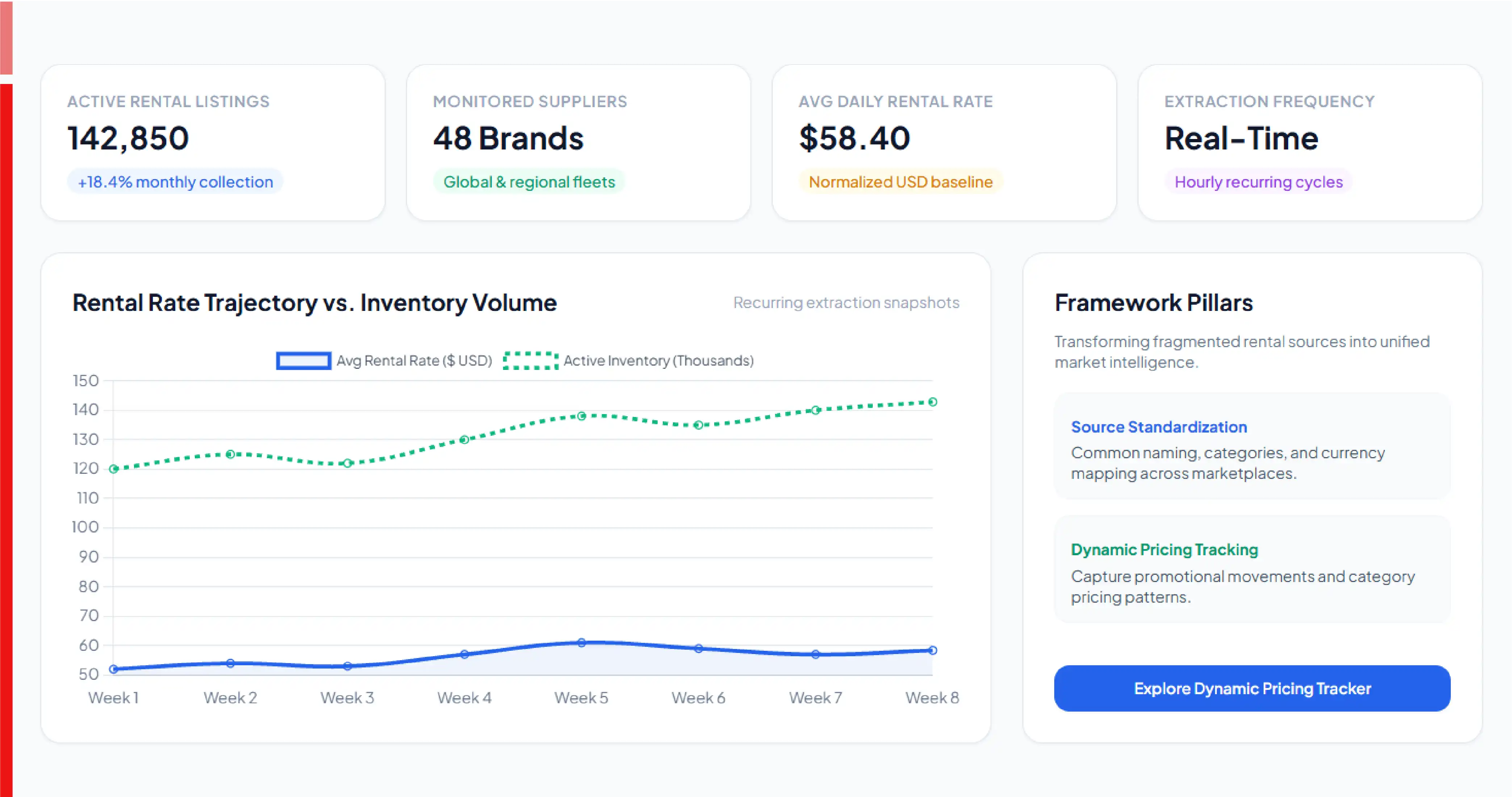
We developed a Real-Time Car Rental Data Scraping API to collect rental listings, prices, availability, vehicle categories, suppliers, locations, and booking conditions through structured data pipelines. The architecture supported recurring extraction and helped maintain fresh marketplace intelligence for downstream analysis.
Source Standardization
Data collected from different rental marketplaces was standardized using common fields, naming conventions, vehicle categories, geographic identifiers, pricing structures, and availability indicators. This allowed the client to compare listings across sources without manually reconciling inconsistent formats or duplicate information.
Dynamic Pricing Tracking
Our solution captured rental prices across selected dates, locations, vehicle categories, and rental durations. Historical snapshots were maintained to identify price changes, promotional movements, category-level differences, and marketplace pricing patterns that could support competitive analysis and commercial planning.
Inventory Monitoring
Automated workflows continuously monitored vehicle listings and availability conditions. New records, removed vehicles, changed prices, modified rental conditions, and inventory fluctuations were identified through recurring extraction cycles, helping the client maintain a more current understanding of marketplace supply.
Geographic Intelligence
Rental listings were mapped to cities, airports, regions, and individual pickup locations. This enabled location-level comparisons of vehicle supply, rental rates, supplier presence, and category availability, giving the client a structured foundation for regional market analysis and expansion planning.
Results Achieved
The implemented solution created a centralized intelligence framework that improved marketplace visibility, pricing comparison, inventory tracking, and location-level analysis across rental markets.
Expanded Marketplace Visibility
The client gained structured access to thousands of rental listings across multiple marketplaces and locations. Standardized records enabled faster comparisons of suppliers, vehicle categories, rental prices, availability conditions, and geographic coverage.
Improved Pricing Intelligence
Historical and current pricing records helped identify rental price movements across vehicle categories and locations. The client could compare pricing differences, monitor market changes, and use structured trends for commercial and competitive analysis.
Stronger Inventory Monitoring
Recurring data collection improved visibility into available and unavailable vehicles. The client could monitor changes in rental supply, detect listing fluctuations, and maintain a more comprehensive view of marketplace inventory across monitored locations.
Better Location-Level Analysis
The solution connected vehicle listings with geographic information, enabling comparisons between airports, cities, tourist markets, and other pickup locations. This supported regional supply analysis and helped identify differences in vehicle availability and rental pricing.
Scalable Intelligence Infrastructure
The resulting architecture provided a reusable foundation for expanding marketplace coverage, adding new vehicle categories, monitoring additional locations, and integrating rental data into dashboards, analytical systems, forecasting models, and business intelligence applications.
Data Performance Snapshot
| Metric | January | February | March | April | May | June | July | August | Total / Average |
|---|---|---|---|---|---|---|---|---|---|
| Rental Listings Collected | 18,450 | 19,280 | 21,640 | 22,850 | 24,170 | 25,430 | 27,180 | 28,760 | 187,760 |
| Locations Monitored | 42 | 45 | 48 | 52 | 55 | 58 | 61 | 65 | 65 |
| Vehicle Categories | 14 | 14 | 15 | 15 | 16 | 16 | 17 | 18 | 18 |
| Suppliers Tracked | 96 | 101 | 108 | 114 | 121 | 128 | 136 | 142 | 142 |
| Price Records | 31,240 | 34,180 | 38,520 | 41,670 | 45,210 | 48,630 | 52,470 | 56,840 | 348,760 |
| Available Vehicles | 12,840 | 13,420 | 14,960 | 15,730 | 16,890 | 17,640 | 19,120 | 20,480 | 20,480 |
| Unavailable Vehicles | 5,610 | 5,860 | 6,680 | 7,120 | 7,280 | 7,790 | 8,060 | 8,280 | 8,280 |
| New Listings Detected | 3,240 | 3,580 | 4,120 | 4,460 | 4,730 | 5,080 | 5,420 | 5,860 | 36,490 |
| Price Changes Detected | 4,180 | 4,620 | 5,240 | 5,680 | 6,120 | 6,580 | 7,040 | 7,460 | 46,920 |
| Daily Collection Runs | 31 | 28 | 31 | 30 | 31 | 30 | 31 | 31 | 243 |
| Data Accuracy Rate (%) | 96.8 | 97.0 | 97.1 | 97.2 | 97.3 | 97.4 | 97.5 | 97.6 | 97.2 |
| Average Processing Time (Minutes) | 42 | 40 | 39 | 38 | 37 | 36 | 35 | 34 | 37.6 |
| Geographic Coverage (%) | 78 | 81 | 84 | 86 | 89 | 91 | 94 | 96 | 96 |
| Structured Records Delivered | 29,680 | 32,740 | 37,410 | 40,820 | 44,860 | 48,210 | 52,920 | 57,430 | 344,070 |
Client's Testimonial
"Working with the data intelligence team significantly improved our ability to understand rental marketplace activity across locations and vehicle categories. Before this project, our analysts spent considerable time consolidating fragmented marketplace information and validating changing prices and availability manually. The structured data pipeline gave us a much more consistent source for competitive benchmarking, inventory monitoring, and pricing analysis. We particularly valued the recurring collection architecture because it allowed our teams to work with fresher marketplace information rather than relying on occasional snapshots. The location-level data also helped us compare markets more efficiently and identify differences in supplier presence, vehicle availability, and rental pricing. The solution has become an important input for our travel intelligence workflows and provides a scalable foundation for expanding our coverage into additional rental markets."
Conclusion
The case study demonstrates how structured rental marketplace intelligence can help travel businesses address fragmented pricing, inventory, supplier, and location information. By combining automated collection, standardized datasets, recurring monitoring, and geographic analysis, the client developed a scalable framework for understanding rental marketplace activity. The solution also created opportunities to integrate Travel Aggregators Data Scraping Services into broader travel intelligence workflows, enabling consistent collection across multiple booking ecosystems. Businesses requiring broader marketplace coverage can also use Travel Industry Web Scraping Services to monitor pricing, availability, listings, and competitive movements across digital travel sources. For mobile-first travel ecosystems, a Travel Mobile App Scraping Service can further extend data coverage to application-based rental marketplaces. Together, these capabilities can support competitive research, pricing intelligence, inventory analysis, forecasting, and strategic decision-making across evolving travel markets.
FAQs
Unlock the Full Report
Enter your details to access premium pricing intelligence insights