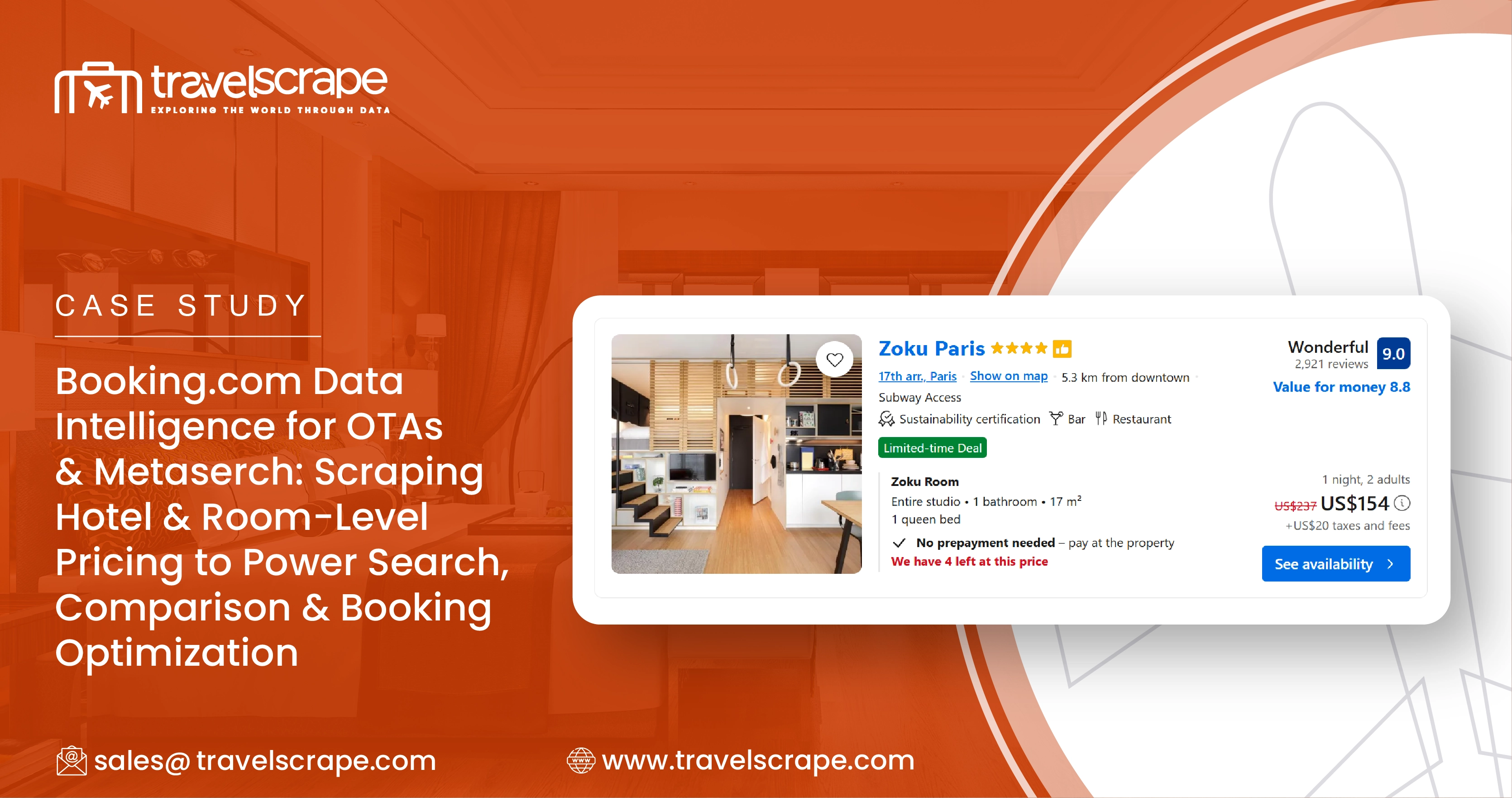
Booking.com Data Intelligence for OTAs & Metasearch: Scraping Hotel & Room-Level Pricing to Power Search, Comparison & Booking Optimization
Introduction
A leading OTA brand partnered with our team to improve pricing visibility and traveler conversion using Booking.com Data Intelligence for OTAs & Metasearch. The client struggled with inconsistent hotel listings, delayed inventory updates, and poor rate competitiveness across global destinations. By collecting structured accommodation insights, the company gained deeper visibility into traveler demand trends, dynamic pricing fluctuations, and booking behavior patterns across multiple regions./p>
Using advanced analytics, we monitored Room Type Availability across luxury, business, and budget hotels in real time. This enabled the OTA platform to instantly identify sold-out categories, seasonal demand spikes, and competitor inventory gaps. The insights helped improve recommendation accuracy, optimize campaign timing, and reduce customer drop-offs caused by unavailable rooms./p>
Our intelligence solution also delivered hotel and room-level pricing data for Metasearch optimization. With real-time pricing comparisons and availability tracking, the client improved bid strategies, enhanced rate parity monitoring, and increased booking conversions while maintaining stronger visibility across metasearch platforms and travel aggregators.
The Client
The client is a rapidly growing travel technology company focused on improving hotel discovery, pricing transparency, and booking conversion across global travel platforms. They required a scalable intelligence solution to monitor changing hotel prices, room availability, traveler demand, and competitor strategies in real time. Their primary objective was strengthening rate competitiveness and enhancing visibility across multiple OTA and metasearch ecosystems.
To achieve this, the company adopted Booking.com hotel pricing data scraping for Metaserch to capture accurate pricing trends, seasonal fluctuations, and regional booking patterns. They also leveraged hotel price comparison data scraping across OTAs to benchmark rates against competitors and optimize promotional campaigns more effectively.
Additionally, the client utilized Web Scraping Booking.com Hotels Data to track hotel-level insights, room categories, discounts, reviews, and inventory updates. These insights helped improve traveler engagement, increase booking accuracy, and support data-driven pricing strategies across international markets.
Challenges in the Hotel Industry
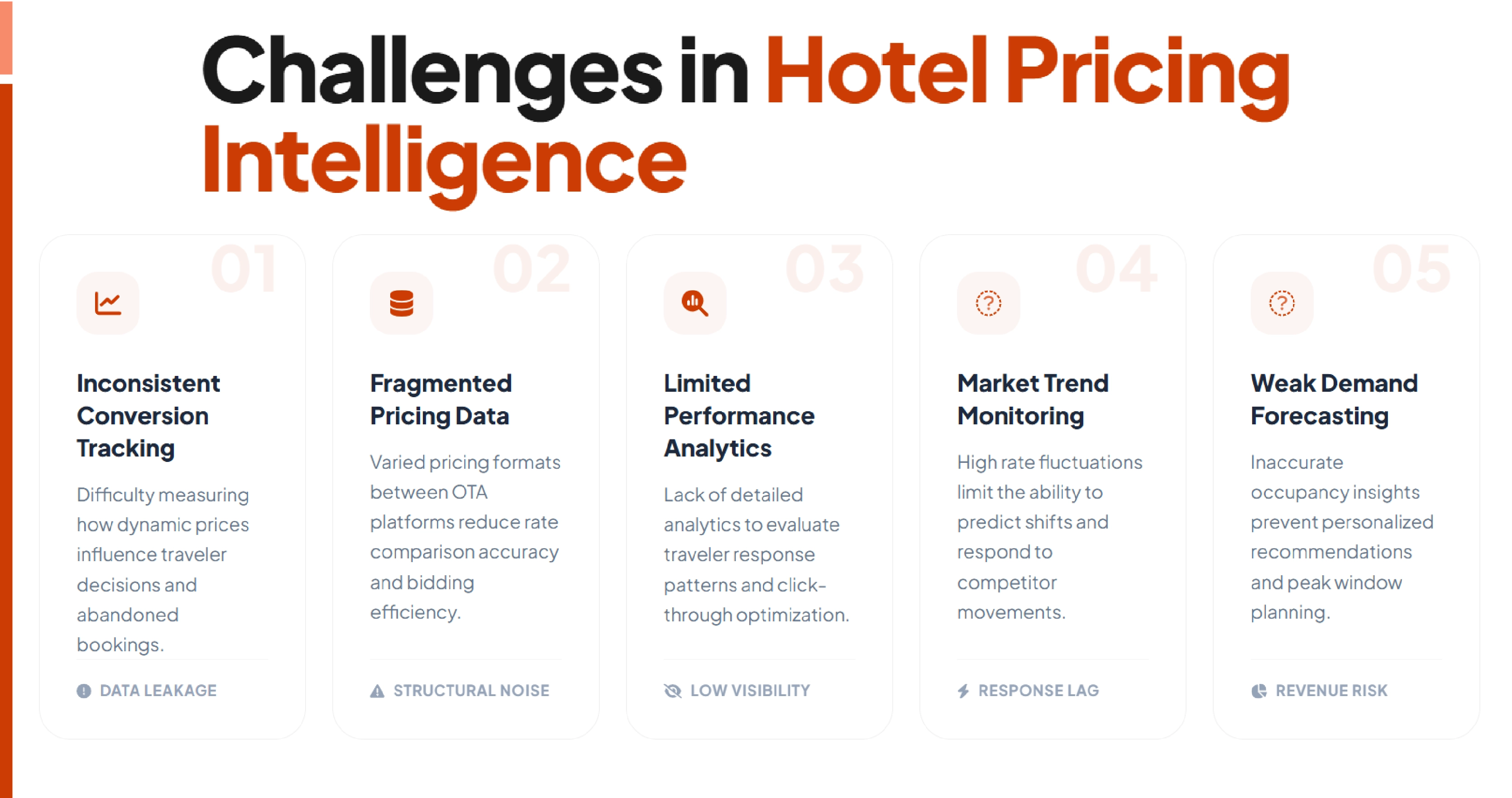
The client faced multiple operational and analytical challenges while managing hotel pricing intelligence across competitive OTA and metasearch platforms. Inconsistent pricing updates, fragmented inventory visibility, and limited booking performance insights affected their ability to optimize traveler acquisition, improve conversion rates, and maintain pricing competitiveness globally.
1. Inconsistent Conversion Tracking
The client struggled to Scrape hotel pricing impact on booking conversion rates across different booking channels. Without centralized pricing intelligence, they could not accurately measure how dynamic room prices influenced traveler decisions, abandoned bookings, or conversion performance during seasonal demand fluctuations and promotional campaigns.
2. Lack of Structured Pricing Intelligence
Managing a reliable hotel room rate dataset for Metaserch became difficult because pricing formats varied between platforms. This inconsistency reduced the effectiveness of rate comparison engines, affected bidding accuracy, and created delays in displaying competitive hotel offers to potential travelers searching across metasearch ecosystems.
3. Limited Performance Analytics
The organization lacked detailed hotel pricing impact on booking conversion analytics needed to evaluate traveler response patterns. Without actionable insights, marketing teams found it difficult to optimize pricing campaigns, improve click-through performance, and identify which pricing strategies generated higher booking engagement across regions and property categories.
4. Difficulty Monitoring Market Trends
Tracking a comprehensive Hotel Room Price Trends Dataset across destinations was challenging due to frequent rate fluctuations and inventory updates. The absence of automated monitoring limited the client’s ability to predict pricing shifts, understand competitor movements, and respond quickly to changing traveler demand conditions.
5. Weak Demand Forecasting Capabilities
The company lacked accurate Booking Trend Insights to understand traveler preferences, peak booking windows, and seasonal occupancy behavior. This reduced forecasting accuracy, impacted promotional planning, and prevented the business from delivering personalized hotel recommendations that aligned with evolving customer booking expectations globally.
Our Approach
1. Centralized Data Collection
We designed a scalable extraction framework to collect hotel pricing, availability, room categories, discounts, and occupancy updates from multiple travel platforms. This centralized structure helped the client eliminate fragmented information sources and gain unified visibility into rapidly changing accommodation and traveler demand patterns globally.
2. Real-Time Monitoring System
Our team implemented automated monitoring pipelines that continuously tracked pricing fluctuations, inventory updates, and seasonal booking movements. This real-time visibility enabled faster decision-making, minimized delays in updating traveler-facing platforms, and improved the accuracy of displayed hotel offers across international destinations and markets.
3. Advanced Data Normalization
We standardized collected hotel information into structured datasets for easier comparison and analysis. By cleaning inconsistent formats, duplicate listings, and missing attributes, we improved data reliability, enhanced reporting accuracy, and created a consistent foundation for analytics, pricing optimization, and demand forecasting initiatives.
4. Competitive Intelligence Analysis
Our approach included competitor benchmarking to evaluate pricing strategies, promotional campaigns, and inventory positioning across multiple booking ecosystems. This helped the client identify pricing gaps, monitor market behavior, and improve strategic decisions related to traveler acquisition, rate optimization, and hotel visibility enhancement.
5. Actionable Business Dashboards
We delivered interactive dashboards featuring booking trends, room availability patterns, occupancy shifts, and pricing performance metrics. These dashboards enabled leadership teams to access clear operational insights, improve forecasting capabilities, optimize campaign timing, and support faster business decisions using accurate, data-driven intelligence.
Results Achieved
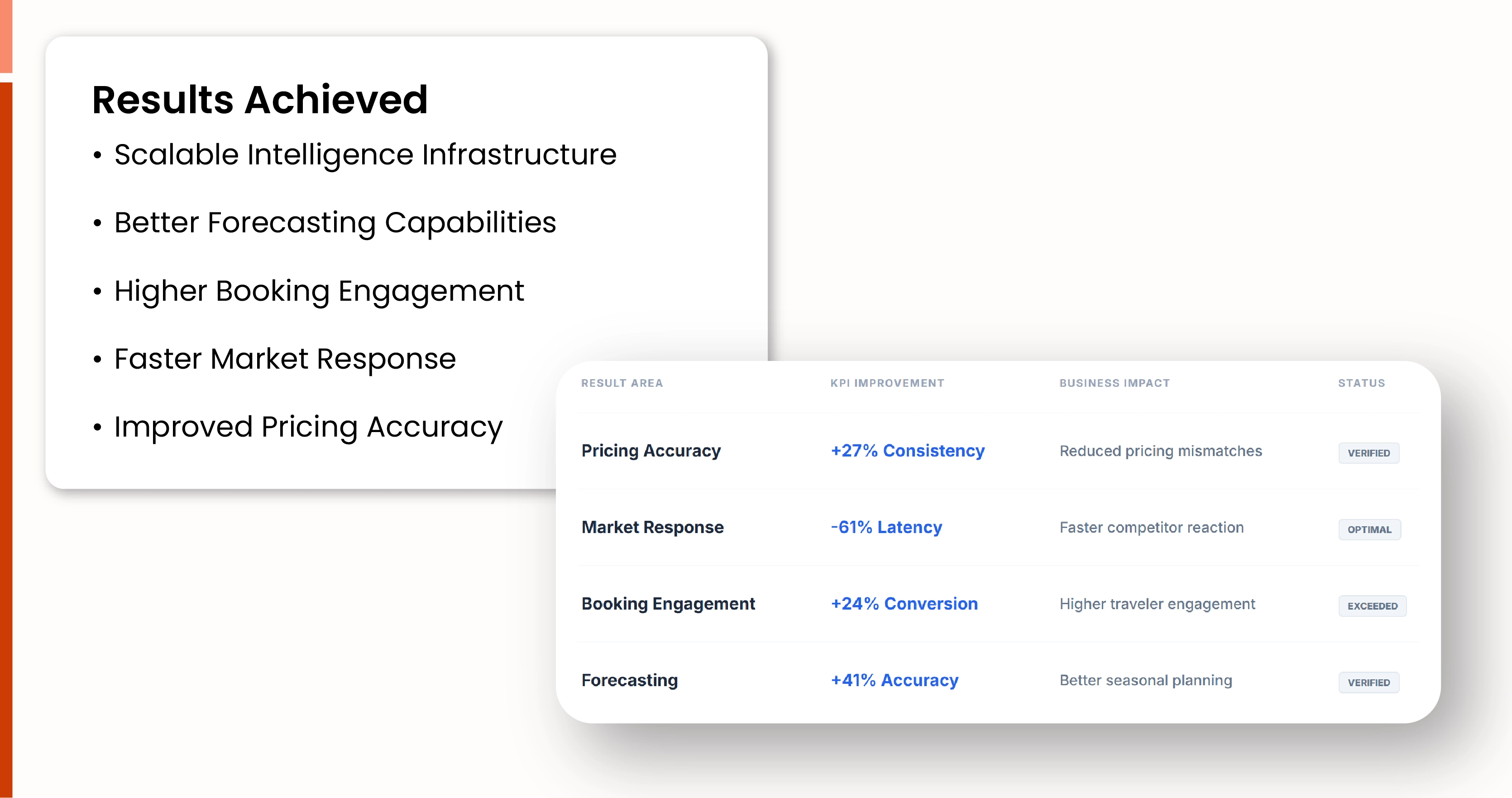
The implemented intelligence framework significantly improved pricing visibility, booking performance, operational efficiency, and competitive positioning across travel platforms globally.
1. Improved Pricing Accuracy
The client achieved stronger pricing consistency across multiple travel channels through automated monitoring and validation systems. Accurate room pricing updates reduced traveler confusion, minimized booking mismatches, improved customer trust, and enhanced the platform’s ability to maintain competitive accommodation listings during peak demand periods.
2. Faster Market Response
Real-time tracking capabilities enabled the client to react quickly to competitor pricing changes, occupancy shifts, and seasonal demand fluctuations. Faster operational response improved campaign effectiveness, optimized promotional timing, and allowed business teams to adjust hotel offers dynamically according to changing traveler booking behavior.
3. Higher Booking Engagement
Enhanced room visibility, structured accommodation data, and accurate inventory updates improved traveler engagement significantly. Better recommendation accuracy increased click-through rates, reduced abandoned searches, and supported improved booking conversions by presenting travelers with more relevant hotel options and pricing transparency across destinations.
4. Better Forecasting Capabilities
The client gained deeper visibility into booking patterns, occupancy trends, and seasonal demand behavior. These insights improved forecasting accuracy, supported strategic planning decisions, optimized marketing allocation, and enabled teams to prepare more effectively for high-demand travel periods and regional market fluctuations.
5. Scalable Intelligence Infrastructure
Our scalable data pipeline supported continuous expansion across new cities, properties, and travel marketplaces. The infrastructure handled increasing data volumes efficiently, maintained reporting consistency, and enabled the client to grow its travel intelligence ecosystem without compromising performance, speed, or analytical accuracy.
| Region | Category | ADR ($) | Occupancy | Weekend % | Lead (Days) | Cancel % |
|---|---|---|---|---|---|---|
| Tokyo | Luxury | 355 | 89% | 24% | 28 | 13% |
| Paris | Luxury | 340 | 91% | 22% | 26 | 15% |
| New York | Luxury | 320 | 88% | 18% | 24 | 14% |
| Dubai | Premium | 275 | 86% | 20% | 21 | 13% |
| Toronto | Premium | 240 | 83% | 16% | 20 | 12% |
| London | Business | 210 | 82% | 12% | 18 | 11% |
| Bangkok | Mid-Range | 140 | 84% | 11% | 12 | 8% |
| Singapore | Budget | 115 | 79% | 10% | 15 | 9% |
Client’s Testimonial
“Working with the team completely transformed our pricing intelligence and operational decision-making. We were struggling with fragmented hotel data, inconsistent updates, and limited visibility into booking behavior across multiple channels. The structured insights and real-time monitoring helped us significantly improve pricing accuracy, optimize campaigns, and enhance traveler engagement. Our conversion rates improved noticeably as we gained clearer visibility into demand patterns and competitor movements. The dashboards and analytics provided actionable intelligence that our teams now rely on daily for strategic decisions.”
Conclusion
In conclusion, the implemented intelligence framework enabled the client to unify fragmented hotel data, improve pricing accuracy, and strengthen overall decision-making across global travel platforms. By leveraging structured insights, the business gained deeper visibility into demand fluctuations, competitor movements, and traveler behavior patterns, leading to more effective pricing strategies and higher engagement.
The solution also enhanced operational efficiency by reducing manual dependency and enabling real-time monitoring of hotel availability and rate changes. This allowed faster campaign optimization and improved booking performance across multiple channels.
Overall, OTAs & Metasearch Data Scraping empowered the client with scalable, data-driven intelligence, supporting long-term growth, stronger market positioning, and improved conversion outcomes in an increasingly competitive travel ecosystem.
FAQs
Unlock the Full Report
Enter your details to access premium pricing intelligence insights