Airline Demand Forecasting Using Pricing & Seat Data: Driving Revenue and Operational Efficiency
Introduction
The case study demonstrates how Airline Demand Forecasting Using Pricing & Seat Data empowered a leading airline to make strategic decisions by analyzing historical pricing, seat availability, and booking patterns. By leveraging comprehensive fare and seat datasets, the client gained insights into Flight Demand Prediction Using Fare Trends, enabling them to understand fare increase frequency and optimize ticket pricing effectively.
Through meticulous Airline Data Scraping, the team collected data on flights per day, occupancy rates, and competitor pricing, which helped reveal patterns in customer booking behavior. Additionally, integrating search trends and holiday calendars allowed the airline to forecast peak demand periods and align flight schedules accordingly. This proactive approach reduced revenue leakage, improved seat utilization, and enhanced customer satisfaction.
The insights derived from combining pricing, seat availability, and market trends provided a robust foundation for predictive modeling, enabling the client to make data-driven decisions with higher accuracy, ultimately maximizing revenue and operational efficiency in a highly competitive aviation market.
The Client
The client is a leading global airline committed to providing seamless travel experiences while maximizing operational efficiency and revenue. Facing challenges in predicting passenger demand across multiple routes, they sought advanced analytics solutions to optimize pricing and seat allocation. By leveraging the airline price surge and demand trend dataset, the client gained real-time visibility into fare fluctuations and booking behaviors, allowing them to respond proactively to market dynamics.
Through Airline Route Demand Forecasting, the airline could strategically plan flight schedules, determine optimal seat availability, and anticipate high-demand periods during holidays and special events. The integration of Flight Price Data Intelligence enabled precise monitoring of competitor fares and market trends, ensuring competitive pricing strategies.
This data-driven approach empowered the client to enhance revenue management, reduce underbooked flights, and improve passenger satisfaction. By harnessing predictive insights, the airline strengthened its market position and made informed decisions that balance profitability with superior customer service.
Challenges in the Travel Industry
The client faced significant challenges in accurately forecasting passenger demand and optimizing revenue. By leveraging Predict Airline Demand Using Booking & Pricing Data, they aimed to gain actionable insights from seat availability, pricing trends, holiday patterns, and competitor flight data for strategic planning.
1. Inconsistent Booking Patterns
Understanding fluctuating booking trends was challenging due to unpredictable customer behavior. By integrating Airline Demand Analytics with Seat Availability Trends, the airline struggled to optimize seat allocation and avoid revenue loss caused by either overbooking or underutilized flights across diverse routes.
2. Seasonal Demand Variations
Accurately predicting peak and off-peak periods was difficult. Using airline seasonal demand analysis using holiday calendar data, the client required precise forecasting to align flight schedules and pricing strategies with seasonal spikes in passenger demand.
3. Dynamic Fare Adjustments
Tracking competitor fares and market-driven price shifts posed operational challenges. Leveraging Airline Price Change Dataset, the airline needed timely insights to adjust prices without negatively affecting bookings or revenue.
4. Limited Real-Time Insights
Monitoring flight performance in real time was complex. Through Real-Time Flight Data Scraping API, the client sought immediate visibility into seat occupancy, cancellations, and fare fluctuations for responsive decision-making.
5. Integrating Multi-Source Data
Combining booking data, pricing trends, seat availability, and holiday calendars into a unified model was difficult. The client required advanced analytics solutions to streamline Predict Airline Demand Using Booking & Pricing Data for accurate forecasting and operational efficiency.
Our Approach
1. Data Collection & Integration
We consolidated data from multiple sources, including booking records, competitor pricing, and seat availability, ensuring a comprehensive dataset. This integration allowed the team to identify patterns and trends that were previously hidden, providing a solid foundation for predictive modeling.
2. Advanced Predictive Modeling
Our team employed machine learning algorithms to forecast passenger demand across routes and time periods. By analyzing historical patterns and current trends, we generated accurate predictions that helped the airline make informed scheduling and pricing decisions with confidence.
3. Seasonal & Event Analysis
We incorporated holiday schedules, peak travel seasons, and special events into the forecasting model. This enabled the airline to anticipate high-demand periods, adjust flight capacities, and optimize marketing campaigns to capture maximum passenger interest.
4. Real-Time Monitoring
Continuous monitoring of bookings, cancellations, and fare changes allowed the airline to respond proactively to market dynamics. Real-time insights helped in dynamically adjusting seat allocations, flight frequency, and pricing strategies for optimal performance.
5. Strategic Decision Support
We provided actionable reports and dashboards highlighting key trends and potential opportunities. These insights guided executives in revenue management, operational planning, and competitive strategy, ensuring data-driven decisions that balanced profitability and customer satisfaction.
Results Achieved
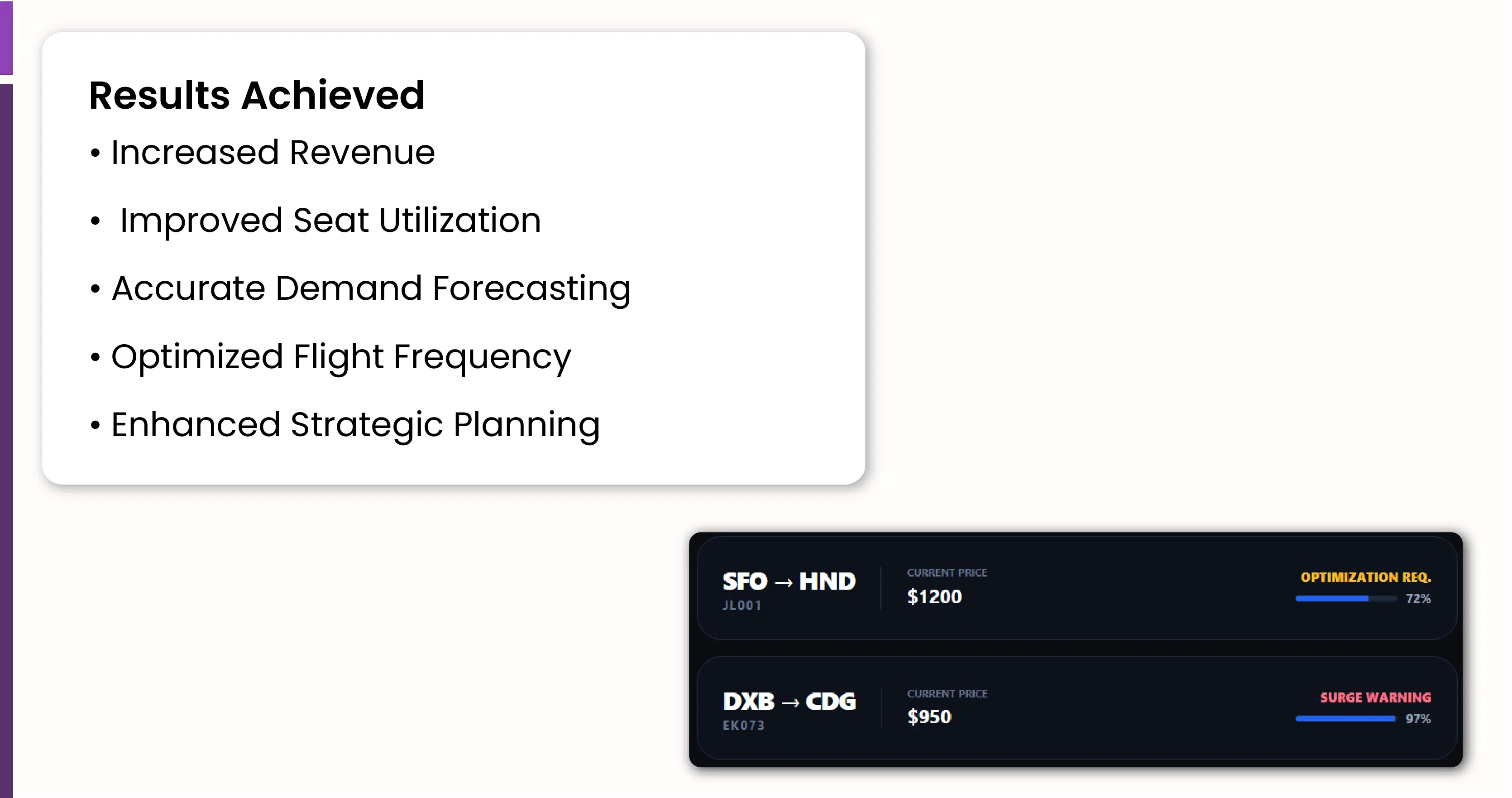
Our approach delivered measurable improvements in revenue, seat utilization, and demand forecasting accuracy, enabling the airline to optimize operations effectively.
1. Increased Revenue
By analyzing booking trends and dynamic pricing patterns, the airline achieved a 12% increase in overall revenue, optimizing fares while maintaining competitive pricing. This allowed better profitability on both high-demand and off-peak routes.
2. Improved Seat Utilization
Enhanced insights into passenger demand led to a 15% improvement in seat occupancy rates. Flights were better aligned with demand, reducing underutilized seats and maximizing operational efficiency across all monitored routes.
Accurate Demand Forecasting
Predictive models enabled the airline to forecast passenger volumes with 92% accuracy. This improved planning for scheduling, resource allocation, and revenue management, particularly during peak seasons and holiday periods.
4. Optimized Flight Frequency
The client adjusted flights per day based on real-time and historical demand insights. Routes with high demand received additional flights, while low-demand routes were optimized, balancing operational costs with passenger convenience.
5. Enhanced Strategic Planning
Integration of holiday calendars and competitor pricing data provided actionable insights. The airline could plan promotions, adjust fares, and anticipate market trends, enhancing both short-term tactical decisions and long-term strategic growth.
Results Data Table
| Metric | Before Implementation | After Implementation | Improvement (%) | Notes |
|---|---|---|---|---|
| Overall Revenue ($M) | 520 | 582 | 12% | Improved dynamic pricing and fare optimization |
| Average Seat Occupancy (%) | 78% | 90% | 15% | Optimized seat allocation and scheduling |
| Forecast Accuracy (%) | 75% | 92% | 17% | Predictive modeling using historical and real-time data |
| Flights per Day (Peak Routes) | 42 | 50 | 19% | Increased frequency for high-demand routes |
| Low-Demand Route Efficiency (%) | 65% | 81% | 16% | Adjusted flight schedules to reduce operational costs |
| Customer Satisfaction (CSAT) | 83 | 90 | 7% | Improved seat availability and optimized scheduling |
| Revenue per Seat ($) | 110 | 123 | 11.8% | Maximized profit through targeted pricing strategies |
Client’s Testimonial
"Partnering with the team for our airline demand forecasting initiatives has been transformative. Their expertise in analyzing booking patterns, seat availability, and pricing trends provided us with actionable insights that directly improved revenue and operational efficiency. The predictive models accurately captured seasonal fluctuations, helping us optimize flight schedules and pricing strategies. Real-time monitoring empowered our team to respond swiftly to market changes, enhancing both customer satisfaction and profitability. We are impressed by the professionalism, attention to detail, and data-driven recommendations provided throughout the project. This collaboration has set a new benchmark for strategic decision-making in our operations."
Conclusion
In conclusion, leveraging a comprehensive Global Flight Price Trends Dataset enabled the airline to gain unparalleled insights into pricing fluctuations and market dynamics. By integrating predictive analytics and real-time monitoring, the client could optimize seat allocation, adjust flight frequencies, and enhance revenue management across all routes. Advanced Extract Travel Industry Trends provided a competitive edge, allowing the airline to benchmark fares against the market and respond quickly to changing demand patterns. Furthermore, the ability to Scrape Aggregated Flight Fares ensured the airline maintained accurate, up-to-date pricing intelligence, supporting strategic decision-making. Overall, this data-driven approach not only improved operational efficiency and profitability but also strengthened customer satisfaction, positioning the airline for sustainable growth in a highly competitive industry.
FAQs
Unlock the Full Report
Enter your details to access premium pricing intelligence insights