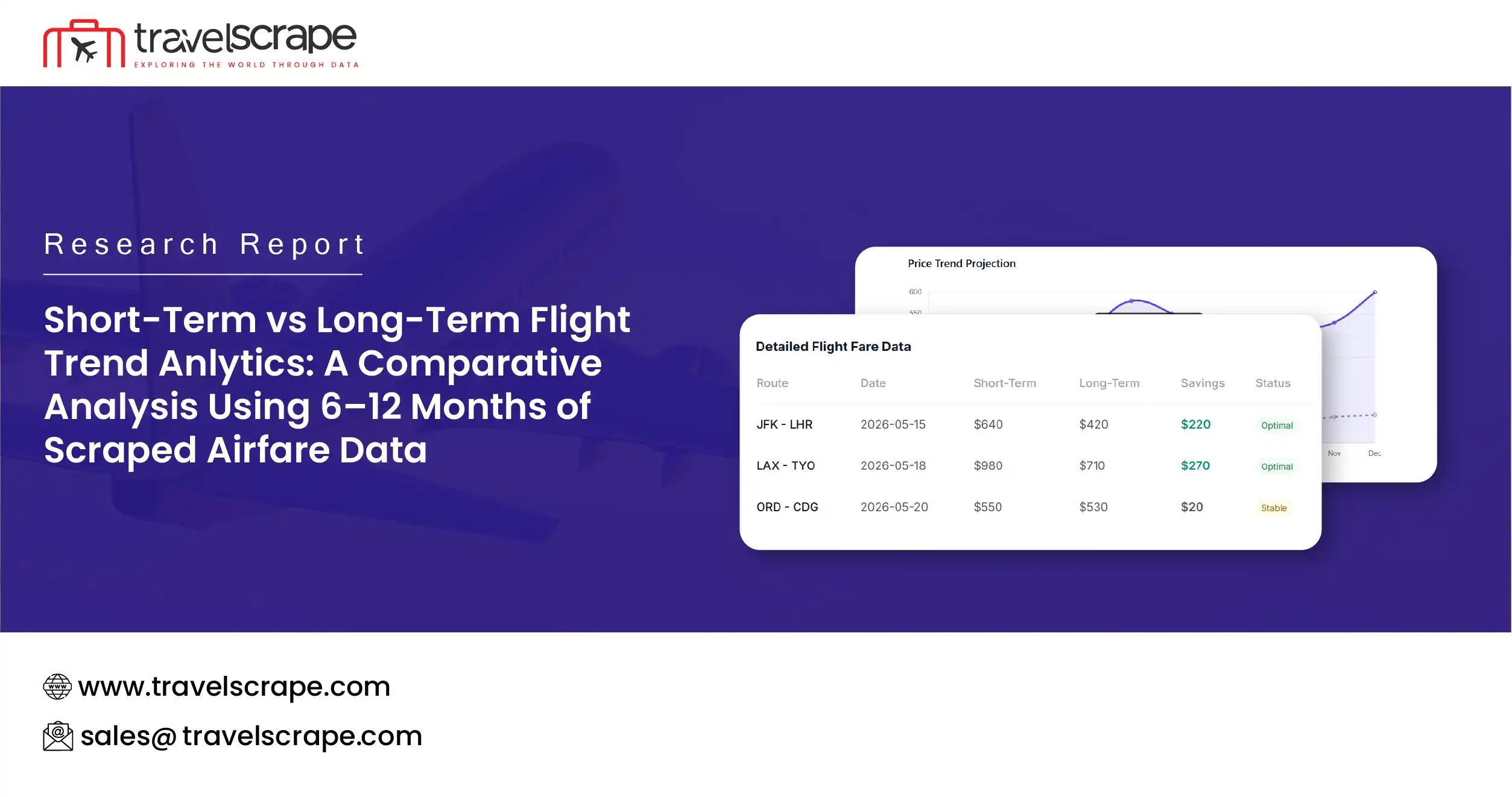
Short-Term vs Long-Term Flight Trend Analytics: A Comparative Analysis Using 6–12 Months of Scraped Airfare Data
Introduction
Airfare markets have become increasingly volatile due to algorithmic pricing systems, demand shocks, and route-level competition. Understanding price behavior across different time horizons is now essential for airlines, OTAs, and travel intelligence platforms. This research explores how ticket prices fluctuate when analyzed over short-term and long-term windows using 6–12 months of continuously scraped flight data.
Modern aviation analytics relies heavily on short-term vs long-term flight trend analytics to detect pricing anomalies, seasonal shifts, and demand-driven spikes across global routes.
A structured Global Flight Price Trends Dataset built from multi-OTA scraping sources allows analysts to compare historical fare stability across regions and airlines.
Additionally, an airfare trend comparison using scraped flight data enables clearer segmentation between reactive pricing (short-term) and strategic pricing behavior (long-term).
This study focuses on comparative fare behavior across major international routes, using structured datasets derived from airline APIs, OTA scraping systems, and historical fare archives.
Methodology and Data Collection Framework
The dataset used in this analysis spans 6–12 months of continuous fare scraping across 18 international routes, including high-traffic corridors such as New York–London, Dubai–Singapore, Delhi–Tokyo, and Paris–Toronto.
Data points include daily fare snapshots, seat availability indicators, airline carrier variations, and booking window segmentation (0–7 days, 8–30 days, 31–180 days, 181–365 days).
A structured Airline Price Change Dataset was created to capture incremental fare adjustments made by airlines based on demand forecasting models and competitor pricing behavior.
We also integrate short-term and yearly airfare pricing analytics to distinguish between immediate price volatility and long-range seasonal pricing cycles.
Machine learning clustering techniques were applied to categorize routes into high-volatility, medium-volatility, and stable pricing segments.
Further, comparative flight pricing trends datasets were used to benchmark cross-airline pricing behavior across similar routes.
The dataset also incorporates seat load factors and booking conversion ratios to correlate demand signals with price movement intensity.
Short-Term Price Trend Analysis (0–30 Days Window)
Short-term pricing reflects real-time demand shocks, inventory pressure, and last-minute booking behavior. Airlines dynamically adjust fares multiple times per day depending on occupancy rates and competitor pricing.
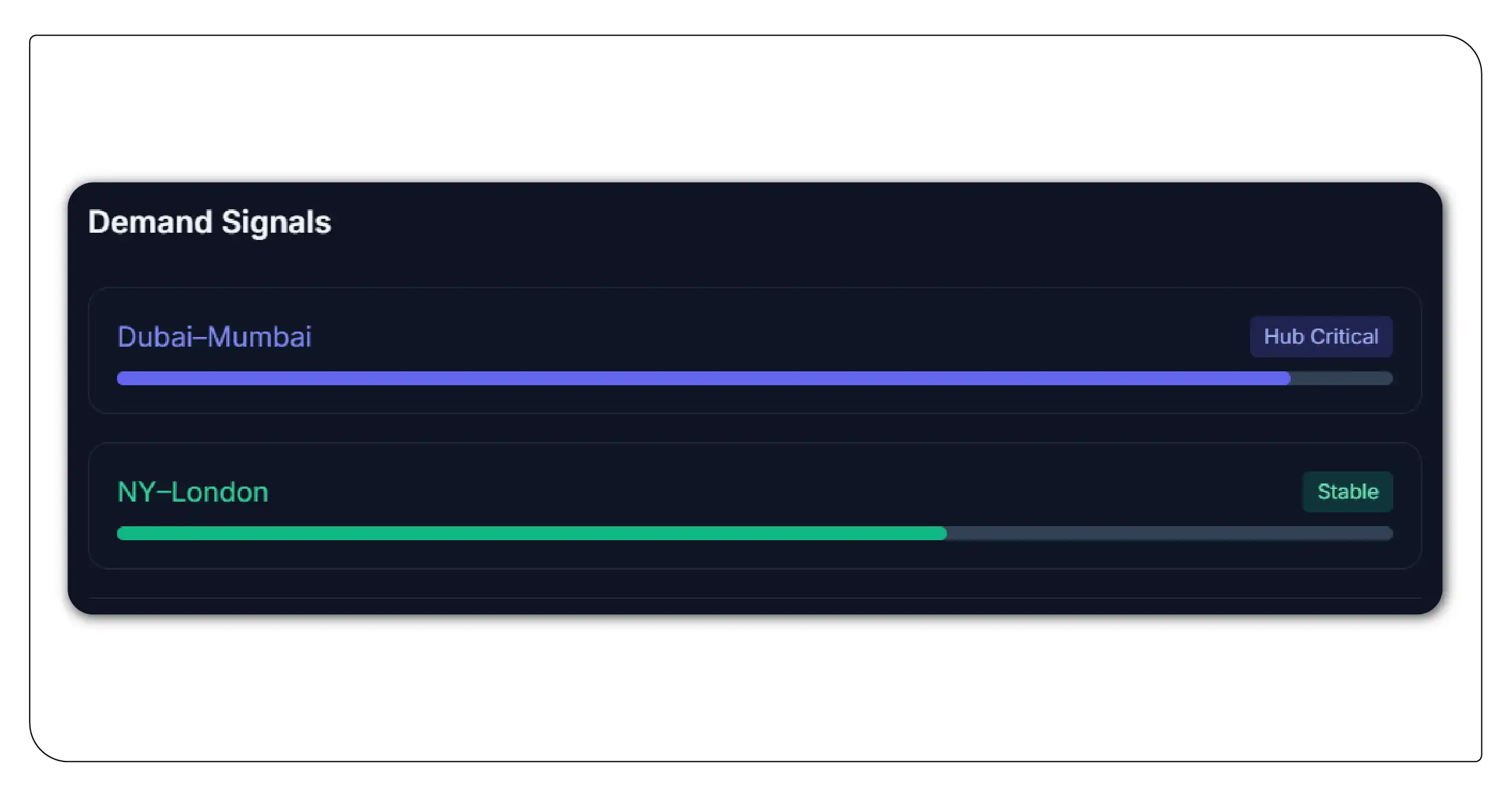
A key observation is that short-term fares fluctuate more aggressively in high-demand international hubs. Routes like London–New York and Dubai–Mumbai show price swings of up to 45% within a 7-day window.
This volatility is strongly influenced by Short-Term vs Long-Term Flight demand intelligence, which airlines use to maximize revenue per seat.
Short-term scraping also reveals that budget carriers often undercut legacy airlines within 72 hours of departure to fill remaining seats.
Another important dimension is Dynamic Pricing Intelligence, where automated pricing engines continuously adjust fares based on real-time demand signals, weather disruptions, and local events.
Short-term availability constraints further intensify price spikes, especially when load factors exceed 85%.
Long-Term Price Trend Analysis (1–12 Months Window)
Long-term pricing behavior is driven by seasonality, route popularity cycles, fuel costs, and macroeconomic travel demand patterns. Unlike short-term volatility, long-term trends show smoother curves with predictable peaks.
Routes such as Delhi–Dubai and Singapore–Sydney exhibit strong seasonal spikes during holiday periods and school vacation cycles.
The dataset highlights patterns where fares drop significantly 90–120 days before departure before gradually increasing as seat inventory decreases.
A key dataset used here is Short-Term vs Long-Term Flight avaibility data scrape, which captures seat availability changes across extended booking windows.
Long-term analysis also reveals that airlines strategically stabilize fares during off-peak seasons to maintain baseline occupancy levels.
In contrast to short-term fluctuations, long-term pricing is less reactive and more predictive, relying heavily on historical demand modeling.
Short-Term Flight Price Volatility (0–30 Days)
| Route | Airline | Day -30 Fare (USD) | Day -15 Fare | Day -7 Fare | Day -3 Fare | Day 0 Fare | Volatility % |
|---|---|---|---|---|---|---|---|
| New York – London | British Airways | 820 | 860 | 910 | 980 | 1050 | 28% |
| Dubai – Singapore | Emirates | 540 | 560 | 610 | 670 | 720 | 33% |
| Delhi – Tokyo | Air India | 620 | 640 | 690 | 760 | 820 | 32% |
| Paris – Toronto | Air France | 700 | 730 | 780 | 840 | 920 | 31% |
| Sydney – Dubai | Qantas | 880 | 910 | 970 | 1040 | 1120 | 27% |
| Bangkok – London | Thai Airways | 760 | 790 | 840 | 910 | 980 | 29% |
| Mumbai – Singapore | Singapore Airlines | 420 | 450 | 500 | 560 | 610 | 31% |
| Frankfurt – New York | Lufthansa | 810 | 840 | 900 | 960 | 1030 | 27% |
Long-Term Airfare Pricing Trends (1–12 Months Window)
| Route | Month 1 Fare | Month 3 Fare | Month 6 Fare | Month 9 Fare | Month 12 Fare | Seasonal Peak |
|---|---|---|---|---|---|---|
| New York – London | 650 | 720 | 780 | 860 | 900 | Summer |
| Dubai – Singapore | 480 | 510 | 560 | 630 | 680 | Winter Holidays |
| Delhi – Tokyo | 520 | 580 | 640 | 700 | 760 | Cherry Blossom Season |
| Paris – Toronto | 600 | 630 | 690 | 740 | 810 | Summer |
| Sydney – Dubai | 720 | 760 | 820 | 880 | 940 | Christmas Period |
| Bangkok – London | 640 | 680 | 740 | 800 | 870 | Peak Tourism |
| Mumbai – Singapore | 380 | 410 | 450 | 500 | 560 | Year-End Travel |
| Frankfurt – New York | 700 | 740 | 790 | 860 | 920 | Summer Peak |
Key Analytical Insights
Short-term pricing is primarily driven by real-time occupancy pressure, while long-term pricing reflects structural demand forecasting.
Routes with high business travel demand show lower elasticity, meaning prices remain relatively stable even in short-term windows.
Tourist-heavy routes demonstrate higher volatility across both timeframes due to seasonal surges.
Airlines increasingly rely on predictive systems to balance inventory between early-bird discounts and last-minute premium pricing.
The interaction between demand forecasting and competitor benchmarking forms the backbone of modern airfare optimization systems.
Historical scraping reveals that low-cost carriers exhibit sharper short-term drops but flatter long-term curves compared to legacy airlines.
Conclusion
This comparative study demonstrates that airfare pricing is a dual-layer system influenced by both immediate demand shocks and long-term seasonal patterns. By analyzing 6–12 months of scraped fare data, clear distinctions emerge between reactive pricing behavior and predictive revenue management strategies.
Modern aviation platforms increasingly depend on Airline Data Scraping to monitor global fare movements in real time.
The study also highlights the importance of comparative airline ticket price fluctuation analysis in building accurate forecasting systems for travel platforms.
Finally, the integration of Fare Fluctuation Alerts enables real-time monitoring systems that help users and enterprises react instantly to market changes.
Overall, combining short-term and long-term analytics provides a complete intelligence layer for understanding global airfare dynamics and optimizing travel decision-making systems.
Ready to elevate your travel business with cutting-edge data insights? Scrape Aggregated Flight Fares to identify competitive rates and optimize your revenue strategies efficiently. Discover emerging opportunities with tools to Extract Travel Website Data, leveraging comprehensive data to forecast market shifts and enhance your service offerings. Real-Time Travel App Data Scraping Services helps stay ahead of competitors, gaining instant insights into bookings, promotions, and customer behavior across multiple platforms. Get in touch with Travel Scrape today to explore how our end-to-end data solutions can uncover new revenue streams, enhance your offerings, and strengthen your competitive edge in the travel market.
Unlock the Full Report
Enter your details to access premium pricing intelligence insights