Why Is Scraping Travel Sites Without Getting Blocked Important for Travel Businesses?
Introduction
The travel industry generates enormous volumes of information across airline websites, hotel platforms, vacation rental portals, tour operators, destination websites, and online travel agencies. Businesses increasingly rely on structured information to understand prices, availability, packages, destinations, reviews, and changing market conditions. Scraping Travel Sites Without Getting Blocked requires a thoughtful approach that emphasizes reliable data collection, responsible request management, data quality, and compliance with applicable website terms and regulations.
Travel companies can use Travel Package Data Scraping to collect structured information about vacation packages, destinations, inclusions, prices, durations, and seasonal offers. Similarly, organizations looking to Extract Travel Site Data can build datasets covering hotel rates, flight information, room availability, package details, destination attributes, and other publicly accessible information.
Why Travel Data Scraping Matters?
Travel websites are highly dynamic. Prices can change throughout the day, inventory can fluctuate quickly, and promotional offers may disappear without warning. A periodic or real-time collection strategy allows businesses to identify these changes and convert them into useful intelligence.
For example, an OTA can compare hotel prices across multiple platforms, while a travel analyst can study airfare movements across destinations. Hotel operators can monitor competitor rates, and tourism companies can evaluate package positioning during peak and off-peak periods.
Travel datasets can support:
- Competitive price benchmarking
- Hotel and vacation rental monitoring
- Flight fare analysis
- Package comparison
- Destination research
- Availability tracking
- Seasonal demand analysis
- Market trend identification
The objective is not simply to collect large quantities of information. The real value comes from creating a consistent pipeline that transforms frequently changing web information into clean, usable datasets.
Understanding What Causes Travel Scraping Blocks
Travel websites may implement different technical controls to protect infrastructure, prevent abusive traffic, and distinguish automated requests from normal browsing behavior. Excessive request volume, repetitive access patterns, unusual traffic behavior, or attempts to circumvent technical restrictions can trigger defensive mechanisms.
Common signals that may affect automated access include:
- Request frequency: Sending too many requests within a short period can create unnecessary server load.
- Repeated patterns: Identical requests at predictable intervals can appear automated.
- Session inconsistency: Rapidly changing sessions or malformed cookies may result in failed requests.
- Unexpected request behavior: Requests that do not resemble ordinary site interactions may be rejected.
- Dynamic content: Important information may be loaded through JavaScript, making basic HTTP extraction incomplete.
- Geographic differences: Travel websites can present different information depending on market, language, currency, or location.
A robust collection architecture should therefore prioritize responsible access rather than attempting to defeat protective mechanisms.
Build a Responsible Scraping Architecture
The foundation of dependable travel data collection is a well-designed pipeline. Instead of repeatedly requesting every page, businesses should determine which information actually needs to be collected and how frequently it changes.
A practical architecture can include a scheduler, collection layer, validation system, transformation process, storage environment, and monitoring dashboard.
The scheduler determines when data should be refreshed. The collection layer retrieves permitted publicly available information. Validation checks whether fields are complete and correctly formatted. Transformation converts raw responses into standardized records, while storage systems preserve historical information.
This architecture makes Travel & Tourism Datasets easier to maintain because businesses can separate collection from analysis.
Control Request Frequency
Request management is one of the most important considerations for reliable data collection. A scraper should avoid unnecessary bursts of traffic and should respect applicable site policies and published restrictions.
Instead of requesting the same page repeatedly, businesses can use scheduling rules based on how frequently information changes. Hotel availability may require more frequent monitoring than static destination descriptions, while historical content may only need occasional updates.
A useful approach is to:
- Prioritize high-value pages.
- Cache information that has not changed.
- Schedule requests according to data volatility.
- Avoid unnecessary duplicate requests.
- Respect published crawling guidance and applicable terms.
- Stop or reduce collection when a website signals that access should not continue.
This improves infrastructure efficiency while reducing unnecessary traffic.
Use APIs Where Available
When a travel provider offers an official API, it can often provide a more stable and structured method of accessing permitted data than extracting information directly from web pages.
A Travel Data Monitoring platform can combine authorized APIs with carefully managed public web data collection. APIs may provide structured fields such as property identifiers, prices, availability, destination information, or booking attributes.
A Travel Scraping API can also standardize data access for businesses that need information from multiple permitted sources.
Organizations should distinguish between legitimate API usage and attempts to bypass authentication, access controls, or usage restrictions. API documentation, rate limits, licensing terms, and permitted use cases should always be reviewed before implementation.
Handle Dynamic Travel Websites Properly
Modern travel websites frequently rely on JavaScript to load prices, availability, filters, maps, reviews, and other information. Traditional HTML parsing may therefore return incomplete datasets.
A better solution is to identify how the required information is presented and determine whether an official API, embedded structured data, server-rendered content, or another permitted source can provide it.
For pages that legitimately require browser rendering, controlled browser automation can be incorporated into the pipeline. However, browser automation should not be treated as a mechanism for defeating access controls.
The goal should be reliable extraction of publicly accessible information while minimizing unnecessary processing.
Maintain Consistent Sessions and Data Quality
Travel information often contains changing currencies, dates, room types, passenger conditions, cancellation policies, and package inclusions. Without normalization, data collected from different sources can become difficult to compare.
A high-quality pipeline should standardize:
- Currency
- Date and time formats
- Property names
- Destination names
- Room categories
- Package durations
- Availability status
- Price fields
- Tax and fee indicators
- Source identifiers
For example, the same hotel might appear with different naming conventions across multiple platforms. Entity matching can help connect those records and produce more meaningful comparisons.
Create Historical Travel Data
One of the biggest advantages of automated travel data collection is the ability to build historical datasets.
A single price snapshot tells a business what a rate looks like today. Historical observations reveal how that rate changes over time.
Travel companies can analyze:
- Weekday versus weekend pricing
- Seasonal price movements
- Holiday demand
- Advance-booking behavior
- Destination popularity
- Hotel availability changes
- Package discount patterns
- Competitor pricing movements
This historical layer transforms basic extraction into Travel Data Intelligence, helping organizations understand market behavior instead of merely observing individual listings.
Use Monitoring and Change Detection
Travel data monitoring becomes more efficient when systems detect meaningful changes rather than processing every record as equally important.
A change-detection system can flag when:
- A hotel rate changes significantly.
- A room becomes unavailable.
- A package is introduced or removed.
- A destination offer changes.
- A flight fare moves outside a defined range.
- A promotional discount appears.
- A property changes its listed amenities.
Businesses can then prioritize important events instead of manually reviewing thousands of records.
Build Scalable Travel Data Scraping Solutions
Large travel projects often involve thousands of properties, destinations, routes, and packages. Scaling such a system requires more than simply increasing the number of requests.
Travel Data Scraping Solutions should be designed around modular components that can independently handle scheduling, extraction, validation, normalization, storage, and delivery.
Cloud infrastructure can support larger workloads, while databases such as PostgreSQL or cloud data warehouses can store structured historical records. CSV and JSON files may work for smaller projects, while larger organizations may prefer databases, object storage, or analytical warehouses.
The pipeline should also include logging and error monitoring so failed jobs can be identified and corrected without rebuilding the entire system.
Compliance Should Be Part of the Strategy
Reliable scraping is not only a technical challenge. Legal and ethical considerations are equally important.
Before collecting information, businesses should review the target website's terms, robots guidance where applicable, copyright considerations, privacy requirements, API policies, and other relevant laws and regulations. Personal or sensitive information should not be collected unless there is a clear lawful basis and appropriate authorization.
A responsible strategy focuses on publicly accessible business information, minimizes server impact, and avoids bypassing authentication, paywalls, CAPTCHAs, or other access controls.
This approach can make data pipelines more sustainable and reduce unnecessary operational risks.
Deliver Data Through APIs and Dashboards
After collection and normalization, travel information can be delivered through APIs, dashboards, scheduled files, cloud storage, or database connections.
A centralized platform allows users to filter information by destination, property, date, price range, package type, or availability status. Analysts can then connect these datasets with forecasting systems and business intelligence platforms. At the same time, structured Travel Package Data Intelligence can help travel companies compare packages, identify pricing patterns, understand market positioning, and improve their strategic decision-making.
For example, a travel company could combine hotel rates with historical demand indicators to evaluate pricing opportunities. Another business could compare package prices across destinations to identify emerging market opportunities.
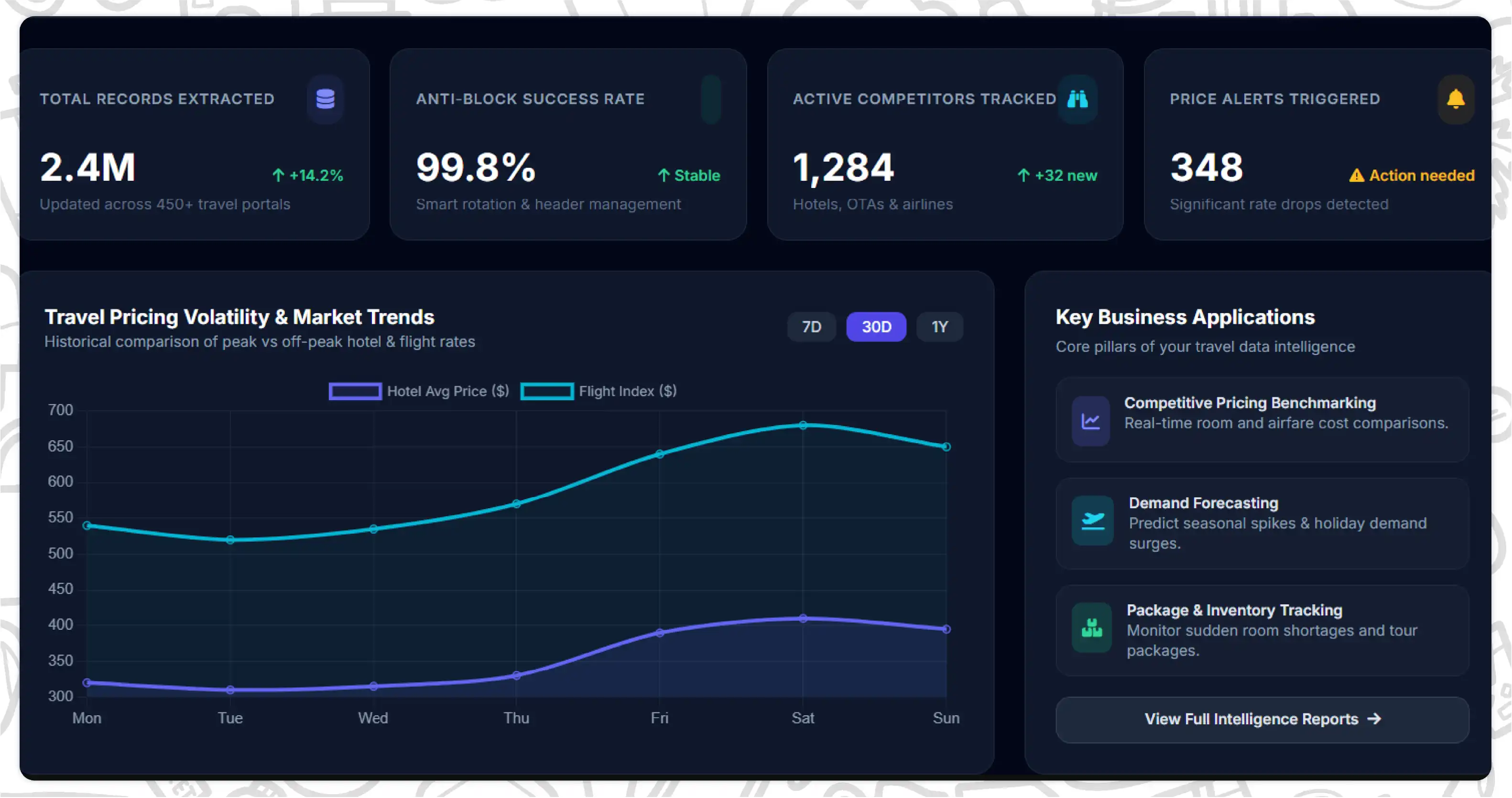
Key Business Applications
Travel data collection supports several practical applications across the industry.
- Competitive Pricing: Businesses can benchmark hotel, flight, rental, and package prices across multiple sources.
- Demand Forecasting: Historical observations can reveal seasonal demand patterns and pricing cycles.
- Availability Monitoring: Travel operators can identify inventory changes and market shortages.
- Package Analysis: Tour companies can compare package inclusions, duration, pricing, and promotional positioning.
- Destination Intelligence: Tourism organizations can evaluate changing prices, availability, and travel product activity across destinations.
- Market Research: Analysts can build structured datasets for studying travel trends and consumer-facing offers.
How Travel Scrape Can Help You?
Competitive Pricing Intelligence
Compare hotel, flight, rental, and package prices across multiple travel platforms to identify pricing gaps, benchmark competitors, evaluate discounts, and support more informed revenue management decisions.
Market Trend Analysis
Track historical travel prices, availability, destinations, seasonal fluctuations, and promotional patterns to understand changing market conditions and identify emerging opportunities before competitors respond.
Availability Monitoring
Monitor changes in hotel rooms, flights, rental vehicles, and vacation packages to identify availability shifts, inventory shortages, sudden removals, and changing supply conditions across markets.
Smarter Business Decisions
Transform large volumes of structured travel information into actionable insights for pricing strategies, destination planning, competitor research, demand forecasting, product development, and strategic business planning.
Scalable Data Intelligence
Travel Scrape enables organized collection and analysis of travel information, helping businesses build reliable datasets, automate monitoring workflows, improve research efficiency, and support continuous market intelligence initiatives.
Final Thoughts
Effective travel scraping is less about sending more requests and more about building a disciplined data collection system. Responsible scheduling, API-first strategies, caching, structured extraction, validation, monitoring, and compliance can help organizations maintain dependable pipelines while reducing unnecessary traffic.
When designed correctly, Travel Site Data Extraction Without Blocking can support continuous monitoring of publicly available travel information without relying on aggressive or evasive collection practices.
The resulting datasets can power Travel Data Market Intelligence, enabling businesses to evaluate competitors, pricing movements, inventory changes, destination trends, and seasonal opportunities.
The strongest travel data strategy therefore combines technical reliability with responsible collection practices. Businesses that invest in clean, historical, well-structured travel datasets can turn constantly changing online information into a dependable foundation for analytics, forecasting, competitive research, and smarter travel business decisions.
Ready to elevate your travel business with cutting-edge data insights? Scrape Aggregated Flight Fares to identify competitive rates and optimize your revenue strategies efficiently. Discover emerging opportunities with tools to Extract Travel Website Data, leveraging comprehensive data to forecast market shifts and enhance your service offerings. Real-Time Travel App Data Scraping Services helps stay ahead of competitors, gaining instant insights into bookings, promotions, and customer behavior across multiple platforms. Get in touch with Travel Scrape today to explore how our end-to-end data solutions can uncover new revenue streams, enhance your offerings, and strengthen your competitive edge in the travel market.
Unlock the Full Report
Enter your details to access premium pricing intelligence insights