Real-Time Competitor Seat Availability Data Scraping Driving Fare Response by 4 Hours on Key Routes
Introduction
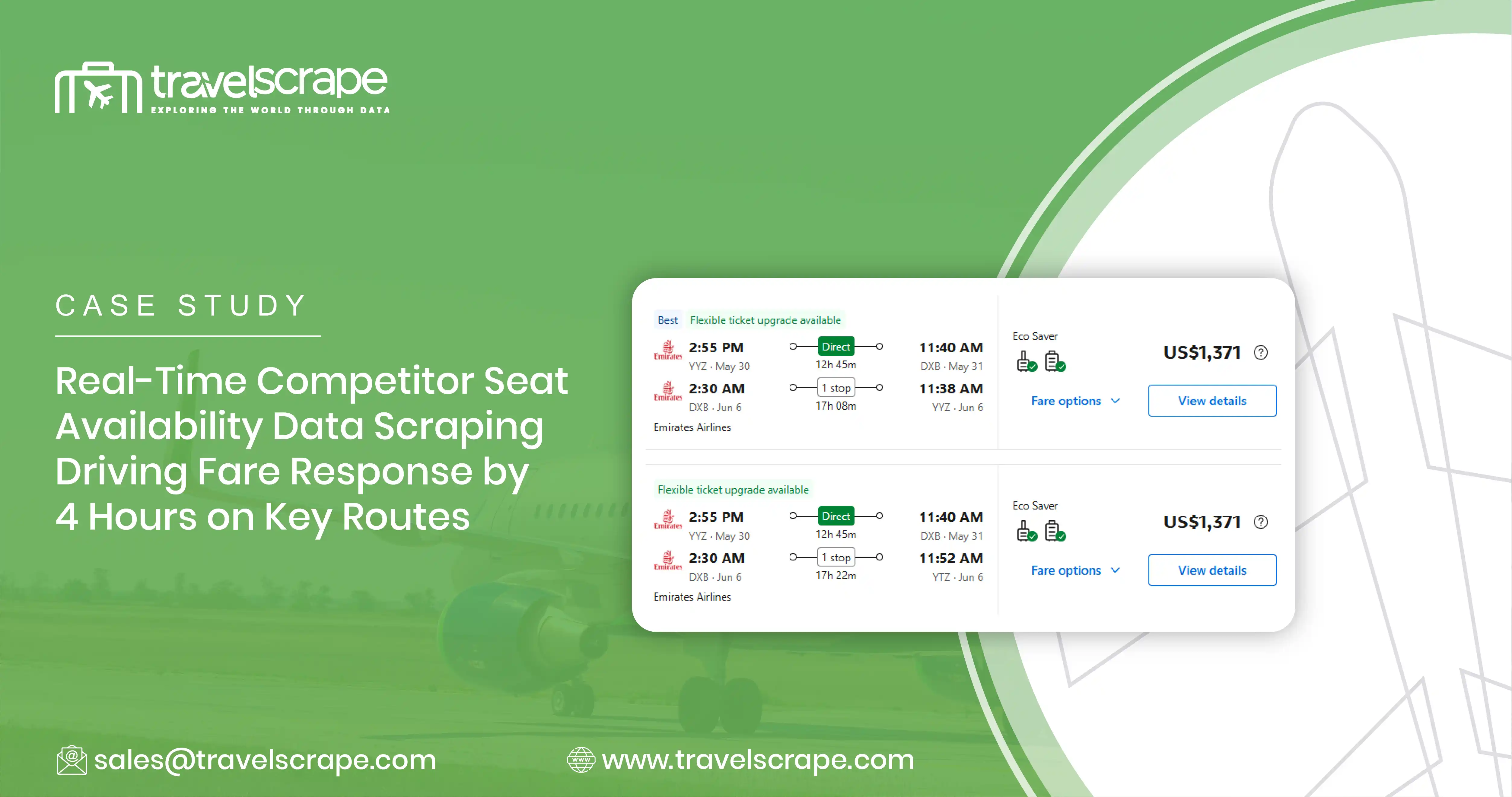
The case study demonstrates how an airline improved intraday fare response time by four hours on key routes through advanced competitive intelligence systems. It leveraged real-time competitor seat availability data scraping to continuously monitor rival inventory shifts and adjust pricing strategies dynamically across high-demand sectors. This integration of Real-Time Competitor Seat Availability Data Scrape enabled faster fare adjustments, reducing pricing lag and improving revenue optimization outcomes significantly. By aligning systems with Flight Seat Availability insights, the airline achieved better load forecasting and enhanced competitiveness in real-time market conditions. Overall, the approach reduced intraday response time by four hours, strengthening strategic pricing agility and market responsiveness across key routes. It also improved coordination between revenue management teams and data engineering units by providing near real-time visibility into competitor pricing movements and seat inventory fluctuations across major routes. These enhancements collectively strengthened revenue agility and reduced missed fare optimization opportunities in highly dynamic travel markets during peak booking windows across routes network.
The Client
The client is a leading travel intelligence and aviation analytics provider focused on improving pricing efficiency and competitive responsiveness across airline networks. It specializes in building scalable data systems that support real-time decision-making for revenue management teams. The organization has invested heavily in advanced tracking infrastructure to strengthen fare optimization strategies and enhance market visibility across routes.
Through its advanced analytics ecosystem, the client actively leverages real-time flight seat availability tracking across airlines to gain continuous visibility into competitor inventory changes and booking patterns. This capability helps airlines respond faster to demand shifts and pricing pressure in highly dynamic markets.
Additionally, its multi-airline availability data aggregation platform consolidates fragmented seat inventory data into a unified intelligence layer, enabling faster comparison, benchmarking, and strategic pricing decisions across multiple carriers.
To further enhance responsiveness, the client utilizes Fare Fluctuation Alerts, which provide instant notifications on competitor pricing changes, helping revenue teams adjust fares proactively and maximize yield opportunities in real time aviation environments.
Challenges in the Flight Industry
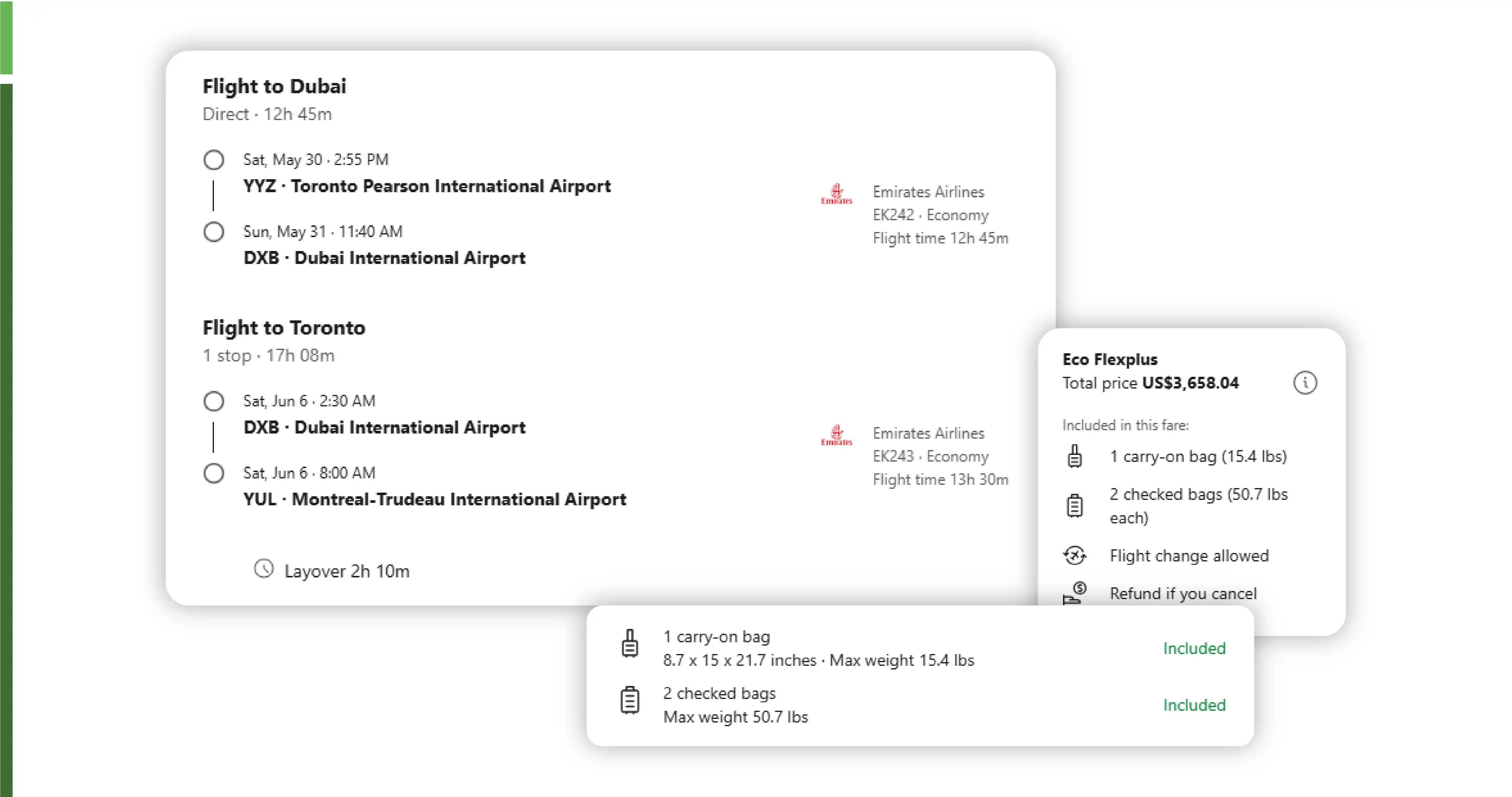
The client faced significant challenges in optimizing airline pricing decisions due to fragmented data sources, delayed competitor insights, and limited visibility into dynamic seat availability trends, impacting timely fare adjustments and reducing overall revenue optimization efficiency across competitive flight routes.
1. Lack of Granular Route Insights
The client struggled with insufficient route-level seat availability analytics, making it difficult to understand demand variations and competitor behavior on specific flight routes, leading to slower and less accurate pricing decisions across high-traffic segments.
2. Weak Pricing Intelligence System
Limited airline pricing intelligence using competitor seat data reduced the ability to benchmark fares effectively, causing delays in reacting to market shifts and resulting in suboptimal pricing strategies during peak booking windows.
3. Delayed Demand Signal Detection
The absence of real-time demand signals using competitor seat scraping created blind spots in identifying sudden booking surges or drops, impacting the client’s ability to adjust fares dynamically in response to real-time market behavior.
4. Fragmented Availability Visibility
Inconsistent Real-Time Availability Tracking across multiple carriers led to incomplete visibility of seat inventory, making it harder for the client to maintain competitive pricing accuracy and optimize load factors effectively.
5. Limited Data Standardization
The client faced challenges in consolidating heterogeneous sources into a unified Airline Price Change Dataset, resulting in data inconsistency issues that affected forecasting accuracy and slowed down automated fare optimization workflows.
Our Approach
1. Unified Data Architecture
We designed a centralized data pipeline to collect and harmonize seat inventory and pricing information from multiple sources. This ensured consistent formatting, reduced redundancy, and enabled faster processing of large-scale airline competitive intelligence data for real-time decision support.
2. Continuous Data Ingestion System
A real-time ingestion framework was implemented to capture frequent updates from competitor systems. This allowed uninterrupted flow of fresh data into analytics models, ensuring the client always worked with the most recent market conditions for pricing decisions.
3. Intelligent Processing Layer
We developed an advanced processing layer that cleaned, validated, and structured incoming datasets. This improved data accuracy, eliminated inconsistencies, and enabled reliable downstream analytics for revenue optimization and fare adjustment strategies across multiple airline routes.
4. Predictive Analytics Integration
Machine learning models were integrated to forecast demand patterns and pricing trends. These models helped identify emerging opportunities, enabling proactive fare adjustments and improving decision-making speed in highly competitive airline markets.
5. Automated Decision Support System
We built an automation-driven dashboard that delivered actionable insights to revenue teams. This reduced manual effort, improved response time, and ensured faster execution of pricing strategies based on live competitive market intelligence.
Results Achieved
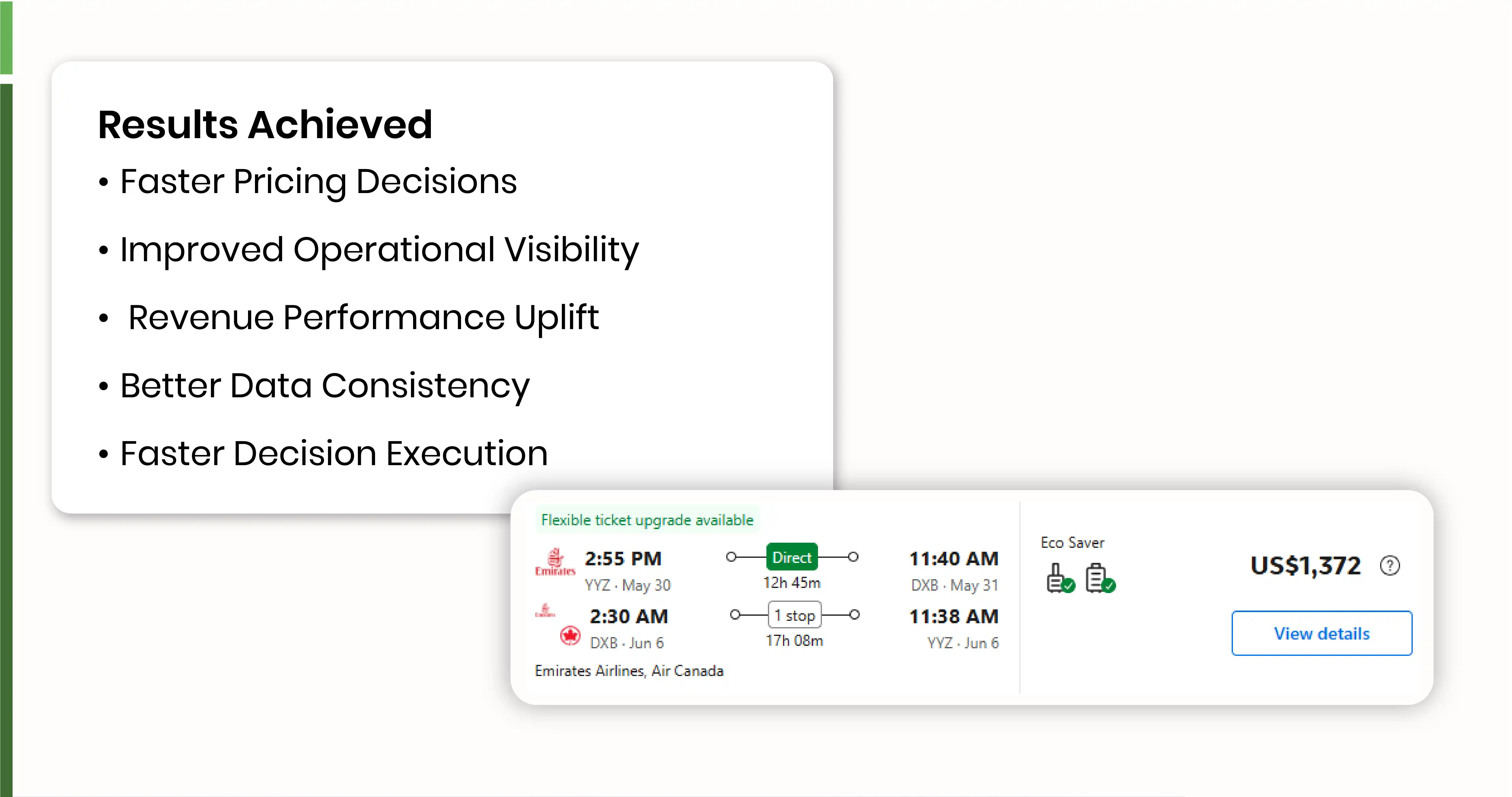
Client achieved significant operational improvements through enhanced data intelligence integration, enabling faster pricing decisions, better market responsiveness, and improved revenue outcomes overall.
1. Faster Pricing Decisions
Implementation enabled significantly faster pricing decisions across competitive routes. Teams were able to evaluate market movements quickly, reduce manual dependency, and respond more effectively to demand shifts, resulting in improved operational agility and stronger positioning in highly dynamic airline markets.
2. Improved Operational Visibility
Operational visibility improved substantially through consolidated information systems that unified multiple inputs. This allowed stakeholders to interpret trends more clearly, reduce data fragmentation, and enhance consistency in analysis, supporting better forecasting and more confident strategic decisions across business units overall.
3. Revenue Performance Uplift
Revenue performance saw measurable uplift due to improved responsiveness and structured decision frameworks. Teams could adjust strategies faster, optimize seat utilization more effectively, and capture higher value opportunities during peak demand cycles, strengthening overall financial outcomes across key routes globally.
4. Better Data Consistency
Data consistency and quality improved significantly after standardization processes were introduced. This reduced discrepancies between sources, minimized errors in reporting, and ensured reliable analytical outputs, enabling more accurate insights for operational planning and strategic business execution across teams overall systems.
5. Faster Decision Execution
Decision-making speed improved as insights became more structured and accessible for stakeholders. This enabled quicker evaluation of market conditions, better coordination among teams, and more efficient execution of pricing strategies, resulting in stronger competitive positioning and operational performance overall.
Sample Structured Data Snapshot
| Route | Date | Seats Available | Fare (USD) | Change Indicator | Demand Level |
|---|---|---|---|---|---|
| DEL–BOM | 2026-04-01 | 42 | 78 | +5 | High |
| BLR–DEL | 2026-04-01 | 30 | 92 | -3 | Medium |
| MUM–HYD | 2026-04-02 | 55 | 65 | +2 | High |
| CCU–BLR | 2026-04-02 | 18 | 110 | +7 | Low |
| DEL–GOI | 2026-04-03 | 60 | 58 | -4 | Medium |
| HYD–MUM | 2026-04-03 | 25 | 85 | +6 | High |
| BLR–CCU | 2026-04-04 | 40 | 95 | -2 | Medium |
| GOI–DEL | 2026-04-04 | 70 | 52 | +3 | High |
Web Scraping Advantages
1. Enhanced Market Visibility
Our data scraping services provide continuous access to structured market information, helping businesses track competitor movements, pricing trends, and availability shifts. This enables stronger market visibility, improved strategic planning, and faster response to changing industry conditions across multiple sectors.
2. Faster Decision Making
By delivering clean, real-time structured datasets, our services reduce dependency on manual research. This accelerates decision-making cycles, allowing teams to act quickly on insights, optimize operations efficiently, and respond to market changes with greater confidence and accuracy across workflows.
3. Improved Pricing Strategy
We enable organizations to analyze pricing patterns effectively by collecting large-scale structured data from multiple sources. This supports better pricing strategy development, helping businesses stay competitive, maximize profitability, and align offerings with real-time market demand and customer expectations.
4. Scalable Data Solutions
Our scraping systems are built to handle large-scale data extraction across multiple platforms simultaneously. This ensures scalability for growing business needs, allowing seamless expansion of data coverage without compromising accuracy, speed, or consistency in analytics and reporting processes.
5. Actionable Business Intelligence
We transform raw data into meaningful insights that support strategic decision-making. By delivering structured and reliable datasets, our services help organizations identify opportunities, reduce risks, and improve overall business performance through data-driven intelligence and predictive market understanding.
Client’s Testimonial
“Working with the data intelligence team has significantly transformed how we approach pricing and competitive monitoring. Their ability to deliver structured, timely, and highly accurate datasets has improved our decision-making speed and operational efficiency. We now have a much clearer understanding of market dynamics and can respond to changes far more effectively than before. The integration process was smooth, and the support team ensured everything was aligned with our business goals. This partnership has strengthened our revenue strategy and enhanced overall performance across key routes.”
Conclusion
In conclusion, the implementation of advanced data-driven intelligence has significantly transformed how airline pricing and competitive strategies are managed. By leveraging Airline Data Scraping, organizations can continuously monitor market movements and improve responsiveness to dynamic fare changes across routes.
The ability to Scrape Aggregated Flight Fares has enabled better benchmarking and optimized pricing strategies, ensuring stronger revenue outcomes. Additionally, Scrape Travel Website Data has improved visibility into competitor offerings and enhanced decision-making accuracy across multiple channels.
Furthermore, Real-Time Travel App Data Scraping Services have strengthened live market tracking, allowing businesses to react instantly to demand fluctuations. Overall, these capabilities collectively empower airlines and travel enterprises to achieve faster decisions, improved efficiency, and sustained competitive advantage in a rapidly evolving aviation marketplace.
FAQs
Unlock the Full Report
Enter your details to access premium pricing intelligence insights