How Car Rental Pricing Intelligence Improve Booking Conversion by 28% for a Southeast Asia OTA
Introduction
A Southeast Asia OTA conducted a case study to improve car rental booking performance across multiple regional markets. Our car rental pricing Intelligence improve booking conversion was implemented using dynamic pricing models and demand signals to enhance user booking intent significantly.
The OTA integrated real-time competitor fare tracking and historical demand trends to identify optimal price points for car listings.
Using optimize rental pricing using competitor data scraping, the platform adjusted daily rates based on competitor fluctuations and seasonal travel spikes.
Advanced segmentation and price optimization led to higher engagement, better search ranking, and improved conversion across mobile app users. The Car Rental Data Intelligence enabled predictive pricing models that responded instantly to competitor and demand shifts across the region.
Within eight weeks, the OTA achieved a 28% increase in booking conversion and significantly reduced price drop abandonment rates.
This transformation demonstrated how data-driven pricing intelligence can reshape competitiveness and maximize revenue efficiency in travel marketplaces across Southeast Asian OTA networks ecosystem.
The Client
The client is a fast-growing travel technology company operating as a leading Southeast Asia OTA specializing in mobility and car rental services across major tourist and business destinations. The platform focuses on delivering seamless booking experiences by leveraging data-driven pricing strategies and real-time market intelligence. It operates across multiple countries in Southeast Asia, serving both leisure and corporate travelers with a strong emphasis on competitive pricing and conversion optimization.
With increasing competition in the mobility sector, the client aimed to strengthen its pricing strategy using advanced analytics and demand forecasting models. By integrating structured and unstructured data sources, the company improved its ability to respond quickly to market fluctuations and competitor pricing shifts.
The Southeast Asia OTA car rental pricing intelligence helped the client standardize pricing decisions across regions and improve revenue efficiency.
The organization implemented scalable data pipelines to continuously improve car rental booking conversion pricing data scrape processes, ensuring real-time visibility into competitor rates and availability.
Through advanced analytics dashboards, Booking Trend Insights were generated to understand customer behavior, seasonal demand spikes, and route-level performance, enabling smarter pricing and inventory decisions across the platform.
Challenges in the Car Rental Industry
The client struggled with pricing inefficiencies and limited visibility into competitor behavior across multiple Southeast Asian markets. These challenges directly impacted booking performance and revenue predictability, requiring advanced analytics and data-driven optimization strategies to improve conversion outcomes.
Fragmented Market Pricing Structure
The client operated across multiple Southeast Asian countries where pricing rules, taxes, and supplier rates varied widely. This fragmentation made it difficult to standardize pricing strategies and impacted car rental booking conversion optimization across regions.
Lack of Real-Time Competitor Visibility
Without consistent data pipelines, the OTA struggled to track competitor pricing changes in real time. This limited its ability to respond quickly to market shifts and weakened car rental pricing intelligence Southeast Asia OTA market effectiveness.
Inefficient Dynamic Pricing Models
Existing pricing systems were static and unable to adjust rapidly to demand fluctuations. This reduced competitiveness during peak travel seasons and restricted car rental dynamic pricing and conversion optimization potential across high-demand routes.
Limited Cross-Vertical Intelligence
The client lacked integrated insights from adjacent mobility ecosystems such as ride-hailing and logistics. This gap reduced strategic decision-making capabilities supported by Ride-Hailing & Delivery Intelligence frameworks for broader mobility optimization.
Data Collection and Quality Issues
Inconsistent and incomplete datasets from suppliers affected pricing accuracy and forecasting models. The absence of structured pipelines highlighted the need for scalable Car Rental Data Scraping Services to ensure reliable, real-time market intelligence.
Our Approach
Market Fragmentation Complexity
The client operated across highly diverse Southeast Asian markets with inconsistent supplier networks and pricing rules. This made it difficult to maintain uniform strategies, leading to operational inefficiencies and unstable performance across multiple travel corridors and booking channels.
Delayed Pricing Response Cycles
Price updates were not synchronized with rapid market fluctuations, causing missed opportunities during peak demand windows. This lag reduced competitiveness and created gaps between actual market rates and displayed customer pricing across digital platforms.
Limited Demand Visibility
The client lacked clear insight into real-time travel demand shifts and seasonal booking surges. This restricted their ability to proactively adjust inventory and pricing strategies, resulting in suboptimal utilization of available rental fleet capacity.
Weak Data Consistency Across Vendors
Multiple suppliers provided inconsistent and incomplete datasets, making it difficult to build reliable pricing models. Data discrepancies led to inaccurate forecasting and reduced confidence in automated pricing recommendations across regions.
High Competition Pressure in Mobility Market
The Southeast Asian mobility space was highly aggressive with frequent price undercutting by competitors. This intensified pressure on margins and required more intelligent systems to maintain competitiveness while protecting profitability and conversion rates.
Results Achieved
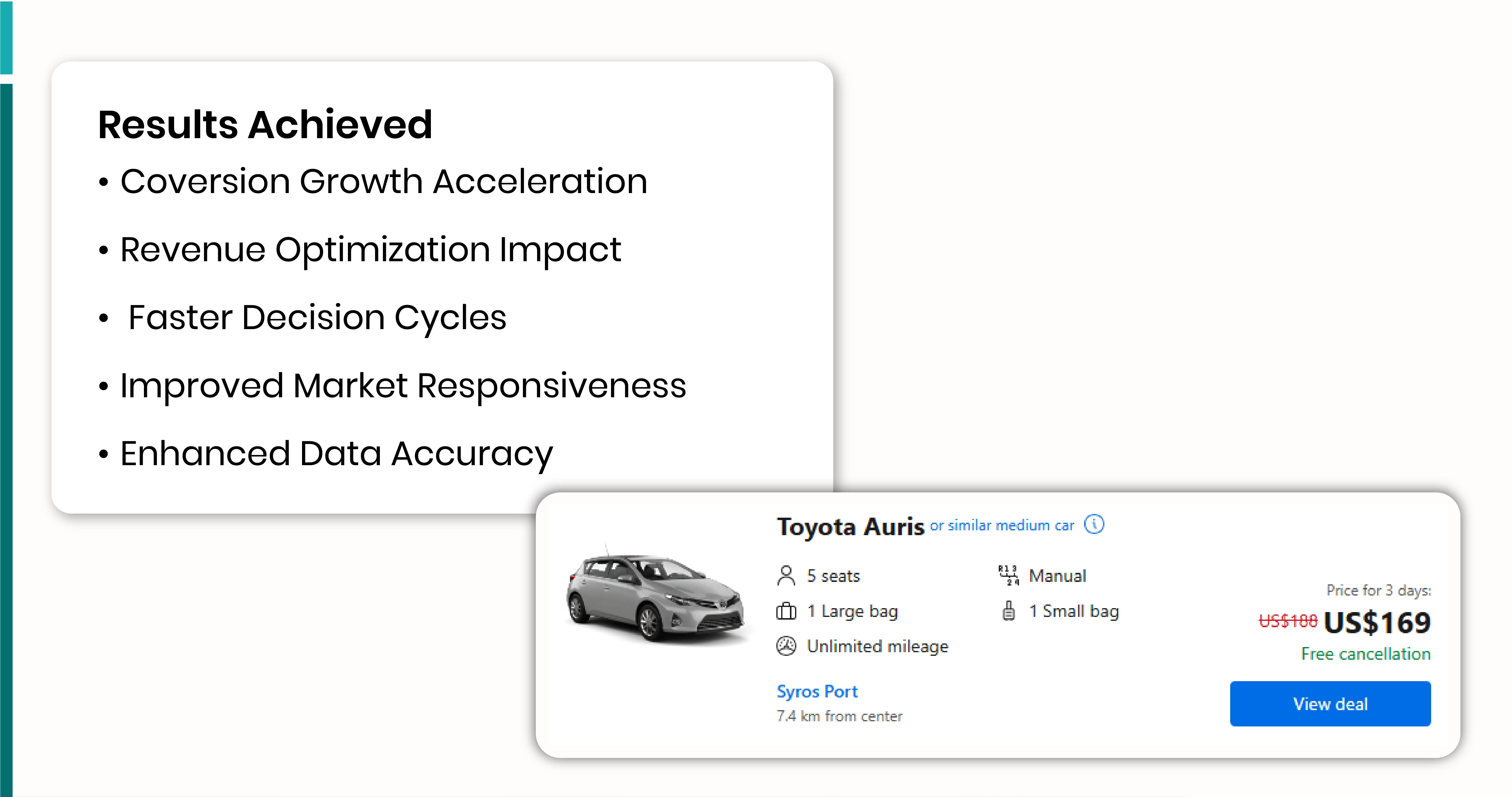
We delivered measurable improvements in pricing efficiency, booking performance, and decision intelligence through advanced data systems and optimization models.
Conversion Growth Acceleration
Booking performance improved significantly after implementing adaptive pricing logic and demand-aligned adjustments across markets. The client experienced stronger user engagement, reduced drop-offs, and higher checkout completion rates driven by more relevant and competitive pricing structures.
Revenue Optimization Impact
Revenue per booking increased due to smarter price positioning and better alignment with demand peaks. The system helped identify underpriced routes and optimize them dynamically, ensuring improved yield management and stronger financial outcomes across high-volume regions.
Faster Decision Cycles
Decision-making speed improved as real-time insights replaced delayed reporting structures. Stakeholders could instantly view pricing shifts and demand changes, enabling quicker reactions and reducing dependency on manual analysis for operational and strategic planning.
Improved Market Responsiveness
The platform became highly responsive to external market fluctuations. Pricing updates aligned closely with competitor movements and demand spikes, allowing the client to maintain competitiveness even during high volatility periods in key travel corridors.
Enhanced Data Accuracy
Data quality and consistency improved significantly after restructuring ingestion pipelines. Cleaner datasets reduced forecasting errors and enabled more reliable pricing models, strengthening overall confidence in automated optimization systems across multiple operational markets.
Sample Scraped Intelligence Snapshot
| Route | Date | Demand Level | Competitor Avg Price | Our Price | Booking Rate | Conversion % |
|---|---|---|---|---|---|---|
| Bangkok - Pattaya | 01 Apr | High | $42 | $39 | 1,240 | 31% |
| Singapore - Johor | 02 Apr | Medium | $55 | $52 | 980 | 28% |
| Bali - Ubud | 02 Apr | High | $60 | $57 | 1,410 | 34% |
| Kuala Lumpur - Penang | 03 Apr | Medium | $48 | $45 | 860 | 26% |
| Hanoi - Halong Bay | 03 Apr | High | $50 | $46 | 1,530 | 36% |
| Manila - Tagaytay | 04 Apr | Low | $38 | $36 | 640 | 22% |
| Phuket - Krabi | 04 Apr | High | $58 | $54 | 1,270 | 33% |
Client’s Testimonial
“Working with the analytics team has been a transformative experience for our mobility platform. We were able to overcome long-standing challenges in pricing consistency, demand visibility, and booking performance across Southeast Asian markets. The structured intelligence framework they implemented significantly improved our decision-making speed and pricing accuracy. We also saw measurable improvements in conversion rates and revenue efficiency within a short period. The insights provided were not only actionable but also highly reliable for scaling operations across multiple regions.”
Conclusion
The project successfully demonstrated how data-driven intelligence can transform mobility pricing and booking performance across competitive travel markets. By integrating advanced analytics and structured insights, the client achieved stronger decision-making and improved operational efficiency. The solution enabled better visibility into demand patterns and competitor behavior, resulting in more stable pricing strategies and higher conversion outcomes.
The Car Rental Price Trends Dataset played a key role in understanding historical fluctuations and seasonal demand shifts for strategic planning.
The system also helped the client Scrape Aggregated Travel Deals to benchmark pricing across multiple platforms in real time.
Additionally, it streamlined the ability to Extract Travel Website Data, improving data reliability for analysis.
With Real-Time Travel App Data Scraping Services, the client gained continuous market intelligence for faster and smarter pricing decisions.
FAQs
Unlock the Full Report
Enter your details to access premium pricing intelligence insights