US Hotel Market Forecasting — Pricing Trends, Demand Dynamics & Capacity Analysis

Introduction
The United States hotel industry continues to evolve under the influence of changing traveler behavior, economic conditions, digital booking platforms, airline capacity, business travel recovery, and tourism demand. Modern hospitality businesses increasingly rely on predictive analytics rather than historical reporting to optimize pricing, occupancy, staffing, and expansion strategies. As revenue management systems become more sophisticated, forecasting has become one of the most valuable capabilities for hotel operators, investors, travel agencies, and destination management organizations.
US hotel market forecasting enables hospitality businesses to estimate future occupancy levels, average daily rates (ADR), revenue per available room (RevPAR), booking windows, and seasonal demand across thousands of properties. Instead of reacting to market changes, hotel chains can proactively adjust pricing, inventory allocation, promotional campaigns, and operational planning.
Hotel Data Intelligence combines large-scale booking information, room inventory, pricing updates, review sentiment, competitor monitoring, local event calendars, airline schedules, and tourism indicators into actionable business insights. Continuous monitoring allows hotel operators to identify market shifts before they significantly impact revenue performance.
US hotel demand forecasting has become increasingly important as travel demand fluctuates across leisure, corporate, group, convention, and international visitor segments. Machine learning models built on historical booking behavior, regional tourism patterns, weather conditions, holidays, and macroeconomic indicators provide more accurate occupancy predictions while helping hotels maximize profitability throughout changing market conditions.
Market Overview
The U.S. hotel market represents one of the world's largest hospitality sectors, encompassing luxury resorts, boutique hotels, business hotels, extended-stay properties, airport accommodations, budget lodging, and vacation destinations. Daily pricing adjustments occur across millions of room listings depending on occupancy forecasts, competitor rates, cancellation activity, and local demand drivers.
Unlike static pricing models used in earlier decades, today's hotels continuously update room rates based on expected demand. Revenue management systems evaluate booking velocity, search traffic, competitor pricing, room inventory, lead times, and historical occupancy before recommending optimal prices.
Business travel remains concentrated around financial centers, technology hubs, convention destinations, and government cities, while leisure demand peaks during school vacations, holiday periods, sporting events, festivals, and summer travel seasons. These varying demand cycles require sophisticated forecasting models capable of accurately predicting regional occupancy trends weeks or months in advance.
Forecasting also supports operational planning by helping hotels schedule housekeeping staff, manage food inventories, optimize maintenance schedules, and allocate resources efficiently during both peak and off-peak periods.
Pricing Trends Across Major Hotel Segments
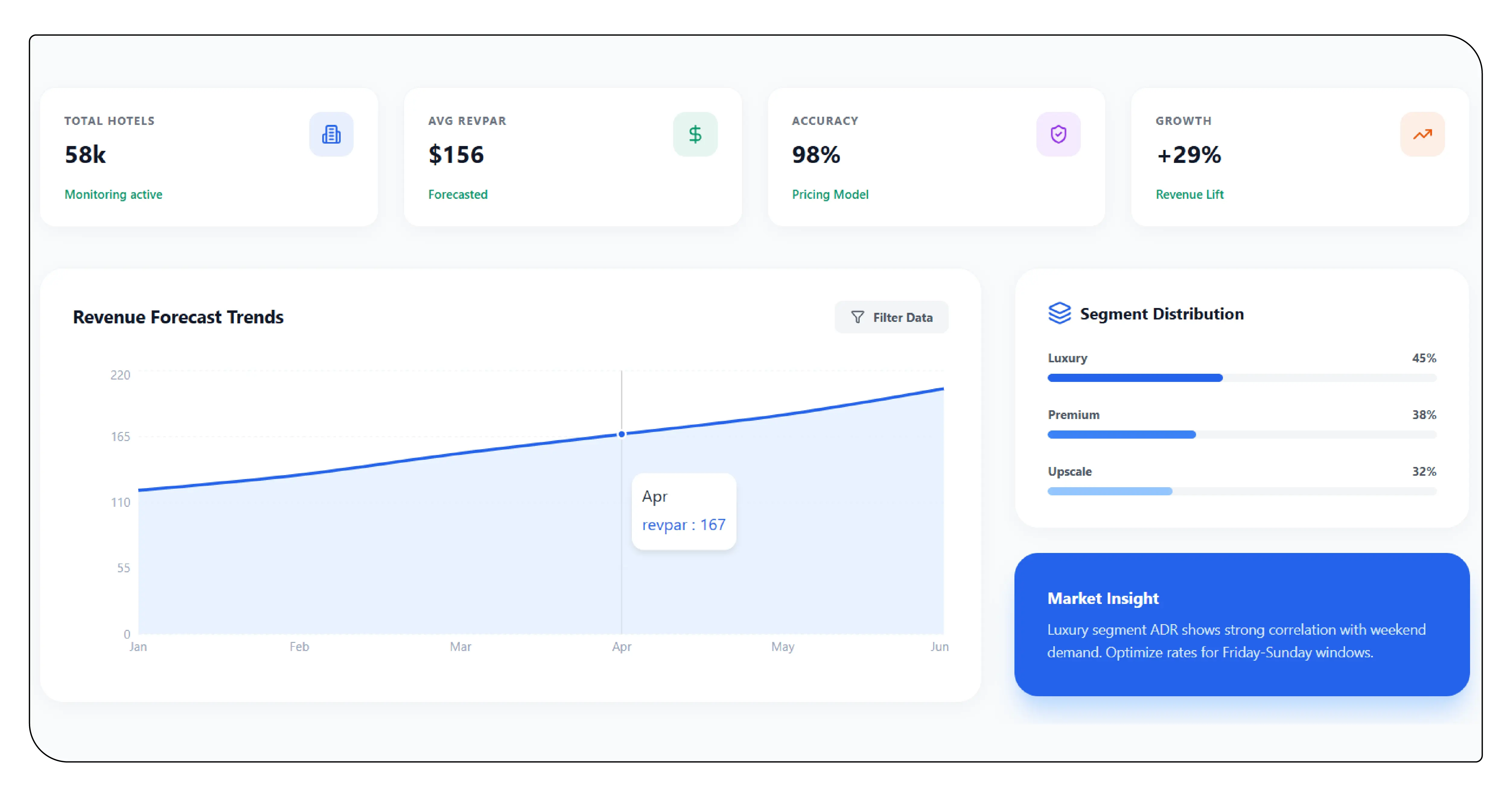
Hotel pricing is influenced by multiple variables rather than a single market factor. Room categories, cancellation flexibility, advance booking windows, brand reputation, loyalty memberships, and local competition all contribute to daily rate fluctuations.
Premium hotels generally experience larger pricing swings because luxury travelers exhibit lower price sensitivity during high-demand periods. Economy hotels often maintain relatively stable pricing while relying on occupancy volume for profitability.
Weekend leisure destinations frequently experience significant ADR growth, whereas business-centric markets often generate stronger weekday occupancy. Convention centers create temporary demand spikes that substantially increase hotel prices within surrounding neighborhoods.
Advanced Demand Forecasting systems analyze these recurring patterns to estimate future pricing opportunities while minimizing revenue losses associated with overpricing or underpricing available inventory.
Table 1: Illustrative U.S. Hotel Market Pricing & Demand Indicators
| Region | Avg Occupancy (%) | ADR (USD) | RevPAR (USD) | Booking Window (Days) | Peak Season | Weekend Price Increase (%) | Cancellation Rate (%) |
|---|---|---|---|---|---|---|---|
| New York Metro | 82 | 286 | 235 | 32 | Q4 Holidays | 18 | 17 |
| Orlando | 79 | 221 | 175 | 44 | Summer | 25 | 14 |
| Las Vegas | 84 | 198 | 166 | 28 | Events & Conventions | 31 | 15 |
| Chicago | 76 | 214 | 163 | 26 | Convention Season | 20 | 18 |
| Los Angeles | 80 | 258 | 206 | 35 | Summer | 17 | 16 |
| Miami | 83 | 274 | 227 | 41 | Winter | 29 | 13 |
| Dallas | 73 | 182 | 133 | 22 | Business Events | 14 | 19 |
| Atlanta | 75 | 191 | 143 | 24 | Conferences | 16 | 18 |
| Seattle | 77 | 226 | 174 | 29 | Summer | 18 | 16 |
| Nashville | 81 | 244 | 198 | 31 | Festivals | 27 | 15 |
| Denver | 74 | 205 | 152 | 25 | Ski Season | 21 | 17 |
| Boston | 79 | 247 | 195 | 33 | Academic Events | 22 | 15 |
Evolving Hotel Pricing Models
Traditional pricing methods primarily depended on historical occupancy reports and manual adjustments. Today's hotels increasingly deploy predictive algorithms capable of processing millions of pricing signals in real time.
US hotel pricing intelligence evaluates competitor room rates, booking pace, occupancy forecasts, customer search activity, local events, airport arrivals, and seasonal travel demand to recommend optimal daily pricing strategies. Revenue managers can therefore maximize profitability without sacrificing occupancy.
Modern pricing engines also segment travelers into business, leisure, family, luxury, group, and last-minute bookers. Personalized offers generated from these segments improve conversion rates while preserving pricing integrity across multiple booking channels.
Hotels are also adopting automated yield management systems that continuously update rates throughout the day as new reservations, cancellations, and competitor pricing changes occur.
Demand Dynamics Shaping the Market
Forecasting demand extends beyond simply predicting occupancy percentages. Hotels must estimate when bookings will occur, which customer segments will travel, and how external events influence purchasing behavior.
Corporate travel recovery continues to strengthen weekday occupancy in financial districts, while hybrid work arrangements have increased extended weekend travel among leisure guests. International tourism also plays an increasingly important role in gateway cities with strong airline connectivity.
Large concerts, sporting events, trade exhibitions, university graduations, and holiday weekends create localized demand surges that significantly alter pricing patterns. Forecasting models incorporating these external variables consistently outperform traditional historical trend analysis.
Consumer booking behavior has also shifted toward mobile reservations and shorter lead times, requiring forecasting systems to update continuously rather than relying on monthly reports.
Capacity Planning and Inventory Optimization
Effective capacity planning requires accurate visibility into both current inventory and expected future demand. Hotels must determine how many rooms should remain available across direct booking channels, online travel agencies, corporate contracts, and loyalty programs.
The US hotel room availability dataset enables operators to monitor inventory distribution across multiple channels while identifying potential overbooking risks or underutilized capacity. Better inventory allocation helps maximize occupancy without reducing average room rates.
Capacity optimization extends beyond guestrooms. Conference facilities, restaurants, spas, parking spaces, meeting rooms, and recreational amenities also require demand forecasts to improve staffing efficiency and customer satisfaction.
Hotel groups increasingly integrate predictive analytics with workforce scheduling, maintenance planning, and procurement systems to reduce operational costs while maintaining consistent guest experiences.
Table 2: Illustrative Capacity Forecast & Operational Performance Metrics
| Hotel Segment | Avg Rooms | Occupancy Forecast (%) | Capacity Utilization (%) | Avg Lead Time (Days) | ADR Growth (%) | Group Booking Share (%) | Direct Booking Share (%) | OTA Share (%) | Forecast Accuracy (%) |
|---|---|---|---|---|---|---|---|---|---|
| Luxury | 340 | 86 | 91 | 39 | 8.4 | 24 | 46 | 32 | 94 |
| Upper Upscale | 290 | 83 | 88 | 35 | 6.9 | 22 | 43 | 36 | 93 |
| Upscale | 240 | 80 | 84 | 29 | 5.7 | 19 | 41 | 39 | 92 |
| Upper Midscale | 180 | 77 | 81 | 23 | 4.5 | 14 | 38 | 43 | 90 |
| Midscale | 145 | 74 | 78 | 19 | 3.8 | 11 | 35 | 47 | 89 |
| Economy | 110 | 71 | 75 | 14 | 2.9 | 8 | 31 | 52 | 87 |
| Extended Stay | 165 | 82 | 86 | 34 | 5.1 | 27 | 48 | 29 | 93 |
| Airport Hotels | 210 | 79 | 83 | 16 | 4.2 | 16 | 39 | 44 | 91 |
| Resort Hotels | 360 | 88 | 93 | 52 | 9.6 | 18 | 45 | 34 | 95 |
| Boutique Hotels | 95 | 78 | 82 | 27 | 6.1 | 10 | 49 | 37 | 90 |
| Convention Hotels | 470 | 84 | 89 | 61 | 7.5 | 38 | 42 | 25 | 94 |
| Lifestyle Hotels | 205 | 81 | 85 | 30 | 6.3 | 17 | 44 | 38 | 92 |
Technology Driving Predictive Forecasting

Artificial intelligence and cloud-based analytics platforms have transformed hotel forecasting capabilities. Modern systems continuously analyze booking pace, customer searches, competitor pricing, review ratings, weather forecasts, airline schedules, fuel prices, and macroeconomic indicators.
Dynamic Pricing Intelligence enables revenue managers to respond immediately to shifting market conditions while maintaining competitive positioning. Predictive algorithms simulate multiple demand scenarios, allowing hotels to prepare for both unexpected surges and sudden slowdowns.
Cloud infrastructure also enables centralized forecasting across thousands of hotel properties, giving corporate revenue teams consistent visibility into regional performance trends while allowing individual hotels to make localized pricing decisions.
Strategic Importance of Data Collection
Reliable forecasting depends on high-quality market data collected from diverse sources. Reservation platforms, hotel websites, online travel agencies, review portals, airline booking systems, tourism statistics, and event calendars collectively contribute to comprehensive forecasting models.
Hotel capacity utilization analytics US helps identify underperforming markets, seasonal occupancy gaps, staffing inefficiencies, and opportunities for revenue optimization. These insights support expansion planning, renovation scheduling, franchise development, and investment decision-making.
Meanwhile, Hotel Data Scraping enables continuous collection of publicly available pricing, room inventory, promotional offers, cancellation policies, amenities, and competitive positioning across thousands of hotel listings. When integrated with predictive analytics, this information provides a comprehensive view of market conditions and evolving customer demand.
Conclusion
Forecasting has become a strategic capability that extends far beyond estimating future occupancy. Hotels now leverage predictive analytics to optimize pricing, improve inventory allocation, enhance staffing efficiency, and strengthen competitive positioning across rapidly changing travel markets.
Future forecasting systems will increasingly combine artificial intelligence, real-time booking behavior, economic indicators, airline capacity, weather intelligence, tourism flows, and customer sentiment into unified forecasting platforms capable of delivering highly accurate operational recommendations.
Continuous US hotel booking demand monitoring enables hotels to detect emerging travel trends earlier, while comprehensive US hotel competitive market analysis provides valuable benchmarking against regional competitors, pricing movements, occupancy shifts, and promotional strategies. Furthermore, detailed Room Type Availability insights allow operators to optimize inventory allocation, maximize revenue opportunities across multiple booking channels, and deliver superior guest experiences in an increasingly data-driven hospitality marketplace.
Ready to elevate your travel business with cutting-edge data insights? Scrape Aggregated Flight Fares to identify competitive rates and optimize your revenue strategies efficiently. Discover emerging opportunities with tools to Extract Travel Website Data, leveraging comprehensive data to forecast market shifts and enhance your service offerings. Real-Time Travel App Data Scraping Services helps stay ahead of competitors, gaining instant insights into bookings, promotions, and customer behavior across multiple platforms. Get in touch with Travel Scrape today to explore how our end-to-end data solutions can uncover new revenue streams, enhance your offerings, and strengthen your competitive edge in the travel market.
Unlock the Full Report
Enter your details to access premium pricing intelligence insights