Scrape European Hotel Chains Mapping Across Luxury, Midscale, and Budget Hospitality Networks in Europe
Introduction
The European hospitality sector is experiencing rapid digital transformation as hotel groups expand portfolios, diversify brand positioning, and optimize regional operations through data-driven intelligence. In this evolving landscape, the need to Scrape European Hotel Chains Mapping has emerged as a critical methodology for analyzing hotel brand expansion, geographic distribution, pricing behavior, franchise penetration, and competitive positioning across Europe's hospitality ecosystem.
Modern hospitality intelligence platforms increasingly rely on structured datasets such as the Accor Hotel Location Dataset to evaluate market saturation, identify high-growth tourism corridors, and monitor strategic investments across business, luxury, midscale, and economy segments. As investors and travel operators seek better visibility into brand ownership and operational performance, Europe hotel brand hierarchy research analytics provides a comprehensive framework for understanding parent-brand relationships, regional subsidiaries, and cross-border portfolio management.
European hotel chains continue to compete aggressively in both mature and emerging tourism destinations. Leading multinational groups such as Accor and IHG Hotels & Resorts are expanding through franchise partnerships, acquisitions, soft-brand strategies, and lifestyle hospitality concepts. Meanwhile, regional leaders across Germany, Spain, Scandinavia, Italy, and Eastern Europe are strengthening their local presence with tailored guest experiences and destination-focused operations.
The adoption of hotel data intelligence enables travel platforms, investment firms, tourism boards, and OTAs to monitor inventory growth, brand clustering, property performance, and competitive positioning in real time. Data extraction methodologies now support location intelligence, chain hierarchy analysis, market segmentation tracking, and portfolio benchmarking across thousands of European hotel properties.
Overview of the European Hotel Chain Ecosystem
Europe represents one of the world's largest hospitality markets, supported by business travel, international tourism, cultural tourism, sports events, and luxury leisure demand. The region contains a mix of global hotel corporations, regional hospitality operators, boutique collections, and independent hotel alliances.
Key operational characteristics of the European hotel market include:
- Strong concentration of hotel assets in major tourism hubs
- Increasing adoption of franchised operating models
- Rapid expansion of lifestyle and hybrid hospitality brands
- Integration of sustainability and ESG-focused operations
- Growth of tech-enabled guest experience systems
- Rising demand for regional luxury and heritage properties
Large hospitality companies now manage multiple sub-brands across pricing categories and customer demographics. These range from ultra-luxury resorts and upscale business hotels to economy chains and long-stay serviced apartments.
Major European Hotel Groups and Brand Structures
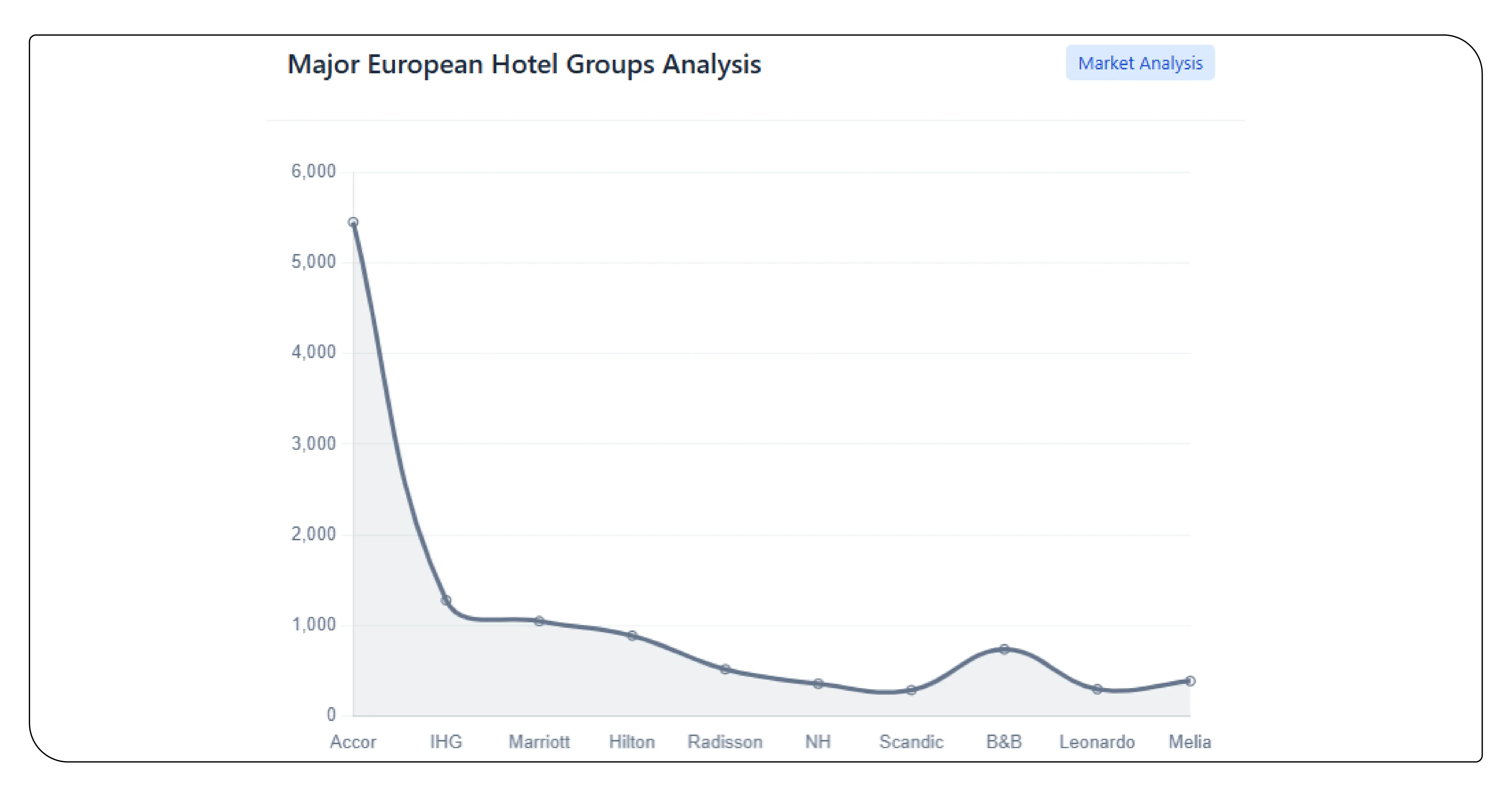
The European hospitality industry is dominated by multinational operators with layered brand hierarchies designed to address diverse traveler needs.
Leading Hotel Groups in Europe
| Hotel Group | Headquarters | Primary Segments | Estimated European Properties | Expansion Strategy |
|---|---|---|---|---|
| Accor | France | Luxury, Midscale, Economy | 5,400+ | Franchise & lifestyle expansion |
| IHG Hotels & Resorts | United Kingdom | Luxury, Premium, Essentials | 1,200+ | Conversion-focused growth |
| Marriott International | United States | Luxury & Premium | 1,000+ | Luxury urban penetration |
| Hilton Worldwide | United States | Business & Upscale | 850+ | Business traveler growth |
| Radisson Hotel Group | Belgium | Upper Midscale & Premium | 500+ | Northern & Eastern Europe expansion |
| NH Hotel Group | Spain | Urban business hotels | 350+ | Southern Europe concentration |
| Scandic Hotels | Sweden | Nordic hospitality | 280+ | Sustainable hotel leadership |
| B&B Hotels | France | Economy segment | 700+ | Budget traveler expansion |
| Leonardo Hotels | Germany | Business & city hotels | 290+ | Central Europe acquisitions |
| Melia Hotels International | Spain | Resort & leisure | 380+ | Mediterranean market dominance |
The competitive structure of European hospitality is heavily influenced by regional specialization. Nordic operators focus on sustainability and business travel, Mediterranean chains emphasize resort experiences, while Central European operators target corporate and conference tourism.
Brand Hierarchy and Segmentation Analysis
Hotel chains increasingly organize operations through multi-tier brand architectures. These structures allow hospitality companies to maximize customer retention while addressing varying travel budgets and preferences.
Accor Brand Hierarchy
Accor maintains one of the most diversified hospitality portfolios globally.
Luxury Segment
Raffles
Fairmont
Sofitel
Banyan Tree
Premium Segment
Pullman
Swissôtel
Mövenpick
Midscale Segment
Novotel
Mercure
Adagio
Economy Segment
ibis
ibis Styles
hotelF1
Accor's European growth strategy emphasizes urban expansion, mixed-use hospitality projects, and lifestyle hotel experiences.
IHG Hotels & Resorts Brand Structure
IHG Hotels & Resorts operates through a highly segmented portfolio focused on loyalty-driven customer retention.
Luxury & Lifestyle
Six Senses
Regent
Kimpton
Premium
voco
Crowne Plaza
Hotel Indigo
Essentials
Holiday Inn
Holiday Inn Express
Suites
Staybridge Suites
Candlewood Suites
IHG continues expanding through franchise conversions and digital loyalty ecosystems across Europe.
Geographic Distribution and Market Penetration
European hotel chains demonstrate distinct regional concentration patterns depending on tourism demand, transport connectivity, and corporate travel activity.
Regional Distribution Trends
| Region | Dominant Hotel Types | Major Chains Active | Key Growth Drivers |
|---|---|---|---|
| Western Europe | Luxury & Business | Accor, Hilton, Marriott | Corporate travel |
| Southern Europe | Resort & Leisure | Melia, NH, Accor | Tourism recovery |
| Northern Europe | Sustainable hotels | Scandic, Radisson | Eco-tourism |
| Eastern Europe | Midscale expansion | B&B Hotels, IHG | Emerging tourism |
| Central Europe | Business conferences | Leonardo, Marriott | Trade exhibitions |
| Mediterranean Coast | Luxury resorts | Melia, Hilton | Seasonal tourism |
| Alpine Regions | Wellness & resort hotels | Accor, Kempinski | Winter tourism |
| Baltic States | Budget & midscale | IHG, Radisson | Digital nomad travel |
Geographic intelligence mapping helps operators identify underserved tourism corridors and optimize future hotel development projects.
Market Segment Monitoring Across Europe
The hospitality sector is increasingly segmented into specialized customer categories. Analysts use Market Share Analysis frameworks to evaluate operational dominance across these categories.
The primary segments include:
Luxury Hospitality
Luxury brands focus on affluent travelers, destination experiences, and premium amenities. Growth is strongest in Paris, London, Milan, Zurich, and the French Riviera.
Business Travel Hotels
Business-oriented properties remain concentrated near airports, convention centers, and financial districts. Corporate recovery has accelerated demand for flexible conference spaces.
Midscale Urban Hotels
Midscale chains dominate secondary cities where affordability and convenience remain top priorities.
Economy and Budget Hotels
Budget chains continue rapid expansion due to increased domestic travel and short-stay tourism.
Extended Stay and Hybrid Hospitality
Long-stay properties and apartment-style accommodations are growing due to remote work and digital nomad trends.
The emergence of hotel chain market segment monitoring Europe solutions allows hospitality analysts to compare pricing tiers, occupancy fluctuations, and seasonal demand across regions.
Growth Strategies of European Hotel Leaders

Major hotel operators are using diversified expansion strategies to strengthen European market share.
1. Franchise Expansion
Franchise-based growth reduces capital expenditure while accelerating geographic penetration.
2. Conversion Projects
Hotel groups increasingly convert independent properties into branded assets using soft-brand models.
3. Digital Loyalty Ecosystems
Loyalty programs now integrate AI-powered recommendations, dynamic pricing, and personalized booking experiences.
4. Sustainability Investments
Green certifications, carbon-neutral operations, and ESG reporting influence investor and traveler preferences.
5. Smart Hospitality Technology
Hotels deploy mobile check-ins, IoT room systems, predictive analytics, and automated pricing optimization tools.
The growing use of the Accor and IHG hospitality growth dataset enables benchmarking of expansion velocity, property density, and operational diversification across Europe.
Competitive Dynamics Among Regional Hotel Leaders
Regional hotel chains continue to compete effectively against multinational operators through localized service models and strong cultural positioning.
Scandinavian Market
Scandic Hotels leads through sustainability-focused hospitality operations.
German Market
Leonardo Hotels has expanded aggressively in urban business destinations.
Spanish Market
Melia Hotels International dominates Mediterranean resort operations.
French Budget Hospitality
B&B Hotels continues rapid expansion across budget travel corridors.
Regional operators increasingly rely on the European Hotel Brand Mapping Dataset to identify acquisition opportunities and evaluate regional competition intensity.
Role of Data Intelligence in Hotel Chain Mapping
Modern hospitality intelligence systems aggregate structured hotel data from multiple sources, including:
- OTA listings
- Corporate hotel websites
- Tourism databases
- Franchise disclosures
- Property management systems
- Review platforms
- Pricing engines
These datasets enable detailed analysis of:
- Brand ownership hierarchies
- Hotel count growth
- Room inventory expansion
- Geographic clustering
- Seasonal pricing trends
- Competitor positioning
- Customer segment targeting
The rise of European hotel group intelligence platforms supports travel companies, institutional investors, and tourism analysts in evaluating market opportunities more accurately.
Technology and Automation in Hospitality Analytics
AI-driven analytics and automated web extraction technologies are transforming hospitality research workflows.
Key Technologies Used
| Technology | Application in Hotel Analytics | Business Impact |
|---|---|---|
| Web Scraping APIs | Property data extraction | Real-time monitoring |
| AI Classification Models | Brand segmentation | Faster categorization |
| Geospatial Analytics | Hotel mapping | Location intelligence |
| Dynamic Pricing Systems | Rate optimization | Revenue maximization |
| NLP Review Analysis | Sentiment tracking | Guest experience monitoring |
| Cloud Data Warehousing | Dataset integration | Centralized reporting |
| Predictive Analytics | Demand forecasting | Capacity planning |
| BI Dashboards | Executive visualization | Strategic insights |
| OTA Monitoring Tools | Competitor tracking | Pricing intelligence |
| Franchise Databases | Ownership mapping | Portfolio evaluation |
Hospitality firms increasingly integrate automated intelligence systems to support expansion planning and competitive benchmarking.
Future Outlook for European Hotel Chains
The future European hospitality market will likely be shaped by:
- AI-powered personalization
- ESG-focused operations
- Smart room automation
- Flexible hybrid hospitality
- Digital-first guest journeys
- Sustainable tourism expansion
- Consolidation among midscale operators
- Increased franchising across Eastern Europe
Large operators are expected to strengthen asset-light models while expanding lifestyle-focused sub-brands.
Cross-border tourism recovery and infrastructure investments will continue driving hotel expansion opportunities throughout Europe.
Conclusion
European hospitality markets are entering a highly data-centric era where structured intelligence determines competitive positioning, expansion efficiency, and operational visibility. The growing complexity of multinational brand portfolios, regional operators, franchise ecosystems, and market segmentation has accelerated demand for advanced hospitality analytics platforms.
Comprehensive datasets and automated intelligence systems now enable organizations to conduct accurate Europe hotel brand market analysis across luxury, premium, midscale, and economy segments. These insights support investment planning, OTA optimization, regional benchmarking, and strategic growth forecasting for both multinational chains and independent operators.
The increasing adoption of Europe hospitality network mapping extraction technologies further strengthens visibility into hotel ownership structures, geographic expansion patterns, and regional competition density. Hospitality businesses can now evaluate emerging tourism corridors, identify underpenetrated markets, and monitor brand evolution in real time.
As competition intensifies across Europe's hospitality sector, scalable intelligence solutions and Hotel Data Scraping Services will play a critical role in enabling data-driven decision-making, operational efficiency, and sustainable long-term growth for hotel groups, travel platforms, and tourism stakeholders.
Ready to elevate your travel business with cutting-edge data insights? Scrape Aggregated Flight Fares to identify competitive rates and optimize your revenue strategies efficiently. Discover emerging opportunities with tools to Extract Travel Website Data, leveraging comprehensive data to forecast market shifts and enhance your service offerings. Real-Time Travel App Data Scraping Services helps stay ahead of competitors, gaining instant insights into bookings, promotions, and customer behavior across multiple platforms. Get in touch with Travel Scrape today to explore how our end-to-end data solutions can uncover new revenue streams, enhance your offerings, and strengthen your competitive edge in the travel market.
Unlock the Full Report
Enter your details to access premium pricing intelligence insights