Transforming Aviation Strategy with Nigeria Airlines Flight Pricing Analytics
Introduction
This case study highlights how our advanced analytics platform transformed airline pricing strategies across Nigeria by delivering real-time, data-driven insights.
Nigeria airlines flight pricing analytics enabled stakeholders to monitor fare fluctuations across multiple carriers, uncover hidden pricing patterns, and optimize revenue strategies effectively.
By leveraging granular datasets, our solution provided route-wise comparisons, helping airlines and travel businesses identify profitable corridors and underperforming routes.
Nigeria airlines route-level pricing intelligence empowered decision-makers with precise visibility into demand shifts, seasonal trends, and competitor fare movements across key domestic and international routes.
Our system integrated historical and real-time data to build predictive pricing models that improved forecasting accuracy and reduced revenue leakage.
Flight Price Data Intelligence further enhanced strategic planning by offering actionable insights into customer booking behavior, peak travel windows, and fare elasticity.
As a result, clients achieved improved pricing efficiency, increased load factors, and stronger competitive positioning in Nigeria’s dynamic aviation market.
The Client
The client is a leading travel analytics and aviation intelligence firm focused on delivering actionable insights across Nigeria’s dynamic airline ecosystem. They specialize in aggregating and processing large-scale aviation data to support airlines, OTAs, and travel management companies in making informed decisions.
Nigeria flight fare and schedule dataset plays a crucial role in their operations, enabling them to track real-time pricing, route availability, and frequency patterns across multiple carriers.
With a strong emphasis on operational efficiency, the client leverages advanced tools to interpret complex scheduling data and optimize route performance.
Nigeria Airlines flight schedule analysis helps them uncover delays, peak travel periods, and route profitability, ensuring better planning and enhanced customer experience.
Additionally, the client integrates international benchmarks to stay competitive in a globalized market.
Global Flight Price Trends Dataset allows them to compare regional pricing with global patterns, refine pricing strategies, and identify emerging travel trends for sustained growth.
Challenges in the Travel Industry
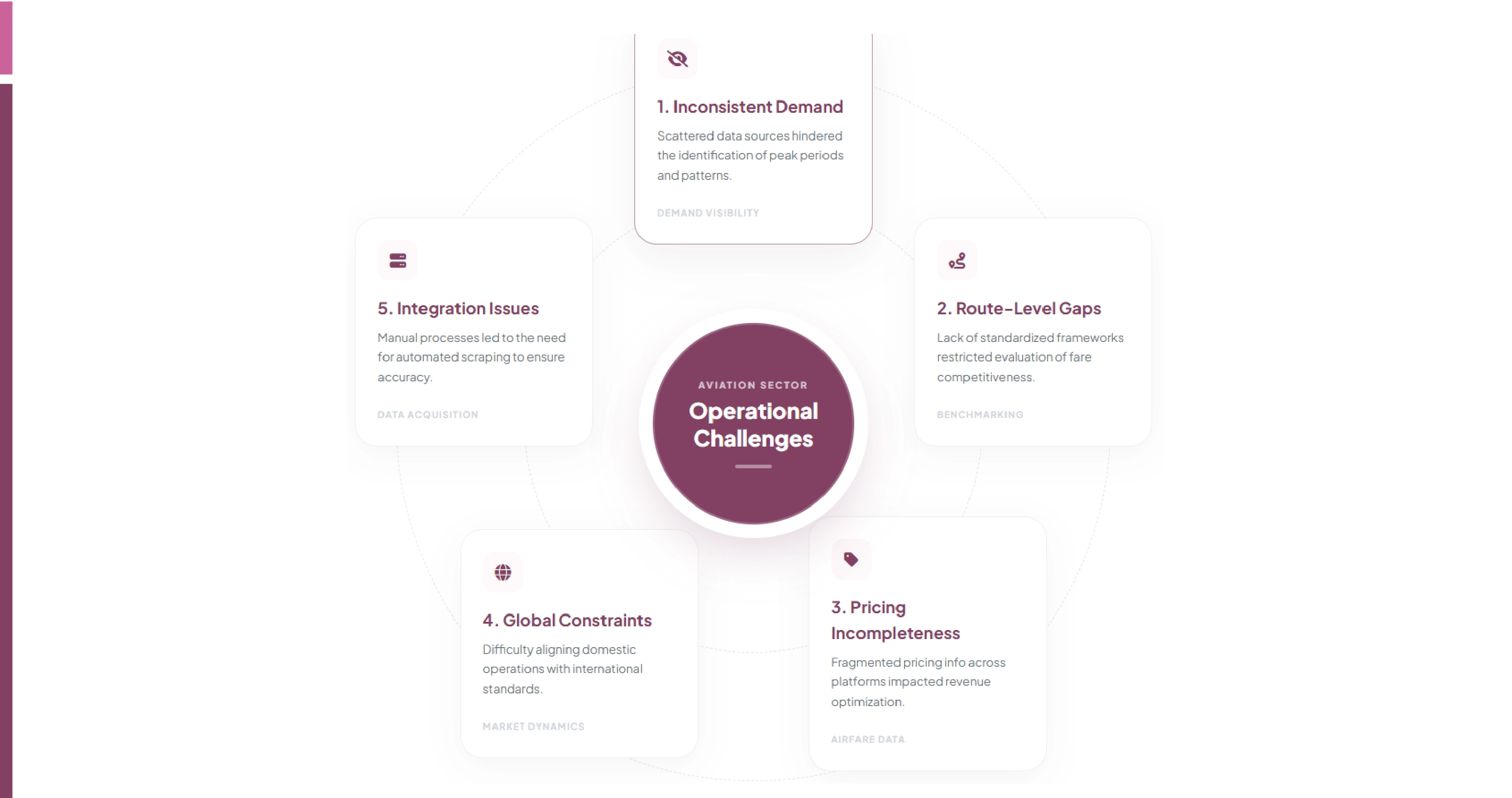
The client faced multiple operational and analytical challenges while navigating Nigeria’s evolving aviation landscape. Limited access to structured, real-time data and fragmented sources made it difficult to gain accurate pricing visibility, forecast demand, and benchmark performance effectively across routes and competitors.
1. Inconsistent Demand Visibility
Understanding passenger behavior was difficult due to scattered and unstructured data sources. Implementing Nigeria flight demand trends scraping was essential, as the client struggled to identify peak travel periods, seasonal fluctuations, and real-time booking patterns affecting strategic decision-making accuracy.
2. Limited Route-Level Comparison
The absence of standardized comparison frameworks restricted performance evaluation across routes. With Nigeria Airlines route-based flight comparison extraction, the client aimed to analyze fare competitiveness, route efficiency, and carrier performance but lacked unified datasets for consistent benchmarking and insights.
3. Incomplete Pricing Data Access
The client faced challenges gathering comprehensive fare data across multiple airlines and booking platforms. Nigeria Airlines airfare data extraction became critical to overcome fragmented pricing information, inconsistent updates, and lack of transparency impacting revenue optimization strategies and competitive positioning.
4. Global Benchmarking Constraints
Without access to a Global Flight Schedule Dataset, the client struggled to compare domestic operations with international standards. This limitation affected their ability to identify global trends, optimize schedules, and align pricing strategies with broader aviation market dynamics.
5. Data Collection and Integration Issues
Manual processes and unreliable pipelines hindered efficient data acquisition. Adopting Airline Data Scraping solutions became necessary to automate extraction, ensure data accuracy, and integrate multiple sources into a centralized system for actionable analytics and improved operational efficiency.
Our Approach
Multi-Source Data Aggregation Framework
We built a robust system to collect aviation data from multiple airlines, booking platforms, and historical records. This ensured complete coverage of fares, schedules, and routes, reducing data gaps and enabling a unified view of Nigeria’s airline ecosystem for deeper analysis.
Real-Time Data Processing Engine
A high-speed processing pipeline was deployed to capture and refresh airline information continuously. This allowed the client to access updated pricing and schedule insights instantly, improving responsiveness to market fluctuations and enabling faster strategic adjustments in competitive environments.
Route-Level Intelligence Mapping
We structured data at a granular route level to identify performance trends across different city pairs. This approach helped the client evaluate route efficiency, demand concentration, and pricing variations, supporting more informed decisions for network expansion and optimization.
Advanced Data Cleaning and Normalization
To ensure accuracy, we implemented strong validation, deduplication, and standardization techniques. This eliminated inconsistencies from raw datasets, improved data reliability, and ensured that analytics outputs were consistent, comparable, and suitable for predictive modeling and business intelligence applications.
Scalable Analytics-Ready Architecture
We designed a scalable infrastructure capable of handling large aviation datasets efficiently. This architecture supported advanced analytics, forecasting models, and visualization tools, enabling the client to expand insights globally while maintaining performance, flexibility, and long-term data sustainability.
Results Achieved
.webp "Results Achieved")
After implementing our aviation intelligence solution, the client achieved measurable improvements in pricing accuracy, operational efficiency, and demand forecasting across Nigeria’s airline ecosystem through structured data insights and automation.
1. Revenue Optimization Strengthened
The client improved revenue outcomes by identifying fare inefficiencies and demand gaps more effectively. Data-driven insights enabled smarter pricing adjustments, better yield control, and higher profitability across key domestic and international airline routes with improved financial precision overall.
2. Faster Market Responsiveness
Real-time data processing allowed the client to respond quickly to fare changes and shifting travel demand. This improved agility in decision-making, reduced reaction time to market fluctuations, and enhanced competitiveness in a highly dynamic airline pricing environment.
3. Better Demand Visibility
Enhanced analytics provided clearer understanding of passenger demand patterns across routes and seasons. This helped optimize seat allocation, improve forecasting accuracy, and support better capacity planning decisions aligned with actual market behavior and booking trends.
4. Stronger Competitive Intelligence
The client gained deeper visibility into competitor pricing and scheduling strategies. This enabled effective benchmarking, improved fare positioning, and stronger strategic planning in competitive markets where pricing and route decisions change frequently and require continuous monitoring.
5. Improved Operational Planning
Streamlined datasets and analytics improved flight scheduling and network planning efficiency. The client reduced manual effort, enhanced route optimization, and achieved better alignment between operational capacity and market demand for smoother airline performance execution.
Sample Scraped Data Table
| Airline | Route | Departure Time | Arrival Time | Fare (NGN) | Frequency (Weekly) | Booking Class |
|---|---|---|---|---|---|---|
| Air Peace | Lagos – Abuja | 07:30 AM | 08:40 AM | 85,000 | 14 | Economy |
| Arik Air | Lagos – Port Harcourt | 09:15 AM | 10:25 AM | 78,500 | 10 | Economy |
| Dana Air | Abuja – Lagos | 12:00 PM | 01:10 PM | 82,000 | 12 | Economy |
| Ibom Air | Uyo – Lagos | 03:20 PM | 04:40 PM | 88,000 | 7 | Economy |
| Green Africa | Lagos – Enugu | 06:45 AM | 08:00 AM | 74,000 | 9 | Economy |
| Air Peace | Abuja – Kano | 02:10 PM | 03:20 PM | 90,500 | 8 | Economy |
| Arik Air | Lagos – Owerri | 05:30 PM | 06:40 PM | 80,000 | 6 | Economy |
| Dana Air | Port Harcourt – Abuja | 08:00 AM | 09:15 AM | 83,500 | 11 | Economy |
| Ibom Air | Lagos – Uyo | 11:25 AM | 12:45 PM | 87,000 | 7 | Economy |
| Green Africa | Abuja – Lagos | 04:00 PM | 05:10 PM | 76,500 | 10 | Economy |
Client’s Testimonial
“Working with this analytics team has significantly improved how we understand and optimize our airline pricing and scheduling strategy. Their data-driven approach helped us gain real-time visibility into fare movements, route performance, and demand patterns across Nigeria’s aviation network. We can now make faster, more accurate decisions that directly impact revenue and operational efficiency. The insights delivered were precise, actionable, and easy to integrate into our existing systems. Their solution has truly transformed our planning capabilities and strengthened our competitive positioning in the market.”
Final Outcome
The final outcome of the project was a fully integrated aviation intelligence system that significantly improved pricing visibility, forecasting accuracy, and operational decision-making for the client. By leveraging structured data pipelines and automated extraction techniques, the client achieved stronger control over fare volatility and route performance. The solution enabled faster insights, reduced manual dependency, and improved strategic planning across Nigeria’s airline ecosystem. Overall business efficiency and competitive positioning were greatly enhanced, leading to more data-driven revenue optimization and improved customer demand alignment.
Flight Pricing Data Scraping enabled real-time fare tracking and ensured continuous monitoring of market fluctuations across multiple airlines. The strategy to Scrape Aggregated Flight Fares helped consolidate fragmented pricing data into a unified view, improving benchmarking and decision accuracy. However, our tools to Extract Travel Website Data provided comprehensive coverage of schedules, fares, and availability, supporting advanced analytics and predictive modeling for better business outcomes.
FAQs
Unlock the Full Report
Enter your details to access premium pricing intelligence insights