OTA Pricing Intelligence for Leveraging Flight & Hotel Data to Generate Real-Time Price Trends and Booking Insights
Introduction
This case study demonstrates how a travel client leveraged advanced pricing systems to monitor market fluctuations, generate insights, and improve decision-making for bookings across multiple global airline and hotel platforms. OTA Pricing Intelligence delivered actionable insights for client growth today.
It helped centralize fragmented travel data sources into a unified intelligence layer, improving visibility across competitive pricing structures and enabling faster response to market volatility in global travel ecosystems. The real-time flight and hotel price trend analysis enabled forecasting accuracy.
It empowered the client to track dynamic fare changes, optimize inventory positioning, and identify high-demand routes and hotel segments, leading to improved yield management and stronger revenue performance.
Metasearch and OTA Price Intelligence has strengthened booking visibility, helping the client compare rates across platforms and identify demand spikes, improve conversion rates, and optimize revenue strategies using dynamic dashboards and historical datasets for smarter pricing decisions across multiple travel channels in competitive markets in real time actionable insights globally.
The Client
The client is a leading travel technology enterprise focused on improving competitive intelligence and revenue optimization in the global travel ecosystem. By leveraging advanced analytics and scalable data pipelines, the client aims to enhance decision-making across airlines, hotels, and online travel platforms. The travel pricing and booking data intelligence enabled the client to gain deeper visibility into market dynamics and customer booking behavior across multiple geographies, helping them refine pricing strategies and improve conversion performance.
With multi-OTA flight and hotel data extraction, the client successfully unified fragmented data sources from various online travel agencies, ensuring consistent, structured, and high-quality datasets for analysis and forecasting. The OTA Ranking & Visibility solutions further helped the client monitor brand positioning across major travel platforms, identify gaps in listing performance, and optimize promotional strategies to increase visibility, engagement, and overall booking share in a highly competitive digital travel marketplace.
Challenges in the Travel Industry
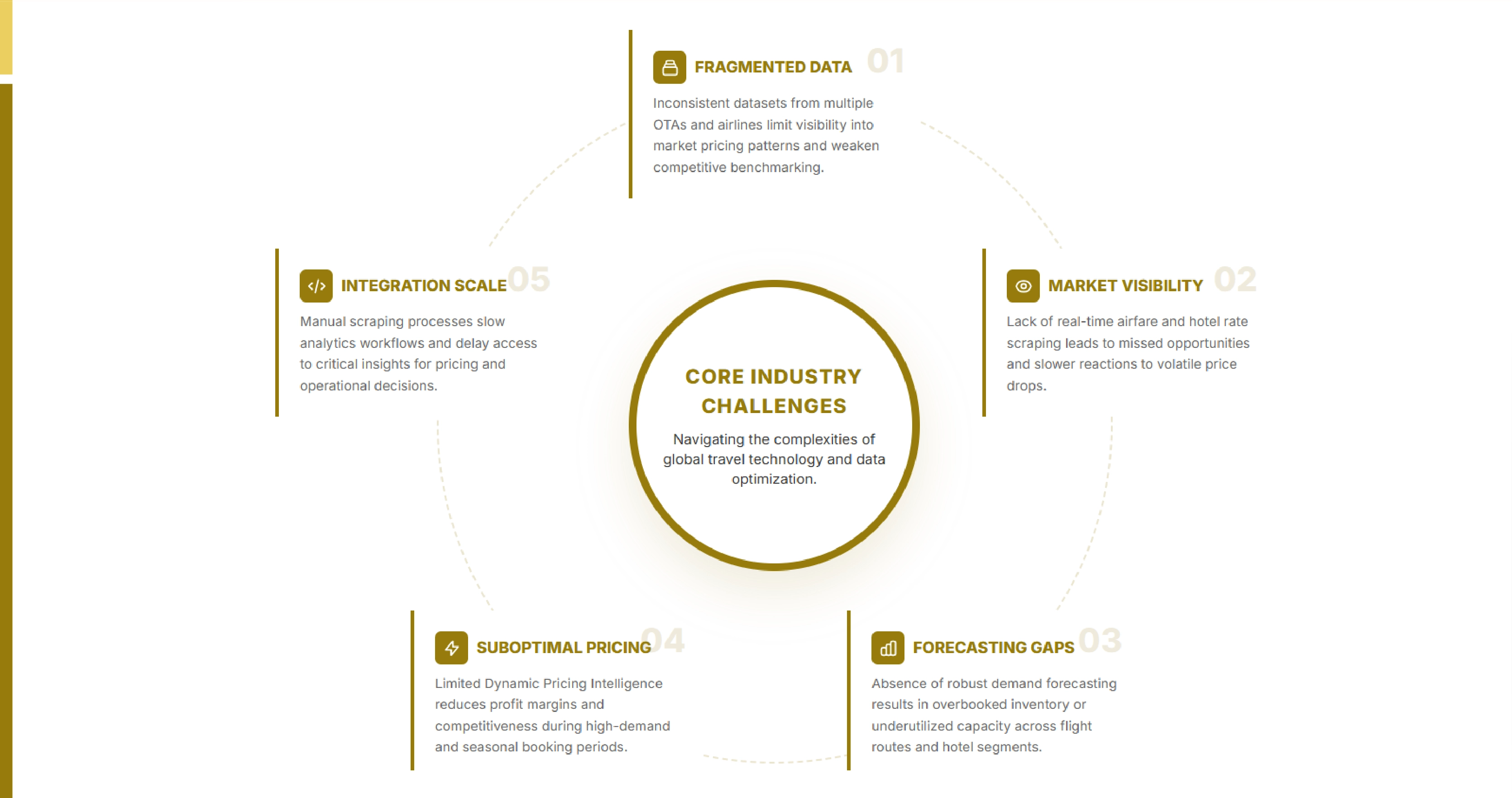
The client operates in the global travel technology space, focusing on optimizing pricing strategies and booking performance. However, increasing market complexity, fragmented data sources, and rapid fare fluctuations created significant operational challenges that impacted forecasting accuracy, competitiveness, and revenue optimization across platforms.
1. Fragmented and Unstructured Travel Data
The client struggled with inconsistent datasets from multiple OTAs and airline sources, making analysis difficult. Lack of standardized inputs limited visibility into market pricing patterns, reducing efficiency in decision-making and weakening competitive benchmarking across global travel distribution channels.
2. Limited Real-Time Market Visibility
Without real-time airfare and hotel rate scraping, the client faced delays in capturing dynamic pricing changes. This resulted in missed opportunities, slower reactions to competitor price drops, and reduced ability to adjust inventory strategies in highly volatile travel markets.
3. Weak Forecasting Accuracy
The absence of robust travel demand forecasting using pricing and booking data impacted strategic planning. Inaccurate demand predictions led to inefficient pricing decisions, overbooked inventory in some cases, and underutilized capacity across key flight routes and hotel segments globally.
4. Inefficient Pricing Optimization
The client lacked advanced Dynamic Pricing Intelligence, which limited their ability to adjust fares based on real-time demand shifts. This resulted in suboptimal pricing strategies, reduced profit margins, and weaker competitiveness across high-demand travel routes and seasonal booking periods.
5. Limited API-Driven Data Integration
The absence of Real-Time Flight Data Scraping API made it difficult to automate data collection at scale. Manual and semi-automated processes slowed analytics workflows, reduced scalability, and delayed access to critical insights for pricing and operational decisions.
Our Approach
1. Unified Data Engineering Approach
We built a centralized data pipeline of travel booking insights using pricing data integrating multiple travel sources including airlines and hotel platforms. this ensured consistent ingestion, normalization, and storage of large-scale datasets, enabling reliable analytics and reducing fragmentation across distributed systems for improved operational efficiency and scalability.
2. Real-Time Market Monitoring Framework
We implemented continuous monitoring systems to capture rapid changes in travel prices and availability This enabled timely insights improved responsiveness and ensured stakeholders could react quickly to market fluctuations across global booking environments with higher precision and operational agility levels.
3. Predictive Analytics Enablement Layer
We designed predictive models that analyze historical trends and behavioral patterns to support forecasting accuracy This approach helped identify seasonal variations demand spikes and booking patterns enabling better strategic planning and improved decision-making across travel operations globally at scale efficiency.
4. Optimization and Intelligence Framework
Our approach focused on building intelligent optimization systems that evaluate pricing dynamics and competitor movements This allowed improved decision frameworks enhanced revenue opportunities and stronger adaptability in highly competitive travel marketplaces across regions and customer segments in real market environments.
5. Scalable Integration and Delivery Approach
We adopted a scalable architecture that supports seamless integration of multiple data streams and ensures consistent delivery of insights This enables faster processing improved system reliability and better alignment with evolving travel industry requirements and business goals at enterprise scale.
Results Achieved
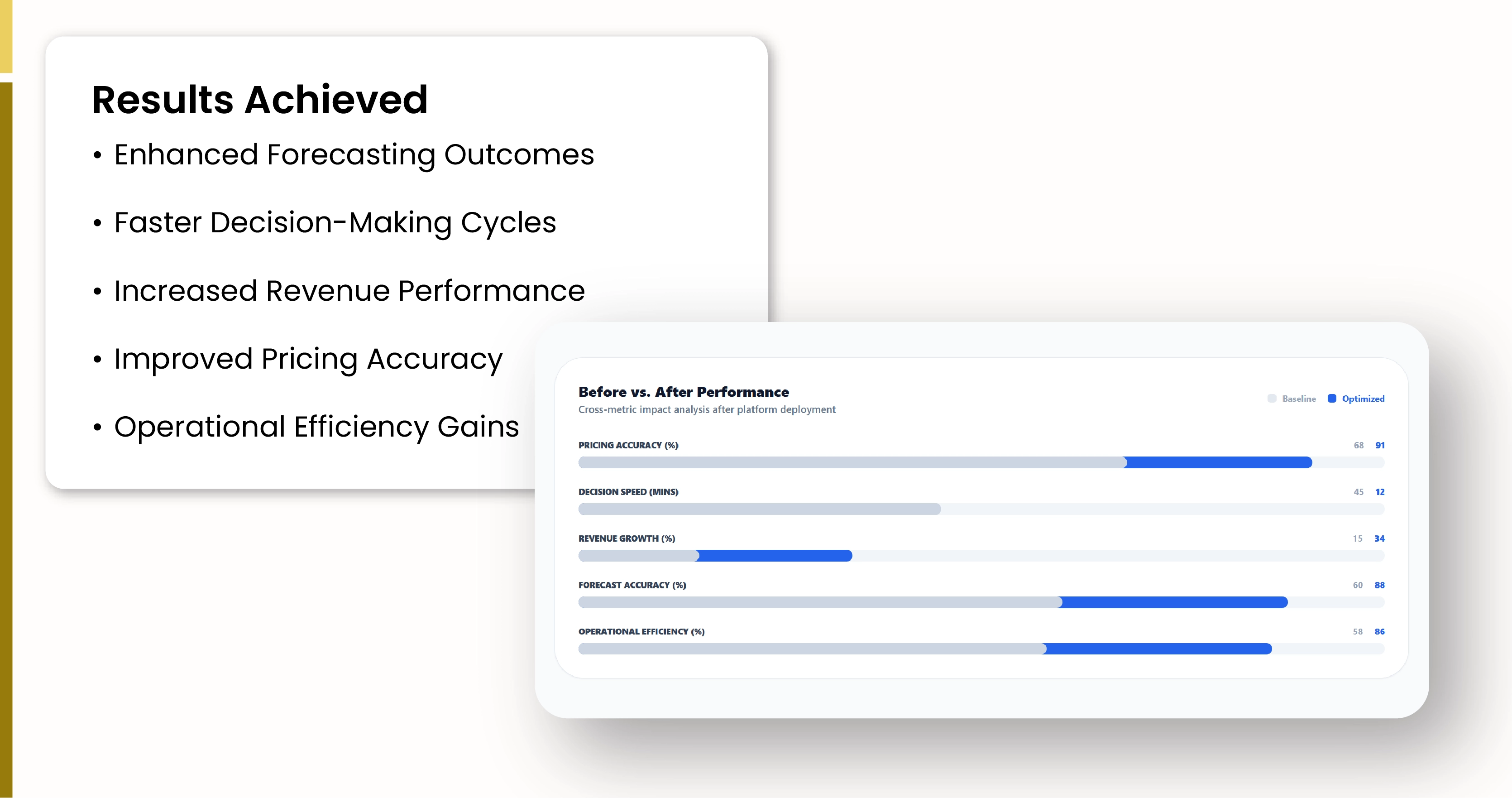
The client is a global travel technology leader seeking improved pricing efficiency, better forecasting, and stronger data-driven decision-making across markets.
1. Improved Pricing Accuracy
The client achieved significantly improved pricing accuracy across travel products. Real-time insights enabled better alignment with market conditions, reduced pricing mismatches, and helped teams respond faster to fluctuations, resulting in stronger competitiveness and more stable revenue performance across global operations.
2. Faster Decision-Making Cycles
Data processing and insight generation time were drastically reduced, enabling faster decision-making cycles. Stakeholders gained near-instant visibility into market movements, allowing quicker strategic responses, improved agility, and enhanced ability to capitalize on short-term demand opportunities effectively across multiple channels.
3. Increased Revenue Performance
The engagement led to measurable revenue growth through optimized pricing strategies and better demand alignment. Improved visibility into market trends helped the client capture high-value bookings, reduce revenue leakage, and strengthen overall financial outcomes across key travel segments and regions.
4. Enhanced Forecasting Outcomes
Forecasting accuracy improved due to deeper analysis of historical and behavioral patterns. This allowed the client to better anticipate demand fluctuations, optimize capacity planning, and reduce operational inefficiencies caused by unpredictable booking trends across peak and off-peak travel seasons globally.
5. Operational Efficiency Gains
The client experienced significant improvements in operational efficiency through automation and streamlined workflows. Manual effort was reduced, data consistency improved, and teams were able to focus more on strategic tasks rather than repetitive data handling and reconciliation processes across systems.
Scraped Travel Pricing Data Sample (OTA Sources)
| Date | Route | Airline | Hotel Name | OTA Platform | Fare/Rate (INR) | Availability | Rating | Scrape Timestamp |
|---|---|---|---|---|---|---|---|---|
| 2026-04-10 | DEL → DXB | Emirates | Hilton Dubai Downtown | OTA A | 28,500 | Available | 4.6 | 10:05 AM |
| 2026-04-10 | DEL → LHR | British Airways | Marriott London Bridge | OTA B | 62,000 | Limited | 4.5 | 10:07 AM |
| 2026-04-10 | BOM → SIN | Singapore Airlines | Marina Bay Sands | OTA C | 34,200 | Available | 4.8 | 10:10 AM |
| 2026-04-10 | BLR → BKK | Thai Airways | Amari Bangkok | OTA A | 18,750 | Available | 4.3 | 10:12 AM |
| 2026-04-10 | MAA → DXB | Air India | Atlantis The Palm | OTA B | 29,900 | Sold Out | 4.7 | 10:15 AM |
| 2026-04-10 | DEL → NYC | United Airlines | Hilton Midtown New York | OTA C | 78,500 | Available | 4.4 | 10:18 AM |
| 2026-04-10 | HYD → FRA | Lufthansa | Radisson Blu Frankfurt | OTA A | 55,300 | Limited | 4.2 | 10:20 AM |
Client’s Testimonial
“Working with the team completely transformed how we understand and act on travel market data. Their solution helped us unify fragmented pricing inputs across multiple sources and turn them into clear, actionable insights. We now have significantly better visibility into fare movements, demand shifts, and booking behavior, which has improved our strategic planning and revenue outcomes. The system is reliable, fast, and scalable, supporting our growing data needs without complexity.”
Conclusion
In conclusion, the implemented travel data ecosystem has significantly enhanced the client’s ability to monitor, analyze, and respond to rapidly changing market conditions across global travel platforms. By consolidating fragmented sources into a unified intelligence layer, the solution improved pricing visibility, forecasting accuracy, and overall decision-making efficiency. It enabled the client to respond faster to demand fluctuations and optimize revenue opportunities effectively across multiple regions.
Real-Time Hotel Data Scraping API enabled continuous access to live hotel pricing and availability updates, improving responsiveness and operational agility in competitive markets.
The system also empowered to Scrape Aggregated Travel Deals to consolidate offers from multiple sources, ensuring better comparison and deal optimization for end users and internal analytics teams.
Additionally, the strategy to Scrape Travel Website Data provided structured insights from global booking platforms, improving competitive benchmarking and market tracking accuracy.
Finally, the method to Scrape Travel Mobile App enabled capture of real-time user-facing pricing and availability trends, strengthening end-to-end travel intelligence capabilities.
FAQs
Unlock the Full Report
Enter your details to access premium pricing intelligence insights