Flight Data Scraping Case Study: How a Travel Startup Launched Live Fare Comparison in 7 Days
Case study summary. A travel-tech startup used flight data scraping from Travel Scrape to launch a live fare-comparison platform in just 7 days, pulling clean fare and seat-availability data across 200+ routes and 10M+ records a month from 10 OTAs and metasearch sources. Instead of spending months building scrapers, the team plugged into a single normalised flight data API and shipped.
This flight data scraping case study shows how a startup skipped months of web scraping engineering and went straight to a working product — with the sample data, setup and results behind a 7-day launch.
The client: a travel startup with a product idea and no data
The client is an early-stage travel-tech startup building a flight fare-comparison and price-alert product for Indian and international travellers. The founding team had strong product and front-end skills, a clear vision, and early funding — but no flight data, and no in-house web scraping expertise. For privacy the company is anonymised, but the workflow, numbers and sample data reflect a real Travel Scrape engagement with an OTA / metasearch client.
Their entire product depended on one thing: a reliable, real-time feed of flight fares and seat availability across the platforms travellers actually book on — MakeMyTrip, Google Flights, Skyscanner, and major airline sites. Without that data, there was no product to launch.
They faced the classic build-vs-buy decision every travel startup hits, and the clock — and their runway — was ticking.
The challenge: months of scraping engineering they couldn’t afford
When the team scoped building flight data scraping in-house, the timeline and risk were sobering. Three problems stood out.
1. Flight data is one of the hardest things to scrape
Airline and metasearch sites are among the most technically demanding scraping targets on the web. Fares load through complex, JavaScript-heavy flows, prices vary by route, date, currency and device, and the sites deploy aggressive anti-bot defences. Building reliable flight price scraping for even a handful of sources is weeks of specialist work — work the startup didn’t have the people for.
2. Every week of building was a week not selling
For a funded startup, time is the scarcest resource. Spending three to four months on web scraping infrastructure meant three to four months not acquiring users, not iterating on the product, and burning runway on plumbing rather than the experience travellers would actually see.
3. Messy, inconsistent data would break the product
Even if the team scraped the sources, each one returns data in a different shape. Normalising fares, seat availability and fare classes across 10 platforms into one consistent schema is its own large project — and getting it wrong would mean a broken, untrustworthy comparison product.
The core issue: the startup’s advantage was its product, not its pipeline. Every week spent on travel data scraping infrastructure was a week of lost momentum.
Why the startup chose Travel Scrape for flight data scraping
Rather than build, the team chose Travel Scrape’s flight data API — a single, normalised feed of live fares and availability. Four factors drove the decision:
- Go live in under a week. A REST API with clean JSON meant the team could integrate flight data scraping output in days, not months.
- Pre-normalised schema. Data arrived in one consistent structure across all 10 OTA and metasearch sources — zero field mapping, zero per-source parsing.
- Travel-specific coverage. Travel Scrape already had parsers for MakeMyTrip, Google Flights, Skyscanner and major carriers, so there was no setup time for standard sources.
- Webhooks for price alerts. Real-time price-change webhooks let the startup power its core feature — fare alerts — without polling or extra infrastructure.
A free sample dataset let the team validate fare accuracy against live bookings before committing — and the numbers matched.
The solution: one flight data scraping API, ten sources
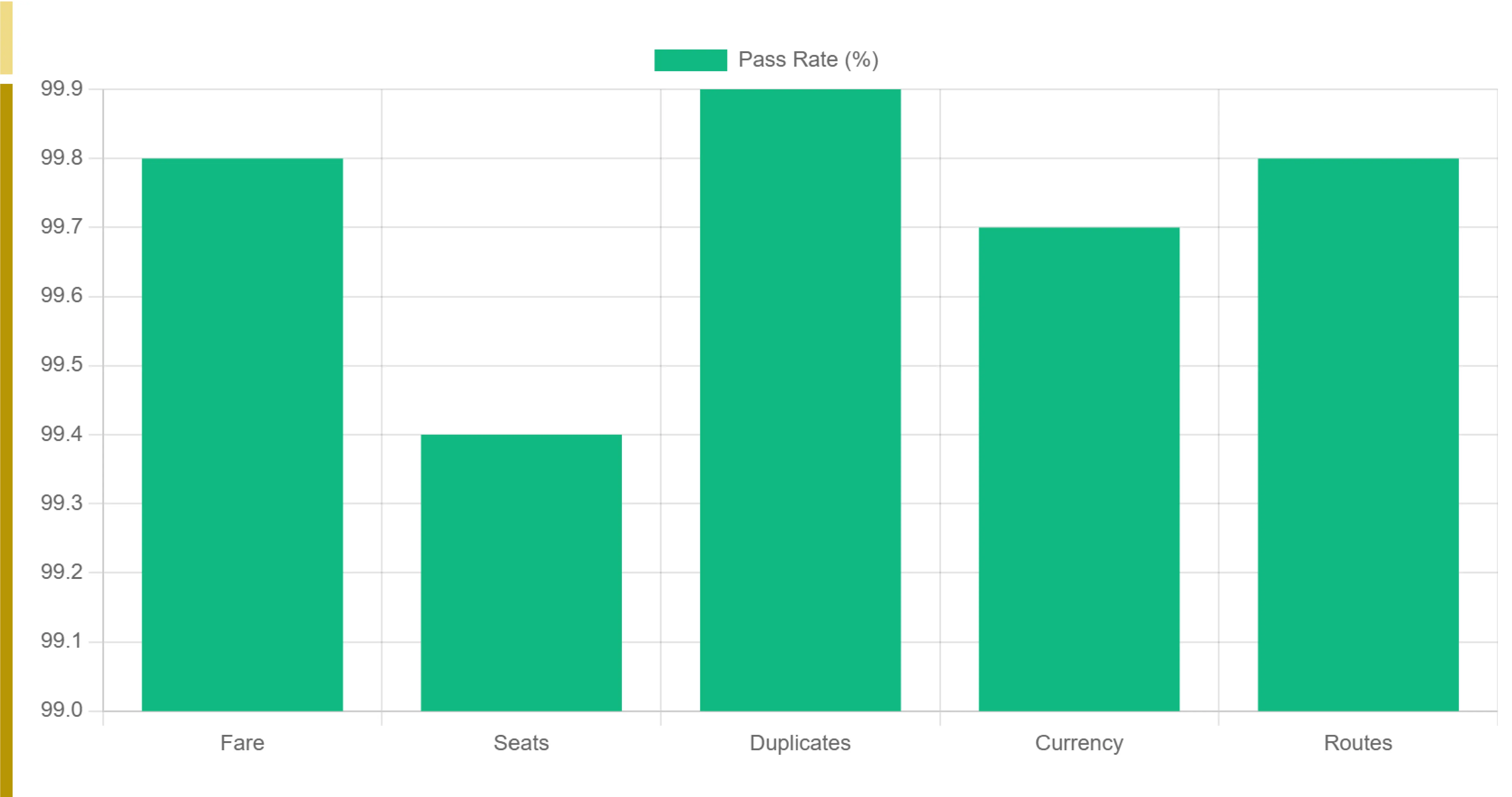
Travel Scrape delivered a flight data scraping pipeline tailored to the startup’s routes and sources, exposed through a single API. The setup followed the standard four-step process, with no scraping work on the client’s side.
Step 1 — Define routes and sources
The team listed the 200+ routes to cover (domestic India plus key international), the 10 OTA and metasearch sources, and the exact fields — fare, fare class, seat availability, baggage and route metadata. Travel Scrape configured everything and delivered a test feed within 24 hours.
Step 2 — Build anti-block flight scrapers
Each source got a dedicated, anti-block scraper using rotating residential proxies, headless browser rendering and CAPTCHA handling — the hard part of flight price scraping that defeats most in-house teams. Geo-targeting ensured fares reflected what real users in each market would see.
Step 3 — Normalise into one schema
Every source was mapped into a single, consistent JSON schema. The startup’s engineers never saw raw HTML or per-site quirks — just clean, comparable fares, validated and deduplicated on every run.
Step 4 — Deliver via API + webhooks
Live fares flowed through a REST endpoint with sub-second responses, while webhooks pushed price-change events in real time to power fare alerts. The team integrated both in days.
Sample data: what flight data scraping delivers
The value of flight data scraping is in clean, comparable, real-time output. Below are representative samples of the web scraping data Travel Scrape delivered (values illustrative).
Sample 1 — Live multi-OTA fare comparison
| Route | Source | Flight | Fare | Seats | Captured |
|---|---|---|---|---|---|
| DEL → BOM | MakeMyTrip | IndiGo 6E-204 | ₹3,899 | 3 left | 09:30 |
| DEL → BOM | Google Flights | IndiGo 6E-204 | ₹3,950 | Avail. | 09:30 |
| DEL → BOM | Skyscanner | Air India AI-805 | ₹4,420 | Avail. | 09:30 |
| BLR → DXB | Skyscanner | Emirates EK-565 | ₹18,200 | Avail. | 09:30 |
| BLR → DXB | MakeMyTrip | IndiGo 6E-1407 | ₹15,750 | 5 left | 09:30 |
In one call, the startup’s product could show travellers the cheapest fare across every source — the core of its comparison feature.
Sample 2 — Normalised fare record (API JSON)
{
  "route": "DEL-BOM",
  "carrier": "IndiGo",
  "flight_no": "6E-204",
  "depart": "2026-08-15T06:10:00+05:30",
  "fare": 3899,
  "currency": "INR",
  "cabin": "economy",
  "seats_left": 3,
  "baggage_kg": 15,
  "source": "makemytrip",
  "captured_at": "2026-06-01T09:30:00Z"
}
One consistent schema across all 10 sources — the startup’s engineers never wrote a line of parsing or mapping code.
Sample 3 — Price-change webhook (powers fare alerts)
{
  "event": "fare_drop",
  "route": "BLR-DXB",
  "carrier": "IndiGo",
  "old_fare": 17200,
  "new_fare": 15750,
  "change_pct": -8.4,
  "currency": "INR",
  "fired_at": "2026-06-01T11:02:30Z"
}
Every fare drop fired a webhook in real time, letting the startup alert users the moment a price fell — with no polling infrastructure to build or maintain.
The results: live in 7 days, 3× traffic growth
By buying flight data scraping instead of building it, the startup launched fast and grew quickly.
| Metric | Plan (in-house) | With Travel Scrape | Outcome |
|---|---|---|---|
| Time to launch | 3–4 months | 7 days | ~15× faster |
| Sources at launch | 2–3 (realistic) | 10 | 3–5× coverage |
| Engineering on scraping | 2–3 engineers | 0 | Freed the team |
| Flight records / month | Limited | 10M+ | Full market view |
| Traffic (first 90 days) | Baseline | 3× growth | ▲ 200% |
The headline win — a 7-day launch — came from removing the single biggest blocker: building reliable flight data scraping. With clean data from 10 sources via one API, the team shipped its comparison and alert features immediately, then spent its engineering time on product and growth instead of plumbing. Within 90 days, traffic had tripled.
“Building our flight meta-search was impossible until Travel Scrape. Clean data from 10 OTAs via API, setup under a week. Our engineering team couldn’t believe how fast it was.”
Launch timeline: idea to live in one week
- Day 1 — Scoping. Routes, 10 sources and required fare fields defined. Free sample feed requested.
- Day 1–2 — Sample validated. Fares checked against live bookings; accuracy confirmed.
- Day 3–5 — API integrated. Clean JSON plugged into the product; comparison view live in staging.
- Day 6 — Webhooks wired. Real-time fare-drop alerts connected, no polling needed.
- Day 7 — Launch. Product went live across 200+ routes and 10 sources.
No proxies bought, no anti-bot systems fought, no per-source parsers written. The hard parts of flight price scraping stayed entirely with Travel Scrape.
Behind the scenes: keeping flight data flowing
Flight sources are uniquely volatile — fares change constantly, and metasearch and airline sites defend hard against automated data extraction. Travel Scrape’s managed web scraping infrastructure absorbed all of it.
Throughout the engagement the sources threw the usual obstacles: CAPTCHAs, rate limiting, IP blocks and periodic layout changes. Each would have broken an in-house scraper and produced gaps in the startup’s fare data — fatal for a comparison product that lives or dies on accuracy. Rotating residential proxies, randomised browser fingerprints and continuous monitoring kept the feed clean and complete, with extraction repaired before any gap reached the product. To the startup, fares simply kept arriving — fresh, normalised and on schedule.
Beyond launch: scaling the data programme
Once live, the startup expanded its Travel Scrape feed in two directions. It added hotel rate scraping to offer flight-plus-hotel comparison, and layered in historical fare data to power a “price prediction” feature — telling users whether to book now or wait. Because every dataset arrived in the same normalised schema, each new source plugged into the existing stack without fresh integration work.
This is a pattern Travel Scrape sees often: a startup buys flight data scraping to launch fast, proves the model, then builds a richer travel data intelligence product on the same foundation — always shipping features instead of maintaining scrapers.
Key takeaways for travel startups
assets/img/case-studies/flight-data-scraping-case-study-200-routes/Key takeaways for travel startups.webp
- Buy the pipeline, build the product. Your edge is the experience, not the flight data scraping infrastructure behind it.
- Normalised data is the real time-saver. One consistent schema across sources removes a hidden project most teams underestimate.
- Flight data is the hardest to scrape. Airline and metasearch sites punish in-house web scraping; a managed feed de-risks the launch.
- Speed compounds. Launching in 7 days instead of 4 months means months of extra growth and learning.
Frequently asked questions
Want to launch fast with flight data scraping?
Tell Travel Scrape your routes and sources. Get a free sample flight dataset within 24 hours — no credit card, no commitment.
Unlock the Full Report
Enter your details to access premium pricing intelligence insights