Travel Demand Forecasting for Revenue Optimization in Modern Tourism Markets
Introduction
Travel demand forecasting is a foundational discipline in modern revenue management systems used by airlines, hotels, online travel agencies, and tourism boards. Its primary objective is to estimate future customer demand for travel services so that pricing, inventory allocation, and marketing strategies can be optimized in advance.
In highly competitive global markets, even a small improvement in forecasting accuracy can significantly increase profitability. This is why travel demand forecasting for revenue optimization has become a core strategic capability for data-driven travel enterprises, enabling them to align supply with expected demand more efficiently.
At the same time, the rise of digital booking platforms has led to the emergence of Travel Data Intelligence, which integrates structured and unstructured data from search engines, booking platforms, reviews, and external signals like weather and events. This intelligence layer enhances forecasting accuracy by capturing real-time consumer intent.
In parallel, travel revenue optimization analytics helps organizations convert demand predictions into pricing actions. Instead of relying on static pricing models, businesses now use predictive analytics to continuously adjust prices based on forecasted demand patterns, competitor behavior, and market conditions.
How Travel Demand Forecasting Works in Practice?

Travel demand forecasting is essentially a predictive modeling system that estimates how many customers will book a specific travel service at a future time.
The forecasting process typically follows these stages:
Step 1: Data Collection
Data is gathered from multiple sources such as:
- Historical booking records
- Search and browsing activity
- Competitor pricing data
- Seasonality and holiday calendars
- Macroeconomic indicators
Step 2: Data Processing
Raw data is cleaned, normalized, and structured into usable formats for modeling. Missing values, anomalies, and duplicate entries are handled carefully to avoid bias.
Step 3: Model Development
Forecasting models are trained using statistical or machine learning techniques such as ARIMA, regression models, or neural networks.
Step 4: Prediction Generation
The model generates forecasts for future demand across destinations, time periods, and customer segments.
Step 5: Revenue Optimization Layer
Forecast outputs are converted into pricing decisions, inventory allocation strategies, and promotional campaigns.
Data Infrastructure and Intelligence Layer
Modern forecasting systems rely heavily on automated data pipelines. One of the most important components is the Travel Scraping API, which enables continuous extraction of real-time travel data from airlines, hotel booking engines, and OTAs.
This ensures that forecasting models are always updated with fresh pricing and availability information, reducing the lag between market changes and predictive insights.
Similarly, the ability to Scrape tourism revenue management systems help organizations analyze revenue structures such as seasonal fare adjustments, occupancy trends, and discount patterns. These insights allow businesses to understand how revenue fluctuates in response to demand changes.
Travel Demand Forecast Dataset (Detailed Analytical View)
The following dataset represents a multi-destination demand structure used for forecasting models.
| Destination | Month | Search Demand | Confirmed Bookings | Average Ticket Price ($) | Occupancy Rate (%) | Seasonal Factor | Demand Strength Index |
|---|---|---|---|---|---|---|---|
| Bali | Jan | 95,000 | 14,200 | 780 | 70 | Low | 0.72 |
| Dubai | Feb | 88,000 | 13,100 | 920 | 68 | Medium | 0.70 |
| Paris | Mar | 105,000 | 15,800 | 1050 | 74 | Medium | 0.76 |
| Tokyo | Apr | 130,000 | 20,500 | 1150 | 82 | High | 0.85 |
| London | May | 145,000 | 22,300 | 980 | 84 | High | 0.88 |
| New York | Jun | 160,000 | 25,600 | 1200 | 86 | High | 0.91 |
| Rome | Jul | 155,000 | 24,800 | 1100 | 85 | High | 0.90 |
| Singapore | Aug | 170,000 | 27,900 | 950 | 89 | High | 0.94 |
| Bangkok | Sep | 120,000 | 18,500 | 700 | 76 | Medium | 0.79 |
| Sydney | Oct | 135,000 | 21,000 | 1200 | 81 | Medium | 0.84 |
Interpretation of Dataset:
This dataset demonstrates how demand varies significantly across destinations due to seasonality, pricing differences, and consumer travel preferences. High-demand months show increased occupancy rates and stronger booking volumes.
From Forecasting to Revenue Optimization
Forecasting alone does not generate revenue value unless it is integrated into pricing systems. This is where revenue optimization becomes essential.
Travel companies use demand forecasts to:
- Adjust ticket and hotel room prices dynamically
- Allocate inventory across different booking channels
- Identify high-value customer segments
- Optimize discount timing and promotional campaigns
The goal is to maximize revenue per available unit (seat, room, or package) while maintaining healthy conversion rates.
Revenue Optimization Performance Dataset
The following dataset shows how forecasting translates into pricing decisions and revenue impact.
| Destination | Predicted Demand Level | Base Price ($) | Dynamic Price ($) | Price Adjustment Strategy | Revenue Growth (%) | Booking Conversion (%) |
|---|---|---|---|---|---|---|
| Bali | High | 750 | 830 | Demand surge pricing | 18 | 13.0 |
| Dubai | Medium | 900 | 870 | Competitive pricing | 12 | 10.2 |
| Paris | High | 1000 | 1120 | Premium seasonal pricing | 21 | 14.1 |
| Tokyo | Very High | 1150 | 1300 | Peak demand optimization | 28 | 15.8 |
| London | High | 980 | 1080 | Balanced dynamic pricing | 20 | 14.5 |
| New York | Very High | 1200 | 1350 | High-yield optimization | 30 | 16.9 |
| Rome | Medium | 1100 | 1050 | Discount stabilization | 11 | 10.8 |
| Singapore | High | 950 | 1100 | Demand-based escalation | 24 | 14.7 |
| Bangkok | Medium | 700 | 760 | Low-season stimulation | 13 | 11.0 |
| Sydney | High | 1200 | 1330 | Seasonal adjustment | 26 | 15.4 |
Insight:
This table shows how predictive forecasting and Price Optimization directly influences pricing decisions and revenue outcomes. Higher demand levels justify higher pricing, while moderate demand requires balancing conversion and revenue.
Role of Travel Data Scraping and Market Intelligence
The accuracy of forecasting models depends heavily on real-time data acquisition. Systems like Travel Package Data Scraping help collect structured information about bundled offers such as flight + hotel + activity packages.
This is critical because modern travelers rarely book single services; instead, they purchase integrated travel experiences. Capturing this data helps improve forecasting accuracy at the package level.
Similarly, travel booking demand intelligence analyzes behavioral signals such as:
- Search-to-booking conversion rates
- Price sensitivity thresholds
- Abandoned booking sessions
- Device-based booking behavior
These insights help refine demand curves used in forecasting models.
Advanced Analytical Applications in Travel Forecasting
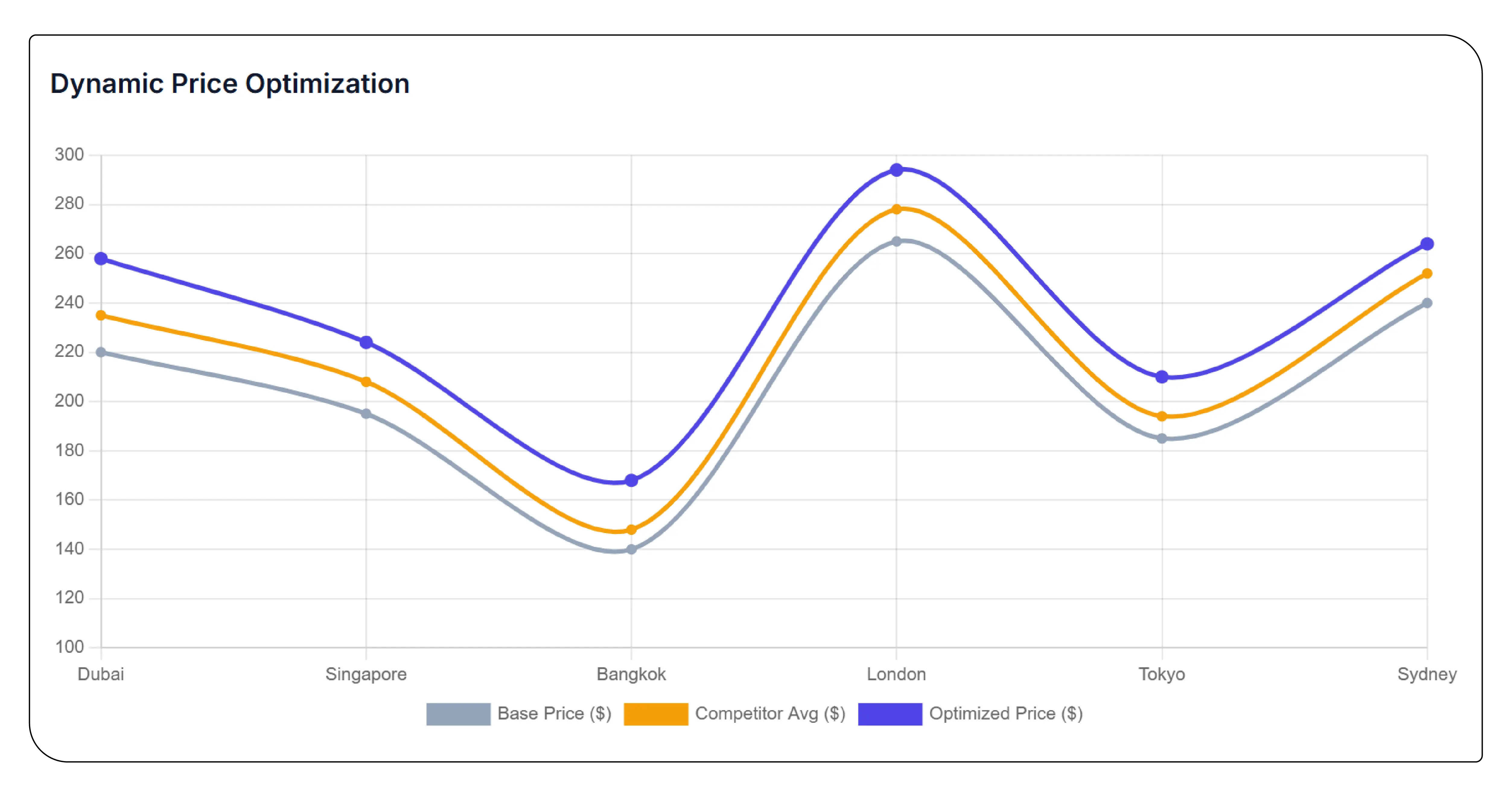
Dynamic Price Optimization
Systems continuously adjust prices based on real-time demand predictions and competitor benchmarking.
Tourism Capacity Planning
Governments and tourism boards use tourism demand planning insights to allocate infrastructure resources like hotels, transportation, and staffing.
Demand Segmentation Models
Forecasting is segmented into business, leisure, group, and solo travel categories to improve precision.
Challenges in Travel Demand Forecasting
Despite advancements, several challenges persist:
- Sudden demand shocks due to global crises
- Incomplete or inconsistent historical datasets
- High variability in consumer preferences
- Rapid changes in online pricing strategies
- Data fragmentation across multiple platforms
These issues require continuous model retraining and integration of multi-source datasets.
Conclusion
Travel demand forecasting has evolved from a statistical planning tool into a core revenue optimization engine. By combining predictive analytics, real-time data streams, and intelligent pricing systems, travel businesses can significantly improve financial performance.
Today, travel market demand analysis is essential for understanding evolving global tourism trends and consumer behavior patterns.
Equally important, demand-driven travel pricing intelligence ensures that pricing decisions are no longer static but continuously optimized based on real-time demand signals.
Ultimately, the effectiveness of these systems depends on high-quality Travel & Tourism Datasets, which form the backbone of forecasting accuracy and revenue optimization strategies across the global travel ecosystem.
Ready to elevate your travel business with cutting-edge data insights? Scrape Aggregated Flight Fares to identify competitive rates and optimize your revenue strategies efficiently. Discover emerging opportunities with tools to Extract Travel Website Data, leveraging comprehensive data to forecast market shifts and enhance your service offerings. Real-Time Travel App Data Scraping Services helps stay ahead of competitors, gaining instant insights into bookings, promotions, and customer behavior across multiple platforms. Get in touch with Travel Scrape today to explore how our end-to-end data solutions can uncover new revenue streams, enhance your offerings, and strengthen your competitive edge in the travel market.
Unlock the Full Report
Enter your details to access premium pricing intelligence insights