Scrape US Domestic Aviation Outlook — Next-Week Flight Schedules, Route Coverage & Capacity Analysis
Introduction
The US domestic aviation market remains one of the most advanced and competitive air transportation ecosystems globally. With millions of passengers traveling across thousands of domestic routes every year, airlines continuously optimize schedules, pricing, capacity allocation, and network strategies. Data-driven aviation intelligence has become a critical component for airlines, travel platforms, airports, and market researchers seeking accurate insights into passenger demand and operational performance.
Scrape US Domestic Aviation Outlook to collect and analyze airline schedules, fares, route information, seat inventory, and booking trends from multiple aviation sources. By transforming publicly available aviation information into structured datasets, businesses can understand market movements, forecast capacity requirements, and improve travel decision-making.
Aviation analytics increasingly depends on large-scale structured datasets covering airline operations worldwide. A Global Flight Schedule Dataset provides information related to flight frequencies, airline networks, departure patterns, airport connectivity, and route expansion trends.
Short-term aviation planning requires updated schedule intelligence. A next-week US domestic flight schedule dataset allows businesses to monitor upcoming flights, airline frequency changes, operational adjustments, and immediate capacity fluctuations.
The US domestic aviation industry includes major carriers such as American Airlines, Delta Air Lines, United Airlines, Southwest Airlines, Alaska Airlines, JetBlue Airways, and other regional operators. These airlines compete through pricing strategies, route expansion, loyalty programs, and operational efficiency.
Modern aviation data intelligence enables organizations to analyze:
- Domestic passenger movement
- Airline capacity changes
- Flight pricing patterns
- Route competition
- Seat availability trends
- Airport connectivity
As airlines increasingly adopt artificial intelligence and predictive analytics, real-time aviation datasets are becoming essential for improving forecasting accuracy and identifying market opportunities.
Growth of US Domestic Aviation Data Analytics
The aviation industry has moved from traditional reporting methods toward automated data collection and advanced analytics. Earlier, airlines and travel companies depended mainly on historical reports and manual market studies. Today, automated extraction technologies allow businesses to collect millions of flight-related records continuously.
US domestic airline timetable analytics provides detailed visibility into flight frequency, departure schedules, airline capacity, and airport connectivity. This data helps businesses identify seasonal trends, operational changes, and competitive movements.
For example, increasing flight frequency between major business hubs such as New York, Chicago, Los Angeles, Dallas, and Atlanta can indicate rising corporate travel demand. Similarly, reduced schedules on specific routes may highlight declining demand or operational restructuring.
Airline Data Collection and Market Intelligence
Airline Data Scraping enables organizations to collect structured information from airline websites, travel portals, booking platforms, and aviation databases. The extracted datasets typically include:
- Flight numbers
- Airlines
- Origin and destination airports
- Departure and arrival times
- Ticket prices
- Fare categories
- Aircraft details
- Seat availability
- Booking conditions
This information supports airline benchmarking, travel comparison systems, corporate travel management, and aviation research. Aviation businesses use structured datasets to evaluate market performance, understand competitive movements, and improve strategic decision-making.
US airline route intelligence helps companies analyze airline networks, identify route expansion opportunities, track competitor movements, and evaluate connectivity patterns across domestic markets. Companies use extracted airline data to identify pricing changes, monitor competitor activity, and optimize customer experiences. Travel companies can update their platforms with accurate availability information, while airlines can analyze market positioning and improve operational strategies.
US domestic aviation capacity forecasting enables airlines and travel organizations to predict future seat supply, evaluate demand fluctuations, optimize flight schedules, and prepare for changing passenger travel patterns.
US Domestic Aviation Market Performance Analysis (2019–2026)
The US aviation industry experienced major disruption during 2020 due to global travel restrictions. However, domestic aviation recovery accelerated from 2021 onward, supported by leisure travel growth, business travel recovery, and increased airline capacity.
The following table presents numerical market indicators showing the development of US domestic aviation.
| Year | US Domestic Passengers (Million) | Domestic Flights Operated (Million) | Active Domestic Routes | Average Daily Flights | Available Seat Capacity (Million) | Passenger Demand Index | Market Growth (%) |
|---|---|---|---|---|---|---|---|
| 2019 | 811 | 9.2 | 8,450 | 25,200 | 1,050 | 100 | 4.1 |
| 2020 | 369 | 5.5 | 6,900 | 15,100 | 520 | 45 | -54.5 |
| 2021 | 598 | 7.1 | 7,650 | 19,500 | 720 | 72 | 62.1 |
| 2022 | 736 | 8.3 | 8,050 | 22,700 | 890 | 88 | 23.1 |
| 2023 | 803 | 8.9 | 8,320 | 24,400 | 980 | 96 | 9.1 |
| 2024 | 835 | 9.4 | 8,620 | 25,700 | 1,040 | 101 | 4.0 |
| 2025 | 861 | 9.8 | 8,900 | 26,800 | 1,090 | 105 | 3.1 |
| 2026 Forecast | 890 | 10.2 | 9,150 | 27,900 | 1,150 | 109 | 3.4 |
Route Coverage and Airline Network Intelligence
US domestic route coverage analysis provides insights into airline expansion strategies, airport connectivity, and market competition. Airlines continuously adjust routes based on profitability, passenger demand, and operational efficiency.
Major domestic aviation hubs include:
- Atlanta
- Dallas/Fort Worth
- Denver
- Chicago
- Los Angeles
- New York
- Seattle
- Miami
These airports handle significant passenger volumes and act as connection points for domestic and international operations.
Route intelligence allows businesses to evaluate:
- Number of flights per route
- Airline competition levels
- Airport demand
- Seasonal connectivity
- Regional growth opportunities
For travel platforms, accurate route data improves search results and booking recommendations. For airlines, route analytics supports fleet allocation and network optimization.
Flight Availability and Capacity Monitoring
Flight Seat Availability has become a crucial metric for aviation businesses. Airlines use dynamic inventory systems where available seats and prices change based on demand, booking speed, and travel dates.
Monitoring seat availability helps companies understand:
- High-demand routes
- Remaining inventory
- Booking pressure
- Capacity shortages
- Fare increase possibilities
During holiday periods, availability tracking becomes especially important because flights often reach high occupancy levels weeks before departure.
US Domestic Airline Intelligence Dataset Analysis (2026 Outlook)
The following table represents a sample aviation intelligence dataset showing airline-level performance indicators for 2026 forecasting.
| Airline | Domestic Routes | Daily Flights | Average Fare ($) | Average Load Factor (%) | Available Seats Per Day | Market Share (%) | Route Expansion (%) | Demand Score (100) |
|---|---|---|---|---|---|---|---|---|
| American Airlines | 1,050 | 5,900 | 265 | 84 | 610,000 | 17.8 | 3.2 | 91 |
| Delta Air Lines | 920 | 5,400 | 278 | 86 | 580,000 | 17.1 | 3.8 | 93 |
| United Airlines | 890 | 5,100 | 272 | 85 | 550,000 | 15.9 | 4.1 | 92 |
| Southwest Airlines | 820 | 4,700 | 220 | 82 | 520,000 | 14.5 | 2.9 | 88 |
| Alaska Airlines | 320 | 1,450 | 245 | 81 | 165,000 | 6.2 | 5.5 | 84 |
| JetBlue Airways | 260 | 1,200 | 230 | 79 | 135,000 | 4.8 | 2.4 | 78 |
| Spirit Airlines | 210 | 1,000 | 170 | 80 | 120,000 | 4.1 | 1.8 | 75 |
| Frontier Airlines | 240 | 950 | 175 | 78 | 110,000 | 3.9 | 2.1 | 73 |
Flight Pricing and Booking Data Intelligence
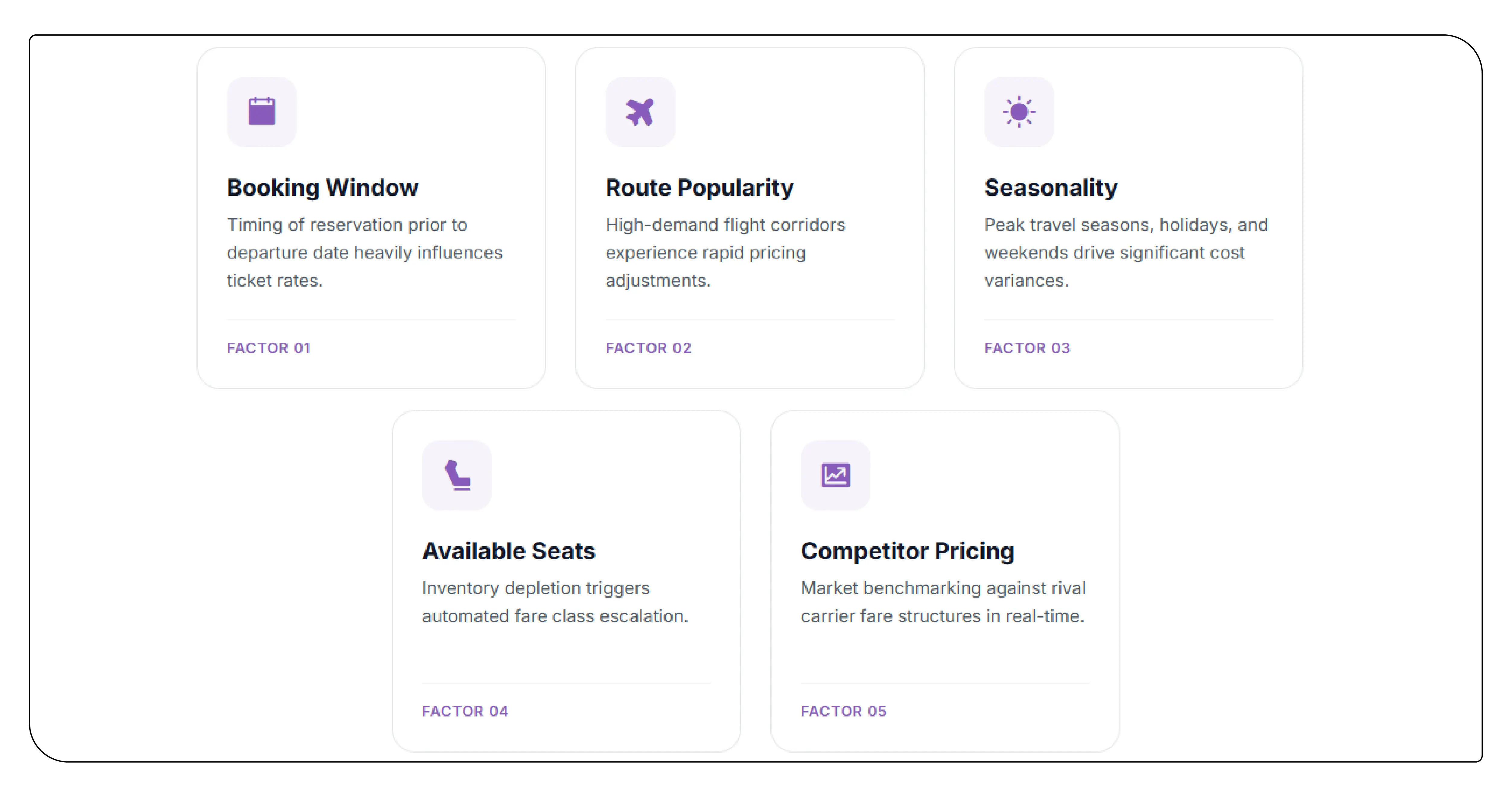
Flight Price Data Intelligence helps companies understand fare movements, competitor pricing, and consumer purchasing patterns. Airline ticket prices fluctuate based on:
- Booking window
- Route popularity
- Seasonality
- Available seats
- Competitor pricing
By analyzing historical and current pricing data, businesses can forecast fare changes and develop competitive strategies.
Extract US airline booking data to gain deeper insights into customer behavior, including booking timing, travel preferences, fare selection, and route demand.
Travel companies use booking intelligence to improve recommendations and personalize offers. Corporate travel platforms use this data to identify cost-saving opportunities for business travelers.
Passenger Demand Monitoring and Future Forecasting
US domestic passenger demand monitoring allows aviation companies to track travel recovery, seasonal patterns, and changing consumer preferences.
Demand forecasting models combine:
- Historical passenger volumes
- Flight schedules
- Pricing trends
- Economic indicators
- Holiday travel patterns
These insights help airlines optimize aircraft deployment and avoid capacity shortages.
The future of US aviation will increasingly depend on artificial intelligence, predictive analytics, and automated data collection. Companies that integrate aviation datasets into decision-making processes will gain stronger competitive advantages.
Conclusion
The US domestic aviation sector is entering a new era where data intelligence drives route planning, pricing strategies, passenger forecasting, and operational efficiency. Automated aviation data collection provides businesses with accurate visibility into schedules, fares, availability, and market movements.
Airlines, travel platforms, and aviation analysts can use structured datasets to identify opportunities, predict demand changes, and improve customer experiences. As competition increases, aviation intelligence will become a core requirement for strategic decision-making.
Advanced Real-Time Availability Tracking enables businesses to continuously monitor flight inventory, pricing fluctuations, and capacity changes, helping them respond quickly to evolving aviation market conditions.
Ready to elevate your travel business with cutting-edge data insights? Scrape Aggregated Flight Fares to identify competitive rates and optimize your revenue strategies efficiently. Discover emerging opportunities with tools to Extract Travel Website Data, leveraging comprehensive data to forecast market shifts and enhance your service offerings. Real-Time Travel App Data Scraping Services helps stay ahead of competitors, gaining instant insights into bookings, promotions, and customer behavior across multiple platforms. Get in touch with Travel Scrape today to explore how our end-to-end data solutions can uncover new revenue streams, enhance your offerings, and strengthen your competitive edge in the travel market.
Unlock the Full Report
Enter your details to access premium pricing intelligence insights