Scraping Cruise Cabin Pricing to Support a Record Booking Season for a Cruise Line
Introduction
This case study shows how a cruise-focused travel business transformed fragmented pricing and availability information into actionable commercial intelligence. The client operated across multiple cruise routes and needed a reliable way to understand competitor pricing, cabin availability, demand patterns, and booking movements. Manual research was slow, inconsistent, and unable to capture frequent changes across cruise websites and booking platforms. To solve this challenge, the client adopted automated Scraping Cruise Cabin Pricing capabilities to collect structured information at scale. The resulting system delivered Cruise Cabin Competitive Pricing Intelligence covering cabin categories, sailing dates, prices, availability, discounts, and booking conditions. By a Cruise Data Scraping and consolidating this information into a standardized dataset, the business could compare competing offers more efficiently, identify pricing gaps, monitor market movements, and support revenue decisions with timely data instead of relying on occasional manual checks.
The Client
The client was a travel technology and cruise-booking company serving customers across several international cruise destinations. Its commercial team needed deeper Cruise Pricing Intelligence to understand competitor fares, cabin categories, sailing schedules, promotions, and availability across major booking channels. The business also wanted Cruise Cabin booking Demand forecasting capabilities to anticipate periods of rising or declining customer interest. Existing reports provided limited historical visibility and required significant manual effort. The client needed automated Booking Trend Insights that could connect pricing movements with cabin availability, sailing dates, route popularity, and seasonal demand. Its objective was to create a scalable intelligence framework that supported pricing decisions, revenue planning, competitive benchmarking, and promotional strategy while reducing the time spent collecting and validating cruise-market information.
Challenges in the Travel Industry
The client faced several operational and analytical challenges caused by rapidly changing cruise prices, fragmented booking information, and inconsistent competitor data. These limitations reduced pricing visibility and made it difficult to respond quickly to market movements.
Fragmented Pricing Information
The client struggled to consolidate Cruise Cabin Pricing Data for Revenue Optimization because fares were distributed across cruise operators, travel agencies, aggregators, and booking platforms. Different cabin types, taxes, promotions, and sailing dates made direct comparisons difficult and increased the possibility of inaccurate commercial decisions.
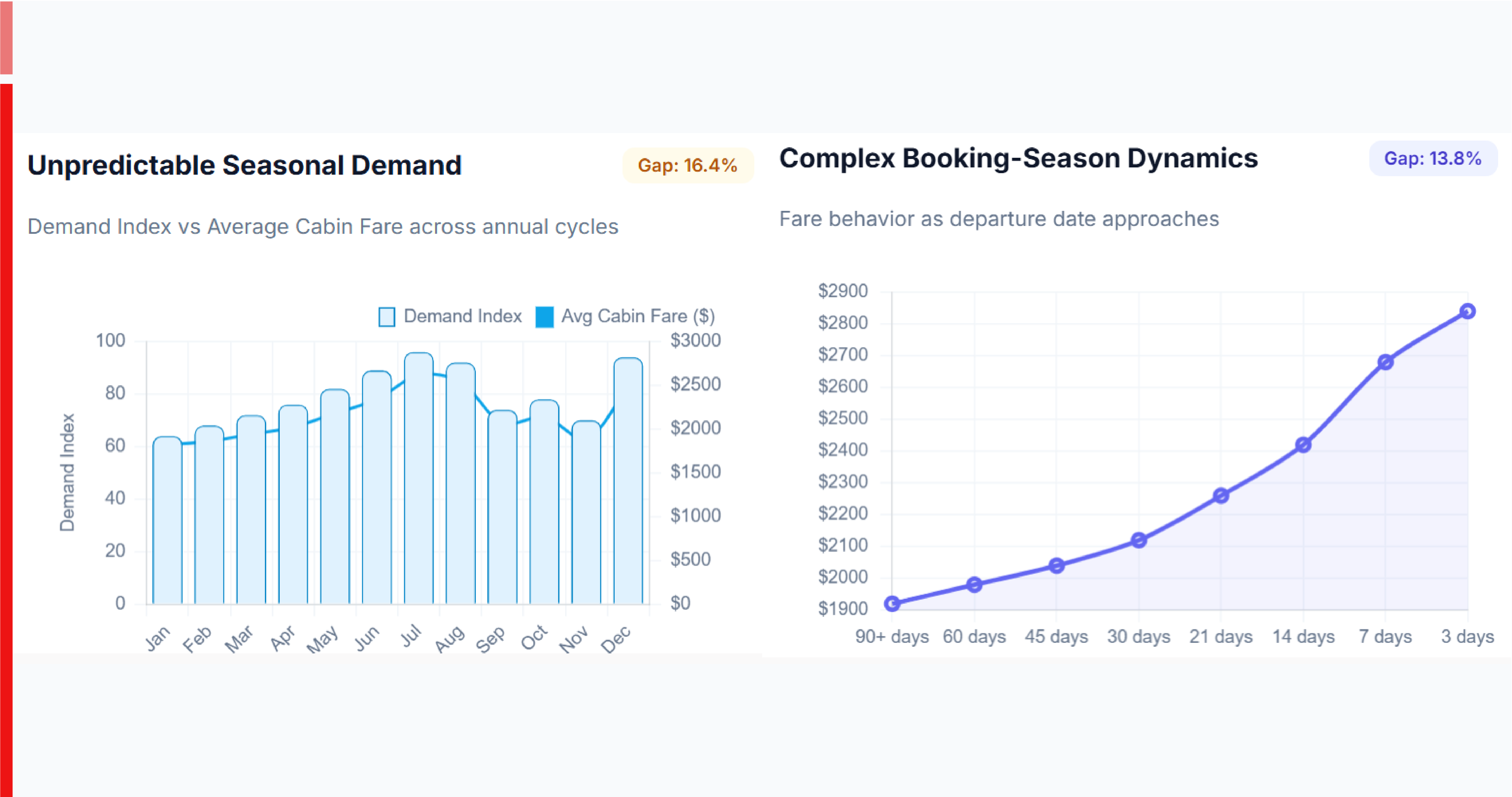
Unpredictable Seasonal Demand
Cruise demand changed significantly according to holidays, destinations, weather conditions, school vacations, and booking periods. Limited Seasonal Trend Analysis prevented the client from accurately identifying recurring demand patterns, making it harder to adjust prices, promotions, inventory strategies, and revenue expectations before major seasonal peaks.
Rapid Competitor Price Changes
Competitor fares could change frequently based on cabin inventory and booking activity. Without automated Cruise Cabin rate monitoring, the client could not consistently identify price increases, reductions, promotional campaigns, or changes in comparable cabin categories across competing travel websites.
Complex Booking-Season Dynamics
The client lacked sufficient historical information for cruise booking season pricing analysis, making it difficult to understand how prices behaved before departure. This reduced its ability to identify optimal pricing windows, recognize demand acceleration, and determine when competitive adjustments could improve conversion and revenue.
Incomplete Availability Visibility
Different platforms displayed cabin inventory using varying structures and terminology. Building a consistent cruise cabin availability and pricing dataset required standardized extraction of cabin names, prices, availability indicators, sailing dates, routes, and promotional information from multiple sources without relying on manual collection processes.
Our Approach
Automated Data Collection
We developed automated extraction workflows capable of collecting cruise information from targeted websites and booking platforms. The system captured sailing dates, destinations, cruise operators, cabin categories, prices, availability, promotions, and related attributes at defined intervals.
Competitive Price Monitoring
The solution introduced automated Price Monitoring across selected competitors and routes. Historical snapshots were maintained to identify price movements, fare differences, promotional changes, and cabin-level variations, enabling the commercial team to evaluate market positioning with greater consistency.
Data Standardization
Collected information was transformed into standardized records using consistent fields for cruise routes, sailing dates, cabin types, occupancy configurations, prices, availability, and promotions. This eliminated duplicate formats and created a unified structure suitable for downstream analytics and reporting.
Historical Trend Development
Historical datasets were organized to support comparisons across routes, seasons, sailing periods, cabin categories, and competitor platforms. This helped the client identify recurring pricing behavior, demand signals, availability changes, and periods where competitor activity differed substantially from historical patterns.
Analytics-Ready Delivery
The final datasets were prepared for integration with the client's analytics and reporting environment. Structured outputs enabled business teams to perform route-level comparisons, monitor competitor movements, evaluate pricing opportunities, and use historical information for forecasting and revenue-management workflows.
Results Achieved
The implementation significantly improved the client's ability to monitor cruise-market conditions and use structured information for commercial decision-making. Key improvements were observed across pricing visibility, monitoring efficiency, competitive analysis, and revenue planning.
Broader Market Visibility
The client gained centralized visibility across multiple cruise operators, routes, sailing dates, cabin categories, and booking platforms. Instead of reviewing individual websites manually, teams could analyze comparable pricing and availability information from a standardized dataset.
Faster Competitive Analysis
Automated collection substantially reduced the time required to identify competitor price movements. Teams could compare cabin-level fares, promotional offers, and availability changes more quickly, allowing commercial managers to react to meaningful market movements without waiting for periodic manual reports.
Improved Pricing Decisions
Historical and current pricing information helped the client identify opportunities for more competitive fare positioning. Pricing teams could evaluate differences between comparable cabin categories and understand where competitors were significantly above or below the client's existing price levels.
Stronger Demand Planning
The accumulated dataset provided a stronger foundation for identifying seasonal patterns and changes in booking behavior. The client could evaluate relationships between sailing dates, availability, pricing, and historical demand indicators when planning inventory and promotional strategies.
Reduced Manual Workload
Automated collection reduced repetitive research activities and improved consistency across market-monitoring workflows. Analysts could spend more time interpreting trends and developing commercial recommendations rather than repeatedly gathering, cleaning, comparing, and organizing cruise pricing information.
Results Snapshot
| Metric | Before Implementation | After Implementation | Improvement | Monthly Volume | Data Points/Record | Monitoring Frequency | Coverage |
|---|---|---|---|---|---|---|---|
| Cruise Websites Monitored | 8 | 32 | 300% | 32 | 18 | Daily | 4 Regions |
| Routes Tracked | 45 | 180 | 300% | 180 | 22 | Daily | 12 Destinations |
| Cabin Categories | 120 | 540 | 350% | 540 | 16 | Daily | 6 Cabin Types |
| Price Records Collected | 18,500 | 96,000 | 419% | 96,000 | 14 | Daily | Multi-Operator |
| Availability Records | 11,200 | 72,000 | 543% | 72,000 | 12 | Daily | Multi-Route |
| Competitor Comparisons | 350 | 2,400 | 586% | 2,400 | 10 | Daily | 32 Websites |
| Manual Research Hours | 160 | 38 | -76% | 38 | — | Monthly | All Teams |
| Data Processing Time | 72 hrs | 14 hrs | -81% | 14 | — | Monthly | All Sources |
| Price Change Detection | 24 hrs | 3 hrs | -88% | 3 | — | Daily | Competitors |
| Historical Records | 75,000 | 1,250,000 | 1,567% | 1,250,000 | 20 | Continuous | Multi-Year |
| Promotional Records | 3,200 | 18,500 | 478% | 18,500 | 11 | Daily | Multi-Platform |
| Reporting Turnaround | 3 Days | 6 Hours | -92% | 6 | — | Weekly | Commercial |
| Pricing Benchmark Coverage | 35% | 91% | 56 pts | 91% | 15 | Daily | Target Markets |
| Data Accuracy Checks | 82% | 97% | 15 pts | 97% | — | Automated | All Records |
| Revenue Planning Inputs | 6 | 24 | 300% | 24 | 13 | Monthly | Business Units |
Client's Testimonial
"The client reported that the new data-driven approach significantly improved the way its commercial and revenue teams evaluated cruise-market conditions. Previously, analysts spent substantial time visiting different websites, recording cabin prices manually, checking availability, and attempting to compare information that was often presented differently. The automated solution created a more consistent source of competitive information and made it easier to understand changes across routes and sailing dates. The team particularly valued the ability to review historical pricing movements alongside current market conditions, helping them recognize recurring patterns and potential opportunities earlier. According to the client, the solution improved internal productivity while giving pricing and revenue teams greater confidence when evaluating competitor fares, cabin availability, promotions, and seasonal movements. The structured datasets also created a stronger foundation for future forecasting and commercial analytics initiatives."
Conclusion
The case study demonstrates how automated travel data collection can convert fragmented cruise-market information into practical competitive intelligence. By combining structured extraction, standardized datasets, historical records, and recurring monitoring, the client developed a stronger foundation for pricing and revenue decisions. The solution helped reduce manual research, improve competitor visibility, accelerate price-change detection, and strengthen demand planning. Businesses seeking scalable Travel Aggregators Data Scraping Services can use similar workflows to collect and standardize information from multiple travel platforms. Organizations can also Extract Travel Website Data to build broader datasets covering prices, availability, schedules, promotions, and customer-facing booking attributes. For businesses operating across mobile-first travel ecosystems, a dedicated Travel Mobile App Scraping Service Service can further extend data coverage and provide additional inputs for competitive benchmarking, pricing optimization, market analysis, and long-term revenue strategy.
FAQs
Unlock the Full Report
Enter your details to access premium pricing intelligence insights