B2B vs B2C OTA Fare Comparison Analytics: Why the Same Flight Costs Different on Consumer vs Agent Portals
Introduction
The airline distribution ecosystem has changed significantly with the expansion of online travel agencies (OTAs), global distribution systems, travel management companies, and direct airline booking channels. Travelers often notice that the same airline, route, cabin class, and travel date can display different prices depending on whether they search through a consumer-facing OTA website or a travel agent portal.
B2B vs B2C OTA fare comparison analytics helps businesses understand how pricing structures differ between consumer platforms and professional travel distribution channels. These differences are influenced by negotiated agreements, inventory access, commissions, markups, promotional strategies, and customer segmentation models.
Competitor Price Tracking enables travel businesses to monitor how different OTAs present similar flight inventory and identify pricing advantages across channels.
Scrape same flight costs different on B2B and B2C OTA platforms to provide valuable insights into fare variations, hidden pricing rules, and channel-based differences that affect booking decisions.
Understanding these pricing differences has become essential for airlines, travel agencies, corporate travel managers, and technology providers. Modern travel intelligence systems analyze millions of fare records to identify pricing patterns, demand fluctuations, and distribution behavior across multiple booking environments.
Understanding OTA Pricing Structures
Online travel agencies operate through multiple distribution models. Consumer OTAs primarily target individual travelers looking for convenience, promotions, and easy booking experiences. B2B travel portals, on the other hand, are designed for travel agencies, corporate booking platforms, and professional sellers.
Although both platforms may access the same airline inventory, the final displayed fare can vary because of several commercial factors.
Consumer platforms frequently apply customer-focused pricing techniques such as:
- Promotional discounts
- Loyalty incentives
- Mobile-only offers
- Personalized pricing
- Package-based reductions
Agent platforms usually operate with negotiated rates, commission structures, and contractual agreements that may not be visible to regular travelers.
The difference does not always mean one channel is cheaper. Instead, each channel uses different pricing logic based on its business relationship with airlines and customers.
Factors Creating Fare Differences Between B2B and B2C Channels
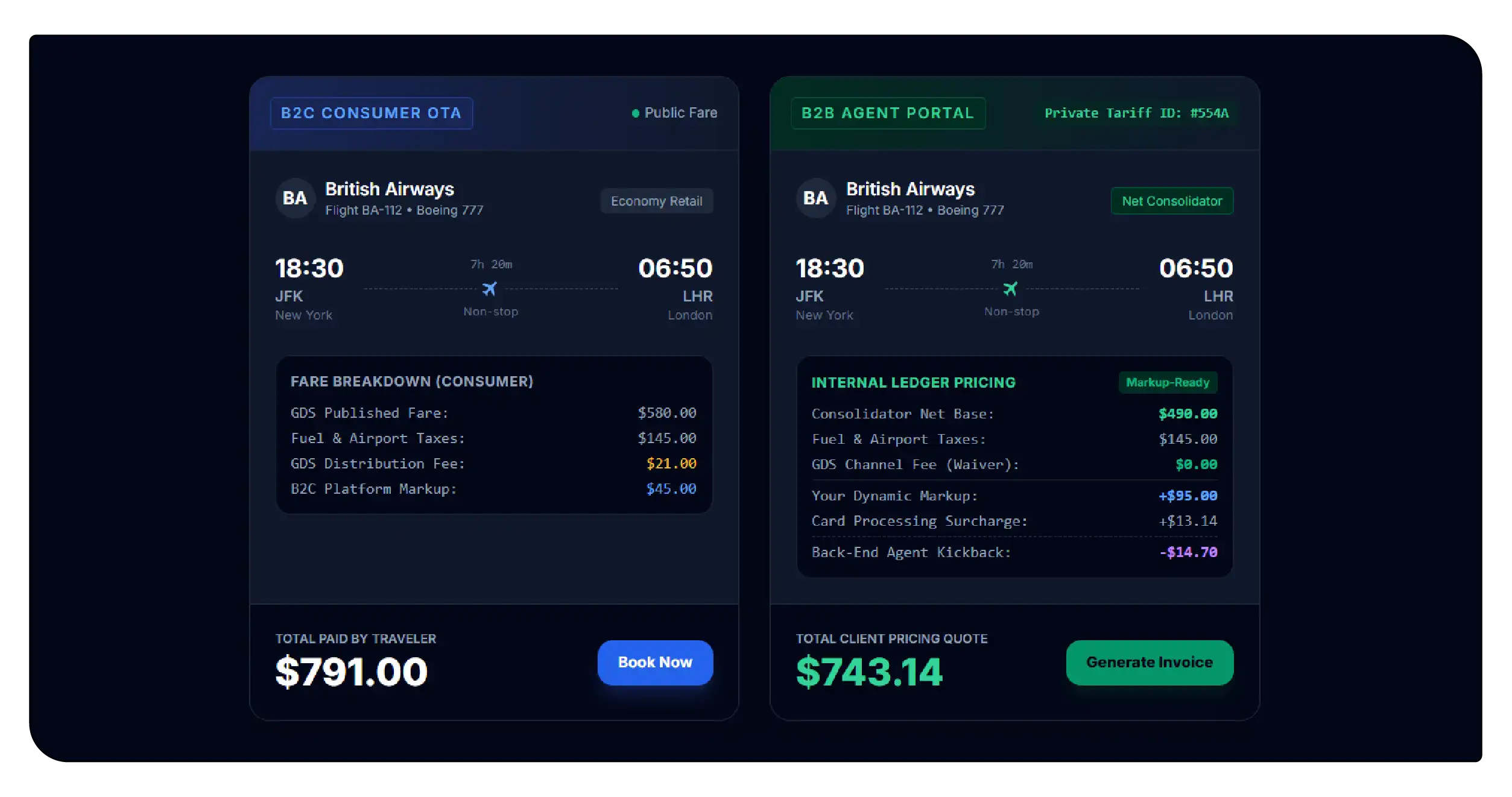
Airline pricing is controlled through complex revenue management systems that continuously adjust fares according to demand, availability, booking speed, and market conditions.
A flight ticket price can change because of:
- Different fare classes being available
- Channel-specific inventory allocation
- Corporate agreements
- Agent commissions
- Service fees
- Promotional campaigns
For example, an airline may provide discounted inventory to travel agencies that purchase large volumes. At the same time, consumer platforms may receive special promotional fares to attract individual customers.
This creates a situation where two users searching for the same flight within minutes can receive different prices.
Fare Comparison Dataset Analysis
A structured dataset allows analysts to compare pricing behavior between consumer and agent portals. The following table demonstrates a sample comparison of identical flights across multiple OTA channels.
Sample B2B and B2C OTA Fare Comparison Dataset
| Airline Route | Travel Date | Consumer OTA Fare (USD) | Agent Portal Fare (USD) | Fare Difference | B2B Discount (%) | Availability Match |
|---|---|---|---|---|---|---|
| New York – London | March 15 | 620 | 585 | 35 | 5.6 | Yes |
| Dubai – Singapore | March 20 | 410 | 395 | 15 | 3.7 | Yes |
| Paris - Tokyo | April 02 | 980 | 925 | 55 | 5.6 | Yes |
| Toronto – Delhi | April 10 | 1120 | 1045 | 75 | 6.7 | Yes |
| Sydney – Bangkok | April 18 | 540 | 515 | 25 | 4.6 | Yes |
| Frankfurt – Madrid | May 05 | 210 | 195 | 15 | 7.1 | Yes |
| Los Angeles – Seoul | May 14 | 890 | 830 | 60 | 6.7 | Yes |
| Mumbai – Singapore | May 22 | 350 | 335 | 15 | 4.2 | Yes |
| Amsterdam - Rome | June 03 | 240 | 225 | 15 | 6.2 | Yes |
| Beijing - Bangkok | June 12 | 460 | 430 | 30 | 6.5 | Yes |
The table indicates that agent portals often provide slightly lower fares due to negotiated pricing agreements and volume-based benefits. However, differences vary depending on airline policies, market demand, and route popularity.
Role of Rate Monitoring in Travel Intelligence
Rate Parity Monitoring helps travel companies identify whether identical travel products maintain consistent pricing across different distribution channels.
Maintaining fare consistency is important because airlines and OTAs must protect brand trust while managing multiple sales channels. Significant price differences can influence customer behavior and create challenges for travel businesses.
Rate monitoring systems continuously compare:
- Flight prices
- Fare classes
- Availability
- Taxes and fees
- Cancellation rules
These comparisons help identify pricing inconsistencies and improve distribution strategies.
Airline Distribution and Data Collection
Travel companies increasingly depend on large-scale data collection to understand market movements. Airline inventory changes frequently due to demand, seasonality, and competition.
B2B vs B2C OTA fare comparison and pricing analysis provides a detailed view of how travel prices move across different booking environments.
By analyzing historical and real-time data, businesses can determine whether price differences come from genuine market changes or channel-specific strategies.
Global Flight Pricing Trends
International airfare is influenced by economic conditions, fuel costs, tourism demand, and airline capacity planning. Different regions often experience unique pricing behavior based on travel patterns.
Global Flight Price Trends Dataset supports analysis of historical pricing movements across airlines, routes, and booking channels.
Large datasets allow travel companies to understand:
- Seasonal fare increases
- Route competitiveness
- Customer booking behavior
- Airline pricing strategies
These insights help businesses create better pricing models and improve customer experiences.
Airline Data Intelligence and Market Transparency
Modern travel analytics platforms collect information from multiple airline and OTA sources to improve market visibility.
Flight pricing transparency in B2B and B2C travel marketplaces intelligence enables businesses to understand how fares are distributed and why variations appear between different platforms.
Greater transparency allows travel providers to improve competitiveness while helping customers receive more accurate pricing information.
Sample OTA Channel Performance Analysis
The following dataset demonstrates how different channels may perform based on pricing, bookings, and conversion behavior.
OTA Channel Comparison Performance Metrics
| Platform Type | Average Fare (USD) | Monthly Searches | Monthly Bookings | Conversion Rate (%) | Average Revenue Per Booking | Price Variation (%) |
|---|---|---|---|---|---|---|
| Consumer OTA A | 540 | 850000 | 76500 | 9.0 | 42 | 8.5 |
| Consumer OTA B | 525 | 720000 | 64800 | 9.0 | 39 | 7.8 |
| Agent Portal A | 505 | 460000 | 55200 | 12.0 | 55 | 5.4 |
| Agent Portal B | 495 | 390000 | 50700 | 13.0 | 58 | 4.9 |
| Airline Direct | 555 | 920000 | 101200 | 11.0 | 60 | 6.2 |
| Corporate Travel Tool | 510 | 250000 | 37500 | 15.0 | 72 | 3.8 |
| Regional OTA | 515 | 310000 | 34100 | 11.0 | 47 | 5.7 |
| Mobile Travel App | 535 | 600000 | 57000 | 9.5 | 44 | 7.0 |
This comparison highlights that B2B channels may achieve stronger conversion rates because travel professionals often manage repeat customers and corporate bookings. Consumer channels generate larger traffic volumes but face stronger price competition.
Importance of Fare Comparison Datasets
Airline Data Scraping supports the collection of airline pricing information, availability changes, and route-level fare movements.
A reliable dataset helps organizations analyze competitive pricing patterns and identify opportunities for better distribution strategies.
Travel companies use these insights to improve:
- Fare forecasting
- Customer targeting
- Inventory management
- Revenue optimization
The availability of accurate data improves decision-making across the travel ecosystem.
Consumer and Agent Booking Behavior
Consumer travelers typically compare multiple platforms before purchasing. They focus on price, flexibility, baggage allowance, and convenience.
Travel agents and corporate buyers often prioritize availability, negotiated rates, refund policies, and service support.
Consumer vs agent portal fare comparison dataset allows businesses to study these behavioral differences and understand how different customer segments interact with pricing channels.
This information helps airlines and OTAs create more effective strategies for each audience.
Future of OTA Fare Intelligence
As travel distribution becomes more complex, pricing intelligence will become increasingly important. Artificial intelligence and automated monitoring systems will continue improving the ability to detect fare differences, predict demand, and optimize inventory.
The future of travel pricing will depend on transparent data analysis, faster monitoring, and better understanding of customer behavior.
Conclusion
The difference between B2B and B2C OTA flight prices is not accidental. It results from airline distribution agreements, inventory management strategies, customer segmentation, and commercial relationships.
Advanced travel analytics helps businesses understand these variations and improve pricing decisions.
Flight fare comparison analytics across OTA channels provides deeper visibility into fare movements, channel performance, and competitive positioning.
Consumer vs Agent Portals booking volume analysis helps organizations evaluate how different customer groups interact with travel platforms and pricing models.
Airline Price Change Dataset supports future forecasting by tracking historical fare movements, market shifts, and distribution trends.
As travel marketplaces continue expanding, data-driven fare intelligence will become essential for improving transparency, competitiveness, and customer satisfaction across global travel channels.
Ready to elevate your travel business with cutting-edge data insights? Scrape Aggregated Flight Fares to identify competitive rates and optimize your revenue strategies efficiently. Discover emerging opportunities with tools to Extract Travel Website Data, leveraging comprehensive data to forecast market shifts and enhance your service offerings. Real-Time Travel App Data Scraping Services helps stay ahead of competitors, gaining instant insights into bookings, promotions, and customer behavior across multiple platforms. Get in touch with Travel Scrape today to explore how our end-to-end data solutions can uncover new revenue streams, enhance your offerings, and strengthen your competitive edge in the travel market.
Unlock the Full Report
Enter your details to access premium pricing intelligence insights