How Does Multi-OTA Price Comparison Benchmarking Help Normalize Fares from Ixigo, MakeMyTrip & Goibibo into One Feed?
Introduction
Online travel has become intensely competitive, with travelers comparing fares, room rates, cancellation policies, availability, discounts, and inclusions across multiple platforms before making a booking. For travel companies, simply monitoring one OTA is no longer enough. Businesses need a broader view of how prices move across competing marketplaces and destinations.
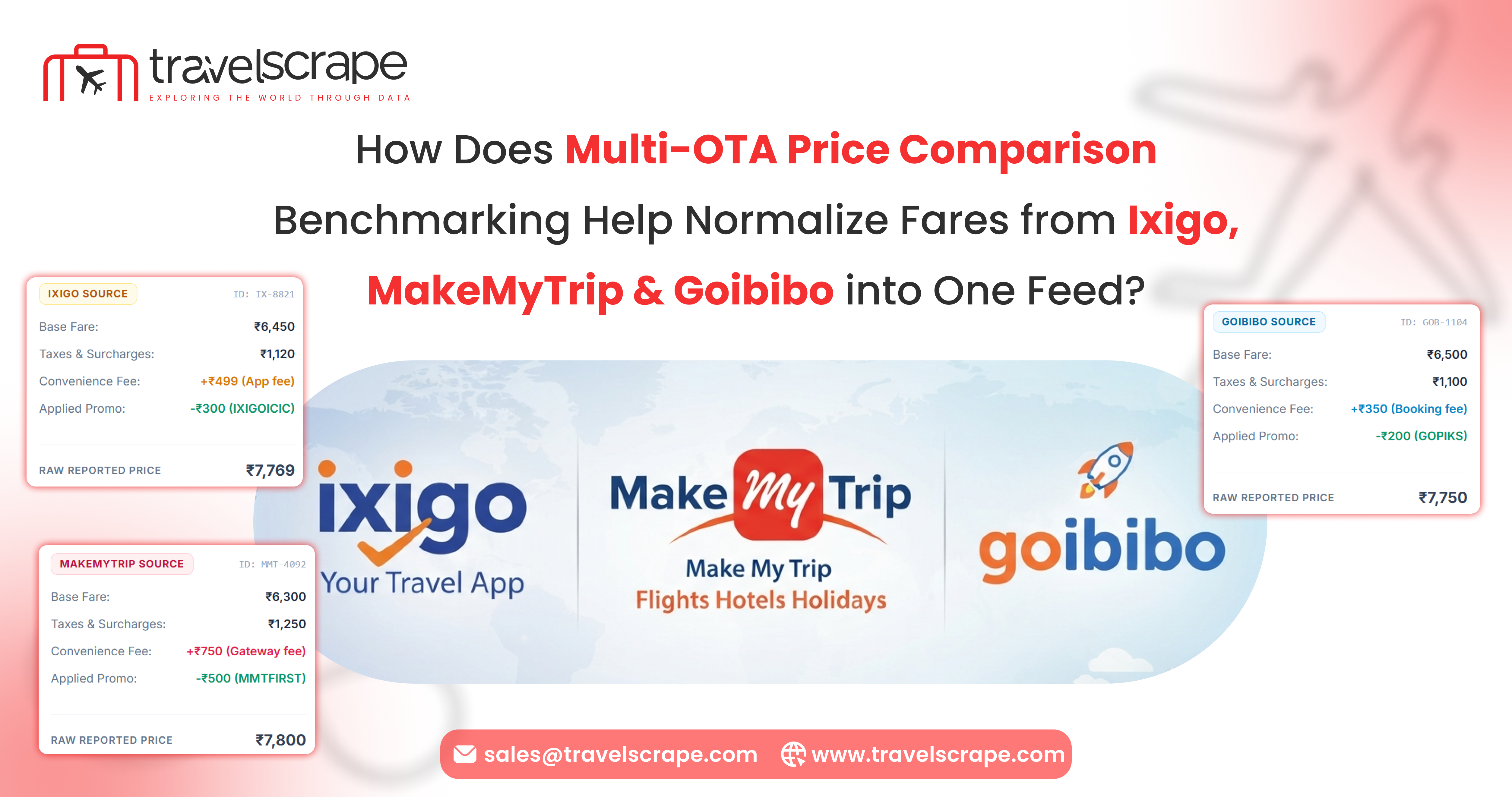
Multi-OTA Price Comparison Benchmarking enables travel businesses to systematically compare pricing, availability, promotions, and booking conditions across multiple online travel agencies. By collecting structured data from platforms such as Goibibo, MakeMyTrip, and ixigo, companies can understand competitive movements and identify pricing opportunities.
For example, Goibibo Data Scraping can help collect information such as hotel rates, flight fares, room availability, discounts, meal plans, cancellation conditions, and other relevant attributes. When this information is combined with data from competing OTAs, businesses can create a comprehensive Multi-OTA price Comparison dataset for benchmarking and market analysis.
The objective is not merely to discover which OTA offers the cheapest price. The bigger opportunity is understanding why price differences occur, how frequently they change, where competitors gain an advantage, and how businesses can respond intelligently.
Why Multi-OTA Price Benchmarking Matters?
Travel pricing changes continuously. A hotel room that costs ₹4,500 in the morning may become ₹5,200 by evening. Similarly, airline fares can fluctuate according to demand, inventory, route popularity, booking windows, and seat availability.
This creates a major challenge for travel businesses.
If a company only monitors its own prices, it cannot determine whether it remains competitive. If it monitors multiple OTAs manually, the process quickly becomes expensive and difficult to scale.
Automated benchmarking solves this problem by continuously collecting comparable pricing information.
Businesses can analyze:
- Base prices
- Discounted prices
- Taxes and fees
- Room or fare availability
- Cancellation policies
- Meal inclusions
- Promotional offers
- Loyalty discounts
- Fare conditions
- Booking windows
- Destination-level pricing
- Competitor price movements
This produces a much clearer picture of the competitive travel market.
How Multi-OTA Data Collection Works?
An effective benchmarking system begins by defining the data fields that need to be monitored. The collection process can then retrieve information from selected OTA websites or applications at predefined intervals.
The data is standardized before analysis because different platforms frequently display similar information in different formats.
For hotels, the dataset might contain property name, location, room type, occupancy, check-in date, check-out date, price, taxes, cancellation policy, meal plan, and availability.
For flights, relevant attributes may include airline, flight number, origin, destination, departure time, arrival time, duration, stops, cabin class, baggage allowance, fare type, and total fare.
Historical snapshots are especially valuable. Instead of analyzing only today's prices, businesses can compare prices across days, weeks, months, seasons, and booking windows.
This transforms raw travel data into an intelligence asset.
Tracking Price Differences Across OTAs
One of the most valuable applications of benchmarking is identifying price disparity.
Suppose the same hotel room appears at ₹5,000 on one OTA, ₹5,250 on another, and ₹4,700 on a third. That difference immediately raises important questions.
Is the cheapest price supported by a promotional campaign?
Does it include the same meal plan?
Is the cancellation policy different?
Does one OTA apply a member-only discount?
Are taxes included in the displayed amount?
Without normalized data, these differences can be misleading.
A robust benchmarking system therefore compares like-for-like products wherever possible. Matching hotel properties, room types, dates, occupancy, and fare conditions makes competitive analysis substantially more meaningful.
Monitoring Booking and Availability
Price alone does not tell the entire story.
Availability can influence pricing significantly. When inventory becomes limited, rates may rise. When inventory remains abundant, platforms may use discounts to stimulate demand.
This makes Multi-OTA Booking and Availability monitoring an important component of competitive intelligence.
Businesses can track whether a property is available across platforms and compare how availability changes alongside pricing.
For example, if a hotel has ten rooms available on one platform but only two rooms available on another, its displayed rates may differ considerably.
Historical availability data can also help businesses identify:
- High-demand dates
- Inventory shortages
- Seasonal booking patterns
- Destination-level demand
- Competitor inventory strategies
- Last-minute pricing behavior
Combining availability with pricing provides considerably deeper insight than monitoring rates alone.
Understanding OTA Promotions and Discounts
Travel marketplaces frequently use discounts to attract bookings. These can include percentage-based offers, coupon discounts, member pricing, bank promotions, app-only deals, seasonal campaigns, and targeted promotions.
A benchmarking system should capture promotional information alongside displayed prices.
This helps businesses distinguish between standard pricing and temporary promotional pricing.
For instance, a competitor may appear to offer a substantially lower room rate, but the discount may only apply to logged-in members or customers using a specific payment method.
Tracking these conditions prevents inaccurate competitive conclusions.
It also enables businesses to evaluate promotional intensity across destinations and travel periods.
Goibibo and MakeMyTrip Competitive Analysis
India's travel ecosystem provides an excellent environment for multi-platform benchmarking because travelers frequently compare multiple booking platforms before purchasing.
Makemytrip Data Scraping can support the collection of flight and hotel pricing information, availability, promotional offers, and booking conditions for structured competitive analysis.
Likewise, Goibibo OTA Pricing Trends analytics can reveal how rates change across destinations, properties, booking windows, and travel dates.
Comparing these datasets can reveal valuable patterns.
For example, businesses may discover that one OTA consistently offers aggressive weekend discounts while another maintains stronger weekday pricing. A third platform may become particularly competitive during holiday periods.
Such insights can support better pricing, marketing, and distribution decisions.
Extracting Data from Metasearch and OTA Ecosystems
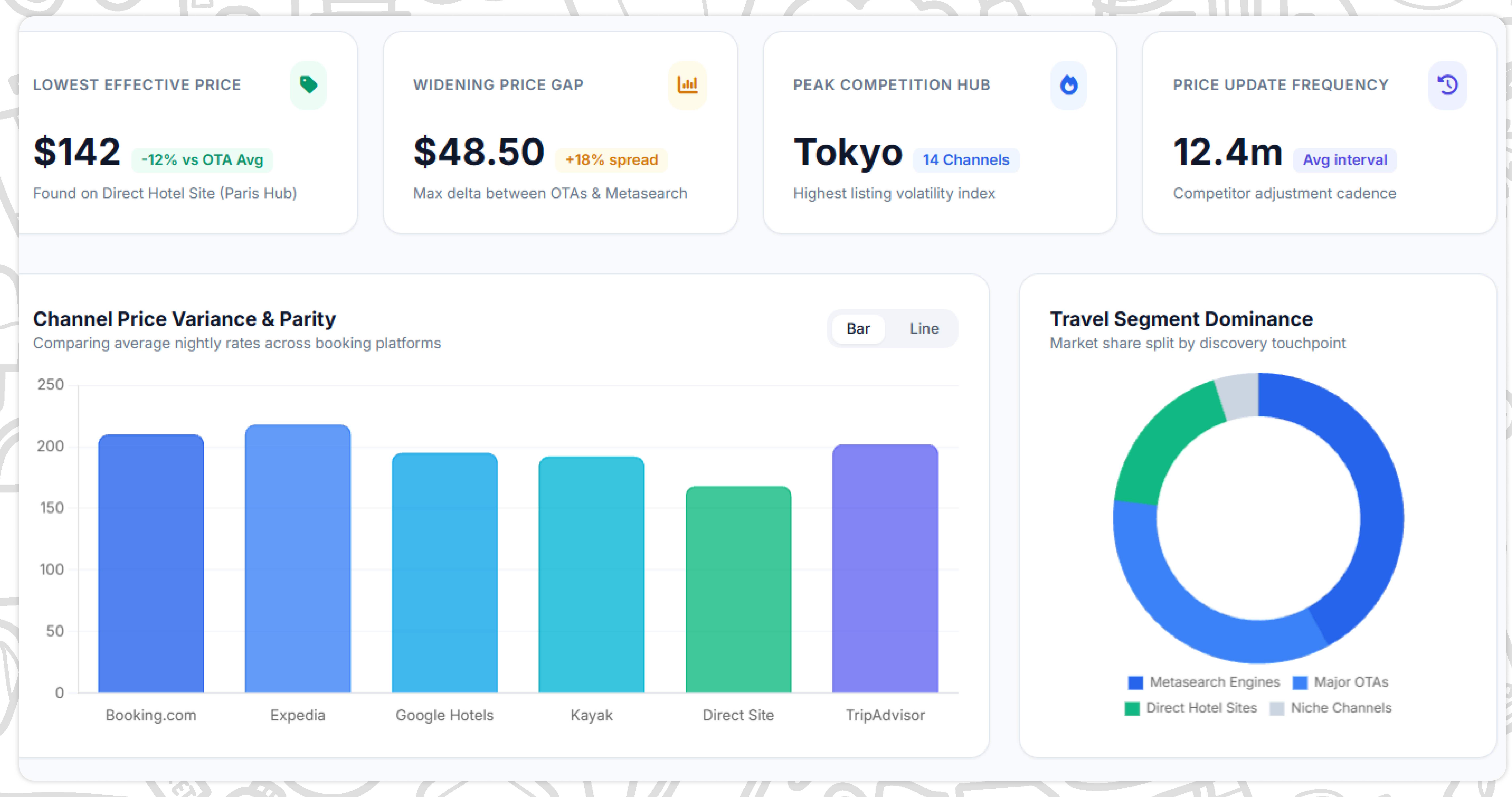
Modern travel consumers rarely depend on a single source. They may begin their search on a metasearch engine, compare OTA prices, visit a hotel website, and then return to another platform to complete the reservation.
This fragmented journey creates a large competitive data landscape.
OTAs & Metasearch Data Scraping helps businesses understand how pricing and availability appear across different travel discovery channels.
Instead of viewing each platform independently, businesses can construct a unified competitive dataset.
This makes it easier to answer questions such as:
- Which platform has the lowest effective price?
- Where are pricing gaps widening?
- Which destinations show the greatest competition?
- How frequently do competitors change prices?
- Which platforms dominate specific travel segments?
These insights can strengthen both commercial and strategic decision-making.
Building Multi-OTA Competitive Pricing Intelligence
A mature benchmarking solution goes beyond collecting prices.
Multi-OTA Competitive Pricing intelligence combines pricing, availability, promotions, historical observations, and contextual attributes into a unified analytical framework.
Businesses can calculate price differences, identify average competitor rates, monitor minimum and maximum rates, and determine how their own prices compare with market benchmarks.
For example, a hotel could establish a target competitive position and receive alerts when its rate becomes significantly higher or lower than comparable properties across monitored platforms.
This enables pricing teams to respond faster instead of relying on periodic manual research.
Using ixigo Data for Travel Market Analysis
Flight pricing presents another important benchmarking opportunity.
Ixigo OTA Price Data Extraction can help businesses analyze airfare movements across routes, airlines, travel dates, cabin classes, and booking windows.
When combined with other OTA datasets, flight pricing can be evaluated at multiple levels.
A business could examine average fares for a particular route, identify the lowest available fare, track fare changes over time, and analyze differences between platforms.
This historical perspective can support demand forecasting and fare strategy.
For travel startups, aggregators, and market researchers, it can also help identify competitive route opportunities and pricing patterns.
OTA Price Intelligence for Better Decisions
OTA Price Intelligence becomes particularly valuable when raw data is transformed into actionable indicators.
Instead of reviewing thousands of individual price records, decision-makers can monitor metrics such as:
- Average market price
- Median competitor price
- Lowest available rate
- Price gap percentage
- Availability percentage
- Promotion frequency
- Rate-change frequency
- Competitive ranking
These metrics can be segmented by destination, hotel category, airline, route, travel date, and booking window.
The result is a decision-support system that helps commercial teams understand market movements without manually checking multiple platforms.
Historical Fare Analysis and Forecasting
Travel businesses can gain additional value by maintaining historical datasets.
MakeMyTrip OTA Fare Data Scraping can contribute historical observations that help businesses study fare movements across routes and booking periods.
Historical data can answer questions that real-time monitoring alone cannot.
For example, companies can investigate whether fares usually rise during the final seven days before departure, whether weekend demand produces predictable increases, or whether specific destinations experience recurring seasonal spikes.
With sufficient historical data, businesses can also develop forecasting models that estimate potential pricing movements.
This can support smarter inventory allocation, promotional planning, and customer acquisition strategies.
Challenges in Multi-OTA Benchmarking
Building a reliable benchmarking program requires more than simply collecting webpages.
Travel websites frequently update layouts, introduce dynamic content, personalize results, and modify pricing displays. Data may also vary based on location, device, login status, occupancy, search parameters, or promotional eligibility.
Another challenge is entity matching.
The same hotel may have slightly different names across platforms. Room categories can also be described differently.
Therefore, normalization and matching are essential.
A strong data pipeline should standardize names, dates, currencies, room types, fare categories, and other attributes before comparison.
Quality checks are equally important because inaccurate or incomplete records can distort competitive analysis.
How Travel Scrape Can Help You?
Multi-Platform Data Collection
Travel Scrape can collect structured hotel and flight information across selected travel platforms, creating standardized datasets that support continuous competitive benchmarking and market-level pricing analysis.
Historical Price Monitoring
Travel Scrape can help businesses maintain historical observations of fares, room rates, promotions, and availability, enabling trend analysis and better understanding of seasonal competitive pricing movements.
Competitive Rate Analysis
Travel Scrape can transform multi-platform travel data into comparable competitive indicators, helping businesses identify price gaps, promotional differences, availability changes, and opportunities for stronger market positioning.
Customized Intelligence Solutions
Travel Scrape can develop customized collection workflows around destinations, properties, routes, booking windows, and required attributes, ensuring the resulting intelligence aligns with specific business and analytical requirements.
Scalable Travel Data Delivery
Travel Scrape can support recurring data extraction and structured delivery, allowing travel businesses to integrate refreshed pricing and availability intelligence into dashboards, analytics systems, forecasting workflows, and internal platforms.
Conclusion
Multi-OTA benchmarking is becoming an essential capability for travel businesses operating in an increasingly price-sensitive marketplace. Comparing multiple platforms provides far more insight than monitoring isolated prices.
By combining pricing, availability, promotions, booking conditions, historical observations, and competitor movements, businesses can build a comprehensive understanding of the travel market.
From Goibibo and MakeMyTrip to ixigo and broader OTA ecosystems, structured data can reveal pricing disparities, seasonal patterns, competitive opportunities, and changing consumer-market dynamics.
The real advantage comes when this information becomes continuous rather than occasional. With automated collection, normalization, historical storage, and analytics, travel businesses can move from reactive price checking to proactive decision-making powered by Real-Time Price Intelligence.
Ready to elevate your travel business with cutting-edge data insights? Scrape Aggregated Flight Fares to identify competitive rates and optimize your revenue strategies efficiently. Discover emerging opportunities with tools to Extract Travel Website Data, leveraging comprehensive data to forecast market shifts and enhance your service offerings. Real-Time Travel App Data Scraping Services helps stay ahead of competitors, gaining instant insights into bookings, promotions, and customer behavior across multiple platforms. Get in touch with Travel Scrape today to explore how our end-to-end data solutions can uncover new revenue streams, enhance your offerings, and strengthen your competitive edge in the travel market.
Unlock the Full Report
Enter your details to access premium pricing intelligence insights