Hotel Rate Parity Monitoring for Chains Across Multi-Channel Distribution Networks
Introduction
The global hospitality industry has experienced a major transformation with the rapid expansion of online travel agencies (OTAs), metasearch platforms, mobile booking applications, and direct hotel reservation channels. Travelers now compare prices across multiple websites before confirming a reservation, making pricing consistency one of the most important aspects of hotel revenue management. Hotel Rate Parity Monitoring for Chains has therefore become a strategic capability that enables hotel brands to maintain consistent pricing while protecting customer trust and maximizing direct booking revenue.
Modern Rate Parity Monitoring solutions continuously compare room prices published across hotel websites, OTAs, wholesalers, and regional booking platforms. By automatically identifying pricing inconsistencies, hotel operators can reduce commission leakage, prevent unauthorized discounting, and improve overall distribution efficiency. Advanced hotel rate parity tracking platforms collect millions of pricing observations every month, allowing revenue managers to respond immediately whenever discrepancies appear across digital booking channels.
The increasing use of dynamic pricing has made hotel pricing far more responsive to demand, seasonal travel, local events, flight schedules, and competitor activity. While these pricing strategies improve revenue optimization, they also increase the possibility of inconsistent room rates appearing across various booking platforms. As hotel chains continue expanding internationally, automated pricing intelligence has become an essential component of sustainable revenue management.
Hotel Rate Parity Monitoring for Chains Market Landscape and Industry Growth
The hotel industry now operates within one of the most competitive digital marketplaces in the travel sector. Large international hotel groups distribute room inventory through official booking websites, online travel agencies, corporate travel portals, loyalty applications, global distribution systems, and regional reservation platforms. Every additional distribution partner increases the complexity of maintaining synchronized pricing across all available channels.
Today's travelers often compare prices on five to ten booking websites before making a reservation. Even a minor pricing difference between an OTA and the hotel's official website can influence purchasing decisions, resulting in reduced direct bookings and increased commission payments. Consequently, hotel companies have shifted from manual pricing audits toward fully automated monitoring systems capable of tracking thousands of room combinations every hour.
Dynamic pricing has further accelerated this transition. Room prices may change multiple times each day depending on occupancy levels, competitor pricing, local demand, airline capacity, weather conditions, conferences, holidays, and special events. Continuous monitoring has therefore become necessary for protecting revenue while maintaining consistent customer experiences across every booking platform.
Factors Responsible for Hotel Rate Parity Violations Across Multiple Booking Channels
Hotel rate parity violations occur for several operational and commercial reasons. Distribution networks frequently involve wholesalers, franchise operators, regional booking partners, and third-party resellers, each of which may update pricing at different intervals. Delayed synchronization often causes temporary differences between official hotel rates and OTA listings.
Promotional campaigns also contribute significantly to pricing inconsistencies. Mobile-exclusive discounts, loyalty rewards, coupon campaigns, member pricing, regional offers, and limited-time promotions may unintentionally create price differences that violate parity agreements. Currency conversion methods, tax calculations, service fees, and bundled meal packages further complicate accurate rate comparisons.
As hotel portfolios expand internationally, manually identifying these discrepancies becomes practically impossible. Automated Price Monitoring systems therefore compare every pricing component rather than simply evaluating the advertised room rate. This comprehensive comparison allows revenue managers to distinguish genuine pricing violations from differences created by booking conditions or regional taxation.
Hotel Rate Parity Performance Across Leading Global Hotel Chains
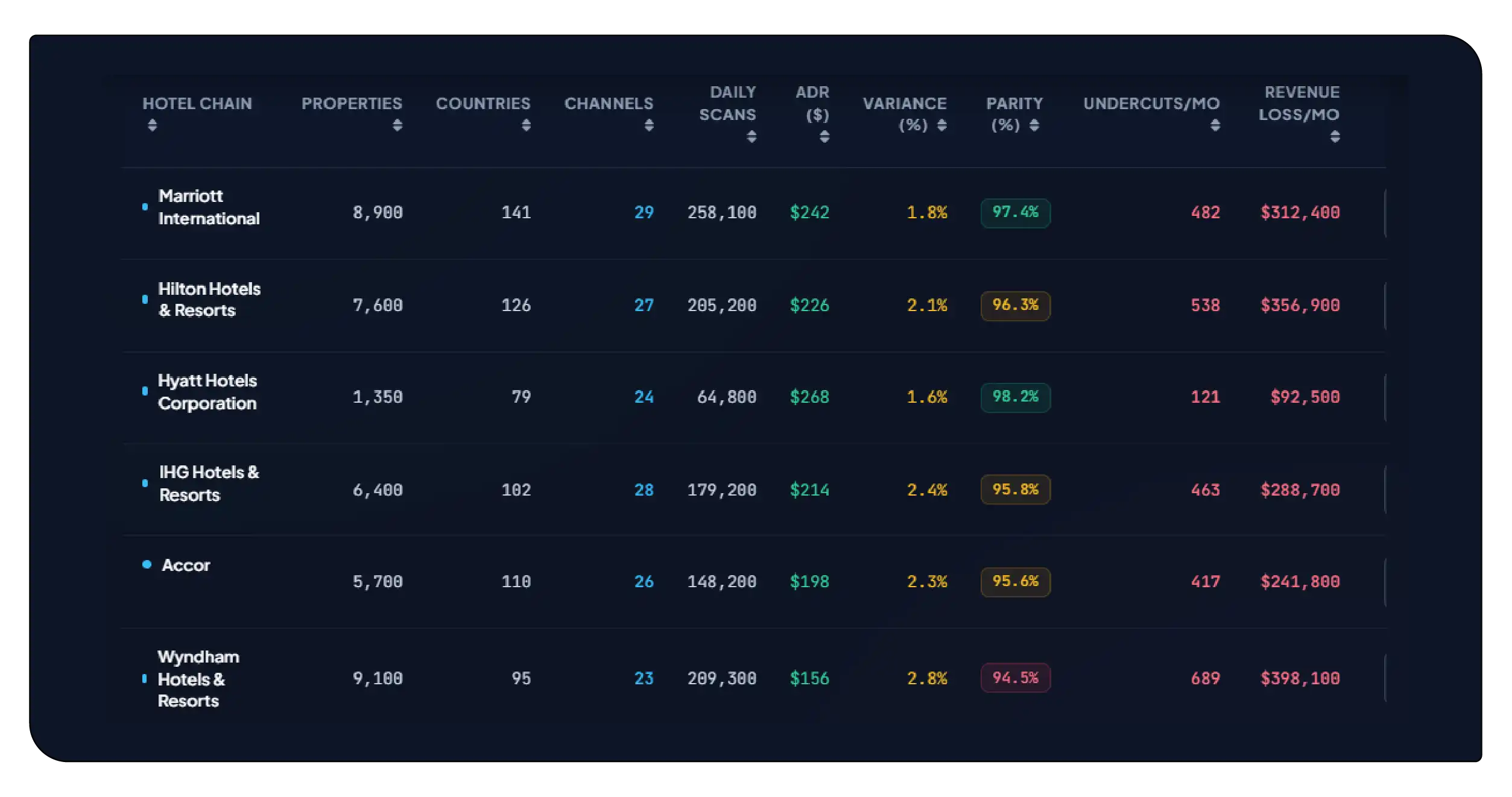
| Hotel Chain | Hotels Managed | Countries | Booking Channels Monitored | Daily Rate Comparisons | Average Daily Rate (USD) | Rate Variance (%) | Parity Compliance (%) | OTA Undercut Cases (Monthly) | Estimated Revenue Leakage (USD/Month) |
|---|---|---|---|---|---|---|---|---|---|
| Marriott International | 8,900 | 141 | 29 | 258,100 | 242 | 1.8 | 97.4 | 482 | 312,400 |
| Hilton Hotels & Resorts | 7,600 | 126 | 27 | 205,200 | 226 | 2.1 | 96.3 | 538 | 356,900 |
| Hyatt Hotels Corporation | 1,350 | 79 | 24 | 64,800 | 268 | 1.6 | 98.2 | 121 | 92,500 |
| IHG Hotels & Resorts | 6,400 | 102 | 28 | 179,200 | 214 | 2.4 | 95.8 | 463 | 288,700 |
| Accor | 5,700 | 110 | 26 | 148,200 | 198 | 2.3 | 95.6 | 417 | 241,800 |
| Wyndham Hotels & Resorts | 9,100 | 95 | 23 | 209,300 | 156 | 2.8 | 94.5 | 689 | 398,100 |
| Choice Hotels International | 7,400 | 46 | 21 | 155,400 | 148 | 2.9 | 94.1 | 712 | 406,800 |
| Radisson Hotel Group | 1,420 | 95 | 24 | 68,160 | 188 | 2.0 | 96.8 | 164 | 118,400 |
| Best Western Hotels & Resorts | 4,300 | 100 | 22 | 94,600 | 162 | 2.5 | 95.2 | 318 | 184,900 |
| Mandarin Oriental Hotel Group | 38 | 25 | 19 | 5,700 | 492 | 1.2 | 98.9 | 16 | 18,700 |
The data demonstrates that larger hotel chains perform hundreds of thousands of pricing comparisons every day to maintain rate consistency across numerous booking platforms. Although parity compliance remains above 94 percent for most global brands, even small deviations generate substantial monthly revenue leakage. Luxury hotel operators generally achieve higher compliance because their distribution networks are more tightly controlled, whereas larger economy and mid-scale brands experience more frequent pricing inconsistencies due to broader OTA participation.
Role of Automated Hotel Chain Price Monitoring in Revenue Optimization
The hospitality industry increasingly depends on automated hotel chain price monitoring solutions to manage complex pricing environments. Artificial intelligence and machine learning algorithms continuously compare room prices, taxes, occupancy combinations, cancellation policies, meal inclusions, promotional discounts, and loyalty pricing across thousands of hotel listings.
Unlike traditional manual audits that require significant operational effort, automated monitoring platforms generate real-time alerts whenever pricing deviations exceed predefined thresholds. Revenue managers can therefore investigate and correct inconsistencies before customers encounter conflicting prices across booking channels.
Modern Hotel Chains Data Scraping technologies significantly enhance this process by collecting structured information from official hotel websites, OTAs, metasearch engines, and regional travel platforms. Millions of pricing observations are standardized and analyzed daily, providing an accurate representation of market activity. These systems eliminate repetitive manual work while improving pricing transparency and operational efficiency throughout global hotel portfolios.
The integration of real-time hotel market intelligence further strengthens pricing decisions. Continuous monitoring allows hotels to observe competitor pricing strategies, promotional activities, occupancy shifts, and inventory availability as they occur rather than relying on historical reports. Immediate access to market intelligence enables faster pricing adjustments and more responsive revenue management.
Regional Pricing Performance and Hotel Booking Behavior Analysis
Regional demand patterns significantly influence pricing consistency and booking performance. North American hotel markets generally experience stronger direct booking adoption, while European and Asia-Pacific markets demonstrate greater OTA dependency due to higher marketplace competition. Luxury destinations often maintain stricter pricing discipline, whereas leisure-focused destinations frequently introduce promotional campaigns that temporarily increase pricing variability.
Historical reservation data also provides valuable hotel booking trends insights by identifying seasonal booking cycles, traveler preferences, average booking windows, cancellation behavior, and promotional effectiveness. Revenue managers increasingly combine these insights with competitor pricing intelligence to develop proactive pricing strategies rather than reacting after demand fluctuations occur.
Regional Performance Analysis Across Major Hotel Chains
| Hotel Chain | Primary Market | Monthly Reservations | Occupancy (%) | ADR (USD) | RevPAR (USD) | Direct Booking Share (%) | OTA Booking Share (%) | Rate Violations Detected | Booking Growth (%) | Forecast Accuracy (%) |
|---|---|---|---|---|---|---|---|---|---|---|
| Marriott International | North America | 1,985,000 | 78 | 242 | 189 | 41 | 47 | 482 | 9.4 | 96.8 |
| Hilton Hotels & Resorts | North America | 1,724,000 | 76 | 226 | 172 | 39 | 49 | 538 | 8.7 | 95.9 |
| Hyatt Hotels Corporation | Global Premium | 398,000 | 81 | 268 | 217 | 44 | 42 | 121 | 10.8 | 97.4 |
| IHG Hotels & Resorts | Europe & Global | 1,402,000 | 75 | 214 | 161 | 36 | 51 | 463 | 8.1 | 95.2 |
| Accor | Europe | 1,315,000 | 77 | 198 | 152 | 34 | 53 | 417 | 9.5 | 94.8 |
| Wyndham Hotels & Resorts | Global | 2,106,000 | 73 | 156 | 114 | 29 | 58 | 689 | 7.2 | 93.6 |
| Choice Hotels International | North America | 1,864,000 | 72 | 148 | 107 | 31 | 56 | 712 | 6.9 | 93.4 |
| Radisson Hotel Group | Europe & Asia | 482,000 | 76 | 188 | 143 | 35 | 52 | 164 | 8.9 | 95.6 |
| Best Western Hotels & Resorts | Global | 928,000 | 74 | 162 | 120 | 33 | 54 | 318 | 7.6 | 94.5 |
| Mandarin Oriental Hotel Group | Luxury Global | 58,400 | 83 | 492 | 408 | 51 | 33 | 16 | 12.1 | 98.3 |
The regional analysis indicates that brands with higher direct booking shares generally maintain stronger pricing consistency and lower parity violations. Hotels that combine predictive analytics with historical booking intelligence are better positioned to optimize occupancy while minimizing unnecessary discounting. Advanced forecasting systems incorporate tourism demand, airline schedules, conference calendars, public holidays, and economic indicators to improve pricing accuracy throughout the booking lifecycle.
The growing adoption of predictive analytics has also strengthened hotel chains demand forecasting capabilities. Machine learning models continuously analyze historical occupancy patterns together with external demand signals, enabling hotels to anticipate market fluctuations several weeks in advance. Revenue managers can therefore adjust pricing proactively, improving occupancy while protecting average daily rates during both high-demand and low-demand periods.
Equally important is the use of hotel chains booking analytics, which provides detailed visibility into customer acquisition channels, booking lead times, cancellation trends, promotional effectiveness, repeat guest behavior, and conversion performance. These analytical capabilities help hotel operators allocate marketing investments more efficiently while strengthening long-term revenue performance.
Conclusion
Hotel rate parity has become one of the most important operational priorities for international hotel brands operating across increasingly complex digital distribution networks. Continuous monitoring enables hotel chains to identify pricing discrepancies, maintain consistent customer experiences, reduce commission leakage, and strengthen direct booking performance. As artificial intelligence, predictive analytics, and automation continue to evolve, hotels will increasingly rely on integrated pricing intelligence platforms that combine market monitoring, demand forecasting, competitor benchmarking, and Hotel Data Intelligence to support faster, data-driven revenue management decisions while maximizing long-term profitability.
Ready to elevate your travel business with cutting-edge data insights? Scrape Aggregated Flight Fares to identify competitive rates and optimize your revenue strategies efficiently. Discover emerging opportunities with tools to Extract Travel Website Data, leveraging comprehensive data to forecast market shifts and enhance your service offerings. Real-Time Travel App Data Scraping Services helps stay ahead of competitors, gaining instant insights into bookings, promotions, and customer behavior across multiple platforms. Get in touch with Travel Scrape today to explore how our end-to-end data solutions can uncover new revenue streams, enhance your offerings, and strengthen your competitive edge in the travel market.
Unlock the Full Report
Enter your details to access premium pricing intelligence insights