Building a Cruise Itinerary Database, Cruise Line, Sailing Date, Historical and Future Voyage Data
Introduction
This case study demonstrates how advanced cruise data extraction transformed fragmented voyage information into a structured intelligence resource for a travel-sector client. The client needed reliable visibility across cruise routes, ports, sailing dates, pricing, availability, and historical voyage patterns to strengthen research and planning. Our solution combined Cruise Itinerary Database development with scalable Cruise Data Scraping, enabling systematic collection from multiple cruise and travel sources. We designed processes to Scrape Historical & Future Cruise Voyage Data, capturing itinerary details, departure dates, destinations, durations, vessel information, and sailing status. The resulting dataset supported comparative analysis across cruise lines, destinations, and voyage periods. Automated collection reduced manual research while improving consistency, coverage, and update frequency. By converting dispersed web information into standardized records, the client gained a practical foundation for cruise market intelligence, pricing analysis, route research, competitive monitoring, and downstream travel applications requiring dependable and structured cruise information.
The Client
The client was a travel intelligence and research company focused on building comprehensive datasets for cruise-market analysis, digital travel products, and strategic decision-making. Its existing research process depended heavily on manually checking cruise websites, aggregators, booking platforms, and destination pages, creating difficulties when schedules, prices, and availability changed frequently. The company wanted stronger Cruise Pricing Intelligence to compare voyage costs across cruise lines, cabin categories, destinations, and travel periods. It also required a reliable Cruise Sailing Schedule dataset covering departure dates, arrival dates, ports, vessels, durations, and route sequences. Beyond pricing, the client sought Cruise Itinerary Intelligence to understand destination combinations, sailing patterns, port frequency, and emerging routes. The objective was to establish a scalable data foundation capable of supporting market research, competitive benchmarking, forecasting, travel applications, and strategic reporting while reducing dependence on fragmented manual data collection and improving the timeliness and consistency of cruise information.
Challenges Faced in the Travel Industry
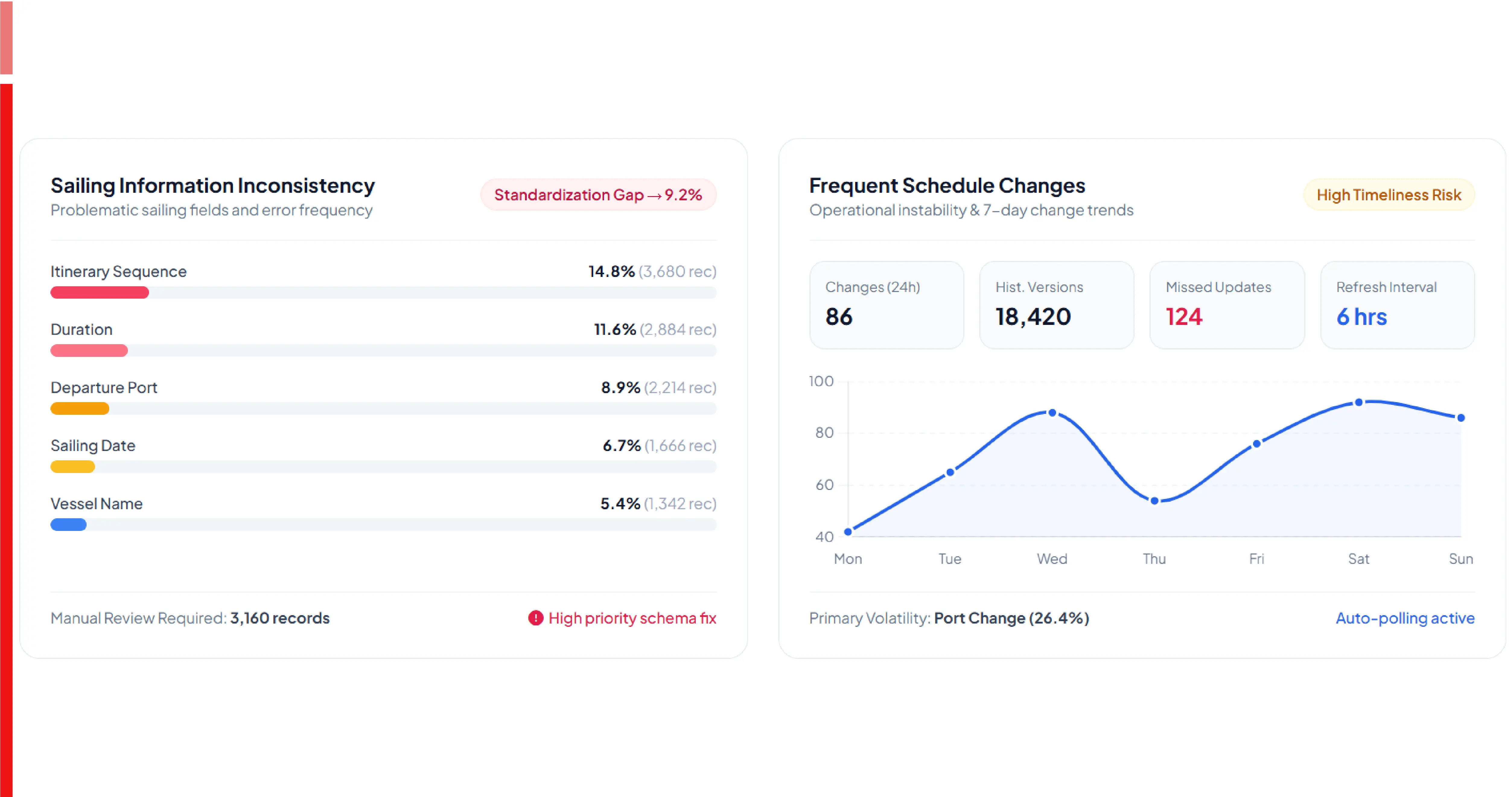
Cruise information changes continuously across operators, booking platforms, destinations, and sailing periods. The client needed dependable data collection that could handle dynamic content while maintaining structured records. These challenges affected pricing intelligence, itinerary analysis, competitive research, and timely travel decision-making.
Inconsistent Sailing Information
Cruise operators published sailing dates, ports, vessel names, durations, and itinerary sequences across different website structures. Inconsistent formats made comparison difficult and increased manual processing requirements. The client needed standardized records that could combine information from multiple sources without losing important voyage-level details.
Frequent Schedule Changes
Cruise schedules could change because of operational adjustments, seasonal planning, port restrictions, or itinerary modifications. Traditional periodic research often missed these updates. Scheduled Dataset Delivery was therefore essential for providing refreshed information at defined intervals while maintaining historical records for comparison and trend analysis.
Complex Cruise Line Coverage
Different cruise operators presented schedules through websites with varying layouts, navigation structures, terminology, and data availability. Cruise Line Sailing Schedule tracking became difficult when researchers had to monitor each source individually. The client required a scalable process capable of collecting comparable sailing information across multiple cruise lines.
Fragmented Route and Port Information
Cruise routes frequently involved multiple ports across countries and regions, while port information was distributed across itinerary pages and destination resources. Building a comprehensive Global Cruise Route Dataset required systematic collection, normalization, and validation of routes, destinations, port sequences, and voyage relationships.
Limited Availability Visibility
Cruise inventory and booking status could vary by sailing date, cabin category, route, and source. Real-Time Availability Tracking was challenging because information could change quickly and appear differently across platforms. The client needed automated monitoring to improve visibility into current availability and support responsive market analysis.
Our Approach
Multi-Source Data Extraction
We developed automated extraction workflows capable of collecting cruise information from relevant operator, travel, booking, and aggregation sources. The process captured voyage dates, ports, vessels, durations, pricing, cabin details, availability indicators, and itinerary sequences while accommodating different page structures and changing source formats.
Historical and Future Voyage Collection
Our solution was designed to Scrape Historical & Future Cruise Voyage Data wherever accessible, creating a broader analytical timeline. Historical records supported trend analysis, while future schedules enabled planning and forecasting. Standardized fields made voyages easier to compare across destinations, operators, vessels, and travel periods.
Route and Port Structuring
We extracted and normalized departure ports, intermediate stops, destination ports, countries, regions, and route sequences. Each voyage was organized into structured records, allowing the client to identify recurring routes, popular destinations, port frequency, route combinations, and geographical patterns across cruise operators.
Automated Data Validation
Collected records passed through validation and normalization processes to identify duplicate voyages, inconsistent date formats, missing fields, abnormal values, and formatting differences. This improved dataset reliability and created consistent structures suitable for dashboards, analytical models, reporting systems, and downstream travel intelligence applications.
Recurring Data Updates
We established repeatable collection workflows supporting regular refresh cycles and structured outputs. Updated records could be delivered according to the client's requirements, helping maintain current sailing, pricing, route, and availability information. Historical snapshots could also support comparisons between previous and current cruise-market conditions.
Results Achieved
The implemented solution transformed scattered cruise information into a structured intelligence resource. It improved data accessibility, strengthened competitive analysis, reduced manual research, and supported more responsive cruise-market decision-making.
Broader Data Coverage
The client gained a centralized dataset covering cruise lines, vessels, routes, ports, sailing dates, durations, prices, and itinerary details. This broader coverage enabled more comprehensive research and reduced dependence on individually monitored websites and manually maintained spreadsheets.
Improved Pricing Visibility
Structured cruise pricing information made it easier to compare fares across operators, routes, sailing dates, cabin categories, and destinations. The client could identify pricing differences, monitor changes, and use comparative intelligence to strengthen market analysis and commercial decision-making.
Stronger Route Intelligence
Standardized itinerary and port records enabled analysis of route frequency, destination combinations, port popularity, and regional sailing patterns. The client could examine geographical opportunities and understand how cruise operators structured voyages across major international cruise markets.
Reduced Manual Research
Automation significantly reduced repetitive website checking and spreadsheet preparation. Researchers could spend more time analyzing market trends rather than collecting information manually. Consistent extraction also improved operational efficiency while lowering the risk of transcription errors and incomplete records.
Scalable Intelligence Infrastructure
The resulting architecture provided a scalable foundation for recurring cruise data collection, analytics, dashboards, applications, and reporting. The client could expand coverage to additional cruise lines, destinations, sailing periods, and data fields without rebuilding its entire research process.
Cruise Data Intelligence Snapshot
| Metric | Before Solution | After Solution | Improvement | Coverage | Update Cycle | Records |
|---|---|---|---|---|---|---|
| Cruise Lines Monitored | 8 | 24 | 200% | Global | Daily | 24 |
| Sailing Records | 18,500 | 86,400 | 367% | 42 Countries | Daily | 86,400 |
| Cruise Routes | 1,240 | 5,850 | 372% | Global | Weekly | 5,850 |
| Ports Covered | 760 | 2,940 | 287% | 68 Regions | Weekly | 2,940 |
| Vessel Records | 310 | 1,120 | 261% | International | Weekly | 1,120 |
| Itineraries Captured | 15,200 | 79,800 | 425% | Multi-Market | Daily | 79,800 |
| Pricing Records | 22,000 | 118,500 | 439% | 18 Markets | Daily | 118,500 |
| Availability Records | 14,800 | 91,600 | 519% | 16 Markets | Multiple Daily | 91,600 |
| Historical Voyage Records | 12,600 | 54,700 | 334% | 10 Years | Monthly | 54,700 |
| Data Completeness | 71% | 97% | 26 pts | All Sources | Continuous | 97% |
| Manual Research Hours | 160/month | 42/month | 74% reduction | All Projects | Monthly | 42 |
| Duplicate Records | 9.4% | 1.6% | 83% reduction | All Data | Continuous | 1.6% |
| Average Processing Time | 14 hrs | 3.5 hrs | 75% reduction | Per Batch | Automated | 3.5 |
| Data Delivery SLA | 72 hrs | 12 hrs | 83% faster | Global | Scheduled | 12 hrs |
| Source Coverage | 15 | 46 | 207% | Global | Continuous | 46 |
Client's Testimonial
"Before implementing this cruise data solution, our researchers spent substantial time visiting different cruise websites, checking schedules, comparing prices, and manually organizing itinerary information. The fragmented nature of the data made it difficult to maintain consistent records and respond quickly to market changes. The new system gave us a much more structured and dependable information foundation. We can now analyze cruise pricing, sailing schedules, routes, ports, vessels, and availability through standardized datasets rather than relying on scattered research. The improved historical coverage has also strengthened our ability to identify market trends and compare current conditions with previous sailing periods. Most importantly, recurring data delivery has reduced operational workload while improving the timeliness of our research. The solution has become an important part of our cruise intelligence workflow and gives our analysts significantly greater confidence when preparing reports, comparisons, and strategic travel-market insights."
Conclusion
This case study demonstrates how structured cruise data collection can turn fragmented online information into actionable travel intelligence. By combining automated extraction, normalization, validation, historical collection, and recurring updates, the client established a dependable foundation for analyzing cruise schedules, routes, ports, pricing, and availability. The resulting datasets support competitive research, market monitoring, itinerary comparison, and digital travel applications while reducing repetitive manual research. Organizations seeking broader travel intelligence can also use solutions designed to Scrape Aggregated Travel Deals, helping consolidate commercial opportunities from multiple travel sources. With scalable Travel Industry Web Scraping Services, businesses can continuously collect and structure changing information across cruise, hospitality, transportation, and tourism markets. Similarly, a specialized Travel Mobile App Scraping Service can provide structured data for applications requiring current travel products, prices, schedules, availability, and destination information. Together, these capabilities create a stronger data infrastructure for informed, timely, and scalable travel-market decision-making.
FAQs
Unlock the Full Report
Enter your details to access premium pricing intelligence insights