Cruise User Behavior and Engagement Tracking Across Cruise Search, Itinerary Planning, and Journey Tracking Experiences
Introduction
Cruise travel platforms have become highly data-driven ecosystems where every user interaction—from initial search to final booking—is tracked and analyzed to improve personalization, pricing strategies, and conversion outcomes. Unlike simple travel bookings, cruise planning involves multiple variables such as itinerary duration, cabin selection, departure ports, onboard amenities, and seasonal pricing fluctuations. This creates a rich behavioral dataset that enables advanced analytics and predictive modeling.
Modern cruise platforms rely on cruise User behavior and Engagement tracking to understand how users navigate search results, compare itineraries, and progress through booking funnels. These behavioral insights allow platforms to optimize recommendation systems and reduce booking abandonment.
Cruise data ecosystems also depend heavily on external data extraction sources. Through Cruise & Ferry Data Scraping, platforms collect structured information such as ship schedules, pricing tiers, cabin availability, and seasonal discounts from multiple operators and aggregators. This helps in building competitive pricing intelligence and real-time availability models.
To interpret user actions effectively, companies deploy cruise user engagement analytics, which measures session depth, click frequency, scroll behavior, and comparison patterns across cruise listings.
Behavioral Data Ecosystem in Cruise Platforms
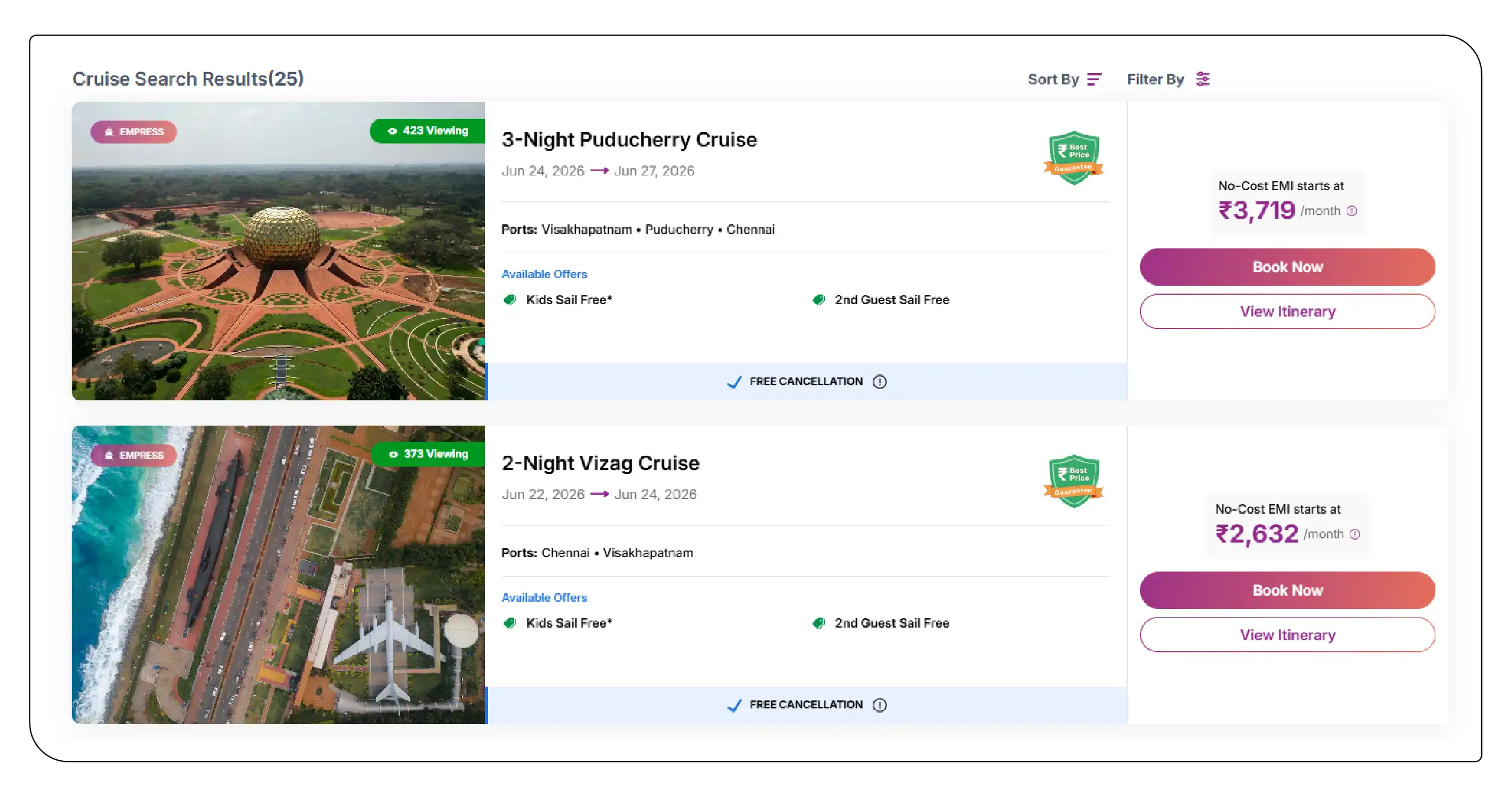
Cruise users rarely follow a linear booking journey. Instead, they explore multiple destinations, revisit itineraries, and compare cabins before making decisions. This non-linear behavior requires advanced segmentation models.
A foundational dataset used across analytics systems is the Global Cruise Route Dataset, which maps global cruise operations across regions like the Caribbean, Mediterranean, Northern Europe, and Asia-Pacific. It includes routes, durations, port stops, and occupancy trends that help correlate user preferences with real-world demand.
Scraped Cruise Behavioral Dataset
| User ID | Session Duration | Pages Viewed | Destination | Cabin Interest | Price Range | Funnel Stage | Device |
|---|---|---|---|---|---|---|---|
| U10021 | 18 min | 22 | Caribbean | Balcony | $1200–$1600 | Research | Mobile |
| U10098 | 27 min | 30 | Mediterranean | Suite | $2000–$2800 | Intent | Desktop |
| U10145 | 12 min | 14 | Alaska | Ocean View | $1400–$1900 | Awareness | Mobile |
| U10277 | 33 min | 36 | Europe | Balcony | $1600–$2200 | Comparison | Desktop |
| U10366 | 20 min | 25 | Asia-Pacific | Interior | $900–$1300 | Research | Mobile |
| U10488 | 29 min | 32 | Caribbean | Suite | $2200–$3000 | Intent | Desktop |
Cruise Funnel Intelligence and User Behavior
The cruise booking journey is divided into awareness, research, comparison, intent, and conversion stages. Each stage reflects different behavioral intensities and decision-making signals.
The concept of cruise booking funnel behavior intelligence helps platforms identify where users drop off and which touchpoints drive conversion. For example, high drop-off rates often occur during itinerary comparison when pricing differences become more visible.
In parallel, user behavior analysis in cruise search platforms focuses on search queries, filter usage, and destination re-visits to classify user intent into categories such as budget traveler, luxury seeker, or family planner.
Cruise Itinerary Engagement and Planning Behavior
Cruise itinerary exploration is one of the most interaction-heavy phases in the travel booking journey. Users frequently adjust dates, compare multi-port routes, and evaluate onboard amenities.
Cruise itinerary planning engagement analytics tracks how users interact with itinerary pages, including dwell time, scroll depth, and modification frequency. Higher engagement often correlates with premium cabin selection and longer cruise durations.
Scraped Cruise Itinerary & Pricing Dataset
| Cruise Line | Route | Duration | Cabin Type | Base Price ($) | Discount % | Occupancy | Engagement Score |
|---|---|---|---|---|---|---|---|
| Ocean Pearl | Miami–Bahamas | 5 Days | Interior | 899 | 15 | 82% | 78 |
| Sea Horizon | Rome–Greece | 7 Days | Balcony | 1499 | 10 | 88% | 85 |
| Arctic Star | Seattle–Alaska | 8 Days | Suite | 2499 | 12 | 91% | 92 |
| Royal Waves | Barcelona–Mediterranean | 6 Days | Ocean View | 1299 | 18 | 79% | 80 |
| Pacific Drift | Singapore–Thailand | 4 Days | Interior | 799 | 20 | 75% | 74 |
| Nordic Cruise | Copenhagen–Norway | 9 Days | Balcony | 1899 | 14 | 86% | 88 |
Journey Tracking and Engagement Scraping
Cruise platforms continuously monitor user actions from search initiation to booking completion. This is known as cruise journey tracking user engagement Scraping, where clickstreams, session flows, and abandonment patterns are captured to improve recommendation systems.
These systems help identify friction points such as confusing itinerary layouts or pricing inconsistencies that may discourage bookings.
Cruise Conversion Optimization and Predictive Modeling
A major goal of cruise analytics is improving conversion rates by aligning user intent with personalized offers. Cruise platform conversion rate optimization uses machine learning models to test different page layouts, pricing displays, and promotional strategies.
These models analyze which combinations of destination, cabin type, and discount levels lead to the highest booking probability.
Cruise Itinerary and Pricing Intelligence Systems
Pricing and itinerary data are central to cruise decision-making. Platforms rely on Cruise Itinerary & Cabin Price Scraping to continuously monitor competitor pricing, seasonal demand changes, and cabin availability across global routes.
This data feeds into dynamic pricing engines that adjust fares in real time based on demand fluctuations and occupancy levels.
Key Behavioral Insights from Cruise Data
- Users spend more time on multi-destination itineraries than single-stop cruises
- Balcony and suite cabins generate higher engagement than interior cabins
- Mobile users prefer shorter cruises (3–5 days)
- Desktop users show higher conversion rates for luxury bookings
- Price filtering is one of the strongest intent signals in search behavior
These insights help cruise companies optimize content placement, marketing campaigns, and recommendation algorithms.
Strategic Impact on Cruise Industry
Behavioral tracking has transformed cruise marketing and revenue optimization strategies. By analyzing engagement patterns, companies can forecast demand more accurately, optimize ship occupancy, and improve customer satisfaction.
Advanced analytics also enable real-time personalization, where users receive tailored itinerary suggestions based on browsing history and engagement depth.
Conclusion
The cruise industry is increasingly dependent on behavioral intelligence systems that merge search data, pricing trends, and user interaction patterns into actionable insights. These systems enhance personalization, reduce booking friction, and improve overall conversion efficiency.
The integration of structured datasets such as Cruise Line Itinerary Dataset strengthens predictive modeling capabilities and improves route planning accuracy.
Ultimately, continuous optimization driven by cruise platform conversion rate optimization ensures higher revenue performance and better user experiences. As data systems evolve, cruise companies will increasingly rely on enriched datasets and real-time analytics powered by Cruise Itinerary & Cabin Price Scraping to deliver hyper-personalized travel experiences.
Ready to elevate your travel business with cutting-edge data insights? Scrape Aggregated Flight Fares to identify competitive rates and optimize your revenue strategies efficiently. Discover emerging opportunities with tools to Extract Travel Website Data, leveraging comprehensive data to forecast market shifts and enhance your service offerings. Real-Time Travel App Data Scraping Services helps stay ahead of competitors, gaining instant insights into bookings, promotions, and customer behavior across multiple platforms. Get in touch with Travel Scrape today to explore how our end-to-end data solutions can uncover new revenue streams, enhance your offerings, and strengthen your competitive edge in the travel market.
Unlock the Full Report
Enter your details to access premium pricing intelligence insights